
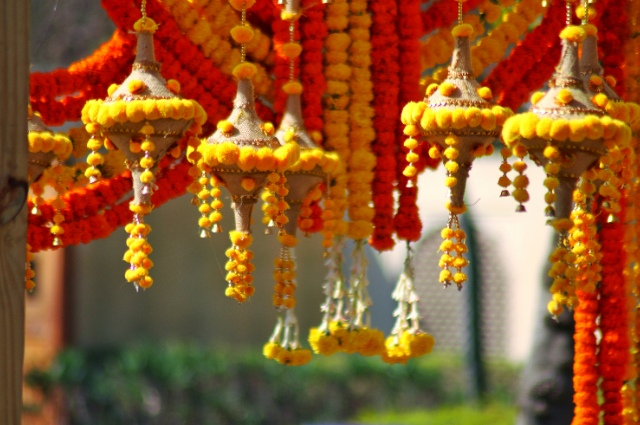
Source: Saubhagya Gandharv on Unsplash.com
1. A Father, a Wedding Morning and ₹5 Lakh
The morning of 10 July 2026 was supposed to be a memorable day for a family in Raebareli, Uttar Pradesh. The wedding of Kaushal's eldest daughter was about to take place. Kaushal, a carpenter who earned his living making wooden furniture, had every reason to be occupied with the final arrangements. But something went terribly wrong. He went missing shortly before the wedding rituals were due to begin. Later, his body was found in an orchard behind a temple, not far from his home.
According to a news report, Kaushal's son told the police that his father had been under considerable mental and financial pressure because of the wedding expenses. He had borrowed money from several people and had remained worried in the days leading up to the ceremony. His son, who worked outside the village, had also contributed towards the arrangements. Villagers told reporters that the family had spent nearly ₹5 lakh on the wedding. The police stated that the matter was under investigation and that they had no information about any dowry demand from the groom's family. That last detail deserves attention. It suggests that the financial pressure surrounding a wedding does not always begin with dowry demands. Sometimes, the expectations attached to the celebration itself are enough to push a family into debt.
The news report does not provide a detailed account of Kaushal's income or explain exactly how the money was spent. Nor would it be right to attribute a person's death to a single cause without knowing all the circumstances. Still, the reported details raise an uncomfortable question. For a carpenter who depended on his daily earnings, how difficult must it have been to arrange ₹5 lakh for a wedding?
There have been other tragedies of a similar kind. In Chennai, an auto driver named Krishnakumar reportedly remained burdened by the debt he had taken on for his elder daughter's marriage. He was worried that the financial pressure would affect his younger daughter's future. He died by suicide, and his younger daughter took her own life the following day. These are separate family tragedies, and each has its own circumstances. Yet both bring attention to a familiar problem: the pressure to arrange a wedding in a manner that society considers respectable, regardless of what a family can actually afford.
There is nothing unusual about wanting to make a daughter's or son's wedding memorable. In India, marriage is not simply a private arrangement between two individuals. It brings relatives together, carries religious and cultural significance and often becomes one of the most important occasions in a family's life. The difficulty begins when the desire to celebrate is gradually replaced by the expectation to impress others. At that point, a wedding can become a financial responsibility that a family struggles to fulfil.
2. A Celebration Worth ₹10 Lakh Crore
Kaushal's family was not alone in preparing for a wedding. Every year, millions of Indian families go through similar arrangements, although their financial circumstances differ considerably.
India is estimated to witness between 80 lakh and one crore weddings annually. The research material places the total expenditure associated with these celebrations at approximately ₹10 lakh crore. These figures give some idea of how deeply weddings are connected with the country's economy. The figures from individual wedding seasons are equally remarkable. According to the Confederation of All India Traders (CAIT), approximately 46 lakh weddings took place between 1 November and 14 December 2025. The business generated during this period was estimated at around ₹6.5 lakh crore. A 2024 report by the brokerage firm Jefferies, as cited in the research material, also described India as the world's largest wedding market, estimating its wedding industry to be nearly twice the size of that in the United States.
But the cost of a wedding is not the same for every family. One estimate places average wedding expenditure at approximately ₹12.5 lakh. A WedMeGood survey covering more than 2,000 couples for 2025–26 reportedly put the average wedding budget at around ₹39 lakh, an increase of 8 per cent over the previous year. The survey also found that roughly one in four weddings were destination weddings, with an average budget of about ₹58 lakh. These figures come from different surveys and methods of calculation. They should therefore be read with some caution rather than treated as a single picture of what an Indian family normally spends. Nevertheless, they indicate the considerable amount of money that now circulates in the wedding industry.
It would be unfair to describe this entire industry as wasteful. Weddings provide work for thousands of people, including caterers, tailors, florists, photographers, decorators, transport operators and small business owners. According to the supplied research material, the previous wedding season generated more than 10 million temporary jobs and approximately ₹75,000 crore in tax revenue.
The economic contribution is real. But the benefits of a growing wedding industry are not shared equally by everyone. A wealthy family may spend several crores without seriously affecting its financial position. For a household dependent on a modest monthly income, even an expenditure of ₹5 lakh can mean borrowing money, selling property or using savings that were meant for education and other essential needs.
The comparison with education is particularly worth considering. The research material estimates that a family spends approximately ₹6.75 lakh on a child's education, from pre-primary school to graduation. Wedding expenditure, according to the estimates discussed above, can be considerably higher. This raises a question that deserves serious consideration: why do some families find it necessary to spend more on a few days of celebration than on several years of their children's education?
3. How Did Weddings Become So Elaborate?
The weddings remembered by many older generations were generally quite different from the celebrations we see today. A gathering of relatives, traditional food, a few customary ceremonies and the presence of neighbours were often enough to make the occasion special. Such weddings were not necessarily less meaningful because they were smaller. The transformation did not happen overnight. It developed alongside changes in India's economy, social structure and popular culture.
During the 1960s and 1970s, India experienced serious economic difficulties, including food shortages. The authorities in some places introduced restrictions on large social gatherings and the serving of food. The historical examples mentioned in the research material include a restriction imposed in Bombay in 1965 on serving food to more than 25 people at home. Delhi introduced limits in 1977, allowing 50 guests at ordinary gatherings and 100 at weddings or funerals. Rajasthan also reportedly imposed a penalty in 1978 for inviting 200 guests. These measures reflected the concern that excessive spending and consumption at social functions were difficult to justify in a country facing economic hardship.
The situation began to change with the economic liberalisation of 1991. As the economy opened up, a growing section of the middle class gained access to new consumer goods, branded clothing, luxury venues and professional services. Weddings gradually became an occasion to display not only family traditions but also purchasing power.
Cinema played a part in shaping this change. The 1994 film Hum Aapke Hain Koun..!, for instance, presented an attractive picture of family celebrations, colourful ceremonies, music and elaborate wedding arrangements. The film did not create the tradition of lavish weddings, which had existed in different forms for generations. However, it helped popularise a particular image of the ideal Indian wedding. Celebrity weddings added another dimension. When Virat Kohli and Anushka Sharma married in Italy in 2017, their wedding attracted enormous public attention. The venue, clothing and arrangements became subjects of discussion. For the fashion and wedding industries, such occasions also created opportunities to promote designer outfits and luxury services.
Social media has taken this influence much further. A wedding is no longer remembered only through family photographs and personal stories. It is also presented through carefully prepared videos, photographs and online posts. Within minutes, images of a celebration can reach thousands of people. This does not mean that every family deliberately tries to copy celebrities or wealthy relatives. The influence is often more subtle. People repeatedly see elaborate decorations, expensive outfits and grand venues until these things begin to appear normal. Gradually, a simple arrangement may seem inadequate, even when it is perfectly suitable for the family.
In this way, the meaning of a good wedding has changed for many people. What was once considered a beautiful family occasion can now be judged by the scale of its arrangements.
4. When the Neighbour's Wedding Changes Your Budget
Most families do not receive a direct instruction to spend more on their children's weddings. The pressure usually comes from the people around them.
A relative may mention how beautifully another wedding was arranged. A neighbour may talk about the number of dishes served at a recent ceremony. Someone may ask why a family has chosen a smaller venue or invited fewer guests. These remarks may appear harmless, but they can influence decisions that have serious financial consequences. The desire to maintain social standing is not new. Economists and sociologists have studied this behaviour for more than a century.
In The Theory of the Leisure Class (1899), Thorstein Veblen introduced the concept of conspicuous consumption. He explained how people sometimes purchase goods and services not simply because they need them, but because these purchases allow them to display wealth and social position.
James Duesenberry developed a related argument in Income, Saving and the Theory of Consumer Behaviour (1949). His idea of the demonstration effect helps explain why people often judge their own spending habits by looking at the lifestyles of those around them. A person's income may remain unchanged, but the desire to maintain a certain standard of living can grow after observing the spending habits of neighbours, friends and relatives.
This behaviour is particularly visible in wedding celebrations. A family may initially plan a modest ceremony. But after attending a relative's expensive wedding, its members may begin to reconsider their own arrangements. The venue needs to be better, the food selection needs to be larger, and the decorations should not appear less impressive.
A study mentioned in the research material, covering approximately 800 households across five districts of Karnataka, reportedly found that elaborate wedding arrangements could function as a symbol of social status. This was particularly noticeable when a bride married into another village. In such circumstances, the wedding was not viewed merely as a celebration for two individuals. It was also seen as a public representation of the family's standing.
There is another expression that often makes it difficult to question unnecessary expenditure: marriage happens only once in a lifetime. There is some emotional truth in this statement. Parents want to give their children a memorable beginning, and many are willing to make sacrifices to fulfil that wish. However, this sentiment can also be used, knowingly or unknowingly, to justify expenses that a family cannot afford.
The wedding industry has its own role in this process. Event planners, photographers, stylists, florists and decorators offer increasingly elaborate packages. Some services also become more expensive when they are marketed specifically for weddings, a practice often described as the wedding markup or wedding tax. No single expense may appear unreasonable at first. But when everything is added together, the final bill can be far beyond the family's original budget.
5. A Few Days of Celebration, Years of Repayment
The financial difference between what families earn and what they spend on weddings is difficult to ignore. According to the estimates in the research material, average annual family income is around ₹4 lakh, while average wedding expenditure is approximately ₹12.5 lakh. If these estimates are comparable, wedding spending can amount to more than three years of a family's income. This calculation does not even take ordinary household expenses into account.
Naturally, most families do not have such a large amount saved. Some use their savings, others seek help from relatives, and many turn to loans. The WedMeGood survey reportedly found that approximately 15 per cent of the couples surveyed had borrowed money to meet wedding expenses. The average loan was estimated at around ₹15.5 lakh. It also reported that about 6 per cent of respondents had sold assets to finance their weddings.
The research notes further cite figures from 2018–19 suggesting that nearly 20 per cent of loan applications submitted by people aged between 20 and 30 were related to marriage. The reported interest rates ranged from 10 to 36 per cent annually.
Consider a family that borrows ₹10 lakh for five years at an annual interest rate of 14 per cent. The monthly instalment would be approximately ₹23,000, and the total interest payment would come close to ₹4 lakh, depending on the lender's terms and additional charges. For a household earning ₹4 lakh annually, such a repayment can become a considerable burden.
The research material also mentions the experience of Nitin Kashyap, who reportedly arranged a wedding costing ₹25 lakh, financed partly through a ₹20 lakh loan. The loan carried an interest rate ranging from 12 to 24 per cent and was to be repaid over approximately seven years. His experience is an individual account rather than a representative picture of all wedding loans, but it illustrates how long the financial consequences can last.
There is an important distinction between borrowing for a house and borrowing for a wedding. A house may remain a valuable asset for many years. A wedding, however, is an occasion that passes within a few days. Once the celebrations are over, the expenditure cannot be recovered, but the debt remains. The couple may then begin married life with loan repayments hanging over them. They may be trying to arrange accommodation, continue their education, establish careers or save for future responsibilities. Instead of entering this new phase with some financial stability, they may find themselves dealing with a burden created before their married life had properly begun. Celebrating a marriage is understandable. Making the first years of that marriage financially difficult for the sake of a few days is a different matter.
6. The Hidden Cost: Dowry
In Kaushal's case, the police reportedly found no information about a dowry demand from the groom's family. That does not mean dowry has ceased to be a problem in Indian marriages. In many households, wedding expenditure becomes even more difficult to manage because of demands or expectations associated with the groom's side.
The Dowry Prohibition Act of 1961 made the giving and taking of dowry punishable under Indian law. Yet the existence of legislation has not brought an end to the practice. In some communities, dowry is still demanded openly. In others, it is presented as a customary gift, a contribution towards household arrangements or a voluntary gesture from the bride's family.
The research material refers to a study covering nearly 40,000 rural marriages between 1960 and 2008. It reportedly found that dowry was present in approximately 95 per cent of the marriages examined. Another estimate from 2007 placed the average net dowry at around 14 per cent of a family's annual income.
The definitions and methods used in such studies need to be considered before applying these figures to the whole country. Nevertheless, they indicate how deeply marriage-related financial transfers have become embedded in certain social practices. The consequences are not limited to financial hardship. In some cases, families face humiliation, harassment and even threats when they fail to meet expectations.
A report from Alwar, Rajasthan, described the case of Kailash Rajput, a 50-year-old man from Haryana. According to the report, he left a note stating that he had arranged approximately ₹13 lakh for his daughter's marriage but could not manage another ₹11 lakh demanded by the groom's family. He reportedly expressed fear of humiliation in society. The allegations in the note should be distinguished from facts established through a police investigation, but the case reveals the kind of pressure that can surround a daughter's marriage.
Another disturbing incident took place in Latur, Maharashtra, in 2017. A young woman named Shital Vayal reportedly left a note explaining that she was ending her life to relieve her father of the financial burden and to protest against dowry. Such incidents are painful reminders of what happens when a marriage is treated as a financial transaction rather than a relationship built on mutual respect.
The problem becomes even more serious when women face harassment or violence because their families cannot fulfil dowry demands. The research notes refer to figures from Crime in India 2024, citing approximately 16 dowry-related deaths each day in the statistics discussed.
Dowry cannot be understood simply as an additional wedding expense. It is connected with wider questions of gender inequality, economic dependence and the social position of women. As long as a daughter's marriage is viewed as an occasion on which her family must prove its financial worth, the practice will remain difficult to challenge. A society that celebrates the birth of daughters must also ensure that their marriages do not become occasions for financial coercion and humiliation.
7. What Can Be Done? Lessons from India and Abroad
The demand for simpler weddings is not a new idea in India. Several social reform movements have challenged unnecessary rituals, expensive customs and practices that place an unfair burden on families.
One example is the Self-Respect Marriage movement associated with Periyar E. V. Ramasamy. The movement encouraged marriages based on equality and personal dignity rather than elaborate rituals or priestly intervention. The first such marriages are generally associated with 1928. Later, Section 7A was added to the Hindu Marriage Act in 1967, giving legal recognition to certain forms of Self-Respect Marriage in Tamil Nadu.
Civil marriage under the Special Marriage Act provides another option for couples who wish to marry without elaborate ceremonies. The research material mentions the November 2016 marriage of two civil servants, reportedly conducted with only ₹500 in court fees. Such examples show that the legal and social meaning of marriage does not depend on the amount spent on its celebration.
There have also been efforts at the community level. In Kashmir, some caterers and community representatives have encouraged families to reduce the number of dishes served during Wazwan feasts. Instead of the usual 15 to 25 dishes, they have suggested limiting the menu to around seven. The intention is to preserve the traditional meal while reducing unnecessary expenditure.
In Bulo village in Bathinda, Punjab, a 2025 initiative reportedly offered a ceremonial gift of ₹21,000 to families that chose not to include alcohol and DJ entertainment in their wedding celebrations. Similarly, community guidelines in the Jaunsar-Bawar region have reportedly sought to restrict the number of ornaments worn by women during weddings, with a reported penalty of ₹50,000 for violations.
Government initiatives have also attempted to reduce the financial burden on poorer families. Under Uttar Pradesh's Samuhik Vivah Yojana, financial assistance was reportedly increased from ₹51,000 to ₹1 lakh for each eligible couple, with ₹60,000 transferred to the bride's bank account. The scheme is reported to have benefited approximately 5.5 lakh couples over nine years.
Such programmes can provide meaningful assistance to families who struggle to arrange marriages. However, financial assistance alone cannot address the deeper problem. If families continue to believe that a respectable wedding must involve expensive decorations, large gatherings and costly gifts, the pressure will remain.
Legislative efforts have also been made. According to the research material, at least ten private members' bills dealing with related issues were introduced between 1988 and 2017, but none became law. One such proposal was introduced by Ranjeet Ranjan in 2016. It suggested that families spending more than ₹5 lakh on a wedding should contribute 10 per cent of the expenditure to a fund supporting marriages of poorer families.
Experiences from other countries provide further points for discussion. A survey cited in the research notes reportedly found that approximately 59 per cent of Japanese couples marrying after October 2019 did not hold a formal wedding ceremony. In the United States, the average wedding is reported to have around 117 guests, compared with approximately 330 in India.
China has also witnessed local restrictions and community initiatives aimed at reducing excessive wedding expenditure. These have included measures concerning bride price, cash gifts and wedding processions, with certain local contexts reporting limits such as 10,000 yuan for bride price and six vehicles in a procession. These should not be mistaken for nationwide legal restrictions.
Tajikistan introduced restrictions on wedding celebrations in 2007, including limits on the number of guests and the duration of ceremonies. The restrictions cited in the research material include a maximum of 150 guests and a three-hour celebration. Uzbekistan also introduced restrictions on certain wedding practices in 2019.
These examples do not necessarily provide a model that India should follow. Every country has its own cultural and social circumstances. Their importance lies elsewhere: they demonstrate that excessive wedding expenditure can be discussed as a social concern rather than being treated as an unquestionable personal tradition.
The challenge is to encourage moderation without unnecessarily interfering with people's freedom to celebrate according to their customs and beliefs.
8. A Different Generation
Despite the continuing popularity of elaborate weddings, there are signs that some younger couples are beginning to question the expectations surrounding them. The research material cites a survey suggesting that approximately 53 per cent of millennials preferred micro-weddings involving fewer than 100 guests. It also reports an increase of around 27 per cent in micro-weddings during 2024. These figures would need to be checked against the original surveys, but they point towards an interest in smaller and more personal celebrations.
For some couples, choosing a smaller wedding is not a compromise forced by financial difficulties. It is a deliberate decision. They would rather spend time with close relatives, avoid unnecessary debt and begin their married lives with greater financial independence. There are also individuals who have experienced the consequences of excessive wedding expenditure within their own families and have decided to work towards change.
Kiran Kaur of Mansa, Punjab, shared her experience with CBC News. According to her account, her father had taken substantial loans to finance her eldest sister's wedding and to meet medical expenses. He later died by suicide. After his death, Kiran established an organisation that works across Punjab to support widows and financially distressed families, including those she describes as being close to a breaking point.
Her experience is a reminder that the financial consequences of a wedding do not always end when the guests leave. Sometimes, the burden continues within a family long after the celebration has disappeared from public memory. At the same time, it is important not to judge every expensive wedding in the same way. A wealthy family spending several crores from its own resources is in a different position from a family earning a modest income and borrowing heavily to maintain its social reputation. The real distinction is between expenditure that a family can comfortably afford and expenditure driven by competition, coercion or fear of public judgement.
The purpose of questioning extravagant weddings should not be to discourage people from celebrating. It should be to ensure that celebration remains a matter of choice rather than becoming a source of long-term financial distress.
9. What Should a Wedding Really Celebrate?
Kaushal's family had been preparing for a wedding. It was supposed to be a day of happiness, family gatherings and new beginnings. Instead, the day became associated with a terrible loss. His daughter's marriage, which should have remained a joyful memory, will always be connected with the tragedy that surrounded it.
His story brings us back to the central question of this discussion. What has happened to the way we understand marriage?
Indian weddings bring people together, preserve cultural traditions and support a large network of businesses and workers. They are an important part of social life. There is no reason why these traditions should disappear. Music, traditional food, religious ceremonies, family gatherings and hospitality can all remain part of the celebration.
What needs to change is the belief that a wedding must be grand to be respectable.
Families should be able to decide their budgets according to their actual financial circumstances, without feeling ashamed of a smaller arrangement. Couples should also have a meaningful say in decisions about their own weddings. After all, they are the ones who will begin their lives together once the celebrations are over.
Community leaders, religious scholars and social organisations can also help by encouraging moderation and questioning customs that place unnecessary pressure on families. Existing laws against dowry and coercive financial demands must be properly enforced. Financial assistance for weaker households can provide additional support, but lasting change will require a change in social attitudes as well.
Perhaps the more important question is not how much a family can spend on a wedding, but what it hopes to provide for the couple as they begin their life together. Is it an expensive display that will remain in photographs and videos? Or is it a secure beginning, built on mutual respect, financial stability and the freedom to plan a future without unnecessary debt?
A wedding may last only a day or two, but its financial consequences can remain for years. The real success of a marriage should not be measured by the number of guests, the cost of the decorations or the price of the food. It should be measured by the life that the couple is able to build after the celebrations have ended.
Perhaps Indian society needs to reconsider what makes a wedding memorable. A celebration should leave a family with happy memories, not years of financial hardship. It is time to give greater importance to the marriage itself and the life that follows, rather than the spectacle created around it.
References:
- Aryan Age Bureau. (2026, 10 July). Father dies by suicide hours before daughter's wedding in Uttar Pradesh's Raebareli over marriage expenses. Aryan Age. https://www.aryanage.com
- Asianet Newsable. (2026). Chennai tragedy: Father dies over daughter's marriage woes, she ends life a day later. https://newsable.asianetnews.com
- Confederation of All India Traders (CAIT). (2025). Estimates for the 2025 wedding season, 1 November to 14 December 2025.
- Jefferies. (2024). Report on India's wedding industry.
- WedMeGood. (2025–26). Wedding survey of more than 2,000 couples.
- Veblen, T. (1899). The Theory of the Leisure Class. Macmillan.
- Duesenberry, J. S. (1949). Income, Saving and the Theory of Consumer Behaviour. Harvard University Press.
- The Dowry Prohibition Act, 1961 (India).
- National Crime Records Bureau. (2024). Crime in India 2024. Ministry of Home Affairs, Government of India.
- India.com. Failing to arrange dowry money for daughter's wedding, Haryana man commits suicide. https://www.india.com
- Deccan Herald. (2017, 15 April). Daughter kills self to ease debt. https://www.deccanherald.com
- CBC News. Burdened by debt and unable to eke out a living, many farmers in India turn to suicide. https://www.cbc.ca