
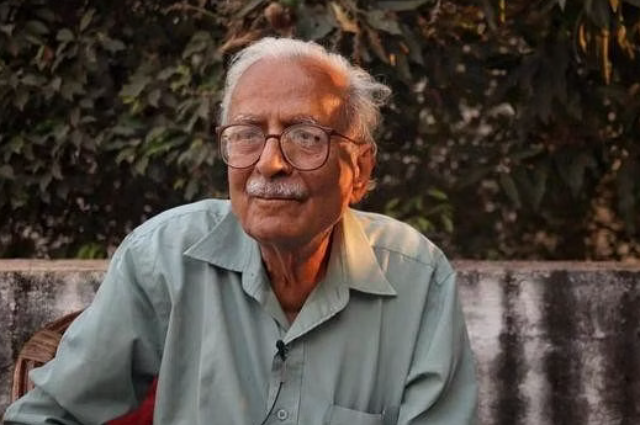
In the wide and diverse world of modern Hindi literature, Vinod Kumar Shukla is known as a writer who brought a new and thoughtful way of seeing life. His writing is not full of loud drama or big events; instead, it moves slowly and calmly, helping readers notice the deeper meaning hidden in everyday life. He had a special ability to turn simple things into powerful ideas, showing that even ordinary moments can carry great emotional and philosophical value. As mentioned in the source text, his works invite readers into a peaceful space where time, memory, and imagination come together. Even after his death in December 2025, his writings continue to influence readers, students, and scholars, making him one of the most respected voices in Hindi literature.
Vinod Kumar Shukla was born on 1 January 1937 in Rajnandgaon, a place in present-day Chhattisgarh. His early life in a village environment played a very important role in shaping his thinking and writing style. The calm atmosphere of rural life, the struggles and emotions of common people, and the beauty of simple living became the main themes of his work. He grew up in a family where reading and writing were encouraged, which helped him develop an early interest in literature. One of the most important influences in his life was Gajanan Madhav Muktibodh, who was his teacher and guided him toward deeper thinking and creativity. Other writers like Padumlal Punnalal Bakshi and Baldev Mishra also influenced his ideas and helped shape his literary personality.
What makes Shukla’s life even more interesting is that he was not only a writer but also a teacher of science. He completed his Master’s degree in Agriculture from Jawaharlal Nehru Krishi Vishwa Vidyalaya, which gave him a strong understanding of farming, rural life, and practical knowledge. He later worked as a lecturer and then as an Associate Professor at Indira Gandhi Agricultural University. His job allowed him to stay connected with farmers, students, and village communities, and this connection made his writing more real and meaningful. He understood life not only through books but also through direct experience. Even after retiring in 1996, he continued to observe life, and this habit helped him write in a thoughtful and detailed way.
Shukla’s literary journey began with his poetry collection Lagbhag Jai Hind in 1971, marking the quiet arrival of a voice that would gradually reshape the sensibility of Hindi literature. From that moment onward, he continued to write poetry, novels, and short stories that did not seek immediate attention but slowly transformed the reader’s way of seeing the world. His celebrated novel “Naukar ki Kameez (1979), later adapted into a film by Mani Kaul, beautifully demonstrates his unique gift: the ability to take something as ordinary as a shirt and turn it into a profound reflection on identity, dignity, and the subtle tensions of everyday life. Another remarkable work, “Deewar Mein Ek Khirkee Rehti Thi”, brought him the prestigious Sahitya Akademi Award in 1999 and established his place among the most original voices of his time.
What makes his writing truly distinctive is its quiet depth. He blends poetry with narrative so naturally that the boundary between the two almost disappears. His language remains simple, yet it carries layers of meaning that unfold slowly in the reader’s mind. Rather than following a fixed or linear storyline, he allows thoughts, memories, and emotions to move freely, creating a space where readers pause, reflect, and rediscover life from a new and deeper perspective.
The contribution of Vinod Kumar Shukla to Hindi literature is very important and long-lasting. He changed the way people looked at writing by showing that stories do not always need action or drama; they can also be quiet and thoughtful. Compared to writers like Gajanan Madhav Muktibodh, whose work is intense and direct, Shukla’s writing is softer but equally powerful. He helped expand the limits of the Hindi language by blending poetry and prose and by focusing on inner feelings and imagination. His works have been translated into many languages and are read in different parts of the world. At the same time, his writings are taught in schools and colleges, helping students learn not only literature but also how to observe life.
Throughout his life, Shukla received many important awards for his contribution to literature. These include the Sahitya Akademi Award, the PEN America / Nabokov Award in 2023, and the Jnanpith Award in 2025, which is one of the highest literary honours in India. These awards show how valuable his work is, not only in India but also around the world. In his final years, he lived a simple life in Raipur, staying close to his thoughts and writing. When he passed away in December 2025 at the age of 88, many people paid tribute to him, remembering his unique contribution to literature.
In conclusion, the life of Vinod Kumar Shukla teaches us that true creativity does not always need loud expression. His writings remind us to slow down, think deeply, and find beauty in simple things. Today, his works are being read and studied by new generations, and his ideas continue to inspire people. His legacy lives on not only through his books but also through the way he changed how we understand literature and life. Through his quiet and thoughtful writing, he showed that even the simplest moments can hold the deepest meanings.