
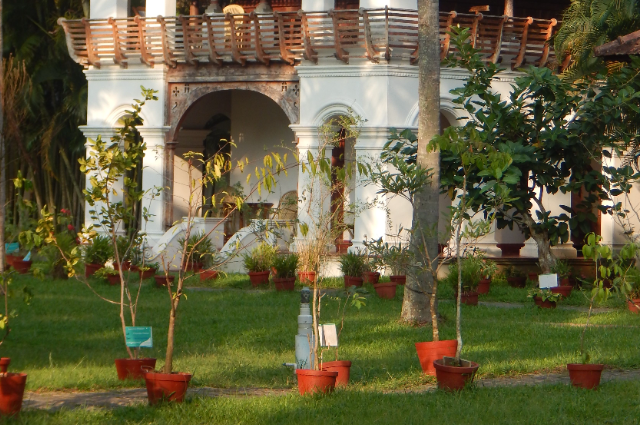
A neighbour called Belief waters the plants outside a house in Kerala and then locks the gate. Nobody lives in the house (Associated Press, 2023).
The house belongs to V Baby, a retired mathematics professor. He put his life savings into a two-storey home meant to last generations and expected his son, Sony, to raise a family in it. Sony went to the United Arab Emirates instead, for work and a better life. Then Baby’s wife, Vasanthi, 82, nearly tripped coming down the stairs, and that decided it. The couple, 84 and 82, moved into an assisted-living centre in Kochi (Associated Press, 2023).
There is no villain in this. The couple says they feel safe at the centre, with nurses on duty all day and people their own age around them. Baby misses his son and admits it, but he won’t blame him: “I cannot ask him to stay here” (Associated Press, 2023). I keep thinking about the stairs. A staircase planned for generations became the thing that frightened two old people, and the next generation was abroad.
I want to ask what happens in a state where houses like this are no longer unusual. Who waters the plants? Who drives a parent to hospital? Who answers the phone? One family cannot settle that for roughly 3.5 crore people (Rajan, 2024), so I treat the Babys as a place to start, not as proof. The popular picture is of a Kerala emptied of its young, but the evidence is more mixed. What I found is that two long processes meet inside the empty house. One is the fall in fertility that made Kerala old. The other is the habit of working abroad that spread its families across the world. Both grew out of the same thing, Kerala’s investment in schools and health, and both are achievements. Put together, they leave older people in houses built for bigger households, in a state whose care services have not caught up.
A state that grew old first
Start with age. In 1961 only 5.1 per cent of Kerala’s people were over 60, a little below the national 5.6 per cent (Shaji, 2026). The share has since more than tripled, to 16.5 per cent, the highest in India (Associated Press, 2023). Newer estimates don’t agree with each other because they are built differently. The Registrar General projected 18.7 per cent for 2026 (Kumar, 2026). The Kerala Migration Survey’s 2023 household sample found 21.8 per cent, against 12.5 per cent in the 2011 Census, and a median age that rose from 31 to 39 (Rajan, 2024).
None of this happened by chance. Nair (2010) dates Kerala’s arrival at replacement-level fertility to around 1987, when much of India still had high or middling fertility, and puts the cause down to human development: schooling, women’s empowerment, health services, family planning. The Sample Registration System for 2021 now gives 1.5 births per woman, though the National Family Health Survey, measuring differently, gave 1.8 (Jha, 2025). Nair adds something I nearly missed. High literacy, together with unemployment among the educated, made Keralites early pioneers of Indian emigration. The same schools that made small families possible trained the people who would leave.
You can see the sums in the houses. Average household size dropped from 4.3 in 2011 to 3.7 in 2023, and over those years the number of households grew 23.5 per cent while the population grew only 6.3 per cent (Rajan, 2024). The state expects 35 people over 60 for every 100 of working age by 2030 (Associated Press, 2023). Old age here is largely women’s, and often a widow’s: Census figures quoted by Shaji (2026) put widows at 23 per cent of women aged 60 to 69 and 43 per cent of those over 70.
The exodus that stopped growing
If you picture an exodus that gets bigger every year, the Kerala Migration Survey will correct you. The 2023 round, covering 20,000 households, estimated 2.15 million emigrants. That is about 32,000 more than in 2018 and well under the 2013 peak of 2.4 million. In nine of 14 districts, the number had gone down, which the survey calls saturation (Rajan, 2024).
What has changed is who goes. Student emigrants roughly doubled, from about 130,000 to about 250,000, some of them leaving at 17. Of students over 16, more than eight in ten went after finishing a degree in Kerala; one in four chose the United Kingdom and one in five Canada. The Gulf’s share of all emigrants slipped from 89.2 to 80.5 per cent. And among women who emigrate, 51.6 per cent are nurses or nursing assistants (Rajan, 2024). The work an ageing Kerala needs most is the most common job among its women emigrants.
Not everyone stays gone. The survey counts 1.79 million returnees. The most common reason, for 18.4 per cent, was losing a job, but 7.9 per cent said they came back to look after elderly relatives (Rajan, 2024).
Then there is money, which is easy to overstate. Remittances are estimated at ₹2.17 lakh crore, or 23.2 per cent of the state’s net domestic product. The part that reaches households is about ₹37,000 crore, and only 12 per cent of households receive any, down from 16 per cent in 2018. The biggest single use was renovating houses or shops (Rajan, 2024). Money can repair a house. It cannot fill one.
S. Irudaya Rajan offers a reading of the locked doors. In the Gulf years, there was no path to permanent residence, so migrants kept thinking they would return, and they built houses at home with that in mind. Their children, heading to the United Kingdom, Canada, Australia or New Zealand, do not plan to come back. He calls it a new trend that could have long-lasting effects (Ramachandaran, 2023). Many of those houses, then, were promises. The next generation hasn’t made the same one.
Two old ages, twenty kilometres apart
Migration has not paid everyone the same. Zainaba Ali, 65, spent most of her youth working as a cleaner in countries around the Middle East. Arthritis and other illnesses ended her working life, and she came home with little savings. Now she lives in a small room with an asbestos roof, tucked into a corner of her daughter’s house in Mattancherry, about twenty kilometres from the centre where the Babys live. Her daughter doesn’t work; her son is a daily-wage labourer. Her small government pension had not arrived in months, and she told the AP she survives on the goodwill of her children (Associated Press, 2023).
What separates them isn’t love. It is access: to savings, to a pension that actually arrives, to a bed with a nurse next to it.
The lane of closed doors
The survey’s own field teams ran into the empty house. Many homes were locked because whole families had gone, and the survey identified about 4.2 lakh cases of family migration. Teams had to visit around 5,000 extra households because everyone was abroad or because residents refused to take part. Rajan writes that migrants increasingly take their families with them, sometimes leaving only the elderly behind (Rajan, 2024).
The 2011 Census gives a rough sense of scale: about 11 per cent of Kerala’s houses were vacant, against 7.45 per cent across India (The News Minute, 2023). A Kerala Sasthra Sahithya Parishad report counted 11.89 lakh vacant houses, about 3.3 lakh of them with four or more rooms (John, 2017). Not every vacant house belongs to a migrant, since some families own two or more, and nobody has a reliable current count. When the 2023 Budget proposed a tax on vacant houses, the finance minister said there were no clear statistics (The News Minute, 2023). Later figures run from roughly 10 lakhs, a rough government estimate (Soman, 2025), to 18 lakh locked houses in local-government data for 2022 (Ramachandaran, 2023).
Pathanamthitta is where the pattern is easiest to see. The migration survey estimates that its population, like Idukki’s, fell between the 2011 Census and 2023; they are the only two districts where that happened (Rajan, 2024). Local-government figures obtained by The South First show more than 61,000 closed homes. An Adoor councillor says most are spotted by Haritha Karma Sena workers when they come to collect waste, and that after the 2018 floods many children abroad began taking their parents with them. A priest of the CSI Diocese says ghost homes come up in churches as attendance falls: “We cannot stop children from migrating” (Soman, 2025). A ₹5 crore state scheme to turn vacant homes into tourist stays had barely started in the district.
Kumbanad, in the same district, sent its young people west. The big houses there hold elderly couples. Pensions, savings and money from abroad keep them comfortable; what is missing is company. A local businessman, Joseph C. Mathew, says the unintended result of the village’s success is parents spending their last years alone (Shaji, 2026). The houses wait for people who may not come.
Census 2027 sent enumerators door to door in Kerala in July 2026, and a house that stays locked after repeated visits is recorded as locked. The population count follows in February 2027 (Onmanorama, 2026). I could find no published Kerala vacancy figures from it yet.
Who picks up the phone?
Every morning, the BBC reported in June 2026, 70-year-old T. O. Dominic phones one of his sons, one in Karnataka and the other in the Middle East. When he and his wife, M. J. Martha, need hands-on help, a phone call only goes so far. “We depend entirely on our neighbours,” Dominic says (BBC News, 2026).
This is where Kerala’s two processes collide. Alex Joseph, managing trustee of the centre where the Babys live, told the Associated Press that trained staff are hard to find. Workers from other states struggle with the language, and local recruits mostly want to work abroad. Kerala, he said, probably sends out more nurses than any other single region, and keeping them is extremely difficult (Associated Press, 2023). In Kumbanad, the village’s women nurse ageing patients in Britain and Germany while their own parents grow old at home (Shaji, 2026). The state that trained the carers can’t keep them.
Left behind, or staying by choice?
What goes on inside these houses is harder to measure. The 2023 migration survey ran a module on migration and the elderly with 10,318 respondents (Rajan, 2024), but I found no published results from it. That means I cannot tell you reliably how many older Keralites live alone because their children left.
Small qualitative studies fill part of the gap. Mohan et al. (2025) interviewed twenty people over 65 in Pathanamthitta, Thrissur and Kannur who lived alone or with a spouse after their children migrated. Many felt looked after by daily calls and hospital visits their children arranged from afar, and most accepted the decision to leave. Yet they spoke of loneliness, anxiety and practical gaps, and hospital emergencies worried them most. “Technology cannot replace people,” said one. The study also cites a national survey analysis finding that older parents with a migrant son were 26 per cent more likely to be depressed (Muhammad et al., 2022, as cited in Mohan et al., 2025). An earlier study of 600 older people left behind in emigrant households found migration-induced exclusion to be pervasive (Rajasenan et al., 2016).
Abandonment is a separate and harsher problem, and the migration data don’t capture it. Health department figures reported by Shaji (2026) show at least 270 elderly patients who had fully recovered but were still in government hospitals because relatives had abandoned them. How much of this overlaps with migration, nobody knows. It isn’t whether children should leave. It is whether the parents who stay are supported.
A budget with two faces
In January 2026, Kerala presented a newly dedicated Elderly Budget of ₹46,236.52 crore, 19.07 per cent of the state budget. The Registrar General projects that 18.7 per cent of Kerala’s people are elderly in 2026, so the outlay is larger than their share of the population (Kumar, 2026). The headline needs unpacking, though. Service and social-security pensions make up ₹43,045 crore, about 93 per cent of it. State Plan spending on elderly welfare, which is what pays for services, was ₹1,341.72 crore, under 3 per cent (Kumar, 2026; my calculation). Pensions matter enormously; my point is how little of the headline buys care.
Then the figures moved. After the change of government in May, the revised budget of June cut the State Plan allocation for elderly welfare from ₹1,341.72 crore to ₹1,097.53 crore, a fall of more than ₹244 crore, or about 18 per cent. Vayomithram, the flagship scheme for older people’s health and social security needs, went from ₹27.50 crore to ₹22 crore. The pension lines were untouched, and the overall elderly budget barely changed, ending at ₹46,110.33 crore. The government blamed much lower expected central transfers after the 16th Finance Commission discontinued the Revenue Deficit Grant. It also created a Department of Elderly Welfare, which it calls India’s first, set aside ₹10 crore for it, and promised a Silver Economic Policy and a statewide survey of senior citizens (Kumar, 2026). So the money for services was cut while the money for pensions was protected.
What a kinder system would look like
What follows is my own argument, not a finding.
Start with Belief. A neighbour is doing by goodwill what a system could do by design. Kerala already has people who notice closed houses: the Haritha Karma Sena workers who see which gates stay shut. A confidential panchayat register of older people living alone, kept up to date and built from the promised statewide survey and Census 2027, would turn that goodwill into service. The migration survey’s elderly module should be published too, so the register starts from evidence.
Then there is distance. Dominic’s sons can phone every morning, but a phone call cannot take a parent to hospital. Migrant families need verified local care managers they can pay to arrange transport, admissions and paperwork. Kerala’s carers also have to be kept at home. The migration survey recommends regulating training centres and recruitment agencies and encouraging students to return (Rajan, 2024), but retention will depend on care work that is paid and respected enough to compete with a job abroad. And the next budget should protect the service lines, because that is where care actually happens.
Last, build for the people who will live in the house. The Babys left after a near-fall on the stairs. Single-level layouts and safer stairs should be standard in new homes and in retrofits.
The gate and the plants
V Baby is right that a father should not hold his son’s life hostage to his own loneliness, and nothing in the data suggests Kerala’s young should stay out of guilt. The harder question is what the rest of us owe the people who built these houses and are still living in them.
A neighbour waters the plants and locks the gate. For one couple the BBC met, neighbours are the whole safety net. Across Pathanamthitta, tens of thousands of doors are shut on houses that may never be lived in again. Quiet attention like that has to become a system. A house isn’t empty while someone remembers it, but no state should leave the remembering to chance.
A note on the evidence
This is a desk-based case study. It rests on one large household survey, whose figures are estimates, on 2011 Census data reported by others, on small qualitative studies, and on press accounts of official documents. India held no Census in 2021, so recent population figures are projections. The Babys’ and Zainaba Ali’s stories date from April 2023 and Dominic’s from June 2026. I do not know how they are doing now, and I conducted no interviews.
References:
- Associated Press. (2023, April 17). As India becomes the most populous nation, Kerala ages. Al Jazeera. https://www.aljazeera.com
- BBC News. (2026, June 25). Kerala: The Indian state trying to ensure no one grows old alone. https://www.bbc.com/news/articles/cg74dj4xev5o
- Jha, S. (2025, May 12). South India’s fertility decline is sharper than earlier estimates, shows latest SRS 2021 data. The South First. https://thesouthfirst.com
- John, H. (2017, October 13). Over 3000 people are homeless in Kerala, while almost 12 lakh houses lie vacant. The News Minute. https://www.thenewsminute.com
- Kumar, D. V. (2026, June 21). ‘Silver economy’ ambitions meet fiscal reality as Kerala prunes elderly welfare spending. The South First. https://thesouthfirst.com
- Mohan, A., Jaihind Jothikaran, T. A., Patil, D. S., & Ashok, L. (2025). “Care beyond co-residence”: A qualitative exploration of emotional and instrumental care gaps among older adults in migrant households of Kerala. International Journal of Environmental Research and Public Health, 22(11), Article 1745. https://doi.org/10.3390/ijerph22111745
- Nair, P. S. (2010). Understanding below-replacement fertility in Kerala, India. Journal of Health, Population and Nutrition, 28(4), 405–412. https://doi.org/10.3329/jhpn.v28i4.6048
- Onmanorama. (2026, June 15). Phase I of Census 2027 to begin in Kerala from June 16; Houselisting from July 1. https://www.onmanorama.com
- Rajan, S. I. (2024). Kerala Migration Survey 2023 (Working Paper No. 11). International Institute of Migration and Development. https://iimad.org
- Rajasenan, D., Jayakumar, M. S., & Abraham, B. G. (2016). Socioeconomic and psychological dimensions of migration-induced exclusion of the elderly in Kerala, India: An empirical analysis. International Journal of Migration, Health and Social Care, 12(1), 51–65. https://doi.org/10.1108/IJMHSC-05-2014-0018
- Ramachandaran, R. (2023, February 23). Nobody home! What Kerala’s ghost houses whisper about migratory trends. The Federal. https://thefederal.com
- Shaji, K. A. (2026, June 28). Of empty nests and ageing parents. National Herald. https://www.nationalheraldindia.com
- Soman, S. (2025, October 29). 61,000 empty homes, a Rs 5 crore project on paper, and the haunting silence of migration in Pathanamthitta. The South First. https://thesouthfirst.com
- The News Minute. (2023, February 3). Additional tax proposed for vacant houses in Kerala. https://www.thenewsminute.com