
A New Paradigm in Opposition Politics
The political landscape of India has reached a critical juncture characterised by growing systemic distrust between the principal opposition alliance and the foundational regulatory bodies of the state. On June 30, 2026, twenty-three opposition parties took the unprecedented step of bypassing standard administrative channels to submit a joint memorandum directly to the Chief Justice of India, Justice Surya Kant. This collective petition formally accuses the Election Commission of India (ECI) of displaying a "biased conduct" that threatens the core tenets of the democratic process.
This joint initiative signifies an escalation in strategy for the opposition coalition, known as the INDIA bloc. By directly petitioning the head of the judiciary, the coalition is attempting to frame its administrative grievances as fundamental constitutional crises. The timing of this memorandum is particularly significant, as it follows recent state assembly elections and arrives amidst ongoing updates to electoral registers across multiple jurisdictions. The move reflects a broader tactical shift: when statutory mechanisms for grievance redressal are perceived as compromised, the judiciary is increasingly called upon to serve as the ultimate arbiter of democratic fairness.
At its core, this dispute highlights a deeper struggle over the structural machinery of Indian elections. The opposition’s willingness to coordinate across distinct regional and ideological lines demonstrates a shared vulnerability regarding the management of voter rolls and constituency delineations. As this analytical report demonstrates, the friction involves more than simple procedural disagreements; it is an active contest over the legitimacy, autonomy, and institutional accountability of the bodies tasked with managing the world’s largest electorate.
The Institutional Nexus: The Opposition and the Judiciary
The decision to approach the Chief Justice of India directly underscores a calculated political calculation regarding the separation of powers within the Indian republic. Historically, political parties have addressed grievances regarding electoral rules directly to the Election Commission or through formal election petitions filed after the conclusion of voting. However, the decision by twenty-three distinct political entities to submit a joint memorandum indicates a systemic belief that the standard regulatory channels are no longer responsive to their concerns.
This institutional manoeuvre relies on the symbolic and legal authority of the Supreme Court of India as the ultimate custodian of constitutional values. By presenting these concerns to Chief Justice Surya Kant, the opposition aims to elevate procedural criticisms into a broader debate on constitutional compliance. This strategy builds on a history of public interest litigation used to seek systemic remedies that are unavailable through traditional legislative or executive avenues.
Furthermore, this development highlights the complex relationship between political actors and the courts. Approaching the judiciary allows the opposition to present its claims in a forum bound by evidentiary standards and public accountability. This legal framework forces a structured examination of institutional behaviour, requiring regulatory bodies to defend their administrative choices against explicit constitutional benchmarks like the right to equal treatment and the demand for free and fair elections.
Deconstructing the Special Intensive Revision (SIR) Controversy
The primary source of friction behind this joint memorandum is the implementation of the Special Intensive Revision (SIR) of electoral rolls. The Special Intensive Revision represents an institutional mechanism designed to audit, clean, and update voter registries within designated states. While the Election Commission defends the exercise as an essential step to eliminate duplicate entries, correct systemic errors, and register eligible new voters, the opposition views it as an administrative tool vulnerable to political manipulation.
The controversy focuses primarily on the states of West Bengal and Bihar, where these intensive revision processes have been deployed. Opposition parties argue that the targeted execution of these audits disproportionately impacts specific demographic groups and regional strongholds, potentially altering the balance of the local electorate. The focus of the criticism is not the abstract necessity of voter roll maintenance, but rather the specific timing, operational criteria, and perceived lack of transparency governing these updates.
In practice, a Special Intensive Revision involves door-to-door verification, physical verification of residency claims, and the scrutiny of existing voter credentials. When conducted close to major electoral events, any operational error, misclassification, or administrative oversight can result in the de facto disenfranchisement of eligible citizens. The opposition contends that without rigorous multi-party oversight, these administrative updates can be executed in a selective manner that favours the incumbent government.
Regional Dynamics: The Impact on West Bengal and Bihar
The geopolitical impact of the Special Intensive Revision is felt most acutely in West Bengal and Bihar, two states characterised by intense competitive politics and deep social stratifications. In West Bengal, the implementation of the SIR followed a highly contested Assembly election that resulted in a defeat for the ruling Trinamool Congress (TMC). Chief Minister Mamata Banerjee has linked the implementation of these intensive voter roll updates directly to broader efforts aimed at weakening her regional political base.
Similarly, in Bihar, the voter roll revision has become a central point of political conflict. The targeted auditing of voters in specific districts has led to allegations from regional parties that the exercise is designed to remove vulnerable socioeconomic groups from the active voter registry. Because electoral outcomes in Bihar often depend on narrow margins across complex caste and community alignments, even minor changes to the voter rolls can shift regional political dynamics.
The focus on these two states highlights a broader trend where administrative initiatives executed by central authorities face intense scepticism from regional political leaders. In these contexts, routine bureaucratic updates are frequently interpreted through the lens of partisan advantage. This dynamic turns technical demographic adjustments into high-stakes political battles, as both regional incumbents and challengers view changes to the voter registry as direct threats to their political survival.
Strategic Alignments: The Convergence of the INDIA Bloc
The collective endorsement of the memorandum by twenty-three political parties represents a significant logistical coordination for the INDIA bloc. The decision to pursue a joint judicial strategy was finalised during a strategic meeting held in Delhi on June 8, 2026. This session, convened at the insistence of West Bengal Chief Minister Mamata Banerjee, initially aimed to build a visible show of opposition unity through direct field visits to states experiencing political transitions.
While the proposal for physical visits did not secure universal consensus among the members, it led to an alternative legal approach. Senior Supreme Court advocate and Independent Rajya Sabha MP Kapil Sibal proposed redirecting the alliance's energy toward a joint legal memorandum addressed to the Chief Justice. This approach allowed the disparate factions within the alliance to unite around a shared constitutional argument regarding electoral fairness, bypassing internal disagreements over local campaigning tactics.
This legal focus functions as an important unifying element for a coalition made up of parties with diverse regional priorities and competing local interests. Agreeing on a single campaign platform can be challenging for an extended alliance, but resisting perceived institutional overreach by central bodies like the ECI offers a reliable point of convergence. The strategy demonstrates how legal challenges can serve as a practical tool for keeping a complex political coalition aligned.
Internal Fault Lines: The DMK, AAP, and Coalition Dynamics
Despite presenting a unified front to the Chief Justice, the memorandum also reveals ongoing internal challenges and shifting alliances within the broader opposition space. Notably, the document bears the signatures of both the Dravida Munnetra Kazhagam (DMK) and the Aam Aadmi Party (AAP), despite neither party attending the pivotal June 8 planning session in Delhi. This pattern of participation highlights the complex dynamics currently shaping contemporary political alliances.
The status of the AAP is particularly unique, as it operates independently from the formal structural mechanisms of the INDIA bloc while still aligning with its legal initiatives on specific issues. Conversely, the DMK’s absence from the Delhi planning meeting stemmed from sharp regional policy disagreements with the leadership of the Indian National Congress. The DMK openly criticised the Congress for what it termed a post-election "betrayal" in Tamil Nadu, following the alliance's defeat in the state assembly elections and subsequent shifts in local governance.
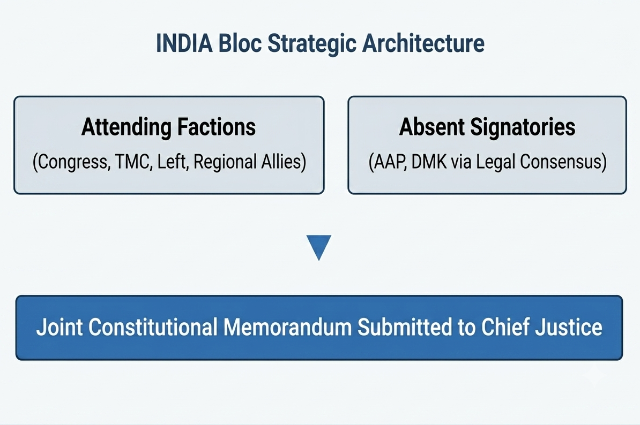
The fact that these estranged parties chose to sign the memorandum despite active internal conflicts emphasises the urgency they attach to the issue of voter roll revisions. It shows that while regional disputes can strain daily political collaboration, concerns over the integrity of the electoral process remain strong enough to produce temporary consensus across fractured alliances.
The Rhetoric of Resistance: The SURE Framework
To justify their legal challenge and maintain public engagement, the leadership of the opposition has adopted a specific political framework designed to rally its base. Following the submission of the joint memorandum, Congress General Secretary in charge of Communications, Jairam Ramesh, summarised the alliance's perspective by stating that the opposition parties remain firmly anchored in "SURE"—an acronym representing Solidarity, Unity, and Resistance.
This terminology serves a dual purpose: it frames a technical legal dispute as a broader democratic movement and seeks to build public support for the coalition's institutional stance. By using the term Solidarity, the alliance attempts to look past its internal divisions and present its legal positioning as a unified defense of constitutional principles. Unity emphasizes their coordinated focus on federal balance, while Resistance positions their challenge to the Election Commission as a necessary defense of democratic checks and balances.
This rhetorical approach reflects a classic political strategy where legal actions are paired with public-facing communication. For the opposition, the technical details of voter roll revisions are deeply connected to the broader health of democratic institutions. By branding their efforts through the SURE framework, they aim to shift public attention away from recent electoral setbacks and focus it on a principled defence of electoral integrity.
Administrative Justifications of the Election Commission
While the opposition views the Special Intensive Revision through a political lens, the Election Commission of India defends the program as a neutral, necessary administrative task. Under Article 324 of the Constitution, the ECI holds the explicit authority and responsibility for the superintendence, direction, and control of the preparation of electoral rolls. From the Commission’s perspective, intensive revisions are routine governance actions required to ensure the accuracy of the voter registry.
The administrative rationale for the SIR centres on managing demographic shifts, urbanization, and changing patterns of migration. In rapidly evolving states, standard annual summary revisions may fail to account for individuals who have relocated, changed residences, or passed away. Left uncorrected, these inaccuracies can lead to distorted voter turnouts or create opportunities for voting irregularities. The Commission asserts that the intensive model provides a rigorous, hands-on methodology to verify the accuracy of the register.
Furthermore, the ECI maintains that the operational protocols governing the SIR are applied uniformly without regard to political boundaries or regional party control. The processes rely on standardized civil service networks, utilizing booth-level officers to verify details through transparent, established parameters. The Commission emphasises that the primary goal of these updates is to protect the principle of "one citizen, one vote" by maintaining an accurate, clean, and reliable database.
Judicial Precedents: The Bihar Validation Benchmark
The legal debate over voter roll revisions is heavily shaped by an important judicial precedent recently established by the Supreme Court. On May 27, 2026, a two-judge bench of the apex court delivered a unanimous judgment that explicitly upheld the constitutional validity of the Special Intensive Revision carried out in Bihar. This ruling provides a significant legal benchmark that directly impacts the opposition's current memorandum.
The comprehensive judgment, authored by Chief Justice Surya Kant on behalf of himself and Justice Joymalya Bagchi, followed extensive hearings that spanned 29 days over nearly seven months. The court held that the intensive revision process was fully valid, proportionate, and fell within the proper exercise of powers granted to the ECI under Article 324 of the Constitution and Section 21(3) of the Representation of the People Act, 1950. The bench concluded that the administrative benefits of maintaining clean voter rolls outweighed the procedural challenges highlighted by petitioners.
| Legal Dimension | Constitutional / Statutory Authority | Supreme Court Finding (May 27, 2026) |
| Institutional Mandate | Article 324, Constitution of India | Confirms full ECI jurisdiction over voter roll preparation and maintenance. |
| Statutory Validity | Sec 21(3), Representation of the People Act, 1950 | Validates the implementation of intensive revisions. |
| Proportionality Check | Judicial Doctrine of Balance | Rules the audit measures appropriate for maintaining accuracy. |
| Operational Scope | Administrative Directives | Confirms the process matches constitutional standards of fairness |
This recent ruling creates a challenging legal path for the opposition's new memorandum. Because the Supreme Court has already validated the legal framework of the SIR, any new challenge must demonstrate distinct, explicit administrative violations or clear evidence of bad faith execution to prompt further intervention by the court.
Systemic Implications for the Future of Electoral Governance
The growing conflict between political coalitions and regulatory bodies raises important questions about the long-term stability of electoral governance in India. When foundational institutions like the Election Commission face consistent criticism from a significant portion of the political spectrum, the broader public consensus supporting electoral outcomes can begin to erode. This institutional friction shifts energy away from routine administrative updates and turns them into ongoing debates over neutral governance.
This trend risks bringing a permanent element of scepticism into standard bureaucratic operations. If every voter roll update, polling place adjustments, or technology upgrade is viewed with suspicion, the regular maintenance of democratic infrastructure becomes increasingly difficult. This friction can lead to a more rigid administrative environment, as regulatory bodies may prioritise legal defensibility over flexible, user-friendly processes to avoid political controversy.
Ultimately, this ongoing tension highlights the need for institutional mechanisms that can rebuild trust between political competitors and electoral regulators. Ensuring transparency through open data sharing, multi-party audits, and clear consultative frameworks offers a potential path to lower political tensions. Without these collaborative steps, the recurring cycle of legal challenges and political pushback could permanently alter the relationship between India's political parties and the institutions that oversee its democracy.
The Judiciary as the Custodian of Democratic Consensus
The submission of the joint memorandum by twenty-three opposition parties to Chief Justice Surya Kant represents a significant moment in India's ongoing political evolution. This initiative highlights the complex balance of power that sustains the democratic framework of the republic. By bringing their concerns directly to the highest level of the judiciary, the opposition alliance has emphasised its view that electoral integrity is a fundamental constitutional concern that requires careful legal oversight.
As the Supreme Court considers these issues, its role extends beyond simply interpreting statutory rules or validating administrative actions. The court is increasingly called upon to preserve the foundational public trust that supports the entire democratic architecture. Its rulings must balance the clear need for administrative efficiency in managing voter registries with the equally important requirement that these processes remain completely transparent and universally accessible.
Ultimately, maintaining a healthy democracy depends on the resilience and perceived neutrality of its core institutions. The current debate over the Election Commission's processes serves as an important reminder that the mechanics of voting require constant care, transparency, and a commitment to
fairness. The resolution of these issues will play a major role in shaping the future of Indian governance, ensuring that the country's democratic processes continue to command the respect and confidence of all participants across the political spectrum.
References and Academic Sources
- Nair, S. K. (2026). "INDIA bloc writes to CJI, flags EC’s ‘biased conduct’." The Hindu, Updated June 30, 2026.
- Supreme Court of India. (2026). Judgment in the Matter of Special Intensive Revision of Electoral Rolls (Bihar). Writ Petition (Civil) No. 412 of 2025, Decided May 27, 2026 (Surya Kant, C.J., and Bagchi, J.).
- Election Commission of India. (2025). Manual on the Revision of Electoral Rolls: Standard Operating Procedures for Intensive Auditing and Verification. New Delhi: ECI Publications.
- Government of India. (1950). The Representation of the People Act, 1950 (Act No. 43 of 1950). New Delhi: Ministry of Law and Justice.
- Institutional Review of Electoral Politics. (2026). "Federal Structures and Regulatory Oversight: Evaluating the Separation of Powers in Contemporary South Asia." Journal of Democratic Governance, Vol. 42, No. 2, pp. 115-134.