
There is a strange irony sitting quietly in the heart of India, one that nobody really talks about at dinner tables or in parliament sessions, but one that stares back at you the moment you look at it honestly. There is a question that Indian environmentalists have been quietly wrestling with for decades, one that is almost too awkward to ask in polite company: What if our holiest rivers are dying precisely because we consider them holy?
And what if the river that mythology cursed, the one that Indian tradition says was born from the blood of animal sacrifice, the one people refuse to use in weddings and religious ceremonies, turned out to be the cleanest, most ecologically alive river in the entire subcontinent? That is not a thought experiment. That is the Chambal. And this is its story.
What the Data Actually Says About India's Sacred Rivers
Start with the numbers, because they are important and because feelings alone have not been enough to save these rivers. According to the Central Pollution Control Board, more than 350 river stretches across India are currently classified as polluted, impacting both rural and urban communities. That is not a fringe problem. That is a national crisis hiding in plain sight.
The Yamuna, worshipped as a goddess, celebrated in songs, and prayed to by millions, tells the most brutal story. Studies tracking the Yamuna in Delhi over a decade found that BOD and COD consistently exceed the upper limits, while total coliform counts spike dramatically, indicating severe pollution stress driven by industrial discharges, urban sewage, and inadequate infrastructure.
Rivers like the Sabarmati in Ahmedabad have recorded BOD levels as high as 292 mg/L, nearly 100 times the safe limit of 3 mg/L for bathing water. The Yamuna in Delhi continues to feature among the most polluted river stretches in Asia.
The Ganga has thousands of crores thrown at it through successive government programmes. A Bihar government report declared Ganga water unsafe even for bathing across key stretches in the state. That headline appeared roughly 30 years after the first Ganga Action Plan was launched.
What is happening here is not a failure of good intentions. It is a structural paradox. The rivers that carry religious weight also carry the weight of entire economies, pilgrimage infrastructure, industrial corridors, and urban sprawl. They are too important commercially to be left alone ecologically. And that tension has been killing them slowly.
Enter the Chambal, India's Most Misunderstood River
The Chambal has a mythology so dark it would put any horror film to shame. The Mahabharata refers to the river by its ancient name, Charmanyavati, describing it as originating from the blood of thousands of animals sacrificed by King Rantideva in a massive ritual fire. The text states that so vast was the slaughter that the fluids flowing from the heaps of animal skins created an entire river, and that is how the Charmanwati got its name.
Then came Draupadi's curse. According to the legend, the infamous dice game in which the Pandavas lost their kingdom and their queen was played on the banks of the Chambal. When Draupadi was humiliated, she cursed the river for being a silent witness to her disgrace, vowing that anyone who drank from its waters would be filled with an unquenchable thirst for vengeance.
These two curses, together one of blood, one of vengeance, meant that for centuries, large parts of Indian society wanted nothing to do with the Chambal. Even today, people living in many parts of Madhya Pradesh and Rajasthan refuse to use Chambal water in auspicious rituals, weddings or religious ceremonies, believing it carries bad fortune.
And then, layered on top of mythology, came the dacoits. From the time of the 1857 rebellion, outlaws and rebels took to the deep ravines of the Chambal. Over time, what began as a political refuge evolved into criminal territory. The Chambal valley became synonymous with dacoit gangs, including India's notorious Bandit Queen, Phoolan Devi, who hid out in these ravines — making the region a place that ordinary people, industries, and governments simply stayed away from.
How the Curse Became Conservation
Here is where this story takes a turn that no mythologist planned for.
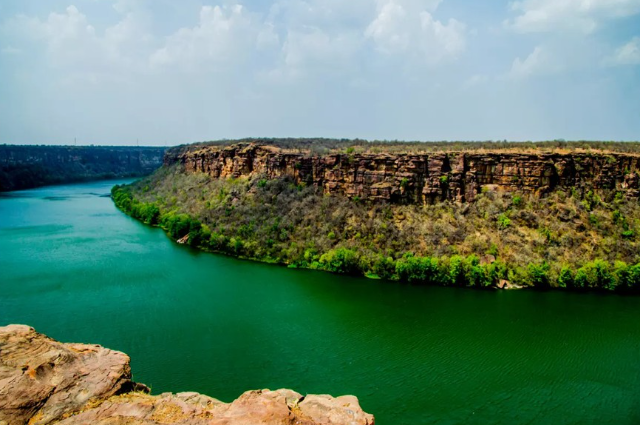
The stigma and terror associated with the Chambal, combined with the rugged and inhospitable topography of its banks, kept people away from it for generations, resulting in very low levels of development along its course. As a direct consequence, the Chambal remained one of India's least polluted rivers.
No major industrial belt is set up on its banks. No pilgrim economy on the scale of Varanasi or Haridwar developed around it. No mass idol immersions. No sewage from tens of millions of devotees. The cultural rejection of the Chambal accidentally became its most powerful ecological shield.
Water quality analysis of the Chambal within the National Chambal Sanctuary found the river water to be pollution-free, capable of serving as a good habitat for aquatic animals, including endangered species. Scientific measurements of the river in the sanctuary stretch recorded dissolved oxygen levels between 4.86 and 14.59 mg/L, consistent with a healthy, living river, along with very low levels of phosphate, nitrate, and biochemical oxygen demand, reflecting the pristine nature of the water in this stretch. In plain terms, the river has enough oxygen to sustain complex life. The Yamuna through Delhi often cannot say the same.
A 2009 ecological survey of the sanctuary stretch formally classified the Chambal as oligosaprobic, the scientific category for water with very low organic pollution. The protected area status of the 425-km sanctuary stretch, combined with minimal industrial encroachment and strong enforcement of anti-poaching and pollution rules, has maintained both water quality and biodiversity.
The Wildlife That Calls Chambal Home
The clearest way to understand a river's health is not through chemistry alone, but through what chooses to live in it. The Chambal is today one of the last remaining homes of the critically endangered gharial and the endangered Gangetic river dolphin. The river also supports mugger crocodiles, smooth-coated otters, freshwater turtles, and at least 150 species of resident and migratory birds, including breeding populations of the endangered Indian skimmer and black-bellied tern.
The gharial, that ancient, long-snouted, fish-eating crocodilian, deserves a special mention because its story is directly tied to water quality. Gharials are extraordinarily sensitive to pollution and habitat disturbance. They disappeared from almost every river in India as those rivers degraded. The Chambal today houses over 300 species of birds, including 13 endangered species, along with the fish-eating gharials whose population had crashed so severely elsewhere that only the Chambal offered them a viable home.
The Gangetic river dolphin, blind, sonar-navigating, ancient, similarly requires clean, oxygenated, free-flowing water to survive. It has vanished from most of the Ganga's mainstream tributaries. In the Chambal, it still lives. That single fact speaks louder than any water quality report.
The New Threat: The Curse Is Wearing Off
Perhaps the most alarming development in recent years is that the Chambal's protective reputation is fading. People are no longer afraid of it the way they once were. Dacoits are gone. The mythology is being forgotten. And with that, forgetting comes a new kind of danger.
Conservation researchers have noted with concern that the pristine nature of the Chambal valley is now attracting a new breed of threats, sand mining mafias, fish poachers, and construction activity. The river's ecological appeal, which was once shielded by its infamy, is now becoming its vulnerability.
The river faces mounting pressure from hydroelectric, irrigation, and water abstraction projects that scar its length and alter its natural flow. During summers in the sanctuary, water diversion reduces river levels to dangerously low points, making it easier for people and cattle to cross and trample the nesting sites of birds and reptiles on its sandy banks.
The Sanctuary and the Science Behind It
The National Chambal Sanctuary was formally established in 1979 by the Indian government, covering a protected area of 5,400 square kilometres shared across Madhya Pradesh, Rajasthan, and Uttar Pradesh. The sanctuary brought legal teeth to what mythology had accidentally created, a buffer zone between the river and human exploitation.
The combination of natural deterrence and legal protection produced measurable results. The Gharial Conservation Project, documented by WWF India, showed how biodiversity conservation and river cleanliness reinforce each other, a model that researchers now cite as a potential blueprint for other river basins across the country.
It is worth acknowledging here that the Chambal is not entirely without challenges. Studies focusing on the stretch near Kota, Rajasthan, an industrial and educational hub, have identified localised pollution from untreated drains and thermal plants, showing that where human activity concentrates near the river, water quality begins to fall. The lesson being that the Chambal's cleanliness is not magical. It is conditional on keeping industrial and urban pressure away.
What This Irony Actually Tells Us
The contrast between the Chambal and India's sacred rivers is not just an environmental observation. It is a profound civilisational one.
We built economies, pilgrimage industries, and urban centres around the rivers we called holy. We extracted from them, discharged into them, and assumed their divinity would absorb the damage. India's CPCB reports that about 46% of the 603 monitored river stretches contain at least one section classified as polluted, a damning statistic for a country that names rivers after goddesses.
The Chambal was left alone because people feared it. Because it was cursed. Because it reminded them of blood and vengeance and outlaws. And that fear, irrational, mythological, unscientific, turned out to be the most effective conservation policy this country has ever accidentally implemented.
As Atlas Obscura pointedly noted: the ancient curse of the Chambal was actually a blessing. It saved the river from human habitation and pollution, and fortuitously created a pristine wildlife sanctuary where critically endangered species now flourish.
The Fact No One Wants to Hear
The Chambal did not survive because India protected it. It survived because India avoided it. And that difference between protecting something and simply leaving it alone is perhaps the most important environmental lesson that this country's rivers have ever offered. The Ganga needs our reverence to be translated into restraint. The Yamuna needs our devotion to become disciplined. The lesson of the Chambal is not that we should curse our sacred rivers. It is that we should respect them the same way we respected a river we were afraid of —
by keeping our industries off their banks, our sewage out of their waters, and our mythologies honest about what rivers actually need to survive.
They do not need our prayers. They need our absence. And where our absence is not possible, they need our accountability. The Chambal proved that. Whether we are listening is another question entirely.