
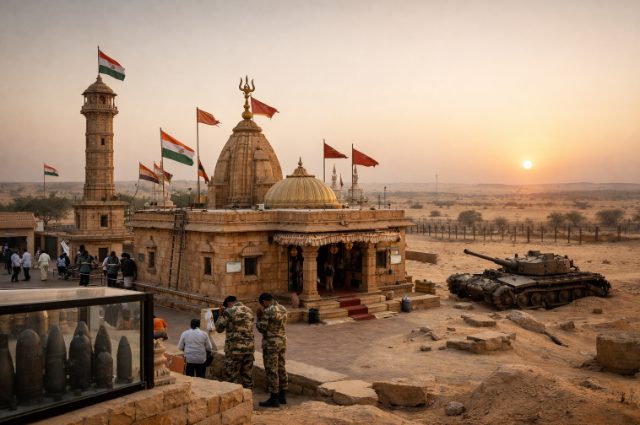
Where Faith Stopped War
Midway through the Thar Desert, close to the Pakistan frontier, sits a temple where events unfolded that baffle experts even now. Not merely one of Rajasthan’s many shrines, Tanot Mata Temple holds stories others do not. Here, battle met belief - yet it was belief that held stronger ground when shells fell nearby during conflict. What remains today feels untouched by time, standing firm despite odds stacked high.
Picture more than three thousand bombs falling from the clouds. Hundreds of them hit a temple's open yard. Yet not even one went off. Feels like something out of a movie, doesn’t it? Could be. Except it was real. Happened two times.
The 1965 War Bombs That Did Not Go Off
Three thousand shells rained down. Not a single one exploded. That September, war broke out between India and Pakistan. Tanot post sat in the crosshairs - just 120 km from Jaisalmer. Pakistan's mission glared sharply: erase the outpost by any means.
That moment broke every rule of war. Around three thousand shells came from Pakistani positions that day. Right into the sacred space - four hundred fifty explosions hit the temple’s core yard. Not nearby. Straight into its heart. Impossible, yet true.
Not a single one triggered.
Not one.
High above, Pakistani pilots stared in disbelief. Through time, stories said that glancing below revealed something strange. Not a temple lay there, but a child near the water's edge where stone once stood. They thought the deity had hidden it completely, cloaking the sacred place beneath an ordinary scene. What seemed solid vanished into myth again.
The Dream That Changed Everything
Soldiers stationed at the border that night reported something strange. The Goddess appeared in their dreams, they said, promising protection if they held their ground within the temple's vicinity. Whether you believe in divine
intervention or not, the fact remains: those soldiers survived an artillery barrage that should have wiped them out.
1971: The Battle of Longewala and Another Miracle
When tanks get buried in desert drifts, questions follow. Not just sand slows them down, though. The year 1965 stood out sharply, yet 1971 pushed further into history. Conflict returned to the zone once more. Pakistani armour advanced here then, drawn into what became known as the Battle of Longewala.
Funny thing happened next. Forward rolled the tanks, heading straight for the temple - only to freeze mid-move. Not a choice. Sand swallowed their tracks, holding them fast. Four days passed with Pakistani tanks stuck where they stood. Into that stillness came the Indian Air Force, taking each target slowly, without hurry.
The temple? Still standing. Once more.
The Museum Holds What You Can See
Now at Tanot Mata Temple, tales aren’t only told - watch them live on weathered stones. Sight proves more than words ever could.
Inside the temple grounds sits a modest museum. Behind glass, you will find actual unexploded bombs - no copies, just the originals from 1965. Still whole. Never detonated. Just resting there like quiet keepers of a mystery that remains unsolved. What they saw, we may never know.
Over there by the open yard stands the Vijay Stambha, a tower put up once the 1971 fighting ended - India raised it when they won. Those old tanks, still sitting where they halted? You can find them just beside the frontier line.
The Pakistani general arrived to pay respects.
Here’s something striking - after everything was over, a man named Shaukat Ali, a brigadier from Pakistan, sought approval to enter the temple grounds. Pause right there. This soldier once directed assaults on that exact place, yet now wanted to stand before it, honoring a Hindu deity.
Strange, really - he believed a ghostly force must have stepped in. Those documents sat heavily on his desk, full of numbers and timelines. Shells raining down by the hundreds, according to the files. Tactics say destruction should’ve been total. Yet somehow, walls still stood where nothing should remain.
A visit came without bare hands. Bringing along a gift was his way of showing honour - a silver chhatra placed gently at the temple entrance. This object remains inside now, untouched by time. Even those who stood against him saw value glowing within these walls.
The Scientific vs. Spiritual Debate
What Sceptics Say
Fair enough. Scientists offer another take - sceptics back it up too. Soft layers of sand fill the Thar Desert; that much is clear. Shells striking there could land without force. Cushioned by loose grains, the fall slows down. Without sharp contact, fuses stay inactive.
Makes sense, right? Except for one problem.
Probability.
Hundreds of bombs landing in one small area, all failing to explode simultaneously? That's not just unlikely. Statistically, it's nearly impossible. Military ammunition isn't designed to fail that consistently. The odds of even ten bombs malfunctioning in a row are astronomical. Four hundred and fifty? Math doesn't support that.
What Believers Know
For the Border Security Force (BSF) and local villagers, there's no debate at all. They've seen too much to doubt. The BSF manages the temple today, and every soldier stationed here follows the same ritual: before heading toward the border, they stop at the temple, bow their heads, and take a pinch of sand from the courtyard .
That sand goes into their pockets, their vehicles, sometimes even their helmets. It's their "protective shield," they'll tell you. And considering how many of them come back safely, who's to argue?
Visiting Tanot Mata Temple Today
What to Expect:
The temple sits about 120 kilometres from Jaisalmer city . The drive takes you through endless desert, past windmills and sand dunes, until suddenly you spot the temple complex. There's no entry fee . The temple opens early morning and stays open until evening aarti .
The atmosphere hits you immediately. It's peaceful in a way that's hard to describe. Visitors consistently mention feeling something "different" here . Maybe it's the history. Maybe it's the unexploded bombs sitting quietly in their glass cases. Maybe it's something else.
The Border Visit:
From the temple, you can also get permits to visit the actual Indo-Pak border, just 15-20 kilometres away . The BSF office at the temple handles the paperwork. You'll need ID proof, and they'll guide you through the process. Standing at the border, watching the sunset over Pakistan, you understand why this place matters so much.
Navratri: When the Temple Comes Alive
If you really want to experience Tanot Mata, come during Navratri. The temple fills with devotees. Special havans and aartis happen throughout the day. The BSF serves free food (langar) to everyone who comes. In September-October 2025, despite ongoing tensions, thousands of pilgrims showed up. War or no war, faith doesn't take a holiday.
Why This Story Matters
The Tanot Mata Temple isn't just about religion. It's about the intersection of history, faith, and human experience. Whether you believe in miracles or prefer scientific explanations, the facts remain:
- 3,000 shells fired
- 450 landed in the temple courtyard
- Zero explosions
- Two wars
- One temple standing
The unexploded bombs sit in that museum today, not as religious propaganda, but as physical evidence of something that shouldn't have happened but did. You can walk up to them, read the markings, and touch the glass case.
And then you can decide for yourself what you believe.
For the soldiers who guard this border every day, there's no confusion. They've seen too much. They've prayed here before deployments, returned here after missions, watched comrades come back safe while knowing how many didn't. The sand from Tanot Mata goes with them everywhere, tucked into pockets and tucked deeper into hearts.
References
- Ministry of Defence (Government of India) – Official Tweet https://x.com Official Defence Ministry tweet acknowledging the unexploded bombs at Tanot Mata Temple from the 1965 war
- Border Security Force (BSF) Official Website – Border Tourism https://bsf.gov.in Official BSF page listing Tanot Mata Temple as a border tourism destination managed by the force
- Press Information Bureau (Government of India) – Rajnath Singh Visit https://pib.gov.in Official government press release about the Defence Minister’s visit to Tanot Mata Temple in October 2025
- Indian Army – Southern Command Official Handle https://x.in Indian Army’s official acknowledgement of soldiers visiting Tanot Mata Temple before deployment
- ANI News (Verified Agency) – Tanot Mata Temple Coverage https://www.aninews.in ANI’s verified news report on the unexploded bombs displayed at the temple museum
- Rajasthan Tourism (Government Portal) – Tanot Mata Temple https://www.tourism.rajasthan.gov.in Official Rajasthan Tourism page with historical information and visitor guidelines
- The Times of India – Verified News Report https://timesofindia.indiatimes.com Detailed newspaper report on the 3,000 shells and 450 unexploded bombs phenomenon
- India Today – Fact-Checked Feature https://www.indiatoday.in Magazine feature covering both the 1965 and 1971 wars and the Pakistani general’s visit
- DD News (Doordarshan) – National Broadcast Coverage https://ddnews.gov.in National broadcaster’s coverage of the Navratri celebrations at the temple
- Archaeological Survey of India (ASI) – Rajasthan Monuments https://asi.nic.in ASI refers to the temple’s historical significance and architectural details.