
India’s gaze is shifting sharply northward. The world is changing, and so must India’s strategy. Climate disruption, great-power rivalry and new trade routes in the Arctic have made the “far north” a source of immediate concern for countries far from the Pole. In late May 2026, Prime Minister Narendra Modi showed up in Oslo for the third India-Nordic Summit with goals broader than usual. Arctic connections now sit alongside climate and commerce in speeches by Indian officials. A note from officials pointed out how shifts in the Arctic echo across the Indo-Pacific, calling for stronger joint work - on science near the poles, yes, but also on safety routes and links between nations. Turning attention north like this isn’t symbolic; warmer poles are messing with rains over India, changing shorelines too. Ice vanishing means new water paths through the top of the world, shifting who holds influence and how goods move. What lies ahead? Building a steady plan - one that handles both environmental risks and strategic needs - learning from Nordic experience while staying alert amid tangled international forces.
A Strategic Pivot to the North
India’s ties with Denmark, Finland, Iceland, Norway, and Sweden once centred on climate efforts and fresh ideas, because of ocean-based industries. Now things look different. Shifts across continents have shaken past thinking. Because Moscow invaded Ukraine, security concerns now shape moves in the Arctic. With Helsinki and Stockholm inside NATO lately, one fact stands out: Russia is now the only Arctic Council nation not part of that defence group. Now, Indian leaders are viewing ties with Nordic nations through a fresh lens. A report released ahead of the Oslo meeting noted that India’s involvement with these countries has shifted - sustainability now drives it, along with shared efforts in defence, sea routes, green power, and how the Arctic is managed.
Out there in Oslo, things looked different. The statement from the meeting pointed to stronger Arctic–Indo-Pacific links, then committed members to deeper work together on science and climate at the poles. Nordic heads of government made room for India’s presence too, recognising its efforts through science projects and climate programs up north. That move says it plainly: New Delhi reaching toward the Arctic isn’t just talk anymore - it now lives inside diplomatic wording itself. With attention fixed on how the region should be managed and cleaner technologies advanced, the gathering pushed past occasional contact toward something steadier, more lasting.
The Arctic: Climate and Security Crucible
The urgency of this pivot can be seen in what is happening at the Pole. The Arctic is warming faster than anywhere on Earth, and this has real consequences for India. Studies show that strong atmospheric links tie the Arctic to the Himalayas, making them climate “neighbours”. Rapid Arctic warming is already disrupting Indian weather: loss of sea ice correlates with more extreme monsoon swings and flash floods in the subcontinent. Indian scientists fear that melting polar ice – by pushing up sea levels and altering monsoon patterns – directly threatens India’s agriculture, coasts and islands. Delhi’s upgraded research station, Himadri, in Svalbard, reflects this concern. Converted to year-round operation in 2024, Himadri gives India a foothold in Arctic science and satellite monitoring. Indian specialists argue that deeper cooperation on Arctic data – for example, sharing satellite observations with Nordic partners – could improve India’s monsoon forecasts and disaster planning.
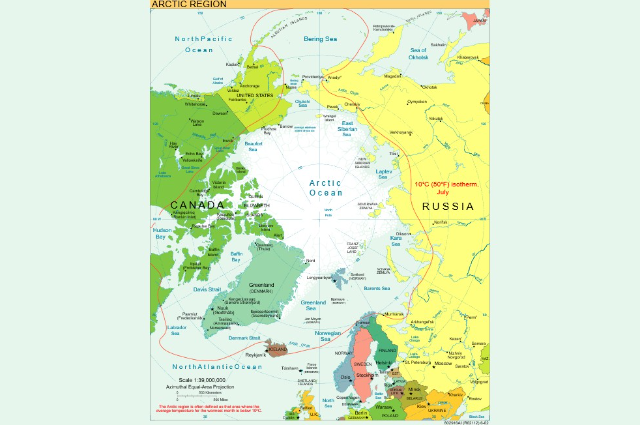
Beyond climate, the Arctic is rapidly becoming a strategic hotspot. Shrinking ice is opening new shipping routes and frontiers. The Northern Sea Route (along Russia’s Arctic coast) can cut Asia-Europe voyages by weeks, and planners have even discussed extending an Indo-Russian “Chennai–Vladivostok” corridor into the Arctic via Murmansk. At the same time, Moscow and Beijing are intensifying their Arctic cooperation. In 2024, they created a joint “Arctic Shipping Lanes” committee to promote China’s involvement in new polar sea routes. Norway and NATO see these moves as part of a larger contest: as Admiral Rob Bauer warned, “increased competition and militarisation in the Arctic by Russia and China” – coupled with melting ice creating new sea lanes – must not be ignored. In short, the Arctic blends climate vulnerability with high-stakes geopolitics. For India, that makes it both a security concern and an opportunity to diversify its connections.
India as an Arctic Stakeholder
India is not an Arctic state, but it has steadily become an engaged stakeholder. India joined the Arctic Council as an observer in 2013, and in 2022, it released a formal Arctic Policy titled “Building a Partnership for Sustainable Development.” The document – and India’s actions – emphasise scientific research and climate studies in the North. Indeed, India has run its Himadri polar station since 2008 and now invests in ice-class research cruises. Its policy calls for collaborating with Arctic nations on sustainability and economic development, reflecting an acknowledgement that “the Arctic is becoming central to India’s climate and food security”.
Indian diplomats highlight that changes in the Arctic have a direct bearing on India’s future. For example, atmospheric circulation patterns link ice loss in the Barents and Kara Seas to variability in the Indian monsoon. Higher sea levels from melting glaciers endanger India’s eastern seaboard and island territories. Recognising this, Indian researchers lobby for joint climate data initiatives – even suggesting an “Arctic–Himalaya climate corridor” with Nordic partners to monitor shared climate risks. Oslo’s communique underlined these ties: it “recognised growing inter-linkages between the Arctic and Indo-Pacific” and called for more joint polar and environmental research. In other words, India insists it has a stake in the Arctic’s future, not because of sovereignty, but because the region’s fate affects billions in the tropics.
Energy and Resource Diplomacy
A major driver of India’s new Arctic posture is energy and resources. India’s power sector still relies heavily on imported oil and gas, and Middle East conflicts make energy security a pressing worry. One expert bluntly noted, “Energy security remains a critical concern for India amid continuing instability in West Asia and volatile global energy markets”. Nordic ties offer options: Norway, for instance, has world-class offshore drilling and Arctic energy expertise. The Economic Times columnist B. Bala Bhaskar suggests India should “leverage Norwegian expertise in offshore oil exploration and advanced drilling technologies” to boost its own upstream sector. Similarly, Nordic advances in offshore wind, hydrogen and carbon capture line up with India’s clean-energy goals. These are areas where India needs outside technology and investment without political strings.
Meanwhile, the Arctic itself teems with resources. Greenland – part of the Kingdom of Denmark – sits on vast mineral wealth. It holds the world’s two largest untapped rare-earth deposits and ranks eighth globally in rare-earth reserves (about 1.5 million tonnes). These minerals – vital for electronics, defence, and green tech – are precisely the kinds India needs to diversify its supply chains. India has also quietly eyed Arctic oil and gas plays, though investments lag. In short, the Nordics control key resource assets: Arctic oil in Greenland, rare earths and uranium there and in Scandinavia, ice-class shipyards in Finland and Denmark. The Arctic Portal analysis explicitly notes how “Greenland’s rare earth and uranium reserves, Finland’s icebreaker technology… and Norway’s marine governance expertise… are identified as areas of strategic relevance for India”.
However, this resource game is not without tension. As the Harvard scholars note, Greenland’s ice melt is making those minerals easier to reach – but also raising ecological and geopolitical alarms. India will have to weigh environmental caution against economic opportunity. It will also navigate great-power rivalries: Russia and China already team up on Arctic gas projects, and U.S. policy now explicitly treats Arctic minerals as security issues. Notably, India’s own energy ties to Russia complicate matters. New Western sanctions on Russian energy have forced Indian refiners to scramble. For instance, U.S. officials even doubled import tariffs on Indian goods in response to India’s Russian oil purchases. This illustrates the tightrope India walks: it wants Russian cooperation (and cheap oil), but also needs Western capital and technology. The Oslo communique discreetly hinted at this balance, welcoming Nordic support for India’s multilateral initiatives while steering clear of zero-sum grandstanding. India’s Arctic strategy must be equally nuanced.
Maritime Connectivity and Infrastructure
Arctic melting is also opening sea lanes that could rebalance global shipping. Longer-term plans envision linking the Indian Ocean to the Arctic. For example, extending the India–Russia Chennai–Vladivostok corridor northwards would connect Indian ports with Murmansk and northern Europe, creating a new Asia–Europe axis. While such projects are speculative, shorter-term issues are already pressing. Last March, fighting in the Middle East (in the Red Sea and Persian Gulf) underscored India’s maritime vulnerability: almost all of India’s liquefied natural gas and LPG imports move on foreign tankers. When a crisis hit the Strait of Hormuz, India faced severe energy supply risks. This has spurred calls for building indigenous ice-class LNG carriers through a Nordic partnership. As one report warned, collaboration with Nordic shipbuilders is “critical for developing indigenous LNG and LPG carriers and strengthening India’s energy security”.
More broadly, India and the Nordics see obvious synergies in shipping and ports. Nordic firms lead in green shipping technology, digitised ports and sustainable shipyards. India’s “Sagarmala” port initiative and its plans to become a top shipbuilding nation by 2030 would benefit from Nordic know-how in icebreakers and green vessels. Already, Mumbai’s Garden Reach Shipbuilders is working with Norway’s Kongsberg on India’s first polar research ship, slated for 2030. The shared interest in secure sea lines underscores why India is now championing cooperation in the “blue economy” and maritime security alongside the Nordics. The Oslo leaders stressed joint maritime dialogue and even new exercises, signalling that sea lanes beyond the tropics now matter to New Delhi’s strategy.
Nordic Strengths, Indian Needs
The Nordic countries bring to the table capacities that India urgently needs. In technology and infrastructure alone, their edge is clear. Norway’s sovereign wealth-funded innovation has made it a world leader in offshore drilling, renewable energy and Arctic research. Finland is at the cutting edge of ice-class ship design; Denmark is innovating green shipping; Iceland leads in geothermal power. As one analysis emphasises, each Nordic state “contributes advanced technology, Arctic governance influence, and institutional capital” while India offers scale and markets. For India’s economy, these are not trivial benefits. India can absorb Nordic investment into wind farms, green hydrogen plants and supply-chain projects. In return, Nordic firms gain access to Indian demand and growing clean-tech markets under stable terms.
This complementarity is visible in policy. In Oslo, the Nordics reaffirmed support for India’s clean energy goals and green-tech innovation. The partnership already spans sectors: Norway now tracks Indian satellites from its Arctic ground stations, and Finland and Denmark have inked space-technology and defence deals with India. At the same time, India’s software and manufacturing know-how promise returns for Nordic industries. The policy brief from New Delhi’s think tank summed it up: by combining Nordic innovation (from icebreakers to semiconductors) with India’s talent and market, the partnership could yield “improved climate and agricultural forecasting, enhanced renewable energy capabilities, stronger maritime security, and more resilient global supply chains”. In short, this is not a one-way street, and both sides hope to reshape industries through collaboration.
Balancing Global Powers
India’s Arctic ambitions must ultimately be seen in a global context of shifting power and alliances. China, for instance, has aggressively pursued an “Arctic Silk Road,” declaring itself a “Near-Arctic State” and signing up to joint projects with Russia. In 2024–25, Beijing and Moscow set up committees to develop the Northern Sea Route and jointly exploit Arctic LNG. One report notes that China and Russia now regularly plan Arctic shipping lanes and Arctic energy projects together. For India, the rise of China as an Arctic actor is a reminder that the region is a stage for big contests. Yet India also needs Russia. New Delhi’s historic partnership with Moscow spans defence, energy and infrastructure. Rather than splitting choices, Indian leaders argue that a balanced approach is possible: India can deepen ties with Europe and the U.S. while still cooperating with Russia on, say, the military and energy fronts. Indeed, India’s statements in Oslo carefully steered clear of vilifying any party.
Meanwhile, the United States and its allies are watching closely. Washington has repeatedly warned of military threats in the Arctic from Russia and China. It is also eager to ensure India does not drift into a conflictual posture. The Commerce Ministry’s recent pressure on India over Russian oil, and even threatened tariffs, show how strongly U.S. strategic interests will shape India’s options. India must balance these external pressures against its own needs. For example, Indian ports and refineries need energy security today. Nordics can help there without political strings, as the Oslo talks reaffirmed. But India must also guard that it does not simply replace one dominant partner with another – hence the repeated emphasis on a “sustainable” approach that combines growth with equity.
Nowhere more than in its northern outlook does India face such tangled currents. Climate shifts, competition among big nations, and markets pulling in different directions - all meet where ice meets open water. Watchfulness matters. Aligning too closely with Moscow could strain relations elsewhere, something New Delhi wants to avoid. Still, the view from India holds that science, warming patterns, and trade paths ought not bend under political pressure. Moving between Moscow and Europe, stressing calm cooperation above conflict - this balance defines the path taken so far.
Conclusion: Sustaining the Arctic Initiative
The Oslo summit was meant to be a statement – and it was. But the real test will be whether India and the Nordics turn ambition into action. The calculus is clear: as one policy brief put it, deeper India–Nordic cooperation could yield a host of tangible gains (new ice-capable ships, better climate prediction, cleaner energy infrastructure, etc.) while helping secure both regions. India must now build on words with concrete steps. That means investing in ice-class vessels, Arctic observatories and joint research with Nordic partners; it means signing energy and mining deals that respect local environments; and it means balancing its friendships so that its Arctic role remains independent and constructive.
This task is urgent. The Arctic is warming, and geopolitics is hardening. For India, the northward turn is not a luxury but a necessity – a chance to protect its climate future and find new avenues for growth. By forging a genuinely mutual partnership with the Nordic countries, India can gain technology and investment without sacrificing sovereignty. As the choppy waters of the 21st century shift, India’s Arctic initiative could anchor a safer, more stable future for the nation. The incoming tide of Arctic change waits for no one – India’s time to turn north has come.
Reference
- https://www.thearcticinstitute.org/
- https://www.thearcticinstitute.org/
- https://www.thearcticinstitute.org
- https://www.impriindia.com
- https://www.orfonline.org
- https://www.drishtiias.com
- https://www.manoramayearbook.in
- https://en.wikipedia.org