
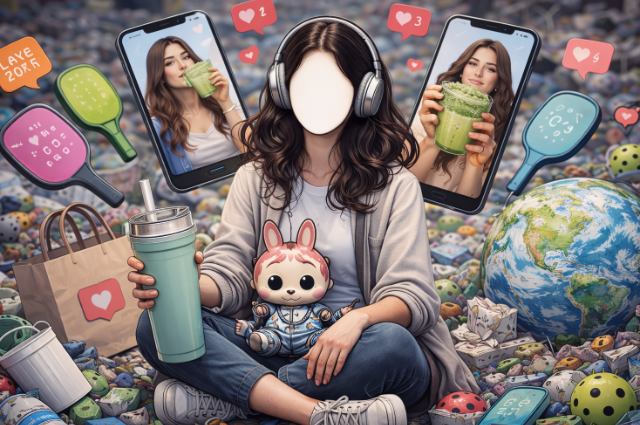
Open Instagram. Scroll for a minute. You will see someone showing off a Stanley Cup, another unboxing a Labubu, and someone else sipping a green frothy matcha latte. All of them, everywhere, all at once.
We sip it. We post it. We collect it. And then we move on.
That pattern looks playful on the surface. But under the filters and the flatlays, something silently dangerous happens: our tastes get outsourced.
We stop choosing. We copy. We perform.
Let’s follow some of those tiny performances - matcha, Labubu, Stanley, pickleball - and see how each one is less about us liking it, and more about us being seen liking it.
The Matcha Crisis nobody is talking about
India loves its chai. Well, that’s the short version. The long version is a deeply cultural story of ritual, place, and memory.
Enter matcha - a powdered Japanese green tea that looks incredible on camera and feels instantly modern.
India’s matcha market is exploding. It’s growing at 8.6% CAGR, set to hit ₹1,400 crore by 2030. Cafes, D2C brands, lifestyle influencers - everyone wants a scoop of this aesthetic green dust.
This boom sounds harmless until you look at the supply side. Japan, the birthplace of ceremonial matcha, faces structural stresses: ageing farmers, lower domestic demand for traditional green tea, climate pressures, and a gap between artisanal production and sudden global demand. Those problems mean tight supply for a product now being democratized and aestheticized in coffee shops around the world. In short, a sacred crop is being turned into a mass Instagram prop.
So we have a mismatch: demand driven by looks and trend energy, supply anchored in slow craft. The consequence is cultural flattening. When a drink becomes a badge, the deeper stories behind it - the rituals, the people who tend the tea - get ignored. The irony is brutal. A drink rooted in slowness is now consumed as fast fashion.
Labubu and the economics of blind-box desire
Collectibles were once niche. Now a small plastic toy can signal insider taste, fandom and a price bracket - especially if celebrities flash it. Labubu, and the broader blind-box collectible wave, moved from being an indie art toy to mass status symbol in many markets.
That pattern is classic: scarcity plus celebrity equals status signaling. Buying the object becomes less about the art and more about saying look, I belong to this rare, curated tribe.
The Stanley cup, water bottles and identity packaging
Remember when a tough thermos was a practical thing you shoved into a hiking pack? Then TikTok remixed it into a cultural object - “a glossy collectable”. The heavy Stanley tumbler became shorthand for a kind of curated, outdoorsy domesticity that plays very well on feeds. A utilitarian product rebranded into a personality trait. Hydration, but make it aspirational.
Pickleball and the fashion of sport
Pickleball’s rise is remarkable. Once a backyard pastime, it is now one of the fastest-growing participatory sports in the U.S. and in India, with huge year on year jumps in players, clubs, and equipment sales. The rapid growth is partly organic. But cultural boosts - celebrities, influencer posts, courts popping up like cafes - accelerate it. The sport becomes fashionable, and fashion, by its nature, asks for quick adoption.
That’s not necessarily bad. Sports can be gateways to real joy and community. The worry is when you play because you want to be seen playing - or because the game merely serves as a prop for a particular Instagram reel.
Why we copy - a short psychology of trends
Belonging is a human hunger. Social cues are quick calories. Trends make belonging low effort.
Donald Winnicott called part of this the “false self” - the version of us built to win approval. Social media monetized that very instinct and tuned it with algorithms that show us what people like us are doing, but in amplified, edited form.
There is a growing body of research showing how algorithmic personalisation nudges behaviour. When feeds get optimised to feed engagement, people report feeling less in control of their tastes and more likely to follow the feed’s cues. A recent study published on ScienceDirect shows that experimentally changed personalisation for users found lower daily usage and a sense of more control when feeds were less personalised, hinting at how personalisation shapes preference and habit.
Further works on platform use and mental health, for example, systematic reviews of TikTok and other short video platforms, flag that heavy, compulsive use can link to anxiety, FOMO, and greater social comparison. The mechanics are clear - when your dopamine hits depend on visible approval, the line between what you like and what gets you likes begins to blur.
So trends do psychological work. They relieve anxiety about belonging - briefly. But over time, they can hollow out a sense of self as an active chooser, not a reactive copier.
The economics of conspicuous consumption
This pattern is old. Thorstein Veblen named it conspicuous consumption over a century ago - buying not for use but to be seen using. Today’s signalling is just faster, cheaper and amplified by algorithms. Whether a thing is a water bottle, a toy, or a sport, it becomes a vehicle for social currency.
That currency has costs. Financially, people spend money on items that give them social returns but little personal return. Psychologically, chasing signals can create an ongoing dissatisfaction cycle.
What it costs the planet
It is not only our personalities that pay the price. The planet does too.
Global solid waste is massive and growing. The World Bank and UN reports show the world produces billions of tonnes of municipal solid waste each year, with projections to increase dramatically by mid-century if current patterns continue. That growth is partly driven by consumption patterns that prize newness over longevity. The more we treat objects as ephemeral badges, the more landfill space we need and the bigger the extraction footprint we accept.
When identity is outsourced to consumables, sustainability becomes a side note.
Not all trends are bad. Here’s how to tell the difference
A trend can be a door. It becomes regret only when it is the only door you enter.
Ask three practical questions before you adopt the next thing everyone is doing:
- Do I want this when nobody sees me?
- Does this add something to my life after the first week?
- Is this ethically and environmentally compatible with what I care about?
If you can’t answer the first question honestly, you may be adopting a performative habit.
How to resist, without becoming a hermit
Resisting trends does not require moralising or puritanism. It asks for small acts of attention.
Slow the loop. Pause before you buy or sign up. Wait 48 hours. You will be surprised how many week-long impulses fade.
Reclaim rituals. Taste, fitness, collecting and play can be deeply personal. Rebuild small rituals that are about practice and meaning, not outward performance.
Follow curiosity, not currency. Try things to learn not to signal. If you take a class, play the sport for three months. If you collect, learn the artist’s story. The investment turns props into provenance.
Make space for boredom. Boredom builds preference. When your palette has space, your actual likes reappear.
Vote with time more than money. Time spent learning an instrument, reading a book or talking to a neighbour compounds in ways a product never will.
For creators and brands: a short callout
You build culture by showing people how to live, not by asking them to live for likes. If you are a brand, think of stewardship over sensation. If you are a creator, credit the craft. Authenticity is not a marketing trick. It is a practice that respects creators, makers, and place.
The paradox worth remembering
Yes, of course, you are allowed to like matcha. You can collect Labubu. You can play pickleball and use a Stanley Cup.
But there is a difference between choosing something because it feeds your life and choosing something because it feeds someone else’s idea of your life.
When we outsource our tastes, we hand over tiny pieces of ourselves to algorithms and trends that rewrite who we are by what we consume.
The planet is choking on our personality crises. The landfills are full, but so are we - of things we don’t need, of people we are not.
And in a world where everything can be purchased, maybe the only thing left worth having is… a self you didn’t find on someone else’s feed.