
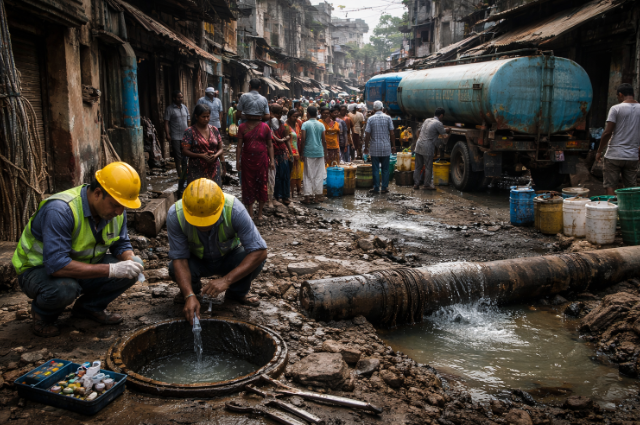
The public health emergency that unfolded in the Bhagirathpura locality of Indore between late December 2025 and early January 2026 represents a seminal failure in urban utility management. Despite Indore’s consistent recognition as the cleanest city in India under the Swachh Survekshan rankings for eight consecutive years, the tragedy has exposed a catastrophic disconnect between surface-level waste management and the structural integrity of subterranean life-support systems. The outbreak, characterized by a rapid surge in acute diarrheal disease (ADD), resulted in a disputed mortality rate, with official figures initially citing four deaths while municipal leaders and residents identified between 10 and 16 fatalities, including a vulnerable six-month-old infant. The scale of morbidity was equally staggering, with more than 1,400 individuals officially affected and unofficial estimates suggesting as many as 2,800 residents suffered from symptoms ranging from profuse vomiting to multi-organ failure.
The Epidemiological Chronology of the Bhagirathpura Outbreak
The genesis of the crisis can be traced to December 24, 2025, when the first clusters of gastrointestinal distress were reported in the Marathi Mohalla area of Bhagirathpura. Bhagirathpura, a densely populated settlement with a significant low-income demographic, relies heavily on the Narmada water supply piped from Jalud, located 80 kilometers away. The clinical presentation was uniform: a sudden onset of voluminous watery diarrhea, persistent vomiting, and high-grade fever, leading to rapid dehydration. By December 29, the situation escalated into a full-scale public health disaster as the first deaths occurred at home or in transit to medical facilities.
Mortality and Morbidity Data Analysis
The data regarding the impact of the outbreak reflects a complex interplay between clinical evidence and administrative reporting. While the Chief Medical and Health Officer (CMHO) initially verified a low number of deaths based on post-mortem findings, the Mayor of Indore and local community leaders documented a higher toll, emphasizing that many victims were cremated before official investigations could be initiated.
| Impact Category | Official Health Department Figures | Municipal/Local Unofficial Figures |
| Total Fatalities | 4 | 10-16 |
| TotalAffected Individuals | 1,400+ | 2,500-2,800 |
| Hospital Admissions | 272-294 | 300+ |
Critical Care (ICU) Admissions | 32 | 32 |
Household Surveillance Coverage | 1,714 households | 12,000+ people |
Suspected Illness in Community | 2,456 cases | 2,800 cases |
Analysis indicates that the presence of multiple pathogens creates a synergistic effect where gastrointestinal inflammation is more severe than in single-pathogen infections. This "pathogenic synergy" likely explains why healthy adults in Bhagirathpura succumbed so rapidly to the infection.
The Anatomy of Infrastructure Failure: The Police Outpost Case
The environmental investigation pinpointed the epicentre of the contamination at a police outpost in Bhagirathpura. The structure, built in 2003 on public land, featured a toilet that had been constructed with a fundamental disregard for sanitary engineering standards.
Construction Lapses and Fecal-Oral Pathways
Investigators discovered that the toilet at the police outpost lacked a mandatory septic tank. Instead of being connected to the city's sewerage network or a self-contained treatment system, the waste line was routed into a primitive pit dug directly above a primary drinking water pipeline. This water pipeline, reported to be over 30 years old, had sustained multiple breaches and leaks over decades of service.
The mechanism of contamination was twofold:
- Direct Infiltration: During periods when the Narmada pipeline was empty or under low pressure—a common occurrence in Indore’s alternate-day supply schedule—the surrounding soil, saturated with raw sewage from the police toilet pit, allowed fecal matter to seep through the pipeline's cracks.
- Back-Siphonage: When the water supply resumed, the initial surge created a vacuum effect (negative pressure) that pulled in the highly contaminated groundwater from the vicinity of the unlined pit.
This configuration turned the drinking water network into a sewage distribution system for the Bhagirathpura locality. Residents reported that the water had a "foul stench" and appeared "black" for days, yet the municipal supply was not immediately suspended.
Compliance Gaps with CPHEEO Standards
The Central Public Health and Environmental Engineering Organization (CPHEEO) provides rigorous guidelines for the design and maintenance of urban water and sewage systems. The Bhagirathpura incident illustrates a systemic failure to adhere to these national standards.
CPHEEO Guideline Parameter | Prescribed Standard | Observed Condition in Bhagirathpura |
| Pipe Separation | Minimum 300 mm lateral/vertical gap | Pipelines touching or intersecting sewage pits |
| Material Integrity | Regular replacement of pipes >20-25 years | 30-year-old pipe with existing breaches |
| Supply Continuity | 24/7 pressurized supply recommended | Intermittent, alternate-day supply |
| On-site Sanitation | Mandatory septic tank/soak pit design | Direct drainage into unlined pits over utilities |
The absence of continuous pressurization in the water network is identified as the single most critical technological failure. In a pressurized system, even if a leak exists, the outward pressure of the water prevents external contaminants from entering the pipe. However, in an intermittent system, the loss of pressure effectively invites surrounding pathogens into the network.
Governance, Accountability, and the "Cleanest City" Paradox
Indore’s status as India’s cleanest city is a cornerstone of its civic identity. The city has optimized its solid waste management, achieving a 7-star Garbage Free City rating and becoming the first "Water Plus" city in India. However, the Bhagirathpura tragedy has exposed the fragility of these certifications when they focus on surface-level metrics at the expense of underground utility integrity.
Administrative Negligence and Reactive Policy
The crisis was exacerbated by administrative inertia. Residents had been lodging complaints regarding the quality of their tap water since July 2025. Despite these warnings, a tender for laying a new water line in Bhagirathpura, which had been issued in August 2025, remained stalled in bureaucratic limbo for four months. The work only commenced on the morning of December 30, after five deaths had already been recorded.
In the aftermath, the state government under Chief Minister Mohan Yadav implemented high-profile punitive measures. These included:
- The immediate transfer of Indore Municipal Corporation (IMC) Commissioner Dilip Kumar Yadav.
- The suspension of Additional Commissioner Rohit Sissoniya and Superintending Engineer Sanjeev Shrivastava.
- The dismissal of in-charge sub-engineer Shubham Shrivastava.
While these actions signal a commitment to accountability, policy analysts argue that the "revolving door" of municipal officials does not address the underlying lack of a dedicated health cell within the IMC to monitor waterborne risks—a recommendation that was made as far back as 2017 but never implemented.
The Role of Smart City Technology
Indore’s Integrated Command and Control Centre (ICCC) is designed to act as the "brain" of the city, monitoring everything from waste management to traffic. However, the ICCC’s role in the water crisis appears to have been largely retrospective rather than preventative. The lack of localized, real-time water quality sensors meant the "smart" systems were blind to the bacterial contamination until the human toll became undeniable.
Historical Warnings and the PCB Findings
One of the most damning aspects of the Indore water tragedy is that it was foretold. A ground-level investigation conducted by the Madhya Pradesh Pollution Control Board (PCB) in 2016-17 had already flagged widespread groundwater and pipeline contamination in Bhagirathpura and 58 other locations across Indore.
The 2017 report identified:
- 113 leaks in the drinking water supply lines.
- 111 cross-connections where drinking water and drainage lines intersected or were in dangerously close proximity.
- High Coliform Levels: Nearly all samples from the low-lying areas of Indore showed total coliform levels exceeding 10 MPN per 100 ml, rendering the water unfit for consumption.
The PCB formally communicated these findings to the IMC years ago, recommending that handpumps and borewells in these areas be declared unsafe and that warning boards be installed. The failure to translate these scientific warnings into sustained corrective action highlights a chronic gap in the "civic sense" of the administration, which prioritized the visible aesthetics of the city over the biological safety of its poorest residents.
Socio-Economic Dimensions and the Trust Deficit
The impact of the Bhagirathpura tragedy extends beyond the immediate medical emergency. For the low-income families of Marathi Mohalla, the loss of a breadwinner or the hospitalisation of multiple family members has led to a cycle of debt and economic displacement.
The Burden on the Poor
While the state government announced an ex gratia compensation of ₹2 lakh for the families of the deceased and free medical treatment for all affected, these measures only address the symptoms of the failure. Families reported a deep-seated fear of municipal infrastructure. Many abandoned the tap water entirely, turning to bottled water jars that cost ₹20 to ₹30 each—a significant portion of a daily wage in this locality.
The "trust deficit" is perhaps the most lasting legacy of the outbreak. Residents stated they no longer believed in the assurances of the municipal corporation, viewing the "cleanest city" tag as "destruction carried out in the name of development. This sentiment is echoed by environmentalist Rajendra Singh (the "Waterman of India"), who categorized the Indore crisis as a "system-made disaster".
Comparative Analysis: Urban Water Quality Trends in India
The tragedy in Indore is part of a broader, systemic challenge across Indian megacities. As urbanization outpaces infrastructure development, the risk of sewage-water intermixing becomes a pervasive threat.
| City | Recent Incident [2025] | Primary Infrastructure Trigger |
| Indore | Dec 2025/Jan 2026 | Illegal toilet construction over a 30-year-old pipe |
| Gurgaon | Dec 2025 | Pipeline contamination in Sector 70A |
| Pune | Oct 2025 | Multiple breaches in the Bavdhan and Bhugaon lines |
| Delhi | Sep 2025 | Inter-mixing of sewage pipes with storm drains in Janakpuri |
| Hyderabad | General 2025 | 949 stormwater management works initiated to prevent overflow |
Data indicate that the states of West Bengal, Andhra Pradesh, and Uttar Pradesh report the highest burden of waterborne diseases nationally, but the rapid urban sprawl in Madhya Pradesh is creating new hotspots of risk. In Bhopal, for example, the water supply network is six times longer than the sewer network, leaving approximately 6 lakh residents in slums vulnerable to similar contamination events.
Future Outlook: Climate Change and Pathogen Virulence
The Indore outbreak occurred against a backdrop of shifting climatic patterns. Research indicates that higher temperatures linked to climate change enhance the survival and replication of pathogens like Salmonella and Vibrio cholerae.
A 1 °C increase in ambient temperature is associated with a 5–10% increase in the risk of Salmonella infection.
Furthermore, extreme precipitation events—such as the heavy monsoons experienced in 2025—overwhelm drainage systems, forcing sewage to mix with drinking supplies in low-lying areas like Bhagirathpura. The recirculation of these "bioaerosols" and stagnant contaminated water creates a breeding ground for bacteria long after the initial flood or leak has occurred.
Strategic Recommendations
The Indore water deaths are not merely a result of a leaky pipe but a consequence of a multi-tiered failure in urban governance, engineering oversight, and public health surveillance. For a city that prides itself on being a global model of cleanliness, the Bhagirathpura episode is a sobering reminder that "Smart City" development must start with the basics: safe water and secure sanitation.
Actionable Policy Directions
- Mandatory 24/7 Pressurization: To prevent back-siphonage and the ingress of pathogens through pipe breaches, urban local bodies must transition from intermittent to continuous supply systems, ensuring pipes remain full and under positive pressure.
- Integrated Utility Mapping: Using GIS-based digital twins, cities must map the exact coordinates of every water and sewer line to identify and rectify hazardous intersections before construction—like the police outpost toilet—is permitted.
- Sanitation Worker Licensing and Accountability: Introducing a structured licensing system for contractors and sanitation workers can ensure that construction standards for septic tanks and sewage connections are strictly followed, with legal penalties for deviations.
- Localized Water Quality Monitoring: Instead of relying solely on centralized testing at the source, cities must deploy real-time sensors at the ward and neighborhood levels to detect chemical and biological anomalies in the distribution network.
- Strengthening Citizen Grievance Redressal: The delay in responding to "dirty water" complaints in Bhagirathpura highlights a failure in the 311-helpline system. A protocol must be established where any complaint of "foul smell" in drinking water triggers an immediate suspension of supply and rapid microbiological testing.
The recovery of public trust in Indore will require more than the suspension of a few officials. It demands a transparent, data-driven commitment to infrastructure equity, where the water quality in a low-income settlement like Bhagirathpura is monitored with the same rigor as the city’s high-profile commercial districts. The tragedy has shown that in the realm of public health, the city is only as "clean" as its most vulnerable pipeline.
References:
- Poison was distributed. Rahul Gandhi slams Madhya Pradesh govt after water contamination kills 10 in Indore https://www.hindustantimes.com
- Fear replaces trust as Indore shuns tap water after contamination deaths - National Herald https://www.nationalheraldindia.com
- Indore water contamination row: 10 dead, over 1,000 affected https://timesofindia.indiatimes.com