
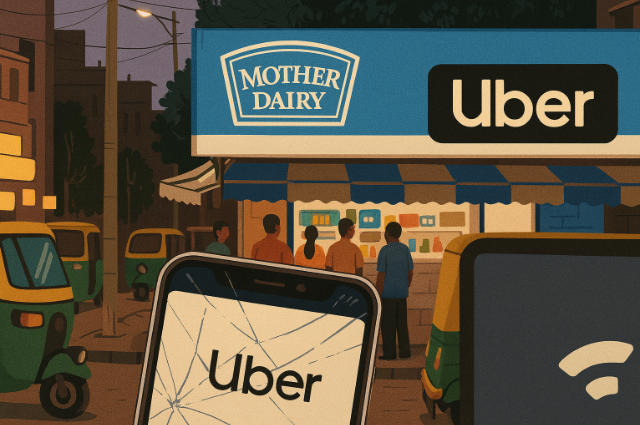
You know that feeling when your phone buzzes and time seems to stop for just a second? Arnav Gupta felt it during what was supposed to be just another Monday morning in Delhi. He'd booked an Uber, texted the driver that he'd be two minutes—typical urban life stuff. Then his phone lit up with a message that made his stomach drop: "I am facing the threat of murder."
His mind went into overdrive. Is the driver in danger? Is this a warning? Am I missing something critical here? That surge of panic hit him instantly, the kind that makes your hands shake a little.
But here's where the story gets interesting.
The Moment Everything Made Sense (And Was Hilarious)
Arnav's first instinct was to check what the driver had actually written. When he tapped on that "See original" button, the Hindi text appeared: "Murder deri ke saamne hu."
Then it clicked. He burst out laughing—the kind of laughter that comes right after terror.
The driver wasn't describing some crime thriller. He'd simply written "Mother Dairy ke saamne hoon"—basically, "I'm standing in front of Mother Dairy." You know, that milk brand that's everywhere in India? The algorithm had mangled it beyond recognition. Somehow, colloquial spelling, phonetic shortcuts, and whatever else the translation system was doing had transformed an innocent location update into a chilling message about violence.
All that adrenaline, all that fear, for a landmark reference
When Arnav posted this on X, the internet immediately recognised the absurdity. People started sharing their own translation disasters—autocorrect gone wrong, place names morphed into something sinister, those weird moments when technology makes things infinitely more dramatic than they needed to be. But underneath all the jokes, there was something else: a collective realisation about how exposed we've become to these digital glitches that can mess with our peace of mind.
Why This Matters More Than Just a Funny Story
On the surface, yeah, it's hilarious. A mistranslation that's so perfectly stupid that it almost seems designed by comedy writers. But spend a moment thinking about what actually happened here, and you start seeing something darker.
First, there's the language problem. Anyone who's grown up in India knows we don't stick to one language. A single message might have Hindi, English, regional languages, slang, and brand names all mixed together. Translation tools were built for structured language—textbook Hindi or textbook English. They weren't built for how we actually talk. They stumble. They fail. And when they fail, they fail spectacularly.
Second—and this is the unsettling part—a single line of text can hijack your entire nervous system. Forget logic for a second. That message came through an app. Apps feel authoritative. When something official-looking tells you there's a threat, your brain doesn't calmly evaluate it. It reacts. The survival instinct kicks in before you've had time to think. That's not a flaw in how Arnav responded; that's just how human brains are wired.
Third, there's this quiet erosion of trust happening. You rely on these platforms for safety. You trust that if a driver sends a message, it means something real. You trust the system. But when the system glitches—when it translates a dairy brand name into a murder threat—what happens to that trust? It doesn't shatter completely. But it cracks. A little. And the next time you get a notification, maybe you're slightly more suspicious. Maybe you're slightly more on edge.
This Isn't The First Time Something Like This Has Happened
There was another incident in Gurgaon where a rider shared screenshots of what looked like "I want to kidnap you." The internet had a heated debate about whether it was a genuine threat, a typo, or another translation nightmare. Some people were absolutely certain it was threatening. Others thought it was clearly a linguistic mix-up. But here's the thing: nobody could really be sure. And that uncertainty itself creates anxiety.
Then there are the other messages—not mistranslations, but actual creepy texts from drivers, unsolicited WhatsApp messages, boundary violations that remind you that apps are just the digital layer on top of human interaction, and humans aren't always trustworthy. Women riders have talked about feeling unsafe after getting messages from drivers. These are real concerns, not jokes. A mistranslation is funny. Actual harassment is not.
So when you pile these things together, the casual text from a driver—whether it's garbled, genuine, or just friendly—starts to feel like it's carrying a lot more weight than it should.
What Actually Needs To Happen
If you're using ride-hailing apps regularly—and most people in cities are—there are some practical things worth doing differently. When a notification comes through, and it sounds weird or extreme, don't just react. Open the app properly, find that original message, and read it in the original language if you understand it. Actually, spend the thirty seconds to verify before your heart goes crazy. It's not paranoia; it's just smart.
Obviously, we should keep our safety instincts sharp. But panic doesn't help anyone. The actual useful sequence is simpler: breathe, open the app properly, check the original, and then decide if something's actually wrong. If it still seems threatening, use the app's safety features—SOS buttons exist for a reason, and so does the ability to screenshot and report.
But the responsibility isn't just on riders to be more careful. Apps and the companies behind them need to step up, too.
Safety language—words like "murder," "kidnap," "threat"—shouldn't be handled the same way as regular words in translation systems. These terms deserve extra caution, especially when the translation algorithm isn't confident. And honestly, people should know when something's been auto-translated. A lot of users don't realise it. Making that visible could save people from unnecessary panic. It's not hard.
India's linguistic reality is chaotic and beautiful, and frustrating all at once. We speak in fragments. We mix languages mid-sentence. We use brand names as landmarks. Generic translation models don't get this. Companies building apps for India need to actually test with real language from real users—with slang, with mixed typing, with the way people actually communicate. Not in a lab. In real conditions.
And perhaps most importantly: platforms need to remember that emotional safety is just as important as functional accuracy. A translation error isn't just an inconvenience; it's a violation of someone's peace of mind.
The Bigger Lesson
Life in a city like Delhi often feels like one massive group chat in a dozen different languages where half the sentences aren't finished and everyone's making assumptions about what everyone else means. Sometimes what one person intends and what another person receives are completely different things. A restaurant name becomes a threat. A casual update turns into panic.
But here's what the "Mother Dairy" story actually teaches us: asking for clarification changes everything. If Arnav had just freaked out without checking, he'd have spent hours anxious about something completely harmless. The moment he looked at the original, the whole narrative flipped from terrifying to absurd in a single tap.
That applies to way more than just ride-hailing messages. It applies to work emails that feel passive-aggressive until you talk to the person. It applies to social media posts that seem rude until you understand the context. It applies to misunderstandings with friends that feel personal until someone actually explains what they meant.
The technology isn't going away. Uber isn't going away. Translation systems aren't going to get removed from apps. But you can train yourself to be less reactive, more curious, more willing to check the original before deciding something's a disaster.
So the next time a notification pings your phone and sets off alarm bells, pause. Breathe. Don't let that first reaction run the show. Open the app. Find the actual message. Ask yourself if this is really what it seems like, or if it's just another "Mother Dairy" in disguise.
Trust the technology. But always—and I mean always—verify what it's actually telling you.
Because your peace of mind is worth more than reacting to an algorithm's mistake.