
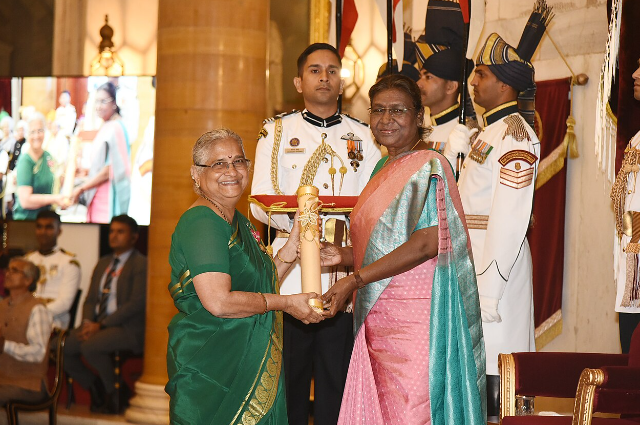
On her first day of engineering college in the late 1960s, Sudha Murty stepped into a classroom of 149 boys staring at her as if she were an exotic animal. Calmly, she took a wet cloth from the janitor and wiped the ink off a desk, clearing a spot where she would sit. In that moment, the only girl among hundreds, she showed quietly that neither dusty seats nor sceptical eyes would deter her. This small act – dusting off prejudice before class began – set the tone for a remarkable life. Sudha Murty’s journey, from that college girl to India’s beloved philanthropist and author, is one of humility, strength, and unwavering compassion. In sharing it, we walk alongside her through moments of challenge and choice – finding the inspiration that endures today.
Breaking Barriers: Childhood and Education
Born in 1950 in a small town in Karnataka, Sudha Kulkarni grew up in a family steeped in learning – her father was a surgeon and her mother a schoolteacher. Quiet nights at home were filled with books, and young Sudha inherited a love of science and learning. When she finished high school, she declared she wanted to be an engineer – a choice that shocked her conservative household. Engineering was still seen as “an all-male domain”, but Sudha’s mind was set. She applied to BVB College of Engineering and became its sole female student.
On the first day of college, clad in a simple white sari, she bowed to her elders at home and prayed, then walked into a world unprepared for her presence. The principal, concerned for her safety, handed Sudha the key to an abandoned room instead of a welcome package. Seeing its filthy, broken desks, Sudha calmly took charge. “Give me a wet cloth, please,” she told the cleaner, and swept it herself. Entering the classroom, she felt 149 eyes on her – a situation designed to intimidate, but she kept her face steady. This resolve won respect by example. When classmates tossed paper planes mocking “a woman’s place is in the kitchen,” Sudha simply folded each away, never responding in anger. Over time, even the boys warmed to her – once gently tucking flowers in her plaited hair and calling her “Flowerpot.” She quietly removed them with a smile.
Sudha’s college years were not just about grit; they were also about belief in education. Despite being “the only girl” among 599 boys, she earned top marks and went on to a master’s at the Indian Institute of Science. Her pioneering spirit showed: she became the first woman admitted to that university’s prestigious Computer Science program, where she was again the lone girl. In those years, she learned that courage often meant stillness – proving herself through quiet determination, not by loud defiance.
Speaking Out: The Tata Motors Postcard
Her courage to challenge inequality found an early test at graduation. In 1974, just after completing her studies, Sudha was browsing job postings on campus when she spotted one from Telco (now Tata Motors). It listed requirements for “bright, hardworking engineers” – but ended with a sting: “Lady candidates need not apply.” Sudha’s heart raced with anger and disappointment. This slogan, a blatant injustice, touched a nerve. Instead of letting it slide, she saw a chance to stand up for all women like her.
That evening she dashed off a letter – on a postcard, no less – addressed to J.R.D. Tata, the head of the Tata group. She praised the Tatas for pioneering industries and founding the Indian Institute of Science (her own alma mater), but she questioned why their automobile plant would discriminate against women. A few days later, a telegram arrived: “Appear for interview at Telco’s Pune facility.” Sudha quietly smiled at fate’s turn. She took the opportunity – and thus became Telco’s first woman engineer.
By writing that postcard, Sudha showed that injustice could be met with dignity, not despair. She later recalled feeling “livid” at the notice but turned her anger into action. The factory’s reply was prompt: within ten days, she was invited, all expenses paid. In Pune, a new chapter began: she
married her husband, Narayana Murthy, and worked on auto design alongside men who had once said “women need not apply.” Sudha’s own words about those times reflect a truth: “Life was full of fun and joy,” even amid battles for respect.
Sacrifice and Faith: Helping Start Infosys
The 1980s brought even tougher choices. Narayana had dreams of founding a software company, but had no capital. Sudha and Narayana were young engineers with modest government salaries. When Narayana announced he wanted to start Infosys in 1981, Sudha did the math: they had 10,250 rupees saved. It wasn’t much – barely enough to live on, let alone launch a business. Still, she believed in the vision. As she later told a conclave audience, she drew out all but 250 rupees, handing Narayana ₹10,000 to serve as seed money. “I took a risk,” she said with a smile, knowing he had failed once before and needed backup.
This act of faith was quieter than the Tata postcard, but no less brave. Sudha’s gesture was not written about in headlines – it was her silent sacrifice. Those rupees were jewellery money, the family’s humble dowry funds. By giving them, Sudha bet on a future they could not yet see. Murthy, who wouldn’t have started Infosys without her blessing, described her as his “better half” and acknowledged she was more qualified than all the founders – yet he insisted on an “enlightened democracy” by not making it a family affair. Even as Infosys began to grow, Sudha never demanded a top seat. She often quipped that she may have been an engineer co-founder on paper, but her heart had chosen another path.
Sudha reflected that starting Infosys felt like “a responsibility, a commitment,” not just a career change. Her life truly changed then: she traded corporate comforts for lean startup budgets. But never once did she mourn lost wealth. Instead, she rejoiced in building something from scratch – not just a company, but a new industry in India. In those early days, Sudha taught at Christ University and supported their two children at home while Narayana and his partners burned midnight oil. Many years later, when Infosys shares soared, Sudha remained grounded. When asked why she didn’t sell any shares, she said simply, *“I have touched many lives through the Infosys Foundation, and I value that more than any other position.”* Her riches were in human impact, not bank balances.
Simplicity Over Splendour
Even as Infosys grew into a global giant, Sudha Murty’s home life stayed humble. She and Narayana never lapped in luxury. On a TV chat show, they laughed about their differences: Narayana would insist on flying business class, Sudha would retort, “Why? I’ll get there at the same time in economy!” She preferred spending on her foundation or on books, not fancy tickets. He called her “extremely prudent with money,” while Sudha called herself practical – insisting on necessity over luxury.
Beyond travel, their lifestyle choices were simple: modest home, simple clothes, and DIY meals. Narayana once remarked that Sudha, a philanthropist at heart, still kept a stingy eye on personal expenses. This might sound contradictory, but for Sudha, it was consistent: she saw money as a tool for good, not for personal indulgence. When netizens met her at an airport, they noted she greeted strangers with the same gentle patience, whether in a sari or salwar-kameez. Her approach was clear: use wealth to uplift others. She lived by example, and many noted that even a Padma Bhushan award and her son’s high-profile marriage didn’t change the person who politely chatted with fellow travellers in the queue. For young people today, this is a simple lesson – we can be successful without becoming self-centred, always remembering that compassion costs nothing.
A Heart for Service: Infosys Foundation
In 1996, Sudha Murty founded the Infosys Foundation as the company’s CSR arm. From a “humble purse of ₹30 lakh,” her little charity trust has blossomed into a powerhouse of social good. Under Sudha’s guidance, it tackled the needs she had seen while visiting villages and schools. If a hungry child can’t learn, the foundation provided mid-day meals – even building an ₹18-crore kitchen in Hyderabad to cook for 100,000 kids every day. If rural schools needed books, the foundation stocked over 70,000 libraries with books and learning materials. If disaster struck, they did the heavy lifting: constructing 3,000 houses for flood victims and digging 14,000 toilets in villages, simply so people could live with dignity.
Sudha often says they let the work speak for itself. And it does: today the Infosys Foundation runs libraries, scholarships, and innovation labs in thousands of schools, equips dozens of hospitals with equipment and new wards, and quietly helps widows, orphans, and rural women find livelihoods. In her words, childhood memories of poverty and privilege alike “opened her eyes to the true state of the country”. That empathy was engraved in every project she championed. Over 25 years, the foundation grew its annual budget to crores, but its spirit stayed modest – checking and measuring impact before scaling up. Sudha always insisted on an exit plan, so projects become self-reliant. She saw philanthropy not as charity, but as gardening: plant seeds of opportunity and help them grow, then step back.
The Storyteller: Writing for Young and Old
Perhaps no one would guess it from the trailblazing engineer-philanthropist image, but Sudha Murty is first a storyteller. She began writing in Kannada as a young mother, and later, at age 50, switched to English on the encouragement of an editor. Her first book for adults, Wise and Otherwise, was a collection of moral tales from her life. But she also wanted to reach young readers. As she explains, she saw children growing up in India reading Cinderella and Enid Blyton – stories far removed from local life. So she began writing simple stories rooted in Indian culture – about grandparents, pets, farms, and festivals. Over time, hundreds of her books have touched millions of children and adults.
Her style is warm and direct. In How I Taught My Grandmother to Read, and in series like The Upside Down King about Ram and Krishna, she writes as if sitting beside her reader, passing on little lessons through gentle humour. She once said writing for kids is “lovely… because through your story, you can teach them the lessons of life”. And she does – without preaching. A dragon who learns compassion, a parrot that overcomes fear, a grandmother learning a new skill – these are Sudha’s heroes. Over 30 years, she has published novels and short stories too, in Kannada and English, all sharing a common thread: faith in the goodness of people.
In fact, as the years went by, Sudha found she was writing as much for adults as for children. Time spent in remote schools and villages through the foundation gave her front-row seats to human drama. She saw fathers riding tractors to school, teachers tying broken spectacles, and children studying by lamplight. These realities, she says, were too vivid to ignore. She shifted toward non-fiction travelogues and memoirs, believing that “fiction limits your imagination. With non-fiction, it’s all real and so much of it is happening right in front of you”. Her recent books recount personal encounters – a hidden Madrasat in a forest, an American asking a simple question about India, a Jain monk under a banyan tree. They are small stories, but each holds big truths about hope, resilience, and kindness. Through every page, readers hear her voice: humble, curious, and eternally hopeful in human nature.
Honours and Humility
Over the decades, the nation took notice. In 2006, the government awarded Sudha Murty the Padma Shri for social work. Years later, in 2023, she was named for the Padma Bhushan, one of India’s highest civilian honours. Many accolades have followed – literary awards, honorary doctorates, and even the Sahitya Akademi’s children’s literature prize. Yet Sudha treats each with the same gentle grace she shows everyone. When reporters ask her about awards, she typically shifts the credit to team members or the people she writes about. She believes “we normally do not like to talk about our personal contributions – we believe our work should speak”.
This humility is legendary. In 2023, a video of her chatting with strangers at an airport went viral. Followers couldn’t believe it: here was a Padma Bhushan awardee (and mother-in-law of a foreign prime minister) casually talking to a business traveller about their hometowns. They praised her “patience, humility and simplicity”. It wasn’t the first time. In interviews, she often sounds surprised by fame, preferring to focus on the next person in need. For young people today, her example is clear: recognition is nice, but it is the work itself that matters. She reminds us that you can achieve greatness but still write the grocery list.
A New Chapter: Service Beyond Retirement
In late 2021, Sudha Murty retired after 25 years as Infosys Foundation chair. Yet she left with the promise that retirement was not the end of giving. In an announcement, she said, *“I will continue on my own journey of helping the underprivileged. She and her family set up a new
Murty Foundation to carry on the same work, in healthcare and education, even pledging to use their personal funds if corporate CSR dried up. In interviews, she makes it plain: “I will continue whether there is CSR or no CSR, with my own money,” she said matter-of-factly.
This attitude – that service has no retirement age – is perhaps her final lesson. Even at 73, she has just begun serving in Parliament, seeing it as “a new chapter” rather than a capstone. Every morning, she wakes up as herself, not as an icon: she hugs her family, feeds her dogs, opens her laptop to work on the next story or speech. Her calendar is full – but these are appointments with schoolchildren and grassroots workers, not galas. Sudha’s life story shows that true service is about continuity. A banner might read “Sudha Murty’s Life,” but the action happens every day, wherever she finds someone in need.
Lessons for Today’s Generation
What, then, can today’s readers take from Sudha Murty’s journey? Perhaps the simplest lesson is to keep one’s feet on the ground, no matter how high one flies. She built a global legacy by deciding – again and again – to do the right thing quietly. When rejection came, she met it with determination; when wealth came, she met it with restraint. From being the lone girl in an engineering class to confronting CEOs with a brave postcard, Sudha’s story teaches that courage looks different depending on the day, but it never leaves your side if you walk with dignity.
Her philanthropy journey shows us that solving big problems can start with small, consistent acts of kindness. You don’t need a title to feed a hungry child or teach a grandmother to read. And her writing reminds us that every person has a story worth telling. In Sudha’s own words, “Courage has to be born within you” – it isn’t given to us, but grows when we choose compassion over comfort, humility over hubris.
For Indian readers steeped in values of simplicity and service, Sudha Murty’s life is a mirror. It asks: What do we do with what we have? She shows that real success is measured by how many lives we touch. In a time that often chases fame, her example whispers a quieter path: stay true to your principles, stay grounded, and let your deeds speak. In the end, Sudha Murty’s legacy is not in trophies or titles, but in everyday lessons – of a woman who lived each day learning from others, teaching through example, and walking gently, always gently, toward the next act of service.
References:
- Sudha Murty’s own accounts and interviews
https://qz.com - Tata Group Heritage article
https://www.tata.com - Mint report on Infosys founding
https://www.livemint.com - Economic Times interviews; Infosys
https://economictimes.indiatimes.com - Foundation and CSR profiles
https://www.infosys.org - Reader’s Digest and Hindustan Times conversations
https://www.readersdigest.in - The News Minute on her retirement.
https://www.thenewsminute.com