
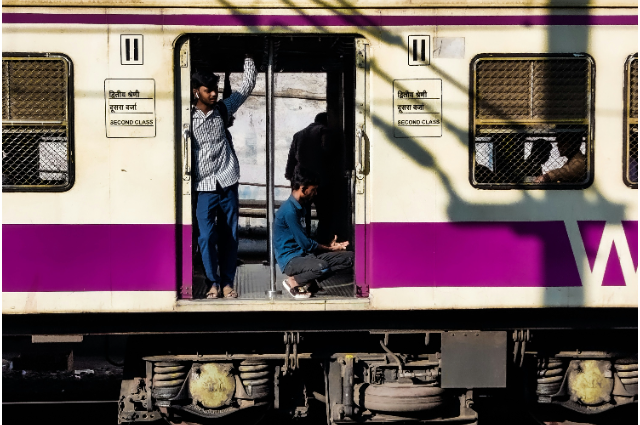
Jaypal was supposed to come back home with his son. Instead, he came back alone.
He had taken 32-year-old Lallu on a train from Mahoba to Jhansi — a routine trip, the kind thousands of families make every single day across India. His son needed medical treatment. The father was right beside him. Everything should have been fine.
But somewhere between Ghutai station and the Didoura railway gate, in a matter of seconds, everything changed forever.
Lallu moved toward the open train door to spit gutkha. The train was moving. The crowd inside was dense. A sudden jolt. And then — he was gone.
By the time he was found on the tracks and rushed to the Community Health Centre in Panwari, it was too late. He didn't survive.
This isn't just a news story. This is a story about a habit that cost a young man his life — and a father who will carry that image forever.
What Actually Happened on That Train
The incident took place around March 20–21, 2026, on a train passing through Mahoba district in Uttar Pradesh. Lallu — also identified as Chandra Prakash in some local reports — was travelling with his father Jaypal for a medical visit.
According to Jaypal's own statement, his son walked toward the open door of the moving train. He wanted to spit gutkha — a tobacco-based product commonly chewed across rural India. The compartment was crowded. Before anyone could react, the jolt of the moving train threw him off balance.
He fell between Ghutai station and the Didoura railway gate — a stretch of track far from immediate help. He was found in a critical state, rushed to the nearest health centre, but couldn't be saved.
A 32-year-old man. A father's hopes. A medical trip that never reached its destination. "He just went to spit. He just went to the door for a second. That second never came back."
Why This Keeps Happening on Indian Trains
If you've ever traveled in an Indian train — especially in general or unreserved compartments — you know exactly the scene Jaypal describes. Overcrowded coaches. Open doors. People leaning out, spitting, smoking, watching the world blur past at 80 kmph.
It feels normal. It feels like something everybody does until it isn't normal at all.
India's railway network is the fourth largest in the world. Millions travel every day. And every day, people fall from open doors — not because they were careless people, but because a moment of habit overtook a moment of caution.
Gutkha, paan, bidis — spitting while traveling is so deeply normalised in parts of India that people don't even think twice before stepping toward an open door at full speed. That normalisation is deadly.
The Real Cost: A Family That Will Never Be the Same
We often reduce tragedies like this to statistics. "One more death on the tracks." A line in a district report.
But think about Jaypal for a moment.
He was taking his son for medical treatment. That means Lallu was already unwell. His father was already worried. He was doing what a father does — accompanying, protecting, hoping. And in an instant, right in front of him, his son was gone.
No parent should have to live with that image. No family should lose someone to a habit that felt harmless.
These stories don't stay in Mahoba. They ripple outward — into homes, into children who grow up without a parent, into siblings who never stop asking "why."
This Isn't an Isolated Incident
Just a few weeks before this tragedy, similar falls were reported in other states. A man in Bihar leaned out to adjust his luggage and fell. A teenager in Maharashtra stood at an open door for a selfie and lost his footing.
Open train doors in moving coaches are not a feature — they are a flaw we've accepted for too long. And the behaviours that lead people to those doors — spitting, smoking, leaning — are habits reinforced by years of nobody saying "stop."
What Every Train Traveller Must Remember
- Never stand near open doors when the train is in motion — even for a second.
- Crowded coaches make balance nearly impossible; avoid door areas entirely.
- Spitting or smoking near train doors puts you and others at serious risk.
- If you feel unwell or need to do something, wait until the train stops at a station.
- Hold on to fixed handles at all times when standing in moving coaches.
What Needs to Change — Beyond Awareness
Awareness campaigns matter. Telling people to "be careful" matters. But it isn't enough.
India needs better enforcement of rules around open doors in moving trains. Coaches need to have functioning door-lock mechanisms. General compartments need better crowd management — not just more slogans on walls.
At the same time, the cultural habit of spitting in public spaces, especially near train doors, needs to be addressed with the same seriousness as drunk driving. It isn't just unhygienic. It is lethal.
Lallu's death should not become just another forgotten news item. It should become a reference point — a reason to finally take open-door safety seriously at a policy level.
A Moment of Honesty for All of Us
If you've ever leaned out of a train door, even briefly — this story is for you.
If you've ever told yourself, "It'll only take a second," while the tracks rushed past beneath you — this story is for you.
Because Lallu thought the same. His father was right there. The train was just going somewhere routine. And none of that mattered when he lost his balance.
Life does not negotiate. Trains do not stop. Tracks do not forgive.
The one thing we can do — the one thing that costs nothing — is to stay away from that door.
Remember His Name
Lallu was 32 years old. He had a father who loved him enough to travel with him to get medical help. He had a life ahead of him. And he lost it in a moment that took less than a second.
His story deserves more than a district news report. It deserves to be the reason someone — maybe you reading this right now — decides to never stand near an open train door again.
If this piece stops even one person from that door, then maybe Lallu's story meant something more. That's the only justice a tragedy like this can have.
Travel safely. Hold on. Stay back from the door.
References
The Mahoba Incident (Primary News Sources)
- Amar Ujala (Hindi) — Reported on March 21, 2026, that a youth died after falling from a moving train while spitting gutkha in Mahoba, Uttar Pradesh. Amar Ujala (Sanvad News Agency, Mahoba, March 21, 2026) https://www.amarujala.com
- Amar Ujala (follow-up report) — Confirmed the victim lost his balance while spitting gutkha at a moving train's gate and passed away during treatment; police investigation was initiated. Amar Ujala https://www.amarujala.com
Scale of India's Train Fall Deaths (Statistical Context)
- The Print / NCRB Data — According to NCRB records, roughly 2.6 lakh people lost their lives in train accidents in India over the past 10 years, with a vast majority caused by people falling off trains or being run over, accounting for about 70% of railway accident deaths between 2017 21. ThePrint https://theprint.in
- TIME Magazine / NCRB — In 2021, more than 16,000 people were killed in nearly 18,000 railway accidents, according to the National Crime Records Bureau. The vast majority were caused by people falling off trains or getting run over, rather than train collisions. Time https://time.com
Mumbai Suburban Train Deaths (Ongoing Crisis)
- Think Global Health — In 2024 alone, 3,588 commuters were killed on Mumbai's suburban railway — an average of 10 deaths per day. The Bombay High Court called for preventive steps such as installing automatic doors on local trains, a recommendation that a parliamentary committee had made eight years earlier. Think Global Health https://www.thinkglobalhealth.org
- Zee News — In 2023, 2,590 people died on suburban railway tracks — an average of about 7 deaths per day — many due to falling off moving trains or standing on footboards. Zee News https://zeenews.india.com
Open Door Safety & Policy Response
- NewsTrack (English) — After a tragic accident near Diva–Mumbra stations in Thane district, where at least five passengers died after falling from overcrowded trains, Indian Railways decided to install automatic door closers in Mumbai Suburban Railway trains — described as the strongest safety action taken so far for Mumbai locals.
- Newstrack English: https://english.newstrack.com
- Academia.edu Research Paper — Open-door travel in Indian Railways, particularly in general and sleeper class coaches, leads to thousands of injuries and fatalities every year due to accidental falls, with 85% of accidents occurring with doors open during train motion. Academia.edu https://www.academia.edu
Broader Safety & Investment Context
- Observer Research Foundation (ORF) — According to NCRB data on accidental deaths between 2010 and 2019, 252,655 lives were lost to railway accidents. A High-Level Safety Review Committee called the casualties on Mumbai's suburban railway services a "massacre which no civilised society can accept." ORF Online https://www.orfonline.org