
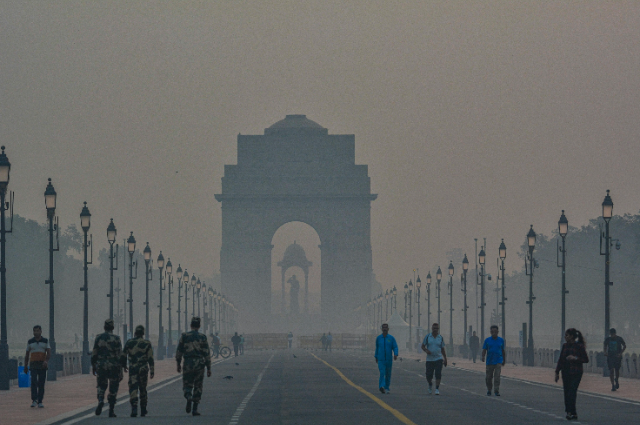
In the light of the expanding interpretation of Article 21 and mounting public health evidence on air pollution, how should the Indian State constitutionally justify its failure to declare toxic air a public health emergency, and where must courts draw the line between policy discretion and enforceable duty to protect the right to breathe?
Air pollution has emerged as one of the gravest public health crises of the 21st century, silently eroding the right to life guaranteed under Article 21 of the Indian Constitution. Notwithstanding constitutional mandates, judicial pronouncements, and policy initiatives, the State's response to air pollution is fragmented, reactive, and largely symbolic. This article critically examines the duty of the State vis-à-vis air pollution as a public health emergency, analysing constitutional jurisprudence, legislative frameworks, and judicial interventions. It further analyses international practices and evolving scientific evidence to argue that the right to breathe clean air is not merely an environmental concern but an inseparable component of the right to life and human dignity. This article identifies systemic failure, societal apathy, and futuristic concerns to propose a rights-based health-centric approach for air pollution governance in India.
Right to Life… but on a Ventilator?
Take a deep breath. Did it feel clean? Or did it come with a burning throat, heavy lungs, and a silent fear you have normalised? “You are overreacting,” society says. “Air pollution has always existed,” the State replies. But then why do our lungs feel like battlegrounds?
Hey, you’re breathing poison!
Yes, you heard it right. You, me, and millions of Indians wake up every morning inhaling air that is legally permissible yet biologically lethal. Ironically, we rarely protest it. We rage when our internet slows down, but we remain calm when the Air Quality Index (AQI) touches “severe” levels. Why? Because pollution does not choke us instantly, but it kills us slowly. Breathing is the most involuntary human act. One may survive without food for days, without water for hours, but without air not even minutes. Then how did something so fundamental become negotiable? How did breathing turn into a privilege instead of a right? Similarly, we all know air is invisible, as are dignity, liberty, and mental peace. Still, we do so because these rights are not questioned. If we say that we must have air to live, then we do not understand the position taken on the constitutional mandate. Article 21 of our Indian Constitution talks about the Right to Life and Personal Liberty. We have stretched it to include the right to live with dignity, the right to health, and the right to a wholesome environment by extending it to those times when we have to. However, we have failed to answer the question, which is rather embarrassing: can we have the right to life without the right to breathe? "If it would be a negligent thought of a mother to leave her child in a choking room, why would it be thought prudent of a State to leave its citizens to choking air?" The purpose of the State’s governing is not merely to control certain lands and resources, but to ensure an atmosphere conducive to a full, meaningful life. A life without breathing does not exist; it merely stagnates.
State, Society, and Suffocation
- The choice of polluted air is not made by children.
- A daily wage worker would not choose to have toxic lungs.
- A human being does not volunteer for respiratory failure.
The State, despite its political beliefs, has a non-negotiable duty of care towards its citizens. It is not just about economic development and building infrastructure; the State is tasked with saving lives. When pollution causes untimely deaths, illness, and irreversible lung damage, it is no longer an environmental issue, but a public health crisis screaming for immediate action. But are we really taking this collective mentality and response so glibly? Masks are no longer obligatory, nor are wake-up calls, nor indignation itself, as witnessed by the winter outrage in Delhi.
Air pollution in India: a silent public health emergency
India has been ranked among the most polluted nations in the world. Recently collected statistics show that over 1.6 million deaths in India are caused by air pollution each year; the rate has exceeded deaths caused by road accidents and infections. Cities like Delhi, Kanpur, Ghaziabad, Patna, and Bengaluru regularly record Air Quality Index (AQI) levels classified as “severe” or “hazardous”. During winter months, children are advised not to step outdoors, schools are shut, construction is halted, and yet, no formal declaration of a public health emergency is made. This raises a disturbing paradox:
If contaminated water leads to emergency measures, if epidemics trigger disaster responses, why does toxic air inhaled by every citizen escape similar constitutional urgency? An emergency is declared, exposing a constitutional paradox in the state's response to toxic air.
Recognition without Realisation: The Enforcement Deficit
Article 21 of our constitution has become a subject of judicial interpretation, which has transformed a right of mere physical existence into a right of living a life of dignity, health, and purity of environment. The Supreme Court has always negated any concept of “animalistic survival,” asserting that “the right to life would include the right to a pollution-free environment.” This has been evident in cases, such as Maneka Gandhi v. Union of India, wherein a right to life in dignity, health, and fairness was emphasised, and in Subhash Kumar v. State of Bihar, wherein a right to pollution-free air and water was clearly asserted under Article 21 of the Indian Constitution. Despite this jurisprudence, these decisions remained largely declaratory rather than transformative. The enforcement model has until now been weak, fractured, and procedural in nature. This is indicative of poor ‘regulation-think’ rather than public health-inspired principles. Constitutional obligation presumes that legislation is just one component of constitutional obligation; effective enforcement and scientific evaluation of evidence are equally critical. If “the right to life” includes “the right to the purity of air,” can we not say that laws on the books must be matched by actions that do not degrade human health/dignity?
Legislation: Plenty of Laws, Little Breath
Although its environmental law structure does not experience a scarcity of legislation, the legislation it does have, such as the Air (Prevention and Control of Pollution) Act, 1981, and the Environment (Protection) Act, 1986, along with recent policy initiatives like the National Clean Air Programme, merely present an appearance of potency, while actually being administrative mechanisms instead of rights-based instruments grounded in public health. In no legislation has there been an express recognition of clean air as a legitimate right under Article 21, or of emergency action being taken when pollution levels transcend danger levels as defined by modern scientific limitations. While there exist binding trigger points, as well as repercussions in case of executive failure, in disaster management legislation, epidemic control legislation, there exist no such provisions in legislation over air pollution. This constitutional obligation, thus, transforms into a policy choice.
Judiciary: The Reluctant Saviour
The Indian judiciary, mainly through the mechanism of Public Interest Litigation, has played a critical role in elevating air pollution from a mere regulatory concern to a constitutional issue. landmark interventions such as M.C. Mehta v. Union of India on vehicular pollution transformed judicial concern into concrete policy outputs in the shape of the conversion of Delhi’s public transport system to Compressed Natural Gas (CNG). Judicial monitoring further led to the formulation of the Graded Response Action Plan (GRAP), while the establishment and active functioning of the National Green Tribunal introduced penal consequences for polluters and erring public authorities. All these interventions put together reflect a clear judicial recognition that air pollution constitutes a direct threat to life and health and thus invokes Article 21 of the Constitution of India.
However, even with this conducive judicial approach, judicial intervention has remained reactive rather than proactive. The courts jump into action only when Air Quality Index readings are of an extreme nature, rather than as an integral part of any overall strategy of constitutional adjudication. Without an express statutory or constitutional declaration that recognises air pollution as a constant existing state of public health crisis, judicial activism runs the danger of being inconsequential rather than impactful.
An interesting case study of failed governance can be described through the example of the constitutional experience of the capital city of Delhi. As can be established through scientific and medical statistics, prolonged exposure to polluted air in the capital increases the possibility of respiratory, cardiovascular, and neurological diseases. The disadvantages of exposure are considerable among young, aged, pregnant, and socio-economically disadvantaged sections. Judicial comments have unequivocally recorded the disproportionate disadvantages arising out of exposure to air pollution, which has been equated to a violation of substantive equality under Article 14. Thus, when the consequences are certain, inaction by the State eventually constitutes connivance, which can equate to breathing into a hazardous activity.
Judicial orders banning firecrackers, regulating construction, restricting vehicular movement, and imposing emergency pollution-control measures during peak smog periods are thus best understood as attempts to contain executive inertia rather than instances of institutional overreach. But courts cannot redesign urban transport, restructure industrial policy or integrate environmental governance with public health planning. The judiciary's role thus is that of a reluctant saviour and underlines, if anything, a more profound malaise at the constitutional level: the disinclination of the State to treat chronic air pollution as a continuing violation of the right to life rather than merely an occasional nuisance requiring temporary palliatives.
Around the World: Breathing as a Right
There is, however, a growing trend internationally to recognise clean air as a human right, and to link air quality standards directly with public health law, supported by systems of independent monitoring and accountability. The WHO consistently lists air pollution among the leading global health risks that prematurely kill millions of people every year. India remains in denial of air pollution as a constitutional emergency, even when its commitments under international environmental and health law so demand. The Covid-19 pandemic forcibly reminded one of the documented fact that chronic exposure to toxic air increases vulnerability to respiratory illness and public health disasters. If the State has the authority to invoke exceptional powers to safeguard life against a viral pandemic, it cannot credibly deny it has the authority to reshape development and governance models to safeguard life against poisonous air. The obstacle is not constitutional authority, but political will.
Future Concerns: Will Breathing Become a Privilege?
The recent history of air pollution in India is noteworthy in the context of a growing trend in which clean air seems possible only as a luxury rather than a right. This trend is evident even in the context of the growing constitutional and international obligations to the achievement of targets related to SDG 3, which ensures healthy life and promotes well-being, and SDG 11, which makes cities and human settlements safe. The kinds of air pollution problems vary in different cities in the country. However, the lack of a cohesive approach to the problem at the city level reflects a regulatory framework in different countries of the European Union, the UK, and China in addressing air pollution as a public health crisis. This would make declaration of air pollution as a national public health emergency under Article 21, attract a non-derogable State duty, collective enforcement, and clean air an enforceable fundamental right. Without such recognition, clean air will remain a class privilege, deepen social inequality, violate intergenerational justice, and hollow out the right to life contrary to the constitutional duty to protect public health affirmed in Paschim Banga Khet Mazdoor Samity v. State of West Bengal.
From Right to Life to Right to Breathe
The right to life cannot be meaningfully realised without the right to breathe clean air. Declaring air pollution a public health emergency under Article 21 is not an act of constitutional radicalism but of constitutional fidelity. It would enable a decisive shift from tolerance to zero tolerance, from symbolic regulation to rights-based protection, and from policy discretion to enforceable duty. A constitutional democracy cannot claim progress while its citizens struggle to breathe; the Constitution demands not ceremonial acknowledgement, but real and effective protection of life in its most elemental form.
References:
- Riya Jain, Article 21 of the Constitution of India: Understanding Right to Life and Personal Liberty from Case Laws, Lawctopus Academike (Jan. 31, 2025), https://www.lawctopus.com
- SCO Team, The Right to Life and Personal Liberty Under Article 21: A Timeline, Supreme Court Observer (June 26, 2025), https://www.scobserver.in
- Shourabh Gupta, India Had World’s Highest Pollution-Related Deaths in 2019: Report, Down To Earth (May 19, 2022), https://www.downtoearth.org.in.
- India Const. art. 21
- Oscar Bimpong, Just a Thought, Law of 4 (Feb. 2, 2024), https://lawof4.com
- Maneka Gandhi v. Union of India, (1978) 2 S.C.R. 621 (India)
- Subhash Kumar v. State of Bihar, (1991) 1 S.C.C. 598 (India)
- Ibid
- Air (Prevention and Control of Pollution) Act, 1981, No. 14 of 1981 (India),
- Environment (Protection) Act, 1986, No. 29 of 1986 (India),
- Portal for Regulation of Air Pollution in Non-Attainment Cities (PRANA), Central Pollution Control Board (CPCB) (India), https://prana.cpcb.gov.in
- Ibid
- M.C. Mehta v. Union of India, (1991) 2 S.C.C. 353 (India).
- Ibid
- Delhi Chokes as Governance Fails: How the Capital’s Air Became a Policy Casualty, The Environment (Dec. 18, 2025), https://www.theenvironment.in.
- INDIA CONST. art. 14.
- World Health Organisation, Air Pollution, https://www.who.int (last visited Feb. 10, 2026).
- Nurshad Ali et al., Exposure to Air Pollution and COVID-19 Severity: A Review of Current Insights, Management, and Challenges, 17 Integr. Environ. Assess. & Mgmt. 1114 (2021), https://www.ncbi.nlm.nih.gov
- Sustainable Development Goals, U.N., https://www.un.org/ (last visited Feb. 10, 2026).
- Ibid
- Paschim Banga Khet Mazdoor Samity v. State of W. Bengal, (1996) 4 S.C.C. 37 (India).