
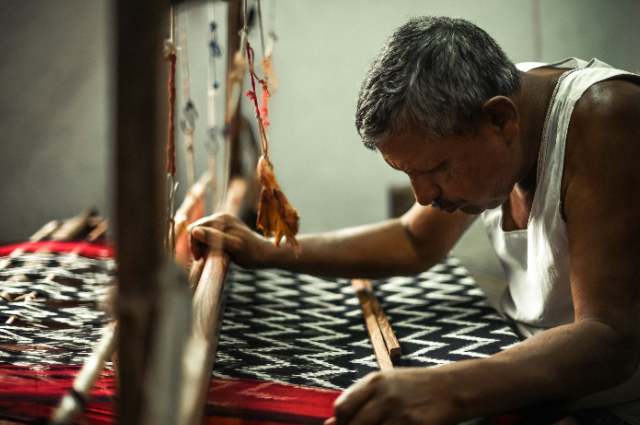
"Art is all about beauty, not in the way it looks, but in the heart that brings life to it," I told myself when I got to witness this most beautiful yet painful journey behind one of the most talented crafts in India: Saree weaving. It was an experience that opened my eyes to a completely different perspective, not towards the perfectly folded, finished product in my hands, but towards the hands that had toiled too much before bringing that masterpiece to life. Upon visiting Gadwal with a group of classmates during the summer break, I had a truly insightful experience learning about the lives of the artisans. The closely knit neighbourhood that radiated warmth, those small yet cosy houses that held countless unheard stories behind their weaving journey, and the pride they felt while talking about their craftsmanship - all of these moments were etched beautifully in my heart.
It felt like I was looking through a magical lens that let their stories unfold before me- unmasked, unfiltered, honest and raw. Those real glimpses of their unwavering resilience in their everyday lives, while each thread was being woven into beautiful sarees, made me delve deeper into their lives. It made me look at weaving as something more than just a skilful craft.
Generational Craft that flourished through centuries: Gadwal’s Tale of Weaving
Gadwal (prominently known as Jogulamba Gadwal), in Telangana, is known for its extensive weaving culture that was passed on through several generations. Known as the Gadwal Samsthanam back in the early 19th century, Gadwal witnessed the birth of weaving as an intricate and flourishing craft that shaped and supported the lives of hundreds of artisans of that era. Thus, weaving was passed down through several generations, serving both as a rich form of culture and as a source of livelihood for the artisans of Gadwal.
The craft that filled the hands behind it: Weaving as a Livelihood
Back in the days, the weaving grew in expertise and was seen as the major source of income that fed many families through several generations. But, in contrast, the present world scenario clearly speaks against it. “We weave around 8-10 sarees per month, and the income we earn for each saree is barely enough to meet the needs of my family,” said an artisan, upon being asked about how weaving supported their livelihood. “Earlier, the entire family used to be involved in weaving, as a major part of their lives, but now things have drastically changed over the years that we encourage our children to take a different path,” he added.
While I enjoyed watching them work with those silk threads to create a beautifully woven border, a part of me was still surprised at the meticulous efforts and their impact on the artisans behind the scenes.
Hurdles that showed up unannounced: Challenges in their Lives
- Bread that was never enough: Their Financial Plight
After documenting the weaving process of Gadwal Saree, one of us asked the artisan out of curiosity, “So, how many sarees do you make in a month?”
“My wife and I work together. Usually, it is 3-4 sarees a month, and I earn about 300-400 Rupees per day for my work. So, it is 10,000 - 12,000 Rupees a month. We earn 20,000 together per month for our family,” he answered.
We then asked, “How do you manage your household expenses then?”
“The amount we get paid barely meets our expenses, and it is very difficult for us. Some of us in this neighbourhood still have debts to be paid, but we earn less. Sometimes, we feel that we are paid too little for the amount of hard work we put in our jobs,” he replied.
This made me speechless upon hearing him. When they gathered all their strength and energy to create a beautifully intricate saree, they got paid an amount that hardly satisfied their basic needs. As if this weren’t enough, during the off-season, or when the demand for the product is very low, weavers often face a harsh economic crisis, which further impacts their livelihood. For instance, considering the Global Pandemic in 2020 and 2021, like all other professions, weavers faced an incredibly tough time making ends meet, yet managed to survive the pandemic somehow.
- Smiles that masked pain beneath: Their Unseen Suffering
Handlooms were set up in their houses. An all-in-one room, to be precise. That single room had a huge handloom set up, a small kitchen in the corner and the leftover space in between was the area where they slept as a family. Later, that afternoon, we moved to another house in the neighbourhood to document an interview. I was indeed surprised that their body and mind were rhythmically tuned and knew what to do next, even when they kept talking to us.
We shot a few videos on how the weaving was actually done on a handloom. Then we asked him, “Apart from your financial struggles, do you face any other issues while weaving sarees?”
“Yes, definitely. We work for 8 -12 hours a day. We experience joint aches in our knees, ankles and necks. And most of us suffer from severe backaches due to continuous strain on our posture. My mother, who was into weaving since her marriage for almost 40 years, lost her ability to see properly. She barely sees anything and has difficulty recognising people now. So, she stopped weaving,” he explained.
The continuous foot pedalling that lifted the loom’s threads, the hands that passed threads through the lifted ones, the eyes that focused on precision, the posture that held them together, everything demanded a price they could never pay off: their health. It was heartbreaking to see their tireless efforts only to be physically and emotionally tattered in their lives.
- Machine Vs Human: The Survival Battle
“These days, machines are taking over our jobs, right?” He laughed. “Machines can produce several sarees in a single day, whereas we take more than a week to make one. So, there is a lot of demand for these machine-made sarees these days.” He added.
Power looms are indeed taking over handlooms in ways they never imagined. Since machines work fast, they produce multiple sarees simultaneously. But handloom weavers are being put under pressure due to the vast difference in selling prices. As power looms offer sarees at a cheaper rate, within a short period of time, people hesitate to purchase handloom sarees that demand a higher price, for a weaver’s hard work and effort. This hectic battle between handloom and power loom creates a state of financial insecurity for the weaver societies, forcing them to back out gradually.
As power looms are dominating this fast-paced world, weavers are slowly stepping out from what was given to them as generational heritage. In 2015, The Times of India reported that the weavers’ population in Gadwal had seen a significant decline from 65,000-70,000 weavers to just 5,000 weavers in the town, given all the hardships they go through. Also, according to the All-India Handloom Census, 1987-88, there were about 67 lakhs weavers all over India. But the fourth census in 2019-20 states a gradual decline of the figure to 35 lakhs weavers. The dwindling population is indeed painful evidence of the generational craft turning its back on the artisans who built lives through it.
Preserving Originality and Authenticity: Government Support and Recognition
By the end of our documentation journey at Gadwal, I had learnt a lot more than I intended to. Now, it has become quite difficult for me to unsee all their efforts behind transforming those bundled yarns into mesmerising pieces of colourful fabric. While shopping for sarees, we casually tend to reject a few, saying we don’t like them or the colours don’t suit us well. But we never spent a few seconds thinking about the tremendous effort that goes into making a handloom saree. Amusing, right?
In 2015, Gadwal Sarees were recognised with the Geographical Indication (GI) tag by the Ministry of Telangana for their unique saree weaving technique and intricate zari borders. The GI tag marks them as ‘original’ and ‘authentic,’ boosting their economic value. It gives another opportunity to honour the efforts of these artisans who take pride in weaving every saree they make.
“These days, we get bulk orders from NRI families staying abroad, or when there is a wedding taking place in Hyderabad. That becomes our only source of profit at that time, as we get to earn more than what we get paid for a month,” an artisan shared.
In addition to this, the Indian government has also initiated a few schemes to support the weaver families. The Ministry of Textiles introduced the National Handloom Development Program (NHDP), which offers financial aid to awardee artisans above 60 years of age, and also supports their children with scholarships. The Pradhan Mantri MUDRA Yojana (PMMY) offers loans to weavers under different categories without collateral. Apart from these, the Handloom Weavers Comprehensive Welfare Scheme (HWCWS) provides social security and financial support, merging different schemes like the Mahatma Gandhi Bunkar Bima Yojana (MGBBY), Pradhan Mantri Jivan Jyoti Bima Yojana (PMJJBY), and many others, that offer life insurance and health benefits for the weavers. These schemes were designed with the intent to support the handloom weavers. While only a small portion of the weaver population gets access to these benefits, others are still waiting for the support and assistance to reach them.
We finished our video documentation that evening. Looking at those elegantly folded bright sarees in front of me, I felt my heart twist with respect, admiration and a soft ache, which was a tribute to their never-ending efforts behind them. Before leaving that place, I purchased a purely hand-woven Gadwal Silk Saree. It felt like a precious souvenir that often brings back those moments from my trip to Gadwal, as well as reminds me of the tremendous effort that went into those threads to make them into fabrics of elegance. This trip also made me look beyond the scene and constantly reminds me to never forget the efforts behind those hardworking hands.
References:
- DT Next (2025, December 8) Varanasi: Banaras Silk Saree Weavers Staring at Crisis. https://www.dtnext.in
- Down to Earth (2008 April 15) Chirala Saree Weavers losing out to computer-aided designs. https://www.downtoearth.org.in
- Citizens for Justice and Peace (2022 January 31) Weavers of Eastern UP Lost Work During Pandemic, Received No Help From Govt, Says Study. https://cjp.org.in
- The Times of India (2015 June 30) Poverty-ridden weavers bid adieu to trade. https://timesofindia.indiatimes.com
- Ministry of Textiles, Government of India (n.d)- Official Page- Schemes for handloom weavers. https://myhandlooms.gov.in
- Press Information Bureau (2025 July 22) Welfare Schemes for Handloom Weavers. https://www.pib.gov.in
Acknowledgement:
I am truly grateful to Sri Vinod Gadwal Saree House and weavers of Gadwal for genuinely sharing their time and incredible insights on weaving, and for allowing the documentation of the weaving process.