
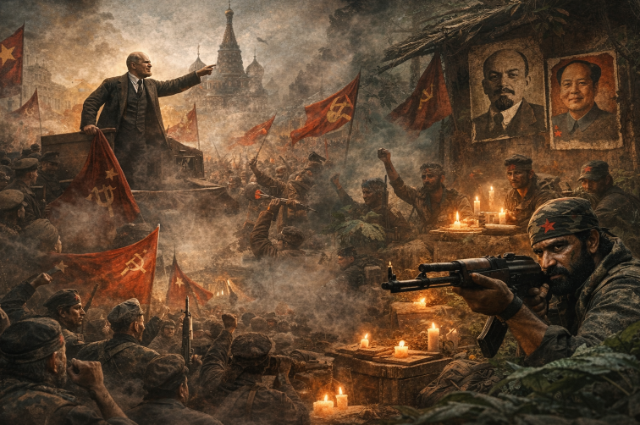
A Revolution That Refused to Die
The Russian Revolution of 1917 is often treated as a concluded historical event—an upheaval that dismantled centuries of Tsarist autocracy, led to the establishment of the Soviet Union in 1922, and ultimately ended with its collapse in 1991. However, such a perspective is incomplete. Revolutions of this magnitude rarely terminate with a mere change of regime; they extend through ideas, institutional practices, political movements, and vocabularies that continue to shape social and political life across generations. The Russian Revolution’s impact was not just national; it became a global ideological reference point, influencing struggles for justice, equality, and anti-colonial resistance worldwide.
The Bolshevik seizure of power on 25 October 1917 (Julian calendar) was more than a transfer of authority. It embodied a systematic critique of political and economic inequality. Vladimir Lenin’s Bolshevik framework offered both an analytical tool for understanding exploitation and a practical roadmap for societal transformation. Unlike spontaneous revolts, this was a structured revolutionary approach, implemented through the vanguard party, mass mobilisation, and institutional experimentation. Its ideas transcended Russian borders, inspiring movements that sought to challenge entrenched hierarchies and colonial domination.
Before the October Revolution, Russia experienced profound social, economic, and political crises. By 1914, the industrial workforce in urban centres such as Petrograd and Moscow numbered approximately 2.5 million, subjected to 10–12-hour workdays, unsafe conditions, and wages that barely matched soaring wartime inflation (Figes, 1996). Rural conditions were even more precarious: 80% of peasants worked plots smaller than 2 hectares, insufficient for subsistence, and remained encumbered by redemption payments stemming from the 1861 emancipation of serfs. These structural inequalities, compounded by World War I, which caused 1.8 million Russian military deaths and 4.5 million wounded by 1917, created a volatile environment in which revolutionary upheaval became almost inevitable.
Globally, the Russian Revolution offered both a model and a language for resistance. The Communist International (Comintern), established in 1919, actively propagated Bolshevik ideology abroad, providing organisational guidance, training, and material support to communist parties worldwide. In China, the CCP adapted Soviet ideas to local agrarian conditions, while in Vietnam, Ho Chi Minh combined Marxism-Leninism with anti-colonial struggle against the French and later the United States. In India, intellectuals and activists like M.N. Roy visited Moscow, studied revolutionary strategy, and returned to help form the Communist Party of India (CPI) in 1925, embedding Russian revolutionary ideas within local anti-colonial and labour struggles.
India’s engagement with the Russian revolutionary legacy has been multifaceted. The CPI’s role in urban trade unions and movements such as the Telangana armed struggle (1946–51) shows how revolutionary principles were adapted to local agrarian and industrial conditions. Conversely, radical offshoots like the Naxalite movement (1967) illustrate the difficulties of sustaining revolutionary change through armed struggle within democratic frameworks. These movements reflect the tension between ideological aspiration and pragmatic governance, a theme central to understanding the long-term significance of the 1917 Revolution.
This article contends that the Russian Revolution remains relevant not because its Soviet model survived intact, but because its ideas evolved, migrated, and embedded themselves in diverse political realities—particularly in India. Assessing these unfinished echoes requires scrutiny of historical facts, socio-political contexts, and comparative outcomes, avoiding simplistic glorification or condemnation. By tracing these continuities, the article situates the Russian Revolution as a living reference point for understanding the interaction between ideology, institutional reform, and social transformation over the last century.
Russia Before 1917: Structural Conditions of Revolution
The Russian Revolution of 1917 was the outcome of long-standing structural failures, not an abrupt occurrence. By the early twentieth century, Tsarist Russia under Nicholas II was a politically rigid, socially stratified, and economically fragile state. Despite attempts at reform following the 1905 Revolution, the monarchy systematically undermined representative institutions. The State Duma, intended as a consultative legislative body, was repeatedly dissolved or restricted, while political parties were limited in scope and influence. The monarchy retained veto power over legislation, ensuring that ordinary citizens had virtually no access to legitimate political channels (Figes, 1996). Opposition groups—including Social Revolutionaries (SRs), Mensheviks, and Bolsheviks—operated under surveillance and faced frequent arrest, further constraining avenues for political expression.
Economic inequality was extreme, particularly in rural areas. The emancipation of serfs in 1861, while legally freeing millions, failed to provide adequate land for subsistence. Most peasant families were allocated plots smaller than 2 hectares, insufficient to sustain households. Redemption payments, imposed to compensate landlords, persisted until 1907, keeping peasants in a cycle of debt. Rural poverty was exacerbated by landlord dominance and exploitative tenancy arrangements, which fuelled chronic agrarian unrest, frequent strikes, and localised uprisings.
Urban industrialisation created a growing working class exposed to harsh conditions. By 1914, approximately 2.5 million industrial workers lived in Petrograd, Moscow, and other cities, labouring 10–12 hours per day in unsafe factories with minimal wages or protections. Industrial accidents were frequent, and the labour organisation faced heavy repression. Strikes in 1912–1914, particularly at the Putilov Steel Works in Petrograd, signalled the growing discontent among urban workers, highlighting a disconnect between the state’s rapid industrial expansion and its social responsibilities.
World War I intensified these pressures. Military defeats at Tannenberg (August 1914) and the Masurian Lakes (September 1914) revealed systemic incompetence, leaving the Russian army demoralised. By 1917, 1.8 million soldiers had died, and 4.5 million were wounded, with mass desertions further weakening the military. On the home front, inflation and food shortages triggered riots; for example, the February 1917 bread riots in Petrograd drew over 200,000 participants, signalling widespread urban unrest. Tsar Nicholas II’s decision to command the army personally removed him from governance, leaving the unpopular Empress Alexandra and her advisor, the mystic Grigori Rasputin, to administer the state. Their perceived incompetence and corruption further eroded public trust, contributing to the monarchy’s delegitimisation.
Partial reforms after the 1905 Revolution, including limited civil liberties and the establishment of the Duma, failed to resolve the structural crisis. Workers, peasants, and soldiers faced sustained repression, while social inequalities persisted. By early 1917, strikes, protests, and mutinies, including the notable Petrograd garrison uprising, demonstrated that dissatisfaction had reached a critical threshold. The convergence of political suppression, economic hardship, and military disaster made revolutionary upheaval not just probable but inevitable.
In sum, the conditions in Russia before 1917 reveal a society under profound stress. Autocracy, social inequality, economic exploitation, and wartime failure created a fertile ground for revolution. These structural realities provide essential context for understanding why the Bolsheviks, under Lenin, were able to mobilise support so effectively in both urban and rural spheres, and why the Russian Revolution continues to serve as a reference point for political movements globally.
Lenin and the Bolshevik Strategy
Vladimir Ilyich Lenin’s role in the Russian Revolution of 1917 was defined less by symbolic leadership and more by strategic planning, ideological clarity, and organisational acumen. Unlike orthodox Marxists such as Karl Kautsky, Lenin rejected the notion that socialism would arise automatically from industrial development. He argued that in a country like Russia—largely agrarian, semi-industrial, and politically fragmented—the proletariat required direction from a disciplined vanguard party capable of mobilising mass discontent into coherent political action. This position was articulated in his seminal work, What Is to Be Done? (1902), where he outlined the need for centralised leadership, ideological education, and tactical flexibility.
By October 1917, the Bolshevik Party numbered approximately 200,000 members, far smaller than the broader socialist and revolutionary currents represented by the Mensheviks and Socialist Revolutionaries (SRs). Despite their smaller numbers, the Bolsheviks’ discipline, centralisation, and operational efficiency enabled them to exert disproportionate influence. Lenin’s strategy emphasised control over urban centres, coordination with workers’ soviets, and alignment with peasant demands, recognising that political legitimacy required both ideological clarity and grassroots support.
Lenin’s April Theses, delivered immediately after his return from exile in April 1917, crystallised the Bolshevik approach. He called for “All Power to the Soviets,” immediate withdrawal from World War I, and redistribution of land to peasants. These demands sharply contrasted with the Provisional Government under Alexander Kerensky, which persisted in prosecuting the war and deferred land reform. Lenin’s theses reframed Bolshevik strategy as both revolutionary and pragmatic—appealing to war-weary soldiers, land-hungry peasants, and urban workers facing food shortages and inflation.
The seizure of power on 25 October 1917 (Julian calendar) demonstrated Lenin’s tactical acumen. Key sites in Petrograd, including the Winter Palace, the telegraph office, and government ministries, were captured with minimal bloodshed, reflecting careful planning and coordination with armed workers and loyal soldiers. Lenin’s consolidation of power following the coup involved centralisation of administrative authority, control over key communication channels, and the rapid establishment of Sovnarkom (Council of People’s Commissars).
The subsequent Russian Civil War (1918–1922) further illustrated Lenin’s strategic pragmatism. Facing opposition from the White Armies and foreign intervention, the Bolsheviks implemented War Communism, centralising grain requisitioning and industrial management to sustain the Red Army. While harsh, these measures ensured political survival amid social and economic collapse, highlighting the tension between ideological purity and operational necessity. Lenin’s leadership demonstrated that revolutionary success depended not only on rhetoric and mobilisation but also on adaptive governance and coercive enforcement when necessary.
Lenin’s approach has lasting analytical significance. It emphasises that revolutions in non-industrialised or semi-industrialised societies often require organised, ideologically coherent leadership capable of balancing ideals with material constraints. The Bolshevik model, under Lenin’s guidance, provided both a framework for understanding social power and a practical template for executing political transformation. This combination of strategy, pragmatism, and ideological commitment became a reference for later communist movements worldwide, including China’s adaptation of Marxism-Leninism under Mao Zedong and the Indian communist trajectory through the CPI and Naxalite movements.
In sum, Lenin’s leadership illustrates the intersection of revolutionary ideals with strategic realism. By uniting disciplined party organisation, mass mobilisation, and tactical flexibility, he ensured that the Russian Revolution achieved immediate objectives while laying the foundation for the Soviet state. Understanding this dynamic is essential for analysing the global legacy of 1917, including its enduring influence on movements that seek to translate ideology into concrete social and political change.
The New Economic Policy (NEP): Pragmatic Compromise
By 1921, the Russian economy was in deep crisis. The Bolsheviks’ initial policies under War Communism (1918–1921) had sought to rapidly socialise the economy to meet the demands of the ongoing civil war. Private trade was banned, banks and industries were nationalised, and the requisitioning of agricultural produce from peasants was strictly enforced. While these measures ensured that the Red Army received supplies, they simultaneously caused widespread economic disruption. Urban populations declined sharply as food scarcity drove migration back to the countryside, industrial output plummeted, and inflation made necessities unaffordable. By 1921, industrial production had fallen to approximately 13% of pre-World War I levels, while grain procurement dropped by more than 50% compared to 1913 figures (Figes, 1996). Social unrest escalated, peaking in the Kronstadt rebellion of March 1921, where formerly loyal sailors protested against Bolshevik policies, demanding political freedom and economic relief. The rebellion highlighted the fragility of the regime and the limits of ideological rigidity.
Faced with this crisis, Vladimir Lenin introduced the New Economic Policy (NEP) at the 10th Congress of the Russian Communist Party in March 1921. The NEP represented a strategic retreat from the radical policies of War Communism while remaining within a socialist framework. Its core principles were pragmatic:
Agricultural Incentives: Peasants were allowed to retain and sell surplus produce after paying a fixed tax in kind to the state, replacing the previous system of forced requisition. This incentive reversed rural unrest, encouraged higher production, and restored the flow of food to urban centres. Agricultural output rose from 37.6 million tons in 1921 to 72.6 million tons by 1926, restoring food security (Service, 2000).
Market Reintroduction: Small-scale private trade and businesses, including shops, workshops, and handicrafts, were permitted. This created a new social category known as the NEPmen, who facilitated the distribution of goods, revived local economies, and re-established urban markets. Their presence, though controversial, helped stabilise the economy without undermining the state’s socialist objectives.
State Control over Key Sectors: Heavy industry, banking, foreign trade, and large factories remained under state control. Strategic industries were not privatised, ensuring that the Bolshevik Party retained ultimate authority over the backbone of the economy. This dual structure—private enterprise for minor trade, state control for major production—was a careful balancing act between ideology and necessity.
The NEP was not without controversy. Orthodox Marxists, including prominent Bolsheviks such as Grigory Zinoviev and Nikolai Bukharin, criticised it as a betrayal of socialist principles, accusing Lenin of capitulating to capitalist elements. Bukharin, who initially defended the NEP as a temporary measure, warned against excessive reliance on NEPmen, fearing that private capital would undermine proletarian power. On the other hand, Lenin insisted that the NEP was “one step backwards to take two steps forward,” framing it as a strategic compromise rather than a reversal of socialist ideals. The policy aimed to stabilise the economy, consolidate political power, and create conditions for future socialist development without provoking further civil unrest.
Economically, the NEP was effective. Industrial output recovered to pre-war levels by the mid-1920s, while the urban population stabilised, food distribution improved, and inflation slowed. Socially, the policy helped to co-opt potentially hostile groups, including peasants and small traders, into the Soviet system. Politically, the NEP strengthened Bolshevik authority by demonstrating that ideological flexibility could preserve state power.
The global influence of the NEP was significant. Revolutionary movements outside the Soviet Union recognised its lesson: ideology must adapt to material and social realities. Mao Zedong, observing the NEP in the 1920s, integrated similar pragmatism in China, focusing on rural mobilisation and staged revolutionary strategies rather than immediate nationalisation. The NEP thus served as a model for hybrid approaches within the broader Marxist-Leninist framework, emphasising that strategic compromise could safeguard both political stability and long-term revolutionary goals.
Ultimately, the NEP illustrates a central tension in revolutionary governance: the need to balance ideological purity with pragmatic policy-making. While it attracted criticism from purists, its success in restoring production, alleviating social unrest, and consolidating Bolshevik authority demonstrates that adaptive strategies can be crucial for the survival of a revolutionary state. The NEP remained in effect until 1928, when Joseph Stalin’s forced collectivisation and industrialisation policies replaced it, marking a return to centralised economic control—but the lessons of NEP persisted in Soviet and global communist strategies for decades.
Global Spread of Communist Thought
The Russian Revolution of 1917 did not remain a confined national event; it rapidly became a template for revolutionary and anti-colonial movements across the world. The creation of the Communist International (Comintern) in 1919 was central to this global influence. The Comintern’s declared objective was to support communist movements worldwide, providing ideological guidance, political advice, and, in some cases, material assistance to sympathetic parties and revolutionary groups. It established regional offices, coordinated training for cadres, and published manuals on revolutionary strategy, making Bolshevik experience accessible to activists from Europe to Asia to Latin America (Service, 2000).
In Europe, the immediate post-1917 period witnessed a wave of communist and socialist agitation. The German Communist Party (KPD), founded in 1918–1919 by Karl Liebknecht and Rosa Luxemburg, sought to replicate aspects of the October Revolution. In Italy, the Italian Communist Party (PCI) emerged in 1921, drawing inspiration from Bolshevik organisational discipline. These parties emphasised worker councils, mass strikes, and anti-capitalist propaganda, though none could replicate the success of the Soviets due to differing political and social conditions. The European experience illustrated that the Russian model could inspire action but required adaptation to local realities.
In Asia, the Russian Revolution’s influence was profound and long-lasting. The Chinese Communist Party (CCP), founded in 1921 with support and guidance from the Comintern, initially focused on urban labour activism but later pivoted to rural mobilisation. Leaders such as Mao Zedong observed Soviet successes and failures, particularly Lenin’s NEP, understanding that agrarian societies required strategies distinct from industrial Russia. The CCP combined Marxism-Leninism with anti-imperialist struggle against the Japanese occupation and later the Kuomintang, culminating in the founding of the People’s Republic of China in 1949.
In Southeast Asia, revolutionary movements also adopted Soviet-influenced frameworks. Ho Chi Minh and the Indochinese Communist Party synthesised Marxist-Leninist thought with the struggle against French colonialism. Later, during the Vietnam War, Ho’s movement adapted tactics to resist American intervention, emphasising guerrilla warfare, mass mobilisation, and ideological education—a clear illustration of applying Bolshevik principles to local conditions rather than copying the Russian experience wholesale.
Latin America provides another example of selective adaptation. While the Cuban revolution of 1953–1959 occurred decades after 1917, leaders like Fidel Castro and Che Guevara studied Soviet models and Marxist theory. They focused on peasant-led guerrilla warfare and state-led social reforms post-victory. Similar movements in Guatemala, Nicaragua, and Chile during the 1960s and 1970s reflected the global appeal of socialist rhetoric, even when local conditions differed dramatically from post-revolutionary Russia.
Across continents, the common thread was the use of the Russian Revolution as a political vocabulary and a strategic reference point. Marxist-Leninist ideology provided language for understanding exploitation, articulating class consciousness, and imagining alternative governance structures. Yet, adaptation was critical: Soviet-style urban industrialisation was rarely feasible outside Europe, and revolutionary parties had to tailor their tactics to agrarian contexts, colonial oppression, or authoritarian regimes.
Even during the Cold War, Soviet influence shaped political alignments, economic planning, and revolutionary discourse. While the USSR itself collapsed in 1991, the ideas it propagated survived in hybrid forms—China’s post-Mao reforms, Vietnam’s socialist-oriented market economy, and persistent leftist parties in India, Latin America, and Africa demonstrate that 1917’s ideological echoes continue to inform both policy and activism.
Ultimately, the global spread of communist thought shows that the Russian Revolution functioned as both an inspiration and a cautionary tale. Movements worldwide borrowed lessons in leadership, organisation, and ideology, but the mixed results highlight the importance of aligning revolutionary ideals with local conditions. The revolution’s legacy lies not in direct replication but in providing a framework for imagining structural change, a framework that continues to shape political thought well into the twenty-first century.
Communism in India: Organised Politics and Mass Movements
Indian communism emerged in the late colonial period as a response both to British imperial exploitation and to the global surge of Marxist ideas following the 1917 Russian Revolution. The Communist Party of India (CPI) was formally founded in 1925 in Kanpur, synthesising Marxist analysis with anti-colonial resistance. Prominent early leaders such as M.N. Roy, a radical thinker who had previously been involved with the Communist International (Comintern), and S.A. Dange, a trade unionist from Maharashtra, played crucial roles in linking Indian leftist movements with the global communist network. Through these international connections, Indian communists accessed ideological guidance, training, and publications from Moscow, ensuring that their activism was aligned with global revolutionary discourse.
In the late 1930s and 1940s, CPI engaged in both urban and rural mobilisations. Trade unions, particularly in cities like Bombay, Calcutta, and Madras, organised strikes demanding better wages, shorter working hours, and social protections. Student movements also became important incubators of communist ideas, with organisations in Delhi University and Banaras Hindu University participating in protests against colonial policies. By combining labour activism with anti-colonial struggle, the CPI established itself as a significant force in shaping Indian political discourse.
In rural India, the Telangana armed struggle (1946–1951) represents one of the most significant communist-led movements before independence. Led by Baddam Yella Reddy and P. Sundarayya, the movement sought to redistribute land from landlords to landless peasants. The guerrilla campaign mobilised thousands of peasants, particularly in Telangana’s districts of Nalgonda and Warangal, and established parallel governance structures in some areas. The movement drew inspiration from the Russian Revolution in its emphasis on peasant empowerment but adapted its methods to the Indian context, recognising the limitations of a largely agrarian society. While the struggle was militarily suppressed by the Indian government and faced criticism for violent excesses, it had a lasting impact by influencing subsequent land reform policies in post-independence India.
After independence in 1947, the CPI faced ideological splits over the approach to electoral politics versus armed struggle. The Communist Party of India (Marxist), CPI(M), formed in 1964 following a split, emphasised parliamentary engagement while retaining revolutionary ideals. In West Bengal, CPI(M) governed from 1977 to 2011, making it the world’s longest-serving democratically elected communist government. One of its landmark policies, Operation Barga (1978–1990), formalised land rights for 1.5 million sharecroppers, providing them security against eviction and ensuring a fair share of crops. Panchayati Raj institutions were strengthened under CPI(M), enabling grassroots participation in governance, while literacy and health indicators improved significantly across rural areas of West Bengal.
Indian communism thus followed dual trajectories: one revolutionary, such as the Telangana movement and later the Naxalbari uprising, and one reformist, such as the electoral politics and socio-economic reforms in West Bengal. The CPI and CPI(M) demonstrate how revolutionary ideas can be adapted within democratic frameworks to achieve tangible social outcomes. The contrast between militant insurgencies and parliamentary strategies also highlights the complex legacy of the Russian Revolution in India—the balance between ideology, practicality, and the socio-political context determined success, influence, and sustainability.
The Indian experience underscores that while the Russian Revolution inspired, its strategies were never copied wholesale. Local leadership, social structures, and colonial legacies shaped the adaptation of communist ideas, making Indian communism a unique synthesis of international ideology and indigenous realities.
The Naxal Movement: Revolution in Indian Soil
The Naxal movement, also known as Left-Wing Extremism (LWE) in India, emerged in 1967 in Naxalbari, West Bengal, as a radical offshoot of the Communist Party of India (Marxist) [CPI(M)]. It was led by Charu Majumdar and Kanu Sanyal, who were deeply influenced by Maoist revolutionary strategy. Dissatisfied with the parliamentary approach of CPI(M), Majumdar and Sanyal argued that armed struggle was the only effective means to address entrenched social inequalities, particularly landlessness and the exploitation of tribal communities. Naxalbari became the symbolic epicentre, where peasants, small farmers, and landless labourers rose against landlords in a movement that combined agrarian agitation with revolutionary ideology.
The Naxalite ideology rejected conventional electoral politics, emphasising guerrilla warfare, seizure of land, and armed insurrection. Inspired by Maoist tactics, the movement propagated the concept of a protracted people’s war, seeking to gradually expand controlled territories before challenging the state outright. The Communist Party of India (Marxist-Leninist), CPI(ML), was formally established in 1969, consolidating various Naxalite factions. By the early 1970s, Naxalite influence spread beyond West Bengal to Jharkhand, Bihar, Odisha, and Andhra Pradesh, reflecting the widespread appeal of radical strategies in areas marked by tribal marginalisation, land disputes, and economic deprivation.
The movement’s growth was accompanied by cycles of violence and state counter-insurgency. Guerrilla operations targeted landlords, state officials, and police, while the government responded with police actions, paramilitary deployments, and legislative measures. The early 1970s saw violent clashes, mass arrests, and internal splits within the movement, which weakened central coordination but also enabled regional factions to operate autonomously. Over the decades, the Naxalite movement evolved into a network of insurgent groups, ultimately consolidating as the Communist Party of India (Maoist) in 2004, which coordinated activities across the so-called Red Corridor, stretching from West Bengal to Chhattisgarh.
Between 2000 and 2025, Left-Wing Extremism in India accounted for over 10,000 deaths, including civilians, security forces, and insurgents. The movement targeted infrastructural projects, disrupted governance, and maintained parallel control in remote tribal areas. One of the most decisive events occurred on November 18, 2025, when security forces in Andhra Pradesh killed PLGA (People’s Liberation Guerrilla Army) commander Madvi Hidma, widely regarded as the operational head behind over 26 attacks in Chhattisgarh and surrounding states. This encounter marked a significant blow to the insurgency, weakening its command structure. Alongside this, there were 1,850 surrenders recorded in 2024, reflecting both operational fatigue and the effectiveness of government rehabilitation programs.
The Naxal movement illustrates the limitations of armed struggle in democratic societies. While initially mobilising for genuine grievances—landlessness, exploitation, and marginalisation—prolonged militancy often alienated local populations, as coercion, extortion, and intra-community conflicts became widespread. Moreover, insurgents’ rigid adherence to revolutionary ideology failed to adapt to evolving political and social realities, contrasting with reformist communist strategies, such as West Bengal’s Operation Barga, which achieved structural change through democratic means.
Analytically, the movement demonstrates the dual legacy of 1917’s revolutionary ideas in India. On one hand, it reflects the appeal of radical empowerment for marginalised groups, echoing the Russian Revolution’s promise of peasant agency and anti-elitist mobilisation. On the other hand, it highlights the pitfalls of transplanting armed strategies without accounting for democratic frameworks, social heterogeneity, and state responsiveness. The Naxal movement’s evolution—from Naxalbari in 1967, to CPI(ML) in 1969, and CPI(Maoist) in 2004—shows a trajectory of radicalisation tempered by persistent socio-economic inequities, illustrating how revolutionary ideology interacts with ground realities over time.
In conclusion, the Naxal movement underscores that revolutionary inspiration alone is insufficient. Success depends on alignment with social conditions, legitimacy among the affected populations, and adaptability to institutional constraints. While the deaths, surrenders, and strategic defeats of 2024–2025 indicate the decline of Left-Wing Extremism, unresolved inequalities continue to pose challenges, making the lessons of Naxal insurgency crucial for policymakers and scholars alike.
2026 Perspective: Why This Debate Still Matters
By 2026, India’s struggle with Left-Wing Extremism has reached a critical juncture. Security operations, developmental programs, and targeted welfare initiatives form the backbone of the government’s strategy to address Naxal influence. Union Home Minister Amit Shah’s March 31 deadline for the eradication of Left-Wing Extremism highlights the political urgency attached to this agenda. Recent developments, such as the November 2025 encounter that eliminated PLGA commander Madvi Hidma and the surrender of 1,850 insurgents in 2024, reflect measurable operational success. Yet, these security gains alone cannot address the underlying causes of radical mobilisation: persistent social inequality, land disputes, limited access to education, and inadequate infrastructure in tribal and rural areas.
The persistence of such socio-economic vulnerabilities demonstrates that radicalism often emerges from neglect and exclusion rather than ideology alone. Historical parallels with the Russian Revolution underscore this point. In 1917, widespread peasant distress, war-induced famine, and political alienation created fertile ground for Bolshevik mobilisation. Similarly, in India, marginalised groups gravitated toward Naxal ideologies not purely out of doctrinal commitment, but because existing institutions had failed to protect their economic and social rights. Understanding this context reframes Left-Wing Extremism not as an isolated threat but as a symptom of structural challenges requiring multifaceted responses.
Lessons from Lenin’s New Economic Policy (NEP) in 1921 are particularly instructive. Faced with economic collapse and mass unrest after War Communism, Lenin pragmatically allowed limited market mechanisms while retaining state control over strategic industries. The NEP prioritised political stability, social cohesion, and economic recovery, demonstrating that ideological flexibility can ensure the survival of revolutionary governance. Applied conceptually to India, NEP-like pragmatism is visible in CPI(M)’s West Bengal reforms. Initiatives such as Operation Barga, which legally empowered 1.5 million sharecroppers, and the strengthening of Panchayati Raj institutions, enabled structural change within democratic frameworks, proving that incremental reform can achieve far-reaching social outcomes.
By contrast, violent extremism—whether in post-1967 Naxalbari insurgencies or contemporary Left-Wing Extremism—undermines legitimacy and public trust. While insurgents initially mobilised around genuine grievances, prolonged militancy often led to coercion, extortion, and disruption of local governance. The state’s inability to deliver basic rights in remote areas further complicated matters, creating a vicious cycle where armed radicalism both arose from and perpetuated social marginalisation.
In 2026, the convergence of historical lessons and contemporary realities underscores the continuing relevance of revolutionary debates. Effective governance requires balancing idealism with pragmatism, addressing structural inequalities through institutions rather than coercion, and ensuring that public trust is maintained. India’s experience demonstrates that revolutionary inspiration must be tempered by social accountability, policy innovation, and inclusive development, or else it risks reproducing cycles of violence.
Ultimately, the 1917 Russian Revolution and India’s communism—both parliamentary and insurgent—offer a dual lesson. Ideological commitment alone cannot sustain social transformation; it must be anchored in context-sensitive, pragmatic interventions. As Left-Wing Extremism declines yet underlying inequalities persist, 2026 serves as a reminder that unfinished revolutionary questions—about equity, justice, and inclusion—remain urgent, making this debate as relevant today as it was a century ago.
. . .
References:
Primary Sources
- These are original texts or firsthand historical documents you referred to in your article.
- Figes, O. (1996). A People’s Tragedy: The Russian Revolution 1891–1924. Jonathan Cape.
- Lenin, V. I. (1902). What is to Be Done? Burning Questions of Our Movement. Moscow: Progress Publishers.
- Lenin, V. I. (1921). The New Economic Policy and the Tasks of the Political Education Departments. Progress Publishers.
- Marxists.org. (n.d.). Historic Eight Documents. Retrieved January 28, 2026, from https://en.wikipedia.org
Secondary Sources
- These are scholarly analyses, articles, or media reports interpreting the historical events or contemporary developments.
- Encyclopaedia Britannica. (n.d.). Russian Revolution. Retrieved January 28, 2026, from https://www.britannica.com
- Indian Express. (n.d.). How the Russian Revolution ignited the first sparks of communism in India. Retrieved January 28, 2026, from https://indianexpress.com
- Indian Express. (n.d.). 100 years of CPI: How India’s communist movement came to be. Retrieved January 28, 2026, from https://indianexpress.com
- The Indian Express. (2025, November 23). The unravelling of CPI (Maoist): Adrift ideologically… Retrieved January 28, 2026, from https://indianexpress.com
- The Times of India. (2025, November 18). ‘Hidma was trapped’: Maoists say contractors acted as informers; Dandakaranya committee rejects encounter. Retrieved January 28, 2026, from https://timesofindia.indiatimes.com
- The News Minute. (2025, November 18). Top Maoist leader Madvi Hidma among six killed in Andhra Pradesh. Retrieved January 28, 2026, from https://www.thenewsminute.com
- The Federal. (2025, November 18). Maoist commander Madvi Hidma killed in Andhra Pradesh encounter. Retrieved January 28, 2026, from https://thefederal.com
- Eurasia Review. (2025, October 22). India: LWE’s revolution unplugged – analysis. Retrieved January 28, 2026, from https://www.eurasiareview.com
- Eurasia Review. (2025, November 25). India: Maoists’ terminal decline – analysis. Retrieved January 28, 2026, from https://www.eurasiareview.com
- Wikipedia contributors. (n.d.). Operation Barga. In Wikipedia. Retrieved January 28, 2026, from https://en.wikipedia.org
- Wikipedia contributors. (n.d.). Telangana Rebellion. In Wikipedia. Retrieved January 28, 2026, from https://en.wikipedia.org
- Wikipedia contributors. (n.d.). Madvi Hidma. In Wikipedia.
- Retrieved January 28, 2026, from https://en.wikipedia.org