
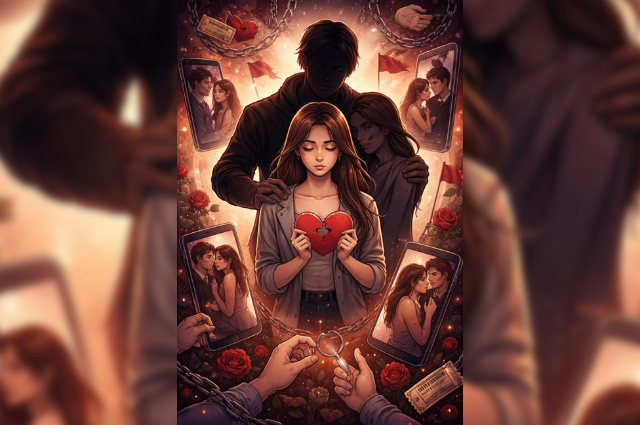
I couldn't live without you! Tum mere jeene ki wajah ho! I cannot breathe when you are not near! I have heard these lines so many times in the countless movies and dramas I have watched. It is honestly disturbing how many mainstream movies and books idolise the toxic ideals of love that centre around obsession, gaslighting, control, manipulation, subservience, dominance and patriarchal norms; the list is endless.
We are so accustomed to seeing men on the cinematic lens controlling and dominating their women, trying to make every decision for them because they are incompetent and in need of being saved by a man, that now any woman who refuses to conform to these ideals is condemned and hated.
I have often had conversations about how toxic love depictions in mainstream media are distorting our idea of love completely, and the most common answer I have heard is, Oh, babe, it is not that serious! It is just a book or a movie at the end of the day! OH, I am a sucker for red flags and bad boys! And yes, another answer I hear is that he is cold to the world and soft just for her. I can change him! I would gasp at these responses and wonder how the idea of toxic love is impacting the minds of the audience to the point where we are accepting bare minimum courtesy as tokens of love, and idealising problematic behaviours.
The Bad Boy, Cold Man, Morally Grey Lie
I am sure that all of us agree that movies like 365 Days, 50 Shades of Grey, and the After series portray the idea of toxic love. They revolve around problematic men who find fucked up mechanisms to survive and use the female protagonists as their healing balms, the reckoning to their storm, and ones responsible for fixing them. There is no other way a woman can have identity other than holding the door of freedom for men from their trauma. However, as I delved deeper into the problematic stances of pop culture media, I discovered more subtle implications of the lover’s dynamic that seem unproblematic at first glance. Still, upon closer examination, we see its true colours.
And yes, one of the most common ones of them is the Bad Boy craze, the Cold Man trope, and how can I forget the morally grey men trope! Let's look at the facts, shall we! If we look at The Vampire Diaries and take Damon and Elena’s relationship dynamic, the fact that we idolise their relationship is because their characters are played by two conventionally hot people. If we put them off the pedestal and look at the characters from a realistic lens, no one would want a guy to randomly sneak into a girl’s bedroom and watch her in silence. I mean, that is beyond creepy behaviour, and it can only be romanticised in an imaginative world.
While we all identify that stalking someone and staring at them while they sleep is not normal, the problem arises when these actions are portrayed as intense acts of attraction and love. I have always found myself dumbfounded when a girl is storming off, and the guy lifts her off on his shoulder and carries her like a duffel bag. Like bro, kidnapping is not sexy and the scary truth that mainstream cinema calls this romance is mind-boggling. The truth that agonises me even more is that a lot of people do not find these things problematic is something we need to think about. I hope this article sheds some truth in its essence.
Stalking, Control, and the Cinematic Blind Spot
Let's talk about some popular dramas and how they propagate the ideals of toxic love. If we take Twilight for a second, Edward stares at Bella for ages and then starts following her everywhere she goes. If you take the vampire and mystery air out of the picture for a second, you realise how obsession and stalking are being normalised and mistaken for love. The creepiness in its plot immediately becomes starkly evident.
It is not just Twilight, if you look at mainstream young adult romance books for a second, the rich Ceo falls in love with the simple and sweet girl, makes it his existential mission to shadow her, make all her life decisions, leave all his work and become jobless for her, following her like a lost puppy and win her heart. As a real CEO would actually risk his entire company’s fortune for the love of his life, we need to stop idealising unrealistic expectations of how love should be. Love in real life does not look like grandiose gestures of extravagance and one devoting their entire life to another.
Another trope that I absolutely despise is the fix-me trait. Where a young girl who knows nothing about the world meets a guy with unhealed trauma, and she makes it her life’s mission to fix his life. I am sure we have all come across at least one drama, movie or series that has idealised this trope, and it is high time we need to stop this. Because trust me, it is no one’s job to fix another person’s trauma or their life. No one is magically going to come into your life and fix your issues; it is you who needs to take responsibility for your shit. I am a big K-drama girl, and if you are too, I know you must have experienced second lead syndrome many times.
I have lost count of the number of times I have liked the green flag, good-natured second lead, who I have yearned for the main lead to end up with. But as always, the movies want the chaotic, selfish and problematic first lead to get the girl. I love Yeh Jawani Hai Deewani, and for the longest time,
I loved Bunny and Naina’s couple. But as I grew up and got acquainted with the truths of the world, I wished Naina would call Bunny out on his selfish behaviour and would much rather choose herself or Vikram. The movie revolved around Bunny and his selfish pursuits of everything he wanted, and not once did the movie talk about Naina’s life and her ambitions. Why does the life of a female character always revolve around a male character's life and his dreams?
The Ideal Woman Myth: Silence, Sacrifice, Submission
Another regressing yet highly depicted notion of our dramas is the woman sticking out with the man till the very end, no matter how poorly she is treated, because it is the job of a woman to love her husband/boyfriend till the very end. I gasp at how people still hold the vision of an ideal woman as one who is subservient, submissive and soft, one who does not defend herself and silently bears through the entire torment. Anytime a drama shows a woman standing up for herself and leaving the toxic man behind, I feel pride about this act of resilience.
Whether we talk about bad boy behaviour, or the cold me rude with the world type of relationship, or the bare minimum in the dynamic, mainstream media holds immense power in the way it shapes young minds around the ideals of love. The biggest problem that lies in this is the way it desensitises problematic behaviours and passes them off as the foundational stances of how love should be.
I understand how this article feels like a controversial rant, one that you were unwarned about. But trust me, when people grow up watching problematic behaviours as acceptable standards of love, it shapes their psyche in ways they do not know, and they end up accepting toxic treatments as love. Engaging in the counterfeited narratives of toxicity that is labelled as love sells the narrative that broken people need other broken ones to fix their scars.
But truth be told, in reality, these people can inflict deeper wounds that continue the cycle of hurt. So I hope after reading this article, you do not let the toxic ideals of propagated love dictate your standards; rather, you make your own. Let the love you find for yourself be the one that feels calm and not chaotic, like the embrace of warm coffee on a winter morning.