
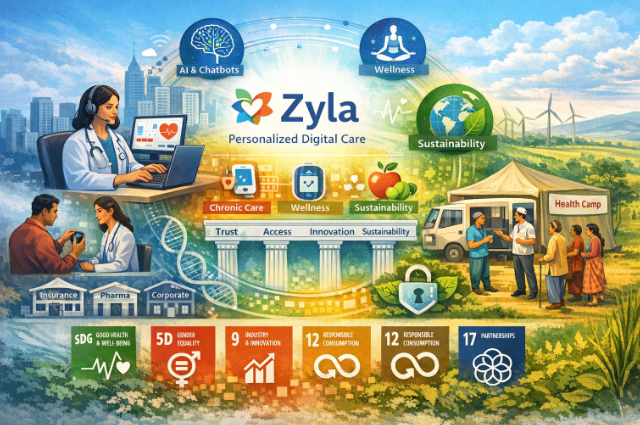
The moment when a need begins to crystallise in a patient is soft and almost imperceptible. For instance, for a diabetes patient, for a hypertension patient, or for someone improvising through the unknowns of post-COVID recovery, the need for continuous, compassionate, individualised care becomes more than service-delivery; it becomes a lifeline.
Zyla Health was born from one such moment of awakening: founder Khushboo Aggarwal's father suffered a cardiac event, and she became aware that health systems that serve patients in India often transition chronic patients into a state of strandedness between hospital visits, medication regimes, and lifestyle alternatives.
This project aims to discover how Zyla operates today: how it is made, how it is marketed, and to evaluate what it excels at and where the challenges lie. It also explores suggestions for effective marketing that is kind, sustainable, and environmentally conscious.
Zyla Health's Product Profile
What is the product?
Zyla Health is not a singular pill or device, but it is a care-management platform. It provides personalised and continuous tracking of chronic and preventive health conditions, including diabetes, high blood pressure, cholesterol, women's health issues (such as PCOS and thyroid disorders), post-COVID medical recovery, and conditions affecting the kidneys and liver, among others. (zyla.in)
The product is delivered through technology (an app and AI/NLP-based chatbots) with a team that includes in-house doctors, paramedics, and care managers. It bridges disease protocols, lifestyle interventions, diagnostics, adherence to therapy regimens and behavioural interventions. (Google for Startups)
Mass-produced or class-produced?
Zyla sits somewhere between mass and class produced. It is mass-produced in terms of reach - aimed at millions, used in various Indian cities, across conditions, with corporate and insurance clients, and has even expanded internationally to Southeast Asia. (Express Healthcare) But it is “class produced” in that it is personalised in its offerings: care journeys are different; monitoring intensity, interactions, and health protocols will vary depending on risk, the nature of the condition, and the available resources. In this sense, it is not a 'one-size' fits all, but its offerings are more bespoke than mass.
Consumer utility status
- Zyla's services have high utility status because if you are a patient with a chronic disease, it's not optional; it's remedial, preventive, and often life-saving. Zyla reduces hospitalisations, improves health, and alleviates costs, especially for those who otherwise are bound to return to the clinic, the emergency room, or have no continuity of care. For healthy or mildly unwell, Zyla's wellness, preventive and risk assessment has utility too. Inputs that secure the basic raw materials for the product.
- In this case, “materials” is slightly more metaphorical: it is developed using medical protocols, data, software infrastructure (servers, apps, AI/ML models), a human workforce (doctors, care managers), diagnostic/monitoring (lab tests, sensors, reports), and communication (chat, phone, app notifications). Inputs also include partnerships with insurance companies, with pharma, with corporate clients; regulatory approval; content creation (nutrition, lifestyle guidelines); and multilingual support. (zyla.in).
- Ease/difficulty to acquire raw material inputs. Certain inputs will be relatively easy depending on the digital infrastructure, app development, and scalable AI models (though they require investments). However, challenges arise in obtaining quality medical data, hiring and retaining trained doctors and care managers, engaging in behaviour adherence measures by patients, partnerships with insurance or pharma, regulatory compliance process, upholding patient privacy, and facilitating lifestyle and behaviour change will all be more difficult.
- Green status (production, consumption, disposal) - This is more difficult to assess because Zyla is a digital service. On one hand, a digital platform gets around some of the physical-waste issues that result from mass-scale physical care (such as paper forms, emissions when patients must travel to clinics, etc.).
On the other hand, there are energy costs (e.g., collection servers, data-centres), possible device usage, environmental costs of diagnostics (e.g., lab reagents, packaging, etc.), disposal of electronic waste, and the data footprint is consideration too. The “green” attribute is in the middle: it is better than a lot of physical-only care models, but there is still a lot of work to do to operate in a truly sustainable fashion. - Changes or versions since inception. - Zyla is still aligned with its mission, but in the six years since its inception, it has changed significantly since its founding. Its offerings were originally focused on diabetes/heart health, and now it is offering preventive care, women’s health, post-COVID recovery plans, and support for multiple chronic conditions (like diabetes and fibromyalgia).
It has expanded from India to Southeast Asia and has augmented its partnerships by engaging the majority of health insurance, pharmaceutical, and corporate partners. The technology has matured - for example, it now offers AI/NLP chatbots, escalation engines, dashboards for doctors, and analytics. The mode of delivery has shifted more toward risk assessments, continuous monitoring, and predictive interventions. - Regulatory environment & government policy- Recently, India has pushed for digital health (Digital Health Mission, telehealth guidelines), and insurance penetration is growing. Policies toward data privacy, patient rights, and telemedicine are relevant. Additionally, public health programs for non-communicable diseases (NCDs) may either support or compete for Zyla.
Additionally, Zyla has to comply with privacy laws, data protection norms, and medical regulations, among others. Any subsidies, incentives for preventive health, insurance incentives (e.g., reduced premiums), etc., will also impact Zyla's operations.
Present Sales & Promotional Modalities Used by Zyla Health
“Sales modalities” is simply how Zyla reaches consumers/users and sells/markets its care services. “Promotional modalities” refers to how Zyla advertises, informs, persuades, raises awareness/trust, etc. According to a recent report, here are the approaches Zyla is pursuing:
- Partnerships with Insurance, Pharma, and Corporations
Zyla collaborates with insurance companies to provide their chronic care and wellness programs as part of insured health plans, which provides access to a large user base and reduces cost barriers for each user. (zyla.in)
Pharma partnerships also align with adherence to medications or drugs, by allowing doctors to incorporate Zyla into their care plans as a follow-up. (zyla.in)
Corporate wellness programs are another channel where companies offer Zyla’s services to employees as part of their wellness benefits. (zyla.in)
- App/Digital Platform, & AI/NLP Chatbot
Zyla has created a digital care platform with an AI chatbot, risk assessment engine, patient monitoring, dashboards, and more. This is a 24x7 platform. The care journey starts with a health risk assessment and is followed by personalised interventions.
- Customer acquisition through HCP recommendations, Doc clinics
Zyla works with participating doctors/clinics, who generally recommend or “prescribe” their digital care platform. (zyla.in) - Content Marketing, Thought Leadership, Online Webinars
Zyla, as a health-tech platform, has developed content in the form of blogs, online webinars, and articles to create awareness and provide education on the management of chronic diseases, lifestyle modifications, and risk reduction. - Digital Marketing / App Store Presence + Reviews
High scores on Google Play/App Store. Review volume. Likely some advertising on digital platforms. Trust = rating + NPS. - Promotional Incentives / Value Proposition through Reduced Hospitalisation Costs
Promotion of outcomes decreased hospitalisation, cost savings, improved health metrics, etc., as important proof points. Value to be shown to both end users + insurance/corporate partners. (ETHealthworld.com) - Geographic and Language Accessibility, Localisation
Considering India's geographic + language divisions, Zyla provides its platform in a number of Indian languages, localising care experience. In the expansion to Southeast Asia, local care teams, culturally adapted interventions.
Evaluation: Pros and Cons of Zyla’s Sales & Promotion Strategies
I will assess what is working well for Zyla and where I see potential gaps, the advantages and the disadvantages.
Advantages
- Personalisation & Trust - By centring around individual care journeys and utilising in-house medical teams, 24/7 support, Zyla is establishing trust. This is critical in health care, where trust is everything.
- Leveraged Partnerships - Insurance, pharma, corporate partnerships, etc., diminish the friction associated with user acquisition and costs. And they can help with scaling. They may also bring some legitimacy.
- Outcomes Evidence - Zyla can show reduced hospitalisations, measurable health improvements (HbA1c reductions, adherence increases), etc. This hard evidence enhances promotional messaging.
- Technology Integration & Scalability - Zyla is leveraging AI, chatbot technologies, escalation management, and risk threshold assessment to scale the business without proportionately scaling the human costs.
- Localisation & Multilingual Support - Zyla has a broad reach across India, and also has a reach in Southeast Asia because of its understanding of language and cultural barriers.
- Digital Presence & Ratings - Zyla has high app reviews in the app store, a high NPS rating, and a positive digital UX that has aided in word of mouth, trust, and organic growth. This also keeps down acquisition costs in ways that are favourable to offline-only channels.
Weaknesses / Challenges
- Cost / Affordability: While they may have insurance or corporate sponsorships, paying subscription or service fees can continue to be a barrier for many users, particularly if they are in a rural or lower-income bracket.
- Digital Divide: Requires a smartphone, internet access, and digital literacy. Many of the chronically ill, particularly older, rural, and non-literate people, may be excluded.
- Difficulty in Behaviour Change: Changing behaviours/lifestyles is difficult. Even if they want to do so, getting users to stick with whole foods, exercise (or abstain), and remember to take medications is a major challenge; too often promotional messaging overstates the "ease" of change.
- Privacy / Trust: Medical data, AI recommendations, and data privacy security all involve levels of trust. Zyla may feel they have strong procedures, but public perception may lag. A breach of trust via a data breach could have huge negative implications.
- Visibility / Differentiated Presence: More health-tech apps and chronic care platforms are popping up. Standing out involves much more than simply promoting a better technology or experience. Values, empathy, concrete evidence, and partnerships matter.
- Regulatory Uncertainty: India does not have a regulatory framework for digital health. Regulations around telemedicine, consent and privacy, data protection, insurance reimbursement, device classification, etc., can impact use.
- Shortage of Green / Environmental Brand Claims: Because the core service is digital, environmental concerns may not be as visible, and it is less frequently mentioned in promotional materials. There are also opportunities to improve in terms of green operational practices.
Modality 2: Green Health Branding and Sustainability Messaging
What: Promote “green” attributes in promotional identity. For example, promote the argument that digital care reduces travel and carbon emissions. Paperless records and smart diagnostics reduce waste. There is a commitment to renewable data centres, carbon offsets, and sustainable/eco-friendly packaging of diagnostic kits.
How: Develop “Green Health Report Cards” for Zyla’s operation in the annual report; label campaigns “Zyla Green Promise”. Utilise blog posts, social media posts, and infographic videos. We could partner with environmental NGOs to validate our claims. Provide “green badges” to corporate clients who adopt sustainable practices while using Zuor’s platform.
Why: Consumers value environmental sustainability when engaging with brands, especially younger, educated users. Appealing to sustainability is a way to differentiate and develop a moral reputation, which develops trust and loyalty for Zyla. Lastly, it may also attract ESG-minded investors and corporate clients.
Modality 3: Hybrid Offline-Online Outreach for Penetration & Affordability
What: Designing outreach programs for semi-urban and rural populations where access to the digital space is intermediate and disease burden is high (however, gap). Mobile Health camps/kiosks, tele-health booths in local clinics and district hospitals; health risk assessment booths; subsidised/sliding scale subscriptions for low-income users?
How: Work with local NGOs, primary health centres, Government health missions, and local health workers to introduce and register users; possibilities to use shared devices and community settings. Provide a free first month or trial programs; training based on the local language to use the app. Also offline materials: posters, pamphlets in the local language; radio segments.
Why: To reduce the digital divide for users who might otherwise not know or trust the digital space. Also, to build trust at the ground level, those who were acquired through community outreach generally produce more stickiness.
Modality 4: Trust & Transparency Campaign
What: Messaging centred around privacy, safety, clinical validation, measurement, and reporting codes of expected/delivered outcomes. Including sharing data on clinical outcomes (with anonymisation), peer-reviewed articles/blog posts, and user surveys and reports. Incorporating transparency in prices and terms of service where possible.
How: Sharing white papers and/or public reports; creating a “Zyla Evidence Series” in health-focused journals; publishing external audits, user dashboards that display anonymised aggregate data; FAQ videos or podcasts to address common fears (e.g., “What if my data is compromised?”; “How do I know the recommended approaches are valid?”)
Why: The foundation of healthcare trust is paramount; many users are uncertain in navigating health interventions from apps or digital resources. Promotion of transparent, evidence-based approaches dampens this scepticism while also mechanically limiting regulatory or reputational liabilities.
Integrated Implementation Timeline and Resource Use Over 6 months:
- Launch the storytelling campaign & trust/transparency pieces (content creation – little cost).
- At the same time, work on the green branding strategy, have a look at the operation for eco-footprint, and partnerships.
- Design offline programs, hybrid in a couple of districts and try them out.
- Iterate on feedback loops, particularly language and with rural audiences.
- Budget implications: a couple of key areas, content creation, community engagement, travel, partnerships, and our current digital infrastructure, are relevant in this space. Can you reuse content?
- Monitor & eval: metrics such as new user acquisition (especially from underserved areas), retention, user satisfaction, behaviour change metrics (medication adherence, lifestyle metrics), hospitalisation rates, cost savings.
Sustainable Development Goals (SDGs) and Zyla’s Alignment
Zyla’s impact should be viewed through the lens of global moral obligation, the United Nations’ Sustainable Development Goals (SDGs). These goals are not theoretical; they do indeed provide the ethical core for how businesses can actually create positive humanity.
SDG 3 – Good Health and Well-Being
Zyla’s core existence is now in direct alignment with SDG 3 as it promotes preventive health and chronic care management, relieving the burden on hospitals. Zyla democratizes access to medical advice so that users can lead longer, healthier lives. While it will bring care to thousands, millions will be left out of the digital safety net, and this inequity goes to the heart of what “universal” care really means.
SDG 9 – Industry, Innovation, and Infrastructure
Zyla is emblematic of the growing health-tech innovation in India and leverages AI/data/machine learning, demonstrating the growth of a digital health infrastructure in India. Innovation brings about responsibilities for strong digital ethics, data protection, and equitable access to health information.
SDG 5 – Gender Equality
Zyla addresses women’s health issues with conditions such as PCOS and thyroid health, and thereby is part of a gender-inclusive approach to healthcare. The irony, however, is that women, particularly in rural and low-income contexts, are often the least digitally enabled. Sustainable impact will require not just digital inclusion, but digital literacy.
SDG 12 – Responsible Consumption and Production
The digital model Zyla is based on naturally reducing paper consumption, transportation-related hospital emissions, and medical waste. The virtual consults reduce carbon consumption as well it's much closer to being considered responsible consumption. However, there are elements of sustainability hidden from view that must be mitigated: data centre energy usage, electronic waste, and the ethical use of AI.
SDG 17 - Partnerships for the Goals
Zyla exists as a partnership between insurers, pharma and corporates which fully embodies the main intent of SDG 17. However, sustainable partnerships must also include NGOs, government health mission programs, and community health workers as important stakeholders in the partnership to ensure coverage and access in the last mile of the healthcare network.
Contextual Policy Landscape and Review
The Indian government has made notable strides towards adopting digital health:
- The Ayushman Bharat Digital Mission (ABDM) is meant to develop a cohesive health ID and data framework.
- Telemedicine Practice Guidelines (2020) provided a framework for remote consultations.
- The Data Protection Act (2023) sets limits on the usage of patient data.
Zyla is operating in this changing environment, usually ahead of policy, although sometimes augmenting policy, otherwise.
The challenges encountered by Zyla's digital-first model are existential due to
- The regulation is ambiguous
- The privacy has unclear conditions
- The affordability is uncertain.
To be clear, Zyla’s model encapsulates the best of India’s entrepreneurial environment, nimble, human-centred, and innovative, but it should actively engage with public policy; otherwise, there is the risk of an "urban-only revolution.
If Zyla can partner with policymakers to develop a sustainable ecosystem for digital health, e.g. increased access to services that develop subsidies for digital health, increasing the participation of digital health more broadly in public health insurance, and developing terms of data governance that are transparent to stakeholders, it could evolve from being a brand, to a blueprint for digital health in emerging markets.
Key Takeaways / Lessons Learned
In thinking about this investigation, I have learned a few things:
Care is more than medicine: Zyla reminds us that health care isn't about diagnosis and prescriptions; it's about relationships and lifestyle and emotional and mental support, and being consistent. Often, promotional strategies that acknowledge human stories, vulnerability and consistency are more effective than industry claims of technical sophistication.
Personalisation is powerful but hard work: Personalisation takes time, money, human resources, and data. It is difficult to scale personalisation and maintain a sense of empathy for each consumer.
Promotion = trust + evidence + visibility: When we consider health products and devices (especially those that are digital), we often think of promotion in terms of claims on branding, advertising, or marketing only, or simply how many people we served. Promotion legitimacy comes from outcome, the clinical evidence, what are the credibility/integrity of the characters involved with the product, or can the promotion can sustain more than marketing slogans.
Sustainability can't be an afterthought: As we consume more digital health, the environmental and ethical footprint becomes greater as well. Green branding and ethically operating and supporting service platform(s), (servers, handling of data, waste, and energy consumption) will matter for regulatory, market, and conscience reasons.
Access and equity are important: We risk that technological health platforms will distribute only to those in privilege...those who are urban, who can read, who are connected to the digital world. If this equity gap becomes the norm, our ability to change health outcomes will not be realised at scale or with equity.
Policy, regulation, and partnerships are vitally important enablers: Without good regulatory frameworks for telehealth, data privacy, insurance reimbursement of preventive/chronic care, and so forth, all implications discussed above will continue to be impediments to the successful practising of consumerism in health care.
Did this project achieve its goals?
- Understanding on-the-ground realities: Yes - by understanding what Zyla does now, what partners it works with, what challenges it may face, I believe I now have an understanding of the business/institutional environment: regulatory, access to digital technologies, cost barriers.
- Deconstructing and reconstructing promotional mechanisms: Yes - I have mapped what Zyla is doing, understood the strengths/weaknesses, and offered new modalities that are congruent with a clean, green, sustainable ethos.
- Thoughtful reflection and authentic representation, I think so - I have reflected not just on what would work, but what wouldn't; considered the ethical dimensions; and acknowledged the trade-offs involved in strategy.
- If there was a protest, it was limited to: data availability for costs, user behaviour metrics, and detailed operational financials of the business; also, some of the promotional ideas may be unrealistic or costly.
Conclusion
Zyla Health comes from necessity and develops through care and innovation. It is a strong and promising example in India's healthtech wave. AI, partnerships, and digital tools are not transactional interventions, but journeys toward chronic and preventive care. Promotions that lean into stories, trust, sustainability, and equity will deepen their resonance. In the end, Zyla will be successful not merely by users or revenues, but by those lives nudged with better care: fewer hospitalisations, less anxiety, more good nights of sleep, greater confidence in health.
References
- Zyla – Google for Startups —
- Zyla Health expands personalised digital care model across Southeast Asia — Express Healthcare
- Zyla clocks 3X growth in 12 months, aims further expansion — The Economic Times / ETHealthWorld
- Zyla Health raises USD 1 mn in funding round led by Seeders VC — The Economic Times
- Zyla Health Raises Series A Funding To Accelerate Growth Across Insurance, Corporates and Big Pharma — Entrepreneur India
- Understanding the Link Between Health and Economic Growth — Harvard Kennedy School / Center for International Development
- The impact of health on economic growth: A narrative literature review — Health Policy (PubMed / NCBI)