
The Sound of the Monster
It is 2:00 AM in Dhuliyan, and the world should be silent. In most places, 2:00 AM is a time for deep sleep, for dreaming about the future. But in my neighborhood, silence is a luxury we cannot afford. I am lying in bed, staring at the corrugated tin roof of my home, trying to memorize the dates of the Battle of Plassey for my history exam tomorrow. But my mind is not on the history of 1757; it is on the terrifying geography of 2025.
Suddenly, I hear it. Thud.
It is a dull, heavy sound, like a massive sack of rice falling from a great height. But I know it is not rice. It is the sound of a massive chunk of soil—perhaps ten feet wide—separating from the mainland and crashing into the dark waters of the Ganges. I hold my breath, my heart hammering against my ribs, and I wait for the second sound. Splash.
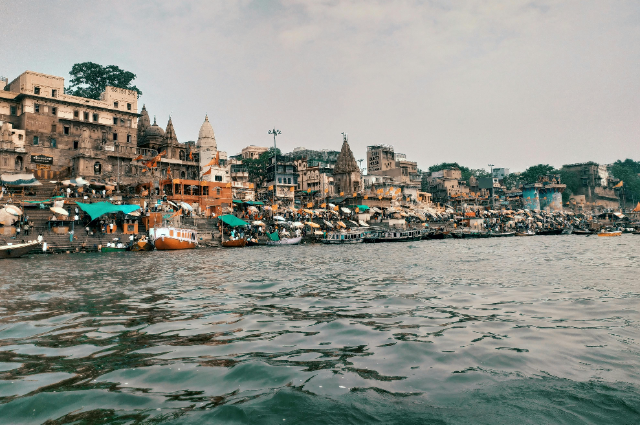
To a tourist visiting Murshidabad to see the Hazar Duari Palace, the Ganges is a holy river, a source of beauty and tourism. They take photos of the sunset reflecting on the water. But for us, the students living on the erosion lines of Shamsherganj and Suti, the river is not a mother. She is a hungry monster. And tonight, she is feeding on our land.
I get up and walk to the window. The moonlight reveals the terrifying truth. The old mango tree that stood fifty meters away yesterday is now standing on the very edge of the cliff. By tomorrow morning, it will be gone. This tree was where my friends and I used to sit and discuss our future, debating which university we would join. Now, that meeting spot has no future. It will be swallowed by the silt and the current.
This is my reality. I am a university student trying to build a career, trying to write articles and give speeches, but I am living on land that is disappearing. The irony is suffocating. In college, my professors teach me about "Nation Building," but at home, I watch my own village falling apart piece by piece. How does one focus on English grammar or political science when the ground beneath his feet is temporary?
The Geography of Fear
To understand my story, you must understand where I live. Murshidabad is a district of kings. It was once the capital of Bengal, Bihar, and Orissa. It is a place of rich history and architecture. But today, in blocks like Dhuliyan, history is being erased by geography.
The river Ganga (Padma) here does not flow straight. It swings like a pendulum, cutting into the soft soil of the banks. Every year, during the monsoon, the water rises. We do not fear the rain because it gets us wet; we fear the rain because it softens the earth. The soil here is sandy and loose; it dissolves in water like sugar in hot tea.
I remember my first year of college. I had a classmate named Rahim (name changed). He was one of the brightest students in our batch, always the first to raise his hand to answer questions about Victorian poetry. He had a dream of becoming a professor. One Monday, he didn't come to class. He didn't come on Tuesday either. When he finally arrived on Friday, he looked like a different person. His uniform was unironed, his hair was messy, and his eyes were red and swollen.
I asked him, "Rahim, where were you? Are you sick?" He looked at me with a hollow expression and said, "Asif, my house is gone."
He didn't mean his house was damaged. He meant it was gone. Vanished. Swallowed by the river in a single night. He told me how his family had to flee at 3:00 AM, grabbing whatever they could carry—cooking pots, a few documents, and his school bag. He was now living in a makeshift plastic tent on the roadside with his parents and three sisters.
That day, I realized that for us, poverty is not just about not having money. Poverty is about not having ground. How can a student focus on his studies when he is living in a tent made of blue plastic sheets, with the noise of trucks passing by all night? Rahim dropped out of college two months later. He had to work as a laborer to help his family build a new hut. The river didn't just take his house; it took his degree. It took his dream.
The Classroom as a Lifeboat
In our university, the lectures are about stability. We learn about fixed dates in history, constant laws in physics, and the permanent rules of mathematics. But for students coming from the "Char" areas (river islands) or the eroding banks, nothing is fixed.
Every morning, the journey to college is a gamble. The road we took last month might not exist today. I have seen classmates arrive with mud up to their knees, breathless and sweating. They didn't just miss a bus; they had to take a 3-kilometer detour through muddy fields because the river swallowed the main paved road overnight.
There is a silent, unwritten understanding among us students. When a student suddenly stops coming for a week, we don't ask the usual questions. We ask, "Is your house safe?"
I visited one of these temporary shelters last week to deliver notes to a friend. It was a humiliating sight. Entire families—grandmothers, fathers, children—were huddled together under tarpaulins. There was no electricity, no privacy, and no sanitation. But in the corner of one tent, under the dim light of a solar-powered lamp, I saw a boy from my junior batch.
He was sitting cross-legged on a plastic mat, cleaning mud off his Geography textbook. The irony hit me hard. He was studying the map of West Bengal, learning about the districts and the rivers, while the actual map under his feet was being erased. He looked up and smiled—a sad, tired smile that did not reach his eyes. "The river took the roof," he said, pointing to the sky, "but I won't let it take my exam result."
That moment changed me. It made me realize that education in Dhuliyan is not a hobby. It is not just a path to a job. It is a survival strategy. It is the only thing we can own that the river cannot touch. The water can dissolve our bricks, it can wash away our gold, and it can destroy our crops. But it cannot wash away the concepts we have learned. It cannot drown the knowledge in our heads.
The Mental Toll of Uncertainty
People talk about the economic loss of river erosion—the loss of land, crops, and houses. But no one talks about the psychological loss. No one writes articles about the anxiety of a 19-year-old student who goes to sleep every night wondering if he will wake up in his bed or in the water.
This fear is a constant background noise in our lives. It affects our concentration. When I sit in the library, trying to read a novel, my mind drifts. I worry about the monsoon forecast. I worry about my father, who stands by the riverbank every evening, watching the water level with a look of helplessness on his face. This chronic stress is invisible. You cannot see it on a mark sheet. You cannot see it in a scholarship application. But it is there, weighing us down, making every assignment feel twice as hard.
And yet, we persist. We study harder than anyone else. Why? Because we know that our diplomas are our passports. We know that if we can get a job—a government service role, a teaching position, a corporate job in Kolkata—we can move our families away from the edge. We can buy a small plot of land two kilometers inland, where the "Thud" of the falling earth cannot be heard.
A Plea to the World
As I write this conclusion, the sun is setting over the Ganges. The river looks beautiful now, orange and gold in the dying light. It is hard to believe that something so beautiful can be so cruel.
My family looks at the sky with worry, calculating how many feet of land remain between our doorstep and the edge. It is a terrifying way to live. But in this chaos, I have found my anchor.
I am writing this article not to ask for pity. We do not want your pity. We want you to see us. When you see the statistics of "Literacy Rates in Rural Bengal," remember that behind those numbers are students studying in tents. When you hear about "Climate Change Refugees," remember that they are not just faces on the news; they are my classmates, my friends, and potentially, me.
The Ganges can swallow our farmland. It can pull down the walls of our concrete homes. It can wash away the roads that lead to our college. But it cannot wash away the ambition in my heart.
For students like me in Murshidabad, education is an act of rebellion. Every time we open a book while the ground shakes beneath us, we are fighting back. We are telling the river:
"You can take my land, but you cannot take my future."
I do not know where my family will live next year. I do not know if we will have a roof or a tent. But I know that I will be holding my degree. That is the only solid ground I have left. And for now, that is enough to keep me standing.