
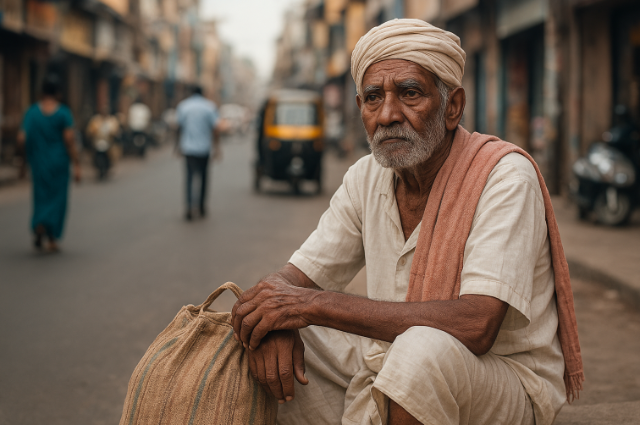
A senior citizen in India is typically someone who has retired from active service, often roaming the streets to buy the bare necessities, waiting for the children to spend a few days with them at the year's end. Does he really matter to anyone? Whatever the people say about social inclusion and respect from seniors, these do not change the basic condition of society.
The man who was considered a useful, productive asset is hardly offered any productive work. Barring a few who have some wealth in the banks, a senior is not in a position to donate money generously to the local club or an NGO, and that is why nobody takes his opinions seriously. Nobody comes to his rescue except one or two fellow seniors. He belongs to a minority community in the sense that senior citizens are now outnumbered in any community by the burgeoning new generation. Therefore, it becomes convenient to sideline seniors from major activities and decision-making processes. This is what happens in most Indian communities. The question is, can such acts of sidelining the seniors really help society? Can India be a USD 30 trillion economy by 2047 by ignoring the productive capacity of seniors, which does not necessarily diminish significantly after 60 or 65? Look at our politicians. At ripe old ages of 75 or 80 and even beyond, they are touring across the country and beyond, addressing gatherings, attending meetings as policymakers, and surviving stressful situations. If politicians can, so can others. If the seniors can take care of their health in post-retirement life, they can excel in almost all fields. The question is, does the nation have the sagacity to use the power of the seniors?
No developed country is putting seniors to unproductive use.
No country has been able to grow economically or socially by undermining the abilities of its seniors. You can remove a man aged 60 or 65 from the workforce, but by doing so, you increase the burden on the younger people to start funding the survival of a larger number of seniors. At age 65 or even at 70 or 75, a man can remain productive albeit at somewhat reduced intensity. But, with rich experience and efficiency, they can remain equally productive as the younger workforce. The society and the government must find out how the skills and experience of seniors can be leveraged to add value to society. The health care experts say that everybody should now be considered young up to the age of 65. People in the age bracket 65-80 should be considered middle-aged. One should be considered old only at the age of 80 and beyond. Advancements in medical science have made this possible. The problem is, when you are made to consider yourself as old, you really accept that suggestion and start behaving as if you have already lived your life. If you are encouraged to work, play, and move around without thinking too much about your age, you can really do wonders. Senior people around the world are excelling in all walks of life, be it sports or music, or business, even at very advanced ages. People above the age of 80 are running full marathons. Scientists nearing the age of 90 are winning Nobels. What is happening elsewhere in the world can happen in India too.
The Seniors here are made to think that they are Old.
The problem starts when the seniors are advised to lead an armchair life, invited only to cut ribbons to inaugurate a program, and requested to hoist the national flag. All this means, seniors are considered of ceremonial value only. By underestimating the value of the seniors, a community fails to make the best possible use of the experience and expertise of its seniors. By excluding seniors from the decision-making process, society is continuously making wrong policy decisions and facing consequences. The senior individuals may not be able to work eighteen hours a day, but can do a high-quality job even in the limited hours of work they put in. The seniors are found to be more committed and disciplined in their work than others half their age.
In the case of a business entity, when senior people are forgotten after their retirement, the institutional memories are lost forever. By advising a senior person only to “enjoy” post-retirement life, the organisation takes up a difficult task to rebuild years of valuable experience, which is both onerous and costly. An experienced senior can never be replaced with a novice in the trade. By sidelining the seniors, an organisation sends a message that it does not believe in continuity.
This is not the hallmark of any mature, inclusive society. Respecting a senior person is laudable. But forcing seniors to forget working productively and spend the remaining life in Bhajans and Teerth-yatras (pilgrimages) is not expected of a nation that aspires to be a Viksit Bharat.
Let’s learn from the nations that are already developed.
All of Europe, including Scandinavian countries and Japan, values senior citizens highly, and that is one reason these countries are considered more inclusive and prosperous than others. For example, most Japanese organisations make fresh job contracts with the employees who reach the age of retirement. This is not mandatory for all retirees, but most of them prefer to continue working. Under these new contracts, the retired employees can work up to the age of 70. So, skills remain within the organisation. Senior employees work at lower wages but with greater flexibility in their working hours. In fact, various flexible roles are designed to suit seniors' abilities and expertise. The workstations are redesigned to help older people work comfortably. The government provides tax benefits to the organisations rehiring retired employees. Various school support work and clerical work are also handled by seniors up to the age of 80 very efficiently. The seniors are even given support to set up micro-enterprises and consulting ventures based on their work experience. Do Japanese seniors find work after retirement painful? Not at all. On the contrary, the Japanese enjoy the highest longevity in the world, with millions of centenarians living happily.
The whole of Europe is senior-friendly. They do not treat the seniors as just the beneficiaries of social welfare schemes but as productive assets. Seniors are assigned roles requiring experience, e.g., consulting, governance, and teaching. In most European countries, the labour force participation rate is very high in the age group 55-74. Getting some part-time work after retirement is not too problematic. Seniors are a fast-growing group in business creation there. Experience, network, and financial stability help this group succeed in business post-retirement.
India Needs Development, not just GDP
Today’s India is euphoric about GDP increasing at a 7-8% rate, the highest among larger economies. It also makes our economy the fourth largest in the world. This is really good news for the country. GDP really matters. But what matters more is development. Growth is just one component of development, and it is sustainable only when accompanied by a high per capita income, opportunities for learning and employment at all ages, availability of healthcare facilities for all citizens, social security, and proper elderly care. There are many more indicators of development, but I have selected only a few to get our discussion on the subject going forward.
In terms of per capita income, India ranks 125th in the world. One reason why we can not grow sufficiently in per capita income is that we fail to include women and senior citizens in the workforce. By depriving senior citizens of the right to work in their chosen fields, we decide to lower the GDP and consequently the per capita income. A growth in GDP does not necessarily benefit the seniors. In fact, the benefit does not reach most low-income segments. The economic activities that bring increased GDP happen without involving many of them.
Increased GDP does not result in an increase in skill-building activities and employment opportunities. In developed countries, senior individuals are encouraged to acquire new skills that fetch them high-productivity jobs. Indian seniors can also be productive. They may not be entitled to government jobs. But, private sector can give them employment opportunities on a contract basis. Will seniors be interested in taking up jobs? Many of them will really be interested. Being a senior does not mean he has zero responsibility to his family. Many seniors have handicapped dependents at home. Special children are visible everywhere. Seniors happily re-engage themselves in work for the benefit of their families. They also work in their own fields to make a contribution that they could not make earlier.
Availability of proper healthcare facilities and social security for seniors is the need of the hour. Increased GDP has not improved these yet. Ayushman Bharat exists for medical treatments that require hospitalisation. What is required for seniors is preventive health check-ups, treatments that are expensive and exceed the limit of Ayushman Bharat. Why do seniors not have enough money to fend for themselves? That is what the votaries of the free market economy may argue. They will do well to keep in mind that many of these seniors dying in neglect had spent their entire money on giving their children a decent education and healthcare. This is the reason why they could not save enough for their own golden days. No developed country forgets the contribution made by its seniors in their younger years to build better societies.
Increased GDP has not improved the longevity of Indians, which hovers around 70, while it ranges between 80 and 85 in developed countries. The developed countries take better care of their seniors, who are happier, wealthier, and healthier. The seniors should not just be given seats in buses and trains; they should be offered earning opportunities in their domains. The seniors have to be encouraged to eat healthier and stay active. The government should think beyond offering insurance schemes. Most insurance schemes are activated only if a senior requires treatment for a major disease. The seniors need heavy discounts on expensive drugs and diagnostic tests, too. The number of senior citizens will increase very fast in the next two decades. If they are allowed to remain unproductive and are marginalised in their community, we will get a very insensitive India in 2047. The growth of GDP that we are proud of today may not remain sustainable. Above all, growth without the development of the living conditions of the seniors will not be a matter of national glory.