
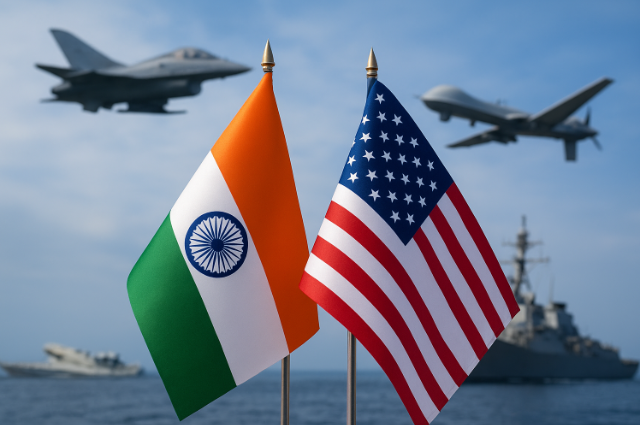
The India-US relationship is often condensed to a post-Cold War emergence, an effective convergence against a common threat to geopolitics. The inherent significance of such a pact, though, is based on a historical imperative, a mutuality born not only by direct expediency but by a similar, foundational structure of democratic tenets and convergence of strategic points of view on expanding world governance. The two countries had a certain level of distance in the past several decades, separated by geopolitical agitation, American liking of Pakistan, and Indian dependency on Soviet-era non-alignment. After the downfall of the Soviet Union and the economic liberalisation of India in 1991, the partnership entered into a period of transformation phase, after which it sped up significantly into a Major Defence Partnership and a key economic axis. This is a major reorientation, which has resulted in historic compromises over the last twenty years, going beyond what ordinary alliances represent, and no more than a reaffirmation that the stability of the Indo-Pacific and more globally the architecture in which the world economic system will be based, is rooted in the sound, mutually beneficial symbiosis of the oldest and largest democracies in the world.
This detailed discussion holds that the India-US partnership is the most quintessential bilateral relationship of modern times. It is both a pillar of security in the world by enhanced defence collaboration and a dynamic driver of economic supremacy through trading and technological unification. The convergence and independence are present in a calculated and methodical balance, defining the relationship. More importantly, strategic independence, the multi-alignment policy adhered to by India, will no longer be perceived by the United States as a hindrance but can be seen as one of the points of strength, giving the partnership credibility and accessibility to the rest of the Global South. This partnership goes beyond a transactional relationship; it is transformational, whereby the norms, technologies, and supply chains of the 21st century are to be modelled so that they are favourable to open rules-based governance.
This relationship will, in turn, be carefully dissected as explained in the following sections. The discussion shall move beyond historical context to explore the profoundness of historical foundational agreements, potential revolution in contemporary technology transfer-advanced weapon systems like the Javelin missile, as well as strategic drones- the complexities and pathway of development of the trade relationship, and the overall contribution of the partnership as developing a rules-based international order to the emerging geopolitical challenges. The actual richness of this cooperation is quantified not only in billions of deals but in the irreplaceable strategic trust earned over time, creating a shared vision of how to be secure and economically robust, as well as create democratic leaders.
The Defence Pillar: Buyer-Seller to Co-Development and Interoperability.
Defence relationship development is the strongest and the most open signifier of strategic credibility between New Delhi and Washington. The process by which India is becoming less dependent on Soviet / Russian military equipment and more intertwined with advanced U.S. defence systems is a seismic change in its security system and power demonstration. Such a change is supported by a set of established arrangements and an intentional search for high-tech transfer technology, and thus radically changing the style of how the two armies plan, communicate and act as one unit.
A. The Foundational Agreements: Architecture of Strategic Trust and Interoperability.
The legal and procedural basis of integrated military cooperation is laid by the implementation of four so-called Foundational Agreements. These papers formally take down the bureaucratic and security barriers that have traditionally hindered real strategic alignment in order to allow the relationship to advance beyond mere defence sales into an improved ability to share operations. The fact that all four accords were signed successfully is a tribute to the pinnacle of political dedication between the two capitals.
General Security Of Military Information Agreement (GSOMIA) (2002):
It is the critical preliminary step in this agreement that allows the safe exchange of classified American military technology and intelligence. It is relevant because the necessary legal framework for discussing and transacting with sensitive U.S.-origin equipment is found. Without the GSOMIA, the further advanced level of technology sales and transfers, the main activity of the current partnership, would have been impossible. It laid the basis of the first level of trust required to achieve strategic depth.
Logistics Exchange Memorandum of Agreement (LEMOA) (2016):
LEMOA allows the armies of both countries to logistically resupply and service their bases, including fuel, spares, and services, in one another. This is a decisive contribution to force projection. LEMOA significantly enhances the interoperability of the two military forces, especially during the long-established deployments, proving the interdependence on the continuity of operations at the broad waves of the Indian Ocean Region (IOR) and the entire Indo-Pacific. Whenever Indian naval vessels are going around Guam, or when the U.S. aeroplanes land on Indian facilities, LEMOA guarantees the smooth and quick aid to enable them to stay longer at sea and in the area.
Communications Compatibility and Security Agreement (COMCASA) (2018):
Through COMCASA, India can acquire secure communication and data-sharing systems provided by the U.S, so that military commanders can communicate safely when acting jointly, and so that an American-provided platform (e.g. the P-8I maritime patrol aircraft or the C-17 strategic transport) can realise its full potential with encrypted U.S. communications and data satellites. This framework will ensure that tactical and strategic intelligence is shared in real-time, which is a requirement of modern warfare conducted by networks, and increase the ability of India to liaise with the U.S. forces when carrying out high-value surveillance or humanitarian aid and disaster relief operations.
Basic Exchange and Cooperation Agreement for Geospatial Cooperation (BECA) (2020):
BECA allows access to sensitive U.S. geospatial intelligence, high-accuracy satellite information and navigation products to India. This intelligence plays a very key role in enhancing the accuracy of Indian cruise and ballistic missile targeting, drone navigation, and situational awareness in general. The United States gives this sensitive information access, thus sending a message to India that it deeply trusts that India will play its strategic role, changing India to be a precision strike power, an important tool of strategic force multiplier in any disputed setting.
The total realisation and working trial of such four agreements will be a declaration of joint strategic vision, bringing a relationship to another level that was hitherto used by the NATO allies. This allows advanced cross-service joint planning and real-time intelligence fusion, and execution.
B. The New Wave of High-Value Technology Transfer: The New Era of Definitions.
The new generation partnership is not only marked by the big acquisitions but an agreement that involves the transfer of technology according to the Aatmanirbhar Bharat (self-reliant India) campaign of India. The driving power of this paradigm of co-development and co-production is mostly provided by the Defence Technology and Trade Initiative (DTTI), a phenomenon that aims to avoid the bureaucratic barrier and focus on flagship and futuristic projects.
1. The Javelin Missile System and Anti-armour Strategy.
The early discussions with regards to the Javelin Anti-Tank Guided Missile (AT) were constrained due to the strict U.S export regulations due to the advanced fire and miss capabilities of the missile. However, a larger strategic background is necessary. The United States has sought to pursue a policy whereby it has sought to enhance India in the areas of its kill-chain capabilities, which entail the combination of intelligence, surveillance and reconnaissance systems along with precision strike weaponry. The effectiveness of battlefields is dependent on systems like the Javelin or its analogues. This discussion, leading to the decision to provide India with similar third-generation or fourth-generation ATGM equipment, whether directly or through embedded technology in other systems, proves that the U.S. has resolved to strengthen the land warfare capabilities of India and specifically in the high-altitude, mountainous terrain. This effort guarantees India the necessary deterrent to deal with the mechanised and armoured threats along the disputed borders. The licensing of the transfer of advanced terminal guidance weapons and related technology, as demonstrated by the state-of-the-art artillery shells like the Excalibur, is are indication of the growing comfort level of the U.S. as regards to sharing previously closed, battlefield-defining capabilities.
2. The SkyGuardian MQ-9B Drone: Strategy-Recon Centrality.
Perhaps the most significant defence acquisition of the current generation is the proposed purchase of 31 MQ-9B High Altitude Long Endurance (HALE) Remotely Piloted Aircraft Systems(RPAS) to the Indian Army, Navy and Air Force, which is worth more than 3.1 billion dollars and can provide a revolutionary change in operational capacity.
Strategic Capability: These HALE drones offer incredible persistence and range, such that the drones last a day plus, which is indeed ISR's every time they need long maritime domain awareness, such as the entire Indian Ocean, but what is far more important is that they can also cover long distances across the Himalayan borders. They therefore counter a critical gap in India of being able to do real-time all weather strategic reconnaissance, and enhancing the intelligence collection process and deterrence.
Technology Transfer: Notably, the contract brings in Maintenance, Repair and Overhaul (MRO) centres in India, developing an indigenous ecosystem in the strategic platforms. This is a significant advance in the spread of technology on which strategic excellence is based, and changes the emphasis on simply obtaining platforms to provide sovereign sustainment and, finally, improvements.
3. The Crown Jewel of Trust Jet Engine Technology Transfer (The Crown Jewel of Trust).
The agreement between General Electric (GE) and Hindustan Aeronautics Limited (HAL) on the co-production of F414 fighter jet engines in India is a milestone of the partnership in this stage of the partnership. Under this pact, the U.S. assumes eighty per cent of what is known as the core manufacturing technology, which is an unprecedented level of share with someone who is not a NATO member, but a treaty ally. This delivers a massive strategic message that goes beyond business.
Indigenisation and Sovereignty: Technology transfer is directly dispersed in the hopes of India to produce its own next-generation fighter aeroplane- Advanced Medium Combat Aircraft (AMCA) and Tejas Mk2. It takes away a stable technological Achilles heel as technology by significantly decreasing the dependence of India on outside sources of the most important part of the Indian strategy, the fighter-engine technology.
Trust indicator: The readiness of the U.S. Congress and the white house to go ahead with this transfer is the final indicator of strategic trust, which demonstrates a long-term interest in developing a genuinely self-help, militarily strong India. It becomes a co-producer of the defence industrial complex of India, not just a supplier of the United States.
C. Joint activities: Interoperability and Shared Security Vision.
The magnitude, intensity, and sophistication of combined military drills are an indication of the operational maturity of the alliance. Malabar, a quadrilateral naval exercise (involving Japan and Australia since then), Yudh Abhyas (land forces) and Cope India (air forces) are exercises that are part and parcel of achieving actual interoperability. The increasing complexity of these exercises, such as the complex multi-domain exercises involving information warfare, space collaboration, and maritime security make ensures that both parties can adequately adjust to high-end challenges, especially in the Indo-Pacific, where their two common interests intersect most significantly. The Tiger Triumph, a triple-service Humanitarian Assistance and Disaster Relief (HADR) exercise, illustrates the ability of the partnership to provide public objects at a worldwide level, which enforces the validity of the ethical and tactical appropriateness of their collaboration.
The Economic Pillar: Building Economic Leadership in the World, by Trade and Technology.
The economic side of the India-US relationship cannot be separated firmly from the defence relationship that gives long-term sustainability and resilience to the strategic relationship. As the two countries are quickly nearing 200bilateral trade and an ambitious target of 500billion by the year 2030, the two countries are placing themselves as prime economic drivers as well as value chains planners of the future world.
A. The Growth Trajectory, The Contradictions and Commerce.
With such huge potential, the trade relationship is often marked with periodic tensions with regard to market access, tariffs, and regulatory impediments, such as matters that touch on intellectual property rights and specialised agricultural tariffs. The anger expressed in recent times was over the withdrawal by the United States based on the Generalised System of Preferences (GSP) status of India, which had allowed it to import some goods duty-free. These concerns need unceasing bottom-line communication, although they are a minor percentage of the entire trade.
However, the pure impetus of trade and the vitality of the business sector guarantee the stability of the relationship and its further development of the relationship. The United States is still the largest trading partner of the United States in goods and services, with high-value, high-growth sectors:
IT and Services Dominance: The Indian IT industry and the huge Diaspora in America are the core of the American technological market. The presence of Indian companies and professionals adds billions to the American economy, and helps to propel the innovation of the American population, and could be seen as an effective people-to-people bridge and stabiliser of the economic relationship.
Pharmaceuticals and Healthcare: India is the pharmacy of the world, with a giant level of generic drug supplies, and its credible, high-volume supply chain is indispensable to the U.S. healthcare system, and shows a profound life-dependent interrelationship.
Energy Trade and Diversification: India is greatly expanding its consumption of U.S. energy, crude oil, and liquefied petroleum gas (LPG), which is contributing to to diversification of its sources out of the geopolitical hotspots, and, most importantly, assisting in setting the balance of the overall trade deficit, further integrating the economy. A long-term energy supply contract highlights this strategic change to a more basic market supplier, being reliable.
Investment Flows: The foreign direct investment (FDI) the U.S. has in India, especially in the areas of fintech, e-commerce, and renewable energy, is still strong, which indicates that it is confident about the long-term economic path and political stability of the country.
B. Initiative on Critical and Emerging Technologies (iCET): Redefining Economic Security.
Cooperation in the critical and emerging technologies (CET) defines the actual future of the economic partnership. One of the key frameworks is the iCET Initiative, started in 2023, which is a coordinating mechanism to enhance the government-to-government coordination on technology to build resiliency, transparent supply chains, and promote the development of a democratic technology ecosystem. It is not economic policy, but economic security policy.
Semiconductors and Electronics (The Flagship): The collaboration is such that there is an acute focus on increasing the manufacturing of semiconductor power within India, research and innovation, and talent pool. These comprise easing investments and joint ventures to put India as a trusted node in the international chip supply chain. This represents a direct strategic action of de-concentrating geopolitical global supply chains and creating a credible technology-manufacturing substitute.
Quantum Computing and AI: Cooperation. One of them is joint research, the establishment of standards, and building ethical standards of AI that put both countries at the forefront of the next technological revolution and make the world technology standards a value defined by democracy.
Aerospace and Advanced Telecommunications (6 G): Cooperation will focus on the incorporation of India into the global aerospace high-value supply chain and collaboration to develop safe and open-architecture next-generation communication networks to support the business and security requirements.
Space Cooperation: The recent Artemis Accords that India has joined have been an indication of a mutual peaceful and transparent space exploration, which has opened the doors to colossal commercial and scientific cooperation.
Through collaboration in research work, co-development and streamlined processes of transferring technology to U.S. companies, iCET is ensuring that India is not a participant in the global value creation network of the United States of America but a co-creator and manufacturing centre and that its economy is safely anchored within the high-value, democratic-led global value chain.
Strategic Convergence: Grounding the Indo-Pacific Order.
The deep integration grasping the domain of defence and technology is inherently driven by similar, though not always overt, strategic pursuit of the preservation of a free, open, prosperous and inclusive Indo-Pacific. This is a strategic point of intersection of the partnership.
A. The Quad and the Multilateral Frameworks.
The Quadrilateral Security Dialogue (Quad) is the most overt and vibrant multilateral expression of this collective vision. Its agenda, driven by the collaboration of India, the United States, Japan, and Australia, has gone far beyond the traditional security issues to respond to systemic local challenges:
Infrastructure and Connectivity: The Quad will support and fund clear infrastructure development programs in the region that are of high quality, therefore providing a viable and sustainable alternative to opaque debt-trap diplomacy and adhering to the principle of sovereignty.
Maritime Security: It will use joint surveillance, information sharing and exercises to ensure the security of the most important maritime routes and, as such, global trade is supported.
Climate Change and Health Security: The alliance has shown the ability to provide public goods on a large scale, such as the Quad Vaccine Partnership in the COVID-19 emergency, a way to address the challenges in the region by using joint actions.
The Quad, along with other fora like the 2+2 Ministerial Dialogue (the longstanding high-level process in which the Foreign and Defence Ministers of both the United States and India meet on one occasion a year), offers the required framework to coordinate the strategies and to be able to address the points of friction that are inevitable. This bilateral relationship ensures that the strategic relationship is lively and reactive to the fast-changing regional issues, such as in the case of the South China Sea or in the Western Indian Ocean.
B. Strategic Autonomy of B. India and the US Conditional.
One of the most successful and well-developed changes in U.S. policy has been the acknowledgement (and, in fact, the implicit support) of the long-standing policy of Strategic Autonomy (or Multi-Alignment) of India. The further development of ties between India and Russia regarding defence spares and the maintenance of the old platforms and overall U.S. relations with the country Iran (Chabahar Port) and Israel is now viewed by the U.S. establishment in a more realistic perspective. Such an adjustment is not viewed as hedging but as a recognition of the unavoidable fact of an emerging global power that has complex regional imperatives.
This development in the bilateral relationship recognises that a formidable, strategically independent India, one which cultivates a variety of partnerships, is in any case the most plausible gatekeeper of stability in South Asia and the larger Indo-Pacific. The earning of non-aligned international posture of India approves its ability to play a key role in central configurations between the U.S.-led Western security framework and the countries of the Global South, and thus making it a more useful and impactful collaborator to the United States on the multilateral front, such as the United Nations and G20.
The Obstacles and the Road to a Long-lasting Collaboration.
There is no such relation on such a huge scale that it would not be fraught with difficulties; contradictory spots require the active political will and approaches to delicate negotiation. To ensure that the partnership achieves the full transformative potential, the two countries have to navigate these complexities wisely and cautiously.
A. Overcoming Geopolitical Tensions and Trade Tariffs.
The first of the geopolitical balancing acts is the balancing between the bilateral relationship and the strong defence relationship that India has had with Russia, and the complex economic and geopolitical association it has with China. The United States, via the Countering America's Adversaries through Sanctions Act (CAATA), has maintained the ability to impose sanctions on nations that are seen to import major military equipment imported through Russia. When India announced that it would purchase the S-400 Triumf missile system, Russia, the United States had issued a waiver; however, the fact that they could be pressured in the future makes it a recurrent friction.
Besides, trade tariffs and related issues with access to the market, though controllable, exist. Continued negotiations of Uruguay Round steel and aluminium tariff wars, and of pragmatic “mini-deals" are evidence of a measurable commitment to the idea of achieving momentum toward the $500 billion trade target without waiting to receive a full-fledged Bilateral Trade Agreement (BTA). The ultimate solution involves the development of a BTA that is fair, equitable, and balanced, an agreement that will address the issues of the U.S. regarding intellectual property rights and tariffs, but protect the interests of the Indian domestic industry, which is largely made up of agricultural and small industries.
B. Breaking the Bureaucracy and Bullwalls on Export.
The ambitious goal of co-production that the Defence Trade and Technology Initiative (DTTI) has pursued has often been hobbled by a robust bureaucratic stasis not only within the amazing U.S. export-control frameworks, but also in India, where a lengthy and time-honoured process of defence licensing and procurement has crucially curtailed its success so far. The first and most important step to achieving the full potential of the concept of co-development is that the United States ensure a quicker, more thorough transfer of dual-use and sensitive military technology under its nominal designation, Strategic Trade Authorisation-1 (STA-1), to India.
As part, India needs to expedite its defence acquisition and integration systems and to revise its defence public-sector undertakings (DPSU), in order to assimilate and indigenise the technology handed over to it effectively. There is still the risk that the partnership will at times revert to lower levels of political focus and fall into a transactional partnership akin to a buyer-seller relationship. The impetus behind joint invention, as such, in turn requires structured, dedicated political attention at the very top of the establishments of the two governments to ensure the successful execution of radical programs like the jet-engine transfer.
The Irreplaceable Stick of a Pluralistic World.
The India-U.S. strategic partnership is not only an alliance of convenience, but an anchor of the new world order that has become the 21st century; it is a symbiotic relationship that cannot be done without. This strong relationship is based on strong demographic, economic and strategic grounds, and has been developed not through strict military treaty alliances but because of a democratic overlapping of interests and values, and in a mutual adherence to the principle of global stability.
The determination of the two defence interests in ensuring the safety of the critical sea lanes of the Indo-Pacific, as well as the exponential expansion in commerce, the spread of vital technology (iCET), and personal-to-individual relationships, places the two countries in an exclusive position to influence the worldwide security and economic outlook. The rise of India into power, as well as its quest to acquire strategic autonomy, combined with the technological and economic capability of the United States, creates a situation that leans more towards a more pluralistic, rules-based, and multipolar world- a needed moderation of revised geopolitics. The task lies in front of relentless execution: how to overcome the transactional obstacles in commerce, to achieve the full doubt extraversion to the co-evolution in the military, especially with breakthrough transfer technologies in the F414 jet-engine and the MQ-9B drones, and the constant political developments needed to propel a partnership that, according to all parameters, is the axis of world stability and the driver of democratic economic leadership.
The future of world security and even the economic prosperity is, in most aspects, being written in the joint utterances and tactical discussions of New Delhi and Washington; their ever-growing embrace gives out the greatest eloquent warning that the forces of democracy, openness, and free market economy will be the formation taking place in this new century.