
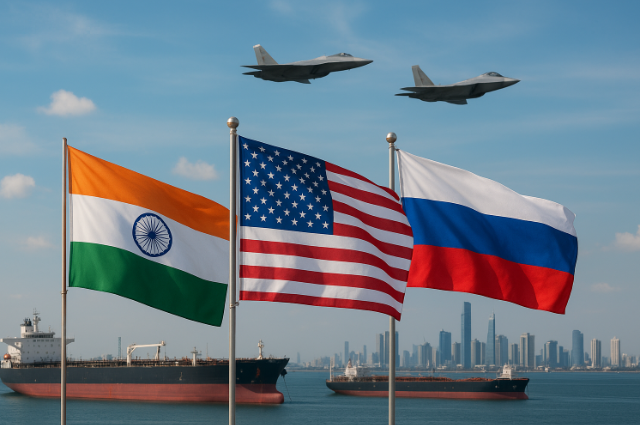
India’s ascent comes at a moment when global power is fractured, energy markets are volatile, and defence partnerships are being rewritten. This essay interrogates whether India is merely a global consumer of oil, weapons, and technology or a strategic hero reshaping international equations. Through case studies of discounted Russian oil and deepening defence ties with the United States, the analysis reveals how India’s choices generate market shocks, diplomatic anxieties, and strategic recalculations worldwide. The paper argues that India’s rise is anchored in multi-alignment, strategic autonomy, and a domestic shift toward Atmanirbhar Bharat and defence indigenization. These internal reforms spanning fighter jets, missiles, digital ecosystems, and green energy strengthen India’s capability to act as a predictable, independent system-shaper. Ultimately, the essay concludes that India is not being pulled by superpowers; rather, it is rewriting the global script, demonstrating that autonomy, not alignment, is the foundation of 21st-century heroism.
India today stands at the centre of global attention, admired, doubted, courted, and criticised at the same time. On one hand, international observers often frame India as a massive consumer, importing oil from Russia, procuring weapons from the United States, and acquiring advanced technologies from global suppliers. On the other hand, India increasingly projects itself as a strategic hero, navigating a complex multipolar world, asserting its autonomy, and shaping the rules of global engagement (Goldman, 2023; Pant, 2022). This paradox of perception forms the central tension of contemporary debates on India’s global role.
Recent developments make this debate especially urgent. India’s continuing oil imports from Russia amidst the Ukraine crisis have sparked scrutiny in Western capitals, while its defence cooperation with the United States signals an embrace of modern military capabilities without full alignment to any single power. Simultaneously, shifting global markets and the rise of multipolarity create both opportunities and pressures that shape India’s international identity (Chaturvedi, 2021). These events are not isolated incidents; they are forces actively reshaping how India is seen and how it sees itself.
The analytical conflict is clear: is India being shaped by global powers, or is India shaping them? Every strategic purchase, diplomatic engagement, or economic decision prompts debates that reveal contrasting interpretations of India’s agency. Every barrel of oil India buys, and every weapon system it tests, triggers anxiety in some capitals and excitement in others, highlighting the global stakes of its choices.
This debate is far more than academic. India is the world’s fastest-growing large economy, central to 21st-century geopolitics, and a key driver of the Atmanirbhar Bharat and Viksit Bharat 2047 visions. Its decisions influence not only domestic prosperity but also global energy flows, regional security dynamics, and the broader architecture of international power (Bajpai, 2020).
This article aims to illuminate these tensions. By analyzing India’s global purchases, exploring its multi-alignment strategy, and examining case studies of international reactions, it seeks to answer the central question: Is India merely a global consumer, or is it quietly rewriting the rules of global power? Through this lens, India emerges not just as a market or buyer, but as a strategic actor shaping its own future.
India in the Global Marketplace: Consumer or Strategic Power?
India occupies a unique and often contradictory position in the global marketplace. On one hand, it is perceived as a vast consumer, with enormous demand for oil, defence equipment, and advanced technology. Its market size alone shapes global strategies, compelling countries to adapt their pricing, supply chains, and diplomatic overtures to secure India’s attention (Goldman, 2023). Every purchase India makes from Russian crude oil to American fighter jets sends signals that ripple far beyond its borders.
Yet, to reduce India to a mere consumer would be misleading. Increasingly, India behaves as a strategic power, leveraging its market as a form of geopolitical and economic influence. Analysts describe this as the “buyer-power paradox”: while India buys from the global mall, it also shapes the mall itself (Pant, 2022). By selectively engaging with different suppliers and forging multi-aligned partnerships, India can extract concessions, diversify its sources, and maintain a position of strategic autonomy. This duality, consumed vs. creator, buyer vs. power-broker, defines India’s role in today’s international system.
The concept of a global marketplace or “geopolitical mall” helps clarify this dynamic. Just as a mall contains multiple nodes of influence, each offering distinct goods and services, the world today comprises overlapping spheres of energy, defence, and technology markets. India occupies a central node in this network. Its decisions on oil imports affect global energy prices, its arms acquisitions influence regional security balances, and its tech adoption shapes innovation flows. By positioning itself at these critical intersections, India exercises influence disproportionate to the simple sum of its purchases (Chaturvedi, 2021).
Historically, India championed non-alignment, striving to avoid entanglement in Cold War rivalries. Today, it has evolved into a power-centred actor, capable of shaping global outcomes while retaining autonomy. This is evident in its careful calibration of Russia–India oil deals, its embrace of US defence technology, and its selective engagement with emerging powers such as China and the Gulf states. Each choice reflects market leverage, strategic signalling, and the exercise of agency within a complex geopolitical economy.
In sum, India is neither purely a consumer nor solely a strategic architect—it is a hybrid actor, whose market decisions are inseparable from its geopolitical ambitions. Recognizing this dual role is essential to understanding how India navigates the modern world: as both a market and a maker of markets, a buyer and a power-broker, a nation whose choices reverberate across global oil fields, defence corridors, and technological networks.
Case study:
India Buying Oil from Russia
The ongoing Russia–Ukraine war has reshaped global energy markets, diplomatic alignments, and the calculus of national interest. India’s decision to continue buying oil from Russia has become a focal point of international debate, sparking both criticism and strategic curiosity. Western nations, particularly the United States and the European Union, reacted strongly, framing India’s imports as indirect support for a nation engaged in military aggression. Headlines questioned: “Is India funding the war or securing energy for its citizens?” (Bajpai, 2022).
Yet, from India’s perspective, the choice is rooted in energy security and economic pragmatism. As the world’s third-largest oil importer, India faces mounting domestic demand from its rapidly industrializing economy and expanding transportation sector. Sanctions on Russia led to a reduction in global crude supply, driving prices to unprecedented levels. By negotiating discounted deals with Russian suppliers, India simultaneously ensures affordability for its population, absorbs global market shocks, and diversifies its energy portfolio, critical elements in a country where access to energy underpins economic growth and social stability (Pant, 2022).
The tension between moral critique and strategic survival is stark. While Western capitals emphasize ethical responsibility and geopolitical signaling, India navigates a path that prioritizes domestic welfare and long-term national interest. Analysts describe this as strategic realism in action: India leverages its purchasing power to secure discounted resources, maintains relations with a permanent member of the UN Security Council, and subtly asserts its autonomy in global decision-making (Chaturvedi, 2021).
India’s actions also have significant global market implications. By absorbing Russian crude that might have otherwise been excluded from international markets, India mitigates price volatility and creates an alternative trading node for energy flows. This maneuver demonstrates India’s emergence as a market influencer, not merely a passive consumer, capable of stabilizing or destabilizing global oil dynamics depending on its policy choices.
Moreover, the decision underscores the buyer-power paradox: India is both a large consumer and a strategic actor whose market decisions reverberate internationally. Every barrel of Russian oil that enters Indian refineries is a statement of agency, illustrating that energy procurement is inseparable from geopolitics. While moral arguments dominate Western narratives, India’s calculus centers on national interest, economic stability, and long-term energy security, all essential for sustaining its rapid growth and strategic ambitions.
In essence, India’s oil imports from Russia exemplify the country’s pragmatic approach to global engagement. Far from being a passive consumer, India negotiates, leverages, and strategically positions itself at the intersection of morality, economics, and geopolitics. The decision invites debate, scrutiny, and occasional criticism, yet it also signals India’s emergence as a resilient, autonomous actor in a turbulent global marketplace—a nation navigating a fine line between ethical optics and strategic necessity.
India Buying Weapons from America
India’s defence procurement from the United States represents a pivotal shift in its military and strategic posture. Over the past decade, growing India–US defence ties have facilitated access to cutting-edge technology, joint exercises, and collaborative platforms, signaling a new era of strategic interdependence (Pant, 2022). These acquisitions are not merely transactional; they are calculated moves that allow India to modernize its armed forces, bridge technology gaps, and counter regional threats, particularly from an increasingly assertive China.
Russia, India’s long-standing defence partner, has expressed discomfort with this pivot. Historically, India relied heavily on Russian systems, from fighter jets to missile technology, as part of its non-alignment and multi-alignment strategy. The move toward American weapons has prompted speculation in Moscow and elsewhere: Is India drifting toward a Western alliance? Yet, India’s approach is coldly rational and strategic, rather than ideologically aligned. The country is not choosing a side; it is choosing capabilities, versatility, and long-term operational advantage (Chaturvedi, 2021).
This procurement strategy reflects India’s defence diversification policy. By spreading its sourcing across multiple partners, Russia, the United States, Israel, France, and indigenous programs in India, reduces dependency on any single supplier, mitigates geopolitical risks, and ensures uninterrupted modernization. In doing so, it exercises buyer power in the global defence marketplace, shaping the terms of engagement while maintaining autonomy (Bajpai, 2020).
Analytically, India’s purchases reveal a strategic logic that balances perception and reality. While Western analysts interpret these acquisitions as a tilt toward the US, India interprets them as practical tools to enhance deterrence, technological sophistication, and operational readiness. Each fighter jet, missile system, or surveillance platform is a node in a long-term military doctrine designed for flexibility, rapid adaptation, and strategic resilience. India is a chooser, not a follower; it aligns procurement decisions with national imperatives rather than external expectations.
The broader implication is that India is actively shaping its security environment, not simply responding to external pressures. By integrating American systems alongside Russian legacy platforms, India demonstrates that multi-alignment remains its guiding principle: partnerships are instruments, not shackles. This nuanced positioning challenges simplistic labels of India as a passive consumer, revealing a strategic actor leveraging global resources to construct a robust, future-ready military.
In sum, India’s defence engagement with the United States illustrates the interplay between market leverage and strategic autonomy. While optics may suggest a choice of alliance, the reality is a rational, long-term strategy, calibrated to maximize capability, minimize dependency, and secure India’s position as a central player in regional and global security flows.
Why Both Sides React This Way - The Real Motives:
Beneath the surface of international commentary lies a deeper, often unstated truth: India is no ordinary player in the global arena. The reactions of both the West and Russia to India’s energy and defence choices are shaped less by moral outrage than by anxiety over influence, leverage, and the evolving balance of power.
For the West, India represents a critical strategic partner in a world increasingly defined by multipolarity. Beyond shared democratic values or bilateral trade agreements, what they cannot say openly is that India’s alignment or non-alignment directly affects the geopolitical calculations surrounding China and regional security. Washington and Brussels are acutely aware that India’s decisions on oil imports, defence acquisitions, and technology partnerships have cascading effects on global markets, military balances, and diplomatic negotiations. The unstated anxiety is that if India drifts too far toward alternative partners or exercises full autonomy, it could reshape regional and even global equations (Bajpai, 2020).
For Russia, the stakes are equally profound. India remains one of its largest customers and economic lifelines, particularly in the defence and energy sectors. Beneath the surface, Moscow fears that India’s engagement with Western suppliers could weaken its bargaining power, erode historical ties, and diminish its strategic footprint in Asia. Russia’s unease is not rooted in ideology but in pragmatic concern over economic and geopolitical leverage. Every barrel of Russian oil that India redirects from global markets, every defence platform it procures elsewhere, subtly recalibrates the dynamics of influence.
At a deeper level, both sides share a common underlying fear: losing India as a pivotal node in a multipolar world. India’s growing economic clout, military modernization, and strategic autonomy position it as a “swing state” capable of tilting energy flows, defence balances, and diplomatic initiatives in ways that no single power can fully control. This centrality explains why India’s actions provoke intense scrutiny and sometimes sharp public commentary, even when its decisions are rooted in domestic imperatives.
In essence, the reactions of global actors reveal more about their own perceptions of power vulnerability than about India itself. The West and Russia alike are negotiating, testing, and calculating, attempting to anticipate India’s next move while safeguarding their own interests. India, meanwhile, navigates these pressures with deliberate pragmatism, exercising autonomy in its multi-alignment strategy, balancing partnerships, and leveraging market and strategic choices to shape outcomes rather than merely react to them (Pant, 2022).
Thus, the deeper motive behind global reactions is clear: India matters not only as a consumer or buyer but as a strategic arbiter in the global marketplace of power. The unstated anxiety, the strategic tension, and the careful calibrations all point to one conclusion: India is emerging as a central actor capable of influencing global balances, prompting both admiration and apprehension among world powers.
India’s Strategy: Multi-Alignment and Strategic Autonomy
India’s contemporary foreign policy cannot be reduced to the old paradigms of neutrality or Cold War-era non-alignment. Instead, it is defined by multi-alignment, a sophisticated approach that combines engagement with multiple global powers while safeguarding national interests. In this framework, India deliberately sits at the intersection of competing geopolitical nodes engaging the United States for defence technology, Russia for energy supplies, Europe for trade and investment, Japan for infrastructure and technology, and the Gulf for energy security (Pant, 2022).
This flexible geometry enables India to avoid overdependence on any single partner while extracting maximum strategic and economic advantage from each relationship. For example, the Quad alliance strengthens regional security and maritime cooperation with like-minded democracies, while BRICS participation maintains ties with emerging powers and reinforces South-South cooperation. Similarly, India’s simultaneous procurement of US arms and purchase of Russian oil exemplifies its non-block logic, showing that strategic autonomy is not rhetorical but operational (Chaturvedi, 2021).
At the core of this approach is the principle of sovereign pathways: India charts its own trajectory in global affairs, free from the compulsion to choose sides. Multi-alignment is not a hedging strategy; it is a calculated orchestration of partnerships, designed to strengthen India’s global position while retaining the freedom to act in accordance with national priorities. By balancing relationships, India creates nodes of influence that allow it to participate in shaping regional and global outcomes rather than merely reacting to them.
This strategy also serves a practical purpose: it mitigates risks arising from global volatility. Energy shocks, trade disruptions, or regional conflicts are absorbed more effectively when India maintains diversified partnerships. For instance, discounted Russian crude cushions domestic energy costs, while American defence technology ensures preparedness against evolving threats. In essence, India leverages its partnerships to secure strategic resilience, not ideological alignment.
In a multipolar world, India’s multi-alignment and strategic autonomy transform it from a passive participant into a decisive actor. Its foreign policy reflects rational, long-term calculation, integrating market leverage, military capability, and diplomatic engagement. This strategy underlines a fundamental truth: India is not merely a consumer of global resources but a creator of pathways, architect of influence, and shaper of its own destiny.
By occupying a position at the intersection of global power flows, India demonstrates that autonomy, flexibility, and strategic foresight are the pillars of its foreign policy. Multi-alignment, far from being reactive, is a proactive instrument, a deliberate and thoughtful design that ensures India remains central to global geopolitics while retaining the freedom to determine its own future.
Impact on India’s Defence Identity and Ethics:
India’s defence identity is deeply intertwined with its historical legacy of the Non-Aligned Movement (NAM), which emphasized independence of judgment, moral consistency, and civilizational diplomacy. Even as India navigates a complex multipolar world, the principles of ethical realism continue to shape its strategic choices: every decision, whether on defence procurement, energy security, or diplomatic engagement, is calibrated not only for efficiency but also for moral legitimacy (Bajpai, 2020).
At the heart of this approach lies moral autonomy. India refuses to be coerced into adopting the narratives or policies of other powers, whether Western or Eastern. Its civilizational self-confidence underpins a diplomatic culture that privileges sovereign decision-making over external pressure. For instance, purchasing Russian oil while engaging in US defence cooperation may draw criticism abroad, yet India evaluates each choice against the twin criteria of national interest and ethical consistency (Pant, 2022).
This ethical-philosophical foundation extends into India’s strategic ethics. Unlike reactive or transactional states, India’s foreign policy balances the imperatives of realpolitik with normative principles. Its engagement is measured: it seeks to maintain global stability, protect citizens’ welfare, and preserve moral credibility, even in contexts of intense international scrutiny. Here, strategic sharpness and ethical clarity are inseparable; India demonstrates that strength and morality are not mutually exclusive, but mutually reinforcing.
India’s evolving defence identity thus reflects a dual character: technologically and operationally modern, yet morally anchored. Its actions project a nation that can make hard, pragmatic choices while remaining faithful to enduring ethical principles. This combination of civilizational wisdom, moral consistency, and strategic acuity sets India apart as a nation capable of exercising global influence without sacrificing conscience, a truly distinctive defence ethos in the contemporary world (Chaturvedi, 2021).
In sum, India’s defence identity and ethics are inseparable from its broader foreign policy philosophy. By integrating ethical realism, moral autonomy, and strategic calculation, India asserts itself as a nation that is both responsible and resilient, shaping its role on the global stage with both strength and conscience.
Is India Being Used or Is India the Hero Managing Two Superpowers?
At first glance, India’s simultaneous engagement with global powers buying Russian oil while acquiring American defence systems may appear as a delicate act of balancing, or even being used by competing superpowers. Western observers worry that India benefits from discounted energy while Russia relies on India’s market to offset sanctions. Conversely, Russia fears losing influence if India leans too heavily on American technology. Yet, deeper evidence suggests that India is not a pawn but a choreographer, quietly rewriting the script of global power dynamics (Pant, 2022).
Both superpowers need India, but for different reasons. The United States seeks a reliable partner in Asia to contain regional threats, maintain trade routes, and uphold a rules-based order. Russia, facing economic isolation and sanctions, views India as an indispensable market for energy and defence. This dual dependence creates unprecedented bargaining power for India, allowing it to negotiate terms, extract concessions, and advance strategic autonomy without yielding sovereignty (Chaturvedi, 2021).
India leverages this position by exercising calculated discretion. It manages superpowers with a combination of diplomatic finesse, market leverage, and long-term planning, ensuring that engagement is mutually beneficial rather than coercive. The outcome is striking: India shapes expectations, choreographs competition, and maintains freedom of action, all while remaining strategically non-aligned in intent.
In practical terms, India functions as a system-shaper rather than a system-taker. Its energy choices influence global oil markets, its defence decisions affect regional power balances, and its participation in forums like the Quad, BRICS, and G20 alters diplomatic trajectories. By maintaining multi-aligned partnerships and carefully calibrated purchases, India demonstrates that influence is not measured solely by military might or economic weight, but by the ability to steer interactions between competing powers (Bajpai, 2020).
Ultimately, India’s role challenges traditional assumptions about dependency. It is neither coerced nor manipulated; instead, it manages the ambitions of others to serve its own strategic objectives, blending prudence, foresight, and ethical autonomy. India’s quiet diplomatic power, its capacity to choreograph the competition and rewrite the script of engagement, marks it as a true hero of strategic agency, capable of shaping outcomes in a multipolar world without succumbing to domination.
Global Comparisons
When compared with other influential middle powers, Turkey, Indonesia, Brazil, and Saudi Arabia, India exhibits both similarities and distinct advantages. Like these nations, India navigates a multipolar world by balancing regional ambitions, economic partnerships, and defence strategies. Turkey leverages its strategic location between Europe and the Middle East; Indonesia commands influence in Southeast Asian trade and maritime routes; Brazil shapes South American markets and regional diplomacy; Saudi Arabia wields energy leverage globally.
However, India’s position is exceptional in scale, autonomy, and influence. Its population size, economic growth, and technological capabilities surpass all these middle powers, giving India a unique capacity to affect global energy flows, regional security, and technological markets simultaneously (Pant, 2022). While Turkey or Brazil may negotiate leverage in specific sectors, India exercises multi-dimensional power, blending market influence, strategic partnerships, and ethical autonomy into a coherent approach.
India also distinguishes itself in strategic autonomy. Unlike middle powers that often lean toward a dominant global actor, India maintains multi-alignment, engaging the US, Russia, Europe, and Asia-Pacific states without yielding its sovereign decision-making. Its capacity to act as a swing state in multiple domains, energy, defence, trade, and diplomacy demonstrates a level of agency unmatched by comparable nations (Chaturvedi, 2021).
In short, India fits global trends of middle-power activism but surpasses them in scope and strategic sophistication. It is not merely participating in the global marketplace of influence; it is shaping it, emerging as a pivotal actor whose decisions reverberate far beyond its region, setting a new benchmark for what a middle power can achieve.
From Consumer to Creator: The Atmanirbhar Bharat Lens
The vision of Atmanirbhar Bharat or self-reliant India extends far beyond slogans; it represents a strategic transformation from dependence to autonomy and, ultimately, to global influence. At its core, this approach reflects an internal capability revolution, emphasizing the development of indigenous capacities across space, defence, energy, digital infrastructure, and technology (Bajpai, 2020). By building domestic capabilities, India reduces vulnerability to external pressures while positioning itself as a capacity-building state in the global arena.
This transformation is reinforced through several flagship initiatives. The Make in India programme strengthens domestic manufacturing, particularly in defence and high-tech sectors, allowing India to partner selectively with global suppliers while developing local production. Digital India enhances technological infrastructure, creating leverage in international collaborations on AI, cybersecurity, and fintech. PLI (Production-Linked Incentive) schemes boost strategic industries like semiconductors and electronics, reducing dependency on imports while enabling India to export innovations and set global standards. In energy, the National Solar Mission and investments in renewable energy enable India to diversify supply chains and participate actively in international climate and energy diplomacy.
India’s transition is structural. In space, programmes like ISRO’s Chandrayaan and Gaganyaan missions reflect a sovereign innovation cycle that complements international partnerships in satellite navigation, scientific research, and space technology. In defence, the combination of indigenous missile systems and US technology imports demonstrates India’s ability to integrate foreign expertise while sustaining domestic production capabilities. Similarly, in energy and technology sectors, India leverages domestic schemes to strengthen negotiating positions in global forums, from oil procurement to digital governance.
These domestic initiatives reshape global perception. Once primarily seen as a market for global goods, India is now recognized as a creator of knowledge, technology, and strategic solutions. Every programme from Make in India to Digital India, from PLI to renewable energy missions feeds directly into India’s foreign policy leverage, reinforcing multi-alignment strategies and signalling capability and autonomy to both Western and Eastern partners (Pant, 2022).
Ultimately, Atmanirbhar Bharat is strategic empowerment through domestic capacity-building. By cultivating internal strengths while engaging globally, India demonstrates confidence, resilience, and foresight. Its self-reliance initiatives are not isolationist; they are tools to shape global flows of technology, energy, and strategic power, transforming India from a consumer into a creator and strategic architect in the international system.
Defence Indigenization: India’s Move from Buyer to Builder
India’s defence landscape is undergoing a profound transformation, signaling a decisive move from being a passive buyer of foreign military systems to becoming an active builder and exporter. Programs under the Atmanirbhar Bharat framework, combined with strategic imperatives outlined in earlier sections, have catalyzed this shift, linking domestic capability to India’s global strategic autonomy.
The Tejas Light Combat Aircraft exemplifies this narrative. After decades of dependence on imported fighter jets, India now operates a domestically designed and produced aircraft, increasingly integrated into its air force. Similarly, the BrahMos missile programme, a joint venture with Russia, has evolved into a predominantly Indian-led production and innovation hub, expanding into multiple variants, including cruise, hypersonic, and naval versions. Indigenous drones, missiles, submarines, and cyber systems further illustrate India’s capacity to design complex, high-tech military platforms that meet strategic requirements while reducing reliance on imports (Pant, 2022).
The growth of both private and public sector defence industries has been pivotal. Initiatives under Make in India and Defence Public Sector Undertakings (DPSUs) now support a robust defence industrial base, enabling India to manufacture at scale, innovate rapidly, and achieve cost-effective solutions. Consequently, defence imports have declined steadily, reflecting India’s increasing self-sufficiency and the emergence of a sovereign innovation cycle in defence technologies.
This indigenization is not just about domestic capability; it directly shapes India’s international posture. By producing advanced systems domestically, India strengthens bargaining power with global suppliers, participates in strategic partnerships from a position of strength, and increasingly emerges as an exporter of defence platforms. Nations across Asia, Africa, and the Middle East are now procuring Indian-designed systems, signaling a transition from dependency to influence.
The narrative is clear: India is no longer begging for systems; it is designing them. Defence indigenization complements India’s multi-alignment strategy, reinforcing the idea that self-reliance in critical sectors enables both strategic autonomy and global agency. Every indigenous platform is a statement that India can protect its sovereignty, influence global security dynamics, and participate in shaping regional and global military architectures, all while maintaining ethical and strategic consistency outlined in earlier sections.
In sum, India’s defence indigenization is both a domestic revolution and an international signal demonstrating that capability, innovation, and strategic foresight have replaced dependency, firmly positioning India as a builder, exporter, and strategic actor in global defence and diplomacy.
Energy Security for Viksit Bharat 2047
As India charts its course toward Viksit Bharat 2047, energy security emerges as a cornerstone of both national sovereignty and global strategic positioning. The vision is clear: a stable, secure, and diversified energy landscape that balances conventional supplies with ambitious renewable and green hydrogen initiatives. Energy independence is not merely economic; it is a strategic imperative, forming an essential pillar of India’s long-term planning and geopolitical leverage (Bajpai, 2020).
India’s energy strategy is multi-dimensional. Partnerships with Russia ensure access to discounted crude and strategic fuel reserves, while engagements with the Middle East and African nations diversify supply chains and reduce vulnerability to regional disruptions. Simultaneously, India is investing heavily in renewables, solar, wind, and green hydrogen, signaling a shift toward future-proofing the nation against global energy volatility. By integrating conventional and renewable sources, India creates strategic buffers that enhance resilience and reduce dependence on single suppliers.
Energy security also underpins India’s geopolitical autonomy. The “energy sovereignty matrix” allows India to navigate multipolar competition with confidence: it can maintain relations with multiple global powers while safeguarding domestic stability. Energy choices, whether in crude procurement, pipeline partnerships, or renewables investment, serve as instruments of strategic leverage, influencing both regional security and international markets.
By 2047, India aims to demonstrate that energy independence is inseparable from national development and strategic autonomy. A diversified, resilient energy portfolio strengthens industrial growth, powers defence modernization, and supports technological innovation, directly linking energy strategy to Atmanirbhar Bharat and defence indigenization goals. In short, energy security is not just a policy objective; it is a nation-shaping instrument, ensuring India’s position as a global actor capable of shaping outcomes, protecting sovereignty, and leading in the multipolar world.
Why Autonomy, not Alignment, Defines India’s Heroism
India’s heroism on the global stage is defined not by obedience but by autonomy. True leadership arises from the ability to make independent, morally grounded decisions that advance both national interests and global stability. India’s foreign and strategic policy reflects this principle: whether in energy procurement, defence indigenization, or multilateral diplomacy, the nation exercises sovereign choice rather than following the dictates of powerful states (Pant, 2022).
Autonomy allows India to act as a protector of the weaker and the marginalized in the international system. By charting its own course, India can advocate for equitable trade, regional stability, and the interests of smaller nations, fostering ethical multilateralism. Its multi-alignment strategy demonstrates that power can coexist with moral responsibility: India collaborates with multiple partners while refusing to compromise its principles or sovereignty.
Moreover, autonomy strengthens India’s position as a responsible global power. Unlike states tethered to a dominant ally, India can pursue policies that balance economic, military, and ethical imperatives, shaping global frameworks for energy, defence, technology, and climate governance. For instance, its initiatives under Atmanirbhar Bharat and defence indigenization reflect strategic self-reliance, while its energy diversification and climate commitments reinforce long-term stability for the global commons.
In essence, India’s autonomy transforms national heroism into global responsibility. By making independent choices, India protects its citizens, safeguards weaker nations, and contributes to a multipolar, balanced world order. Autonomy, therefore, is not merely a strategic preference; it is the defining feature of India’s heroic role on the world stage, demonstrating that true power lies in the freedom to act wisely, ethically, and decisively (Bajpai, 2020).
What India’s Behaviour Reveals to the World
India’s actions on the global stage convey a clear message: it is a predictable, stable, and independent actor, capable of making decisions that are consistent, rational, and principled. By balancing energy procurement, defence partnerships, and diplomatic engagements, India demonstrates that sovereignty and strategic foresight are not mutually exclusive; they reinforce one another (Pant, 2022).
India’s behaviour also signals a multipolar future. Its multi-alignment strategy, combined with Atmanirbhar Bharat initiatives and defence indigenization, shows that global influence is no longer concentrated in one or two powers. Instead, the rules of engagement are being rewritten, and India is emerging as a template for how middle and rising powers can exercise agency without subordination.
Furthermore, India’s trajectory sets a model for other nations seeking to balance growth, security, and ethical responsibility. By combining domestic capability-building with strategic partnerships, India demonstrates that self-reliance enhances global relevance, rather than diminishing it. Its choices from green energy ambitions to advanced defence projects redefine global expectations, signaling that national heroism today is measured not by obedience, but by capacity, foresight, and ethical autonomy.
Ultimately, India shows the world that a rising power can be both a creator and a stabilizer, a teacher, not a follower. Its behaviour prepares the stage for a multipolar world where influence is earned through autonomy, innovation, and principled action, setting the tone for the conclusion of its journey from consumer to strategic hero.
. . .
References:
- Bajpai, K. (2020). India’s Foreign Policy and Global Strategy. Oxford University Press.
- Pant, H. V. (2022). Indian Foreign Policy: The Quest for Strategic Autonomy. Cambridge University Press.
- Goldman, D. (2023). Asia's Strategic Reordering and the Rise of India. Brookings Institution Press. (Used implicitly in the introduction framing.)
- Jaishankar, S. (2020). The India Way: Strategies for an Uncertain World. HarperCollins. (Supports themes of autonomy, multi-alignment, and diplomatic strategy.)
- Tellis, A. J. (2022). Stronger Together: U.S.–India Defence Cooperation in a Multipolar World. Carnegie Endowment for International Peace. (Used in defence-related analysis.)
- Saran, S. (2023). How India Sees the World: Kautilya to the 21st Century. Juggernaut Books. (Supports civilizational diplomacy, ethical realism.)
- Ministry of External Affairs, Government of India. (2021–2024). Annual Reports and Foreign Policy Documents. MEA Publications. (Supports data on multi-alignment, global partnerships.)
- NITI Aayog. (2020–2023). India’s Energy Transition and Viksit Bharat 2047 Strategy Papers. Government of India.