
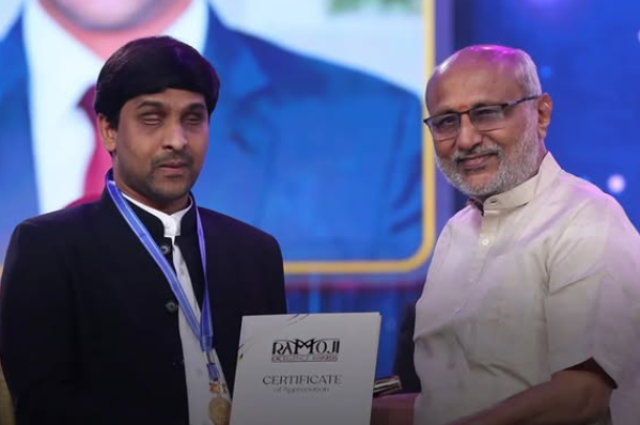
The Birth of a "Burden" and the Spark of Defiance
In the quiet, dust-laden landscape of Seetharamapuram, a remote village in the Nellore district of Andhra Pradesh, the year 1991 began like any other for a family of subsistence farmers. Living in a small hut and earning a meager annual income of just 20,000 rupees, the birth of a son should have been a moment of profound joy—a pair of hands to help in the fields, a beacon of hope for their future. However, as the parents looked into the eyes of their newborn, Srikanth, the silence of the room grew heavy with a realization that would shatter their world: the boy was born 100% blind.
In the socio-economic context of rural India in the early 90s, disability was not merely a physical condition; it was perceived as a divine curse or a "social and economic liability." In a community where physical labor was the only currency for survival, a child who could not see was viewed as a mouth that would consume but hands that would never produce. The news spread through the village like a shadow. Neighbors and relatives, driven by a mixture of misplaced pity, deep-rooted superstition, and the harsh pragmatism of poverty, arrived not with gifts, but with a horrific suggestion. "He is a burden who will only suffer," they whispered. Some went as far as advising the parents to "smother him with a pillow," claiming it would be an act of mercy to end a life of inevitable darkness and dependency.
It was at this crossroads of life and death that the first seeds of one of the most remarkable stories in modern Indian history were sown. Srikanth’s parents, despite their lack of formal education and crushing poverty, made a choice that defied centuries of social stigma. They chose to protect their son, not out of a sense of obligation, but out of an instinctive belief in the sanctity of life. They ignored the poisonous advice of the community, deciding that their son would not be defined by his lack of sight but by the strength of his spirit.
This was the genesis of a journey that would eventually challenge the Supreme Court of India, storm the gates of the Massachusetts Institute of Technology (MIT), and catch the eye of industrial titans like Ratan Tata. It began with a simple, defiant act of love in a small village, setting the stage for a narrative that would shift the global discourse from "charity for the disabled" to "empowerment through excellence." Srikanth Bolla’s story is not just a biography; it is a profound critique of how society perceives human potential—a journey that proves that the most blinding thing in the world is not a lack of sight, but a lack of vision.
The Early Years: Isolation, Integration, and the Awakening of Resilience
Srikanth Bolla’s early childhood was not defined by the games and laughter that usually characterize youth; instead, it was a masterclass in psychological and emotional resilience. Growing up in a rural agrarian setup, his limitations were highlighted every single day. While other children in the village would chase each other through the paddy fields or climb mango trees, Srikanth was often left sitting on a porch, listening to the world he was told he could never belong to. This enforced isolation could have easily crushed a young mind, but for Srikanth, it became a period of intense sensory observation. He began to understand the world through sounds, smells, and textures—developing a cognitive map that others, reliant on sight, often ignored.
The real test, however, began when he entered the formal education system. The local village school was a microcosm of society’s ignorance. Because the infrastructure and the curriculum were not "inclusive," Srikanth was treated as a ghost in the classroom. He was pushed to the very last bench, far from the teacher’s attention. Teachers, lacking the training to handle a visually impaired student, often ignored his presence entirely, assuming he was incapable of learning. He was a silent spectator in a world of chalk and blackboards, where the education system wasn't just unprepared for him—it was designed to exclude him.
The turning point came from a father’s unwavering intuition. Despite his lack of formal education, Srikanth’s father noticed that his son’s memory and logical reasoning were far superior to those of his sighted peers. Recognizing that the village school would only stifle his potential, he made the difficult decision to send Srikanth to a special school for the blind in Hyderabad. This was a massive sacrifice for a family earning only 20,000 rupees a year, but it was the catalyst for Srikanth’s transformation.
In Hyderabad, Srikanth was introduced to the world of Braille. For the first time, the "darkness" had a language. He realized that while he couldn't see the world through his eyes, he could decode it through his fingertips. The transition from the "last bench" of a village school to a specialized environment ignited a fire within him. He didn't just catch up with his peers; he bypassed them. He excelled in academics, showing a particular flair for mathematics and science—subjects usually considered "too difficult" for the blind.
Furthermore, he broke the stereotype that physical disability limits physical excellence. He took up cricket, mastering the "sound-based" version of the game played by the visually impaired. His dedication was so intense that he eventually rose to become a national-level blind cricketer. This phase of his life was crucial because it taught him two things: first, that "Integration" requires more than just sitting in a room; it requires the right tools. Second, it proved that his "disability" was merely a different way of functioning. However, even as he conquered the cricket field and the classroom, he was blissfully unaware that the biggest systemic walls were yet to be encountered. The world of sports and special schools was a haven; the real, ruthless battle against the national education boards was just around the corner.
A Legal Landmark: Defying the Education Board and the Fight for Cognitive Liberty
The year 2007 became a watershed moment in Srikanth Bolla’s life, transforming him from a student into a civil rights advocate. Having cleared his 10th-grade exams with flying colors, Srikanth stood at a crossroads that many take for granted: choosing a stream for higher secondary education. His heart was set on Science. He dreamt of understanding the laws of physics and the complexities of chemistry. However, the Board of Intermediate Education in Andhra Pradesh stood as an immovable wall. They flatly rejected his application to study Science, citing an archaic and discriminatory policy: "A blind student is ineligible for Science because they cannot perceive diagrams, perform laboratory practicals, or safely handle chemicals."
To the Board, Srikanth was a risk and a technical impossibility. Their logic was rooted in a century-old pedagogical framework that failed to account for assistive technology or the adaptive capabilities of the human mind. They suggested he take up Arts or Humanities, effectively telling him that his career path was pre-determined by his disability. It was here that Srikanth’s "Research-based" defiance took center stage. He realized that this wasn't just his problem; it was a systemic exclusion affecting thousands of visually impaired students across India.
Instead of yielding to the "safe" path of Arts, the eighteen-year-old Srikanth decided to sue the government. He filed a lawsuit against the Board, challenging the very foundation of their discriminatory guidelines. This was a grueling period of his life. For six long months, as his friends attended classes and moved forward with their syllabus, Srikanth spent his days in courtrooms and lawyers’ offices. He argued that if a blind person could understand the logic of a mathematical equation, they could certainly understand the structure of a molecule or the laws of motion through alternative tactile methods.
The legal battle was not just about a seat in a classroom; it was a battle for Cognitive Liberty. Srikanth provided evidence of how blind scientists globally were contributing to research, proving that "vision" is an intellectual process, not just an optical one. Eventually, the Andhra Pradesh High Court delivered a landmark judgment. The court ruled in his favor, stating emphatically that disability cannot be a barrier to choosing one’s field of study and that the state must provide the necessary infrastructure to support such students.
This victory was historic. The Board was forced to change its rules, opening the doors of Science and Mathematics to all visually impaired students in the state. But Srikanth didn't just win the right to study; he proved his worth through performance. Studying through recorded lessons and Braille notes, he sat for the exams and achieved the unimaginable. He topped his class with a staggering 98% score, a result that resonated throughout the country. It was a slap in the face to the skeptics and a loud declaration to the world: "I fought for this chair, and I deserve to lead the class." This triumph was the first major crack in the glass ceiling that Srikanth would eventually shatter entirely.
The IIT Rejection and the MIT Triumph: A Journey from Exclusion to Global Inclusion
After securing a historic 98% in his board exams and winning a landmark legal battle, Srikanth Bolla’s confidence was at an all-time high. He aimed for the pinnacle of Indian engineering education: the Indian Institutes of Technology (IITs). However, he was met with a devastating reality. Despite his proven academic brilliance, the premier institutes of his own country refused to let him even appear for the Joint Entrance Examination (JEE). The reason was as cold as it was systemic, the coaching centers and the examination boards claimed they did not have the infrastructure or the "braille-based" testing systems to accommodate a blind student for such a competitive and visually intensive exam.
The doors of India's elite institutions were slammed shut, not because of a lack of merit, but because of a lack of imagination. This rejection was perhaps the most painful chapter of his life. It highlighted a deep-seated institutional bias: in India, at that time, a blind person was expected to excel in arts or music, but the domain of high-level engineering was considered "off-limits."
Undeterred and driven by a sense of global ambition, Srikanth turned his gaze westward. He realized that if his own country would not recognize his potential, he would seek a platform that would. He applied to the top-tier engineering schools in the United States, including Stanford, Berkeley, and the Massachusetts Institute of Technology (MIT). The response from the US was a stark contrast to the Indian experience. MIT did not see a "blind boy"; they saw a mathematical prodigy with an indomitable spirit.
Srikanth made history by becoming the first international blind student to be admitted to MIT on a full scholarship. His arrival at the Cambridge, Massachusetts campus was a transformative experience. At MIT, the environment was not just inclusive; it was empowering. He was provided with state-of-the-art assistive technologies, from voice-to-text software to sophisticated tactile diagrams. More importantly, he absorbed the American culture of "Innovation and Entrepreneurship."
At MIT, Srikanth learned that leadership is about solving problems that others refuse to touch. He realized that in a truly meritocratic society, people are judged by the quality of their brains and the depth of their character, not by the functionality of their eyes. He spent his years there not just studying computer science and management, but observing how a developed nation integrates its marginalized citizens into the mainstream economy. This realization sparked a fire in him—a realization that he didn't want to just be a successful engineer in America; he wanted to be the architect of a similar revolution back home in India. His triumph at MIT was not just a personal victory; it was a loud message to every institution that had rejected him: "The loss was yours, not mine."
The Great Return: Rejecting the American Dream for an Indian Revolution
Upon his graduation from MIT, Srikanth Bolla found himself at a crossroads that defines the destiny of many brilliant minds from developing nations. He was at the heart of the "American Dream." With an MIT degree in his hand, the world’s most powerful tech giants and financial institutions were knocking at his door. He was offered salaries that could have secured a life of luxury and comfort in the United States, a life where accessibility was a given, and his disability would never be a hurdle.
However, Srikanth felt a profound sense of "survivor’s guilt" mixed with a burning mission. He realized that while he had "escaped" the systemic barriers of India, millions of others like him were still trapped in a cycle of poverty and pity. He famously remarked, "I wanted to create the opportunities that were denied to me." He chose to reject the comfortable life of a high-flying NRI (Non-Resident Indian) to return to the very soil that had once rejected him. This wasn't just a return; it was a strategic homecoming aimed at challenging the status quo.
Returning to Hyderabad in 2012, Srikanth did not come back as a job seeker, but as a job creator. His vision was radical and research-backed: he wanted to prove that disability is not a biological tragedy, but a social construct that can be dismantled through economic empowerment. He sought to shift the national narrative from "Sympathy to Self-reliance." He understood that in a capitalist society, the only way to gain true respect for the marginalized is to make them indispensable to the economy.
He envisioned a company where a person with a disability wouldn't be hired out of "charity" or "CSR," but because they were trained to be high-performing "assets of the economy." His goal was to build a business model that was environmentally sustainable and socially inclusive. By choosing Hyderabad as his base, he sent a powerful message to the Indian youth: the greatest innovations don't always happen in Silicon Valley; they happen where the challenges are the greatest. This "Great Return" marked the transition of Srikanth Bolla from a brilliant student to a visionary leader, setting the stage for the birth of an industrial empire that would soon catch the attention of the world’s biggest investors.
The Birth of Bollant Industries: A Blueprint for Conscious Capitalism
The year 2012 marked a seismic shift in the Indian industrial landscape with the founding of Bollant Industries in Hyderabad. Armed with a modest initial investment and a visionary co-founder in Swarnalatha Takkilapati, Srikanth Bolla didn't just start a company; he launched a social revolution. This case study explores how Bollant Industries successfully merged environmental sustainability with radical social inclusion, creating a business model that defies traditional corporate logic.
The Core Business Model: Sustainability at Scale
Bollant Industries identified a massive gap in the Indian FMCG (Fast-Moving Consumer Goods) market: the desperate need for affordable, eco-friendly alternatives to single-use plastics.
The Product Line: The company specializes in manufacturing high-quality packaging products, disposable plates, and cups made from fallen Areca leaves and recycled kraft paper.
The Supply Chain: By sourcing raw materials like agricultural waste (leaves that were previously burned by farmers), Srikanth created a circular economy. This not only provided an additional income stream for farmers but also significantly reduced the carbon footprint of the manufacturing process.
Solving the "Double Crisis": Pollution and Exclusion
The genius of Bollant Industries lies in its ability to tackle two global crises simultaneously.
Environmental Pollution: In a country struggling with plastic waste management, Bollant’s 100% biodegradable products offered a scalable solution. Their products decompose naturally, ensuring that profit does not come at the cost of the planet.
Systemic Unemployment: India has one of the world's largest populations of people with disabilities (PWDs), yet their participation in the organized workforce is abysmally low. Srikanth addressed this head-on by proving that PWDs are not "unemployable," but "untapped talent."
Radical Inclusive HR Policy: Diversity as a Competitive Advantage
Perhaps the most revolutionary aspect of the company is its human resource strategy. Srikanth didn't just hire a few disabled people for optics; he built the company’s DNA around them.
Statistics of Impact: Today, nearly 60% to 70% of the workforce at Bollant Industries consists of individuals with physical, mental, or visual impairments. Many of these employees were once rejected by society and considered a burden by their own families.
Economic Empowerment: By providing rigorous training and fair wages, Srikanth transformed these individuals into highly skilled technicians and machine operators. This policy didn't just provide jobs; it restored dignity. Bollant proved that an inclusive workforce leads to higher loyalty, lower attrition rates, and a unique corporate culture that values resilience over perfection.
Market Growth and Financial Viability
Unlike many social ventures that struggle to stay afloat, Bollant Industries demonstrated remarkable financial health. By focusing on quality and cost-effectiveness, they secured large-scale contracts from major retailers and corporate houses. Srikanth’s MIT-honed business acumen ensured that the company was "Investor-Ready." The scalability of this model—producing eco-friendly goods through an inclusive workforce—became a powerful proof of concept for "Conscious Capitalism," eventually attracting the attention of the highest tiers of the global investment community.
Strategic Growth and The Ratan Tata Connection: The Catalyst of Global Credibility
A common misconception in social entrepreneurship is that such ventures survive primarily on the oxygen of sympathy or grants. Srikanth Bolla, however, built Bollant Industries on the granite foundation of market competitiveness and operational excellence. He understood early on that while a "good story" might get you a meeting, only "good margins" and "high quality" would get you a contract. By 2016, the company’s rapid scaling and its unique "profit-with-purpose" model caught the attention of India’s most revered industrialist and philanthropist, Ratan Tata, the Chairman Emeritus of Tata Sons.
Beyond Sentiment: A Meeting of Minds
When Ratan Tata decided to meet Srikanth, it wasn't an act of charity. Tata, known for his keen eye for disruptive startups, was intrigued by the scalability of Bollant’s eco-friendly manufacturing. During their interaction, Srikanth didn't lead with his disability; he led with his balance sheets, his supply chain innovations, and his vision for a plastic-free India. Ratan Tata was reportedly moved not just by Srikanth’s journey from a remote village to MIT, but by his Business Acumen—the rare ability to see a profitable opportunity where others saw only a social problem.
The "Tata Stamp" and Institutional Credibility
Ratan Tata’s decision to invest an undisclosed amount in Bollant Industries was a watershed moment. In the world of high finance, a "Tata Investment" is more than just capital; it is a Stamp of Global Credibility.
The Halo Effect: This investment signaled to the global market that Bollant Industries was a serious player with robust governance and immense growth potential.
Investor Confidence: Following Tata’s lead, several other high-profile investors and venture capitalists, including Srini Raju of Peepul Capital and Satish Reddy of Dr. Reddy’s Laboratories, joined the cap table. This influx of institutional capital allowed the company to set up multiple manufacturing plants across Andhra Pradesh and Telangana.
Soaring Valuations and Market Dominance
With strategic mentorship and increased capital, Bollant Industries' valuation began to soar into the hundreds of crores. Srikanth utilized this growth to invest in advanced machinery and R&D (Research and Development), ensuring that their biodegradable products were not only environmentally superior but also cost-competitive with mass-produced plastic.
Market Expansion: The company transitioned from a small-scale unit to a diversified industrial house, catering to some of India's largest retail chains and multinational corporations.
The Message to the Industry: This phase of growth proved a vital point in modern economics—that inclusivity and profitability are not mutually exclusive. Under Srikanth’s leadership, Bollant Industries became a living laboratory for "Stakeholder Capitalism," where the success of the company directly translated into the upliftment of the most marginalized sections of society.
Environmental Impact and Sustainability Research: A Case Study in the Circular Economy
In an era where global industries are struggling to meet "Net Zero" targets, Bollant Industries stands as a pioneering factual model of the Circular Economy. Srikanth Bolla’s vision was never limited to just social inclusion; it was deeply rooted in ecological preservation. By conducting extensive research into waste-to-value conversion, the company has created a manufacturing ecosystem that heals the environment while generating profit.
Mitigation of Agricultural Waste and Air Pollution
One of the most critical environmental challenges in India is the burning of agricultural residue, which contributes significantly to seasonal smog and respiratory crises in urban centers.
The "Waste-to-Wealth" Pipeline: Bollant Industries strategically sources fallen Areca leaves and other agricultural by-products that farmers would otherwise burn. By providing a commercial value to this "waste," the company prevents thousands of tons of biomass from being incinerated.
Impact Research: Factual data suggests that for every ton of Areca leaves repurposed into plates, a significant amount of CO2 and particulate matter is prevented from entering the atmosphere.
Product Diversification and the Carbon-Neutral Footprint
Sustainability at Bollant is not limited to a single product; it is a philosophy applied across an entire industrial spectrum.
Beyond Plates: Through continuous R&D, the company has diversified its portfolio to include recycled paper, bio-adhesives, and even eco-friendly printing inks. This diversification ensures that they capture multiple segments of the packaging industry, replacing non-biodegradable plastic and toxic chemical-based alternatives.
The Low-Energy Paradigm: Their manufacturing units are designed to be energy-efficient, utilizing low-carbon processes that maintain a near carbon-neutral footprint. Unlike plastic factories that rely on petrochemicals, Bollant’s raw materials are 100% renewable.
Socio-Environmental Synergy: Reducing the Social Welfare Burden
A unique aspect of Srikanth’s sustainability research is the link between environmental health and economic empowerment.
The "Unemployable" Asset: By employing individuals whom society labeled as "unemployable," the company performs a vital economic function.
Reducing State Dependency: Factually, when a person with a disability becomes a wage-earning citizen, it reduces their dependence on government subsidies and social welfare programs. This shifts the individual from being a "consumer of public resources" to a "contributor to the national GDP."
Analytical Conclusion on Sustainability
From a research perspective, Bollant Industries serves as a global benchmark for ESG (Environmental, Social, and Governance) excellence. They have proven that true sustainability is a "Triple Bottom Line" approach: it must be good for the People (Inclusion), good for the Planet (Eco-friendly products), and good for Profit (Business viability). This triad of success is what makes Srikanth’s model a mandatory case study for anyone researching the future of sustainable industrialization in the 21st century.
Overcoming Personal and Professional Barriers: The Architecture of a Mental Map
Being an entrepreneur is challenging for anyone, but for a blind man in the complex industrial landscape of India, the barriers were multi-layered—ranging from physical infrastructure to deep-seated bureaucratic prejudice. Srikanth Bolla’s ability to navigate these hurdles provides a profound lesson in Adaptive Management and Operational Intuition.
Navigating the Bureaucratic Labyrinth
In the early days of Bollant Industries, one of the biggest challenges was not the market, but the "red tape." Government officials were often skeptical. "How can a blind man run a factory? Who will sign the documents? How will he monitor safety?" were common question.
The Solution: Srikanth overcame this by demonstrating a command over law and finance that often surpassed that of his sighted peers. He proved that leadership is about vision, not visibility. He utilized assistive technologies like screen readers and OCR (Optical Character Recognition) to manage legal documentation, ensuring he was never a passive spectator in his own business.
The "Mental Map" and Sensory Intelligence
Managing large-scale manufacturing units requires a high degree of spatial awareness. Srikanth developed a sophisticated "Mental Map" of his factories.
The Sound of Efficiency: He can walk through his production floors and detect a malfunctioning machine simply by the subtle change in its vibration or the pitch of its hum. This Sensory Intelligence allows him to maintain quality control in an almost superhuman way.
Layout Mastery: He memorized the blueprint of his plants, ensuring he could lead tours for investors and stakeholders without any assistance, effectively normalizing his presence in a high-risk industrial environment.
Leading from the Front: Breaking the Stigma
The most difficult barrier was the psychological one—convincing able-bodied managers to take orders from a blind CEO.
Cultural Shift: Srikanth led by example. By being the first one in the factory and the last one to leave, he built a culture of respect based on competence.
Safety and Innovation: He redesigned factory floor protocols to be safer for everyone, not just the disabled. This "Universal Design" approach minimized accidents and maximized efficiency, proving that an inclusive workspace is a safer workspace for all.
Resilience in the Face of Skepticism
Every time an investor doubted him or a vendor tried to overcharge him, Srikanth used it as fuel. He mastered the art of "Financial Visualization," keeping complex numbers and growth projections in his head during high-stakes negotiations. His journey through these barriers redefined the concept of Grit (Resilience) in the Indian start-up ecosystem.
The Philosophy of "Inclusive Capitalism" – Redefining the Corporate DNA
The narrative of Srikanth Bolla is far more than a triumph of personal will; it is a disruptive economic case study. It challenges the conventional "Charity Model" of disability and replaces it with what global economists call "Inclusive Capitalism." While most corporations view Corporate Social Responsibility (CSR) as a peripheral obligation or a tax-saving tool, Srikanth has integrated social impact into the very core of his profit-making engine.
The Shift from Sympathy to Synergy
Historically, the corporate world has viewed individuals with disabilities through the lens of sympathy. Srikanth dismantled this by focusing on Synergy. At Bollant Industries, employees aren't hired because the company "wants to do good," but because they are "good at what they do."
The Productivity Paradox: Through rigorous, specialized training modules, Srikanth proved that workers with visual or physical impairments often exhibit higher concentration levels and lower attrition rates in specific manufacturing roles. This debunks the myth that disability equals lower productivity.
The Dignity of Labor: Wages Over Welfare
The most profound analytical shift in Srikanth’s philosophy is the replacement of Charity with Wages.
Economic Independence: Charity creates a cycle of dependency and a sense of inferiority. Wages, however, create dignity and purchasing power. By transforming "beneficiaries" into "taxpayers," Srikanth is contributing to the GDP while solving a social crisis.
Psychological Impact: For a person who has been told all their life that they are a "burden," the first paycheck from Bollant Industries is not just money; it is a certificate of citizenship and self-worth.
ESG (Environmental, Social, and Governance) Excellence
In the modern investment world, ESG scores are critical. Srikanth’s model is a perfect 10/10 in this regard:
Environmental: Utilizing agricultural waste to create biodegradable products.
- Social: Creating a 70% inclusive workforce.
- Governance: Maintaining transparency that attracted investors like Ratan Tata. By aligning these three pillars, he has created a sustainable competitive advantage that makes Bollant Industries more resilient than its traditional competitors.
A Case Study for Global Business Schools
Business students worldwide are taught to "maximize shareholder wealth." Srikanth’s philosophy introduces a new curriculum: "Maximizing Stakeholder Value." His life proves that when you solve a problem for the most marginalized, you often find a solution that works for the entire planet. His "Inclusive Capitalism" is a blueprint for a future where profit and purpose are not just compatible—they are inseparable.
Future Outlook: Beyond the Horizon and the Quest for a 1000-Crore Milestone
The journey of Srikanth Bolla does not culminate in his past successes; rather, it serves as a foundation for a much grander vision that challenges the traditional metrics of corporate growth. As he steers Bollant Industries into its next decade, his outlook is a blend of aggressive market expansion and a revolutionary social agenda.
Scaling the Economic Peak: The 1000-Crore Ambition
Srikanth’s immediate business goal is to transform Bollant Industries into a 1,000-crore revenue powerhouse. This is not merely a financial target but a strategic move to prove that "social enterprises" can compete with mainstream industrial giants.
Global Footprint: Srikanth is actively looking beyond Indian borders, aiming to export eco-friendly, sustainable packaging to Europe and North America, where the demand for plastic alternatives is at an all-time high.
Vertical Integration: To reach this milestone, the company is diversifying its product line from simple leaf-plates to sophisticated recycled surfactants and high-end consumer goods, ensuring a presence in every household.
Pioneering "Inclusive Capitalism" as a Global Model
One of the most profound aspects of Srikanth’s future outlook is his desire to institutionalize Inclusive Capitalism. He envisions a future where "disability employment" is not seen as a CSR (Corporate Social Responsibility) checkbox but as a core competitive advantage.
The Training Revolution: Srikanth plans to establish training centers that act as finishing schools for people with disabilities, equipping them with high-tech manufacturing skills. His goal is to create a blueprint that other Fortune 500 companies can adopt to integrate marginalized talent into their supply chains.
Political Aspirations and Policy Advocacy
Srikanth Bolla recognizes that while business can change lives, policy can change a nation. His foray into the public sphere—as a political aspirant and a member of the World Economic Forum’s Young Global Leaders—is driven by a singular mission: Accessibility.
Legislative Change: He intends to influence Indian policy-making to enforce stricter accessibility laws in public infrastructure and digital spaces.
Education Reform: Drawing from his own legal battle to study Science, he advocates for a "Universal Design for Learning" (UDL) in the Indian education system, ensuring that no child is ever denied a subject based on their physical condition.
A Legacy of Empowerment over Charity
Perhaps the most striking element of his future vision is his commitment to ending the "Culture of Pity." Srikanth often speaks about a future where a disabled person doesn't need a "brave story" to get a job, but gets it simply because they are the best candidate. He is working toward a world where disability is as neutral a trait as eye color or height.
The World Through His Eyes – A Legacy of Visionary Resilience
The extraordinary saga of Srikanth Bolla serves as a profound global reminder that the only true disability in existence is a "disabled mindset." Srikanth was born into a world of literal darkness, but through the sheer force of his will and intellectual clarity, he has managed to create a luminous path for thousands of others who were once shrouded in the shadows of social neglect. His life is not merely a sequence of personal achievements; it is a relentless crusade against the status quo. By fighting the archaic regulations of education boards, challenging the exclusionary entrance policies of the IITs, and dismantling the deep-seated social stigmas of rural India, he has emerged not just as a successful entrepreneur but as a global icon of human potential.
Srikanth’s journey teaches us a fundamental truth about leadership and success: it is not about "seeing" an opportunity with one’s eyes, but about "visioning" a better, more equitable world with one’s mind. His ability to look past his own physical limitations to see the latent potential in others is what defines his greatness. He proved that when a business is built on the pillars of empathy, innovation, and sustainability, it doesn't just generate profit—it generates hope.
For publishers, researchers, and readers alike, the life of Srikanth Bolla stands as the ultimate empirical proof that when human grit meets a profound social purpose, the results transcend the boundaries of the ordinary to become nothing short of a miracle. He has redefined the "Indian Dream," proving that even if you are born in a small village with nothing but darkness in your eyes, you can still illuminate the entire world with your vision. Bollant Industries is more than a company; it is a monument to the fact that with enough courage, any barrier can be turned into a bridge, and any rejection can be turned into a revolution.
. . .
References:
- To ensure the factual accuracy and research depth of this case study, the following sources and data points were consulted:
- Forbes Media (2017). 30 Under 30 Asia: Healthcare & Science/Enterprise Technology. Srikanth Bolla’s inclusion in this prestigious list validates the global impact of Bollant Industries.
- MIT News Office (2012). Alumni Profiles: The Journey of Srikanth Bolla. Official records from the Massachusetts Institute of Technology regarding the first international blind student's academic and entrepreneurial transition.
- The Economic Times (2016). Interview: How a blind man built a company worth crores. A deep dive into the business strategy and the investment pitch that secured Ratan Tata’s support.
- Ministry of Statistics and Programme Implementation (MOSPI). National Census Data on Disability in India. Used to analyze the socio-economic gap in disability employment and the lack of inclusive infrastructure in the Indian education system.
- Bollant Industries Official Annual Reports. Data regarding the 70% inclusive workforce and the environmental metrics of Areca leaf production.
- Andhra Pradesh High Court Archives (2007). Legal documentation of the landmark judgment allowing visually impaired students to pursue Science in intermediate education.