
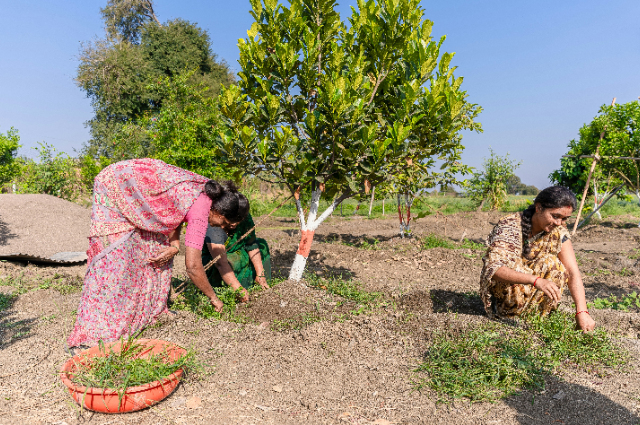
A tree planted in memory
Some stories begin with a public celebration. The story of Piplantri, a village in Rajasthan's Rajsamand district, began with a family's loss. In 2006, Shyam Sunder Paliwal lost his teenage daughter, Kiran. Published accounts say he planted a kadam tree in her memory. The act was personal: a living thing placed in the landscape as a way of remembering someone who would no longer grow older. But the tree became the beginning of a much larger idea. In the years that followed, Paliwal, who served as the village's elected sarpanch, helped turn the birth of a girl into an occasion for planting trees and asking the community to take responsibility for her future.
It is tempting to retell such a story as a neat sequence: a father experiences grief, plants a tree, and transforms a village. That version is memorable, but it can make lasting change seem easier than it is. Piplantri's experience is more useful when viewed as a long effort rather than a single dramatic moment. One memorial tree did not, by itself, restore damaged land or change every attitude toward daughters. The significance lies in the decision to repeat a meaningful action, involve others, and connect that action to continuing work. A private remembrance became a public practice because it was carried beyond the person who first imagined it.
The detail that gives Piplantri's initiative its particular force is its connection between the arrival of a girl and the planting of trees. Reports describe a village custom under which 111 saplings are planted when a girl is born. The exact history is reported somewhat differently by different sources, and older reporting used a different number. Still, the broad principle is consistent: a daughter's birth is marked by planting, and the saplings are meant to need attention long after the day of the ceremony. The child and the trees begin their lives at the same time, and both become reminders of a commitment that must be maintained.
That connection matters because it changes the public language surrounding a birth. A family may love a daughter deeply, yet still live in a society where the birth of a son is treated as more desirable, or where a girl is viewed through the future costs and constraints her family expects to face. A ritual cannot remove all those beliefs, but it can challenge the messages people encounter. Instead of greeting the birth of a girl with silence or disappointment, neighbours are invited to recognise it through a shared act. The idea turns an abstract statement that girls matter into an event others can see and join. It asks the community to practice respect, not merely praise it.
Why the landscape mattered
Piplantri's environmental setting is essential to understanding why trees became more than a symbol. The village lies in Rajasthan's semi-arid region, in an area associated with marble quarrying and mining. Accounts of the village describe a landscape under pressure from tree loss, water scarcity, and soil disturbance. The Guardian's 2018 report recalled a severe drought in 2005, when water had to be transported to the area by train, according to Paliwal. A 2024 paper on systems leadership similarly portrays Piplantri as a place that faced long-running environmental and economic challenges before the village's development efforts gathered momentum. These sources provide context, though they should not be treated as a substitute for a comprehensive ecological survey.
A semi-arid environment teaches a hard lesson: planting is not the same as growing. A sapling may be placed in the soil in a moment, but its survival may depend on the availability of water, the health of the soil, protection from animals, the choice of species, and the time someone can devote to maintenance. If these conditions are ignored, plantation counts become a record of activity rather than evidence of restoration. A successful environmental project therefore needs to ask what happens after the ceremonial photograph: who waters the trees, who replaces those that die, who protects the land, and how will people know whether the area is healthier years later?
The reports on Piplantri describe a programme that grew beyond a single annual planting event. Trees were planted at other times of the year as well, and the community's work was linked to water conservation and land management. The 2024 article describes contour trenches and work on sloping land to slow runoff and reduce soil erosion. Such measures are relevant in a dry, hilly landscape because rain that runs away quickly may carry valuable topsoil with it instead of soaking into the ground. These details help explain why the story should not be reduced to the slogan 'plant 111 trees.' Planting becomes more meaningful when joined to an understanding of the land and to practical work that helps trees survive.
There is a difference between environmental renewal as a visual impression and renewal measured over time. A hillside may look greener in photographs, but the long-term condition of a landscape depends on more than colour. What species are growing? How many young trees survive their first dry season? Is the vegetation suited to the local climate? Has soil erosion fallen? Are water sources being replenished, or is demand simply shifting somewhere else? Are local residents able to use the land productively without exhausting it again? The available accounts of Piplantri provide a reason to investigate these questions, not permission to skip them. The strongest version of the story welcomes measurement because it wants environmental progress to last.
The number, the ritual, and the promise
A real story should be careful with numbers, especially when a number has become the best-known part of the story. The United Nations Sustainable Development Group's 2022 account says 111 trees are planted when a girl is born and estimated that nearly 400,000 trees had grown through the practice by then. A 2018 Guardian report, however, stated that 101 trees were planted for each girl. The 2024 article in Pacific Business Review and reporting in 2026 again describe 111 saplings. The difference may reflect a change in practice or differences in reporting, but the sources do not fully settle the question. It would be misleading to pretend that every account has always agreed.
This inconsistency is not a reason to dismiss the initiative. It is a reminder that public-interest writing must distinguish a well-supported core fact from a detail that requires context. The consistent account is that Piplantri linked each girl's birth with tree planting; the precise number used in every year is less certain from the sources available. An attentive writer should say so plainly rather than select whichever figure sounds most impressive. That habit is important in any research-based story. Credibility is not created by making every detail look certain. It is created by telling readers what is known, where it comes from, and where the record is incomplete. [1, 2, 3]
The ritual is also not simply a matter of placing saplings in the ground. Accounts describe families and community members participating in planting and later care, while girls have been associated with the trees through the festival of Raksha Bandhan. The Guardian and the 2024 study describe girls tying rakhis to trees, adapting a familiar symbol of care and kinship to the relationship between a child and the living landscape. In this practice, a tree is not only an environmental unit. It becomes a marker of time: a sapling planted when a girl is born can grow alongside her, reminding family and neighbours that both require attention.
Making a daughter's future part of the community's work
Piplantri's initiative is frequently described as an example of eco-feminism because it places the dignity of girls and the condition of the environment inside the same community story. The idea suggests that the future of a girl and the future of the land are not separate concerns. A community that celebrates a girl's birth publicly can also be invited to consider whether she has a safe home, access to school, healthcare, and the freedom to imagine a future beyond the roles assigned to her. Environmental improvement alone cannot guarantee those things, but a public ritual can create an opening for a broader discussion about responsibility and respect.
Published accounts also connect the tree-planting practice with a financial commitment to the newborn girl's future. The Guardian described contributions that were used to build a deposit of 31,000 rupees and a pledge by families to care for the trees, educate the girl, and avoid marrying her before the legal age. The 2026 Tribune report also describes an account being opened in a girl's name. Details of the amounts and arrangements have differed across reports and may have changed over time, so they should not be repeated as guaranteed current rules without confirmation from the people administering the scheme. The enduring principle is clearer than the precise amount: the ceremony was linked to a commitment that extended beyond the day of birth.
Why connect a savings pledge with planting trees? Because a public gesture can be stronger when it is accompanied by a material responsibility. A tree needs resources and care; a child needs resources, care, and opportunities. Saving money does not solve every economic challenge, and a village deposit cannot substitute for quality education, nutritious food, healthcare, safety, or a fair labour market. But linking a celebration to a pledge can remind adults that the future is not only an emotional idea. It requires decisions now, often repeated across many years. The value of such a pledge depends on transparency: who contributes, where funds are held, who can access them, what the conditions are, and how families are informed of their rights.
One of the most important claims made about initiatives like Piplantri is that they can help challenge the idea that daughters are a burden. It is a claim worth taking seriously, but it should be expressed carefully. A village custom may contribute to changing attitudes, yet those attitudes are shaped by many forces: income, inheritance practices, education, employment, religion, family expectations, health services, and local law. The birth ritual does not prove that discrimination has ended. It changes a visible part of the environment in which beliefs are expressed. The next questions are whether girls' everyday experiences improve, whether they can remain in school, whether child marriage becomes less common, and whether their choices are respected as they grow older.
There is an ethical distinction here. A tree should not be presented as the price of a girl's life, nor should her value depend on a financial deposit or a public ceremony. Every child deserves care regardless of whether a local programme records the birth, whether there is enough money for a contribution, or whether a family can participate in an event. The ritual works best as a reminder of a value that should already be unconditional: a daughter matters because she is a person. The trees are a symbol and an instrument of community participation, not the source of a girl's worth. A strong account of Piplantri must keep that distinction clear.
From planting to livelihoods
A community project becomes more sustainable when it fits into everyday life instead of depending solely on occasional enthusiasm. The 2024 study of Piplantri describes efforts that connected land restoration with work, village institutions, and livelihoods. It discusses how saplings were sourced through different channels, including government schemes, corporate contributions, and donations, and describes attempts to organise ongoing care. It also notes the use of employment programmes for tree maintenance. Those details matter because a plantation can create unpaid work for people who already carry heavy responsibilities; a system that recognises labour and provides a fair way to support it is more likely to endure. The precise implementation of such arrangements needs local verification, but the general lesson is sound: maintenance has a cost, and someone must plan for it.
The study also describes women's self-help groups processing aloe vera and other locally available products, with related activity in amla and other plant-based goods. This suggests another route by which ecological work can affect community life: vegetation may support useful products, which in turn can contribute to local income. But a responsible analysis should not turn this possibility into a guarantee. A livelihood built around natural products depends on market access, quality control, processing equipment, transport, reliable buyers, and the ability to negotiate a fair price. If any link is weak, people may not earn enough to justify the work. The lesson is that environmental restoration and local business can reinforce one another, but they need practical economic planning as well as a compelling story.
The relationship between restoration and livelihood can become especially important in places where people rely on land for grazing, farming, or small-scale production. Healthier vegetation may help protect soil and provide fodder, while water-management measures may support cultivation. Conversely, poorly designed projects may fence people out of resources, privilege groups with more land, or shift costs onto women and poorer households. The question is not only whether the landscape becomes greener. It is who benefits, who does the work, who decides what is planted, and who bears the cost when a project fails. Sustainability includes ecology, economics, and fairness; if any one of these is ignored, the gains may not last.
What Piplantri can and cannot prove
A real-life case study becomes less useful when its ending is decided before its evidence is examined. Piplantri is widely presented as an inspiring example, and there are understandable reasons for that reputation: a personal act of remembrance became a community ritual; tree planting was joined to broader environmental work; published accounts describe financial commitments linked to girls; and the story attracted national and international attention. But an article that aims to inform should not move from these facts to a claim that one programme solved gender inequality or restored an ecosystem completely. Such conclusions would require detailed evidence over time, including comparisons with similar villages and transparent measurements of outcomes.
Counting saplings is one form of evidence, but it is an incomplete measure of environmental recovery. A planted tree may die; a seedling may survive only after repeated care; different species provide different ecological benefits; and a change in groundwater level may have multiple causes, including rainfall, extraction, and wider land use. A rigorous evaluation would track survival rates by year, species and site; examine soil condition and vegetation diversity; and measure water in a consistent way over enough time to distinguish a lasting shift from seasonal variation. It would also document the resources used to maintain trees, so that the apparent success is not separated from the labour and costs that made it possible.
A similarly careful approach is needed when evaluating outcomes for girls. It is encouraging when a community declares that daughters deserve to be celebrated. But meaningful progress is not fully captured by the number of ceremonies held, or accounts opened. Useful questions include: Are girls enrolled in school, and do they attend regularly? How many complete secondary education? Are health services accessible? Do girls feel safe travelling to school? Do they have a say in decisions about education, employment, and marriage? Are families able to use the savings or support mechanisms promised to them? Do the benefits reach households across different income levels? Answers require data and, just as importantly, listening to girls and women themselves. The purpose of measurement is to understand lived experience, not simply to produce a flattering scorecard.
The evidence available to a writer is also uneven. News reports provide valuable descriptions, interviews, and context, but they are snapshots made at particular times. A university project may offer a closer look at local life, yet its scope and methods should be read carefully before it is treated as a definitive impact evaluation. An institutional account, including one from the United Nations, can bring attention to an initiative and explain why it matters, but recognition by a respected institution does not mean every reported result has been independently tested. Each source has a role, and each has limits. Responsible research means comparing them rather than using one source to confirm every detail.
Contradictions in reporting can be handled openly. When one article says 101 trees and later sources say 111, a writer should not conceal the difference. When estimates of the total number of trees vary, the date of each estimate should be provided. When a savings scheme is mentioned without current terms, the article should identify the amount as a reported historical figure. Such caveats may appear to interrupt a smooth story, but they make the account more trustworthy. Real communities change; practices evolve; and public reporting may simplify details. Precision is not the enemy of inspiration. Precision is what allows other communities to learn from a story instead of copying an inaccurate version of it.
It is also important to avoid claiming that Piplantri alone caused every positive change reported in the area. If forest cover increased, several factors may have contributed: planting, water harvesting, government support, community maintenance, rainfall, and changes in land use. If attitudes toward girls changed, that shift may also be influenced by education, public policies, media, employment, and wider cultural changes. A single case study can show how these factors may work together; it cannot automatically prove which factor caused which outcome. To establish stronger causal conclusions, researchers would need suitable baseline information, follow-up measurements, and some way to compare results with what might have happened without the initiative. This is not a dismissal of local action. It is a request to describe its impact honestly.
The wider recognition of a local story
Piplantri's story has travelled far beyond the village. In 2022, the United Nations Sustainable Development Group published an account titled 'Daughters, water and trees', describing the initiative as an example of a community connecting the birth of girls with tree planting. The UN account placed the story alongside broader goals related to sustainable communities, climate action, and gender equality. Its significance is not that the UN thereby certified every claim about Piplantri. Rather, it shows that the village's model spoke to questions being discussed internationally: how to connect environmental responsibility with social dignity, and how local practices can make broad development goals understandable to ordinary people.
In July 2026, the Government of India's official list for the 72nd National Film Awards named the film 'Piplantri: A Tale of Eco Feminism' the winner in the category for a non-feature film promoting social and environmental values. The official listing credits Suraj Kumar as director. The Tribune's August 2026 report describes how the filmmaker found the story and developed the documentary's focus on the relationship between ecology and the girl child. This recognition shows that Piplantri's story has been important enough to inspire a documentary that received a national award. It does not, by itself, answer every question about the village's social or ecological outcomes; awards recognise films, not necessarily every statistic or causal claim in the story they tell.
Why are stories like this able to travel? Partly because the central image is immediately understandable: each girl is welcomed through an act of planting. The connection is concrete and visual. A reader does not need specialist knowledge of development policy to understand the idea. Yet the story also connects with much larger questions. Can environmental protection be built into daily social life? Can communities move beyond awareness campaigns toward habits that require continued care? Can a public symbol help change what people expect from families and institutions? Can a local project generate livelihoods as well as ecological benefits? Piplantri offers a way to explore these questions, even if the answers remain more complicated than a headline can express.
There is a danger in turning a place into a symbol. Once a village becomes internationally celebrated, visitors may expect a perfect model rather than a real community. Residents can be reduced to characters in someone else's inspirational story, and unresolved difficulties may disappear from the picture. It is better to treat Piplantri as a living place where people have pursued a significant idea under particular conditions. Its success should not depend on claiming that the village is free from conflict, poverty, discrimination, or environmental pressure. An honest story can recognise achievement while leaving room for complexity. It can honour people's work without turning them into symbols who must always match an outside audience's expectations.
How the idea might travel responsibly
The lesson for other villages is not that every newborn girl must be associated with exactly 111 trees. A number that has become meaningful in Piplantri may be unsuitable somewhere else. Species that thrive in one region may consume too much water in another, fail in different soil, or damage local biodiversity if chosen without care. A project should begin with local ecological knowledge: what vegetation belongs in the area, what land is degraded, which species support local wildlife, how much water is available, and what maintenance a community can realistically provide. Planting native or locally appropriate species, protecting existing vegetation, and restoring soil may be more effective than pursuing the largest possible count of saplings. The principle worth carrying forward is not a fixed number, but a shared responsibility for living systems.
A community considering a similar initiative should also avoid assuming that a ceremony alone will change gender relations. It must ask what practical support girls need. Are nearby schools safe and accessible? Can families obtain birth registration, healthcare, nutrition, and reliable information? Are scholarships available? Do adolescent girls have opportunities to learn skills and participate in public life? Are there mechanisms to prevent child marriage and respond to violence? A public event can create a conversation, but institutions and sustained services must help turn the conversation into a real opportunity. The best local model would bring community enthusiasm together with public responsibility rather than presenting one as a replacement for the other.
Finance needs equally clear design. If families are asked to make deposits or sign pledges, the arrangement must be understandable, fair, and transparent. Participants should know whether contributions are voluntary, where the money is held, whose name appears on the account, what conditions govern withdrawal, and which institution is responsible if local leadership changes. Poor households should not be shamed or excluded because they cannot afford a contribution. A daughter should never receive less respect because a family lacks money. The moral promise must remain universal, while financial mechanisms are designed in ways that protect families and do not create new burdens. An initiative intended to reduce disadvantage should not unintentionally deepen it.
Hope, accountability, and long-term care
For environmental projects, the period after planting is where the real work begins. Saplings require maintenance, and maintenance requires people, time, tools, water, and a system of responsibility. A village can agree that planting matters, but it still needs to decide who checks each site, who replaces a dead sapling, how animals are kept from damaging young trees, and what happens during a dry spell. These are ordinary questions, not glamorous ones, yet they often determine whether a celebrated project survives. A photo can record the beginning of a tree's life. Only continued observation can tell whether the tree grew and contributed to a healthier landscape. The same principle applies to social commitments: a pledge needs follow-up.
The work of care is often unevenly distributed. Women and girls may be expected to look after plants, household needs, and family responsibilities without receiving recognition or compensation. In Piplantri, published accounts describe the role of women and self-help groups in maintaining trees and processing agricultural products. Those accounts invite a further question: did the initiative create meaningful opportunities and influence for women, or did it add another responsibility to their existing workload? A serious evaluation would ask the women themselves how the work affects their time, income, status, and choices. A project centred on daughters' dignity should pay attention not only to the image of a girl beside a tree but also to the conditions of the women doing the everyday work that keeps the project alive.
At the same time, the most useful version of hope is not blind optimism. Hope becomes durable when it is open to evidence, correction, and learning. If a species fails, the programme should understand why and choose differently. If some families are excluded, it should revise its approach. If girls remain out of school, a planting ritual cannot be treated as sufficient; the community and public institutions must ask what barriers remain. If water data do not show the expected improvement, the project should investigate rather than repeat the claim. This ability to learn is not a weakness. It is the distinction between a campaign that wants to look successful and a community effort that wants to keep improving.
A compelling public story can encourage action elsewhere, but imitation should never take the place of local consultation. Each place has its own climate, land ownership, economic pressures, histories, and gender relations. A good idea must be translated rather than copied. One village might combine the birth of a girl with native tree planting; another might build a scholarship fund, restore a pond, organise a community library, or improve safe transport to school. The specific action can differ. What matters is that a value becomes a clear commitment, that people agree on who is responsible, and that the outcome is reviewed honestly over time. Piplantri's wider message is not that one formula fits every village, but that communities can make a value visible through repeated collective choices.
What the trees ask of us
The image of a tree growing alongside a child is powerful because it makes time visible. A newborn cannot plan her education, challenge unfair expectations, or decide the condition of the land she will inherit. Adults make choices around her before she can speak for herself. The planting ritual gives those choices a public form. It asks families and neighbours to think of the child's future as something worth preparing for, and it gives them a living object that will require care after the original celebration has passed. That is the promise at the heart of the story: not that planting settles every question, but that a community can choose to make its responsibilities visible and return to them again and again.
The story began with a father's grief for Kiran, but its public meaning reaches beyond one family. Grief cannot be undone by a tree, and a community's social challenges cannot be solved by a single act. Yet a memorial can become the starting point for something that others are able to carry forward. Piplantri's practice linked memory to a repeated community action, and that action opened space for conversations about daughters, land, water, work, and the future. The meaning of the initiative lies not in pretending that the village has reached a perfect destination, but in recognising the effort to join emotional conviction with practical responsibility.
The research also teaches a final lesson: admiration is only the beginning of useful attention. We should ask how many trees survive, how the land is changing, whether the financial arrangements work as promised, whether girls continue in education, and whether women share fairly in the benefits and decisions. We should ask the questions in a way that strengthens the project rather than searching for a reason to dismiss it. Celebration and scrutiny belong together. An idea that is genuinely valuable should be able to stand up to careful questions, and a story told with care can make its achievements more credible by being honest about uncertainty.
In the end, Piplantri is not simply a story about turning brown land green, nor only a story about a village finding a better way to welcome daughters. It is a case study in how a local ritual may connect values that are too often treated as separate: gender dignity, environmental care, livelihood, local leadership, and accountability. Some of the details remain inconsistent across sources, and long-term outcomes deserve continued measurement. Those limits should shape the story, not end it. They remind us that real transformation is not a miracle recorded in one headline; it is ongoing work that has to survive changing seasons, budgets, leaders, and expectations.
A tree planted for a newborn girl cannot guarantee her freedom or her future. But when the community that plants it also supports her education, respects her choices, protects the land, and reports honestly on its promises, the tree becomes part of something larger. It becomes a reminder that care must be practical, sustained, and shared. Piplantri's strongest message to the rest of us is therefore not simply to plant more trees or repeat a memorable number. It is to ask what commitments we make when a new life begins and whether we are willing to keep those commitments long after the ceremony ends.
REFERENCES:
- Dhillon, Amrit. “‘It's for my daughter's memory’: the Indian village where every girl's life is celebrated.” The Guardian, 11 October 2018. https://www.theguardian.com
- United Nations Sustainable Development Group. “‘Daughters, water and trees’: India's unique campaign for eco-feminism.” 6 October 2022. https://unsdg.un.org
- Soni, Swati, Vaidehi Soni, and Sanjeela Mathur. “Systems Leadership for Sustainable Development.” Pacific Business Review (International), February 2024. https://www.pbr.co.in
- FLAME University, Discover India Program. “The Trees of Piplantri Bearing the Fruits of Self-Sustenance.” Research Project, 2019–2020. https://dip.flame.edu.in
- Sandhu, Simran. “Where Daughters Are Celebrated with Trees.” The Tribune, 2 August 2026. https://www.tribuneindia.com
- Press Information Bureau, Government of India, Ministry of Information & Broadcasting. “72nd National Film Awards for the Year 2024 Announced.” 18 July 2026. https://www.pib.gov.in