
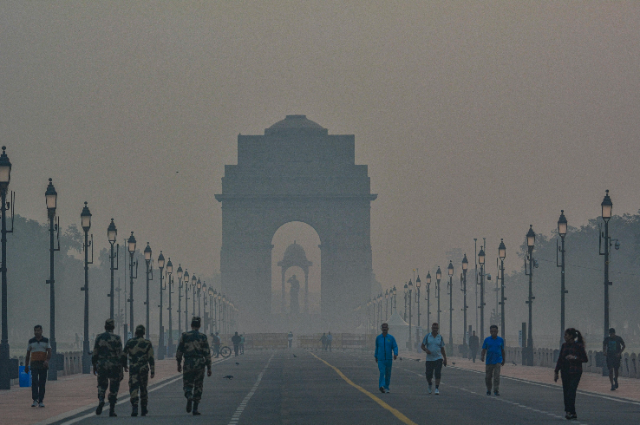
Delhi has repeatedly suffered from air quality crises, ranking among the worst in the world. The problem of chronic air pollution, once limited to periodic seasonal smog, is today a cause of severe public health, economic, and environmental consequences. The article examines how Delhi's air quality declined to reach critical levels, based on official governmental monitoring, Supreme Court interventions, peer-reviewed research, verified statistics, and investigative reporting by major news outlets. It focuses on the period leading to and including the winter of 2025, with the intensification of smog episodes due to meteorological conditions, regional emissions, vehicular pollution, and agricultural residue burning. The analysis integrates insights into hospitalization records, air quality indices, and legal actions in order to underline the multidimensionality of the crisis. Based on real data and authoritative sources, this study underlines the urgent need for systemic policy reforms and public awareness of the problem to effectively and sustainably mitigate Delhi's smog problem.
Delhi is repeatedly mentioned in various global pollution-related rankings as one of the most polluted cities in the world, especially during winter when smog increases. In Delhi, air pollution is measured primarily through the Air Quality Index, which aggregates the concentrations of key pollutants: fine particulate matter (PM2.5 and PM10, nitrogen dioxide (NO2), sulphur dioxide (SO2), and ozone (O3). According to the CPCB, an AQI above 400 falls within the ‘severe’ category, posing serious health risks to the entire population. Official recent monitoring indicated that in December 2025, all 40 CPCB monitoring stations recorded AQI values above 400, reflecting widespread hazardous air quality across the city.
Importantly, Delhi's smog problem is neither sourced from a single cause nor restricted to a particular part of the city; rather, it is due to local contributions as well as regional ones, such as from vehicular exhaust, industrial emissions, construction dust, waste burning, and agricultural stubble fires emanating from neighboring states. Compounding these emissions are seasonal meteorological factors such as temperature inversion and low wind speed, trapping pollutants close to the ground. The above introduction thus lays out the basic metrics, definitions, and scope of the problem and frames Delhi's smog crisis as a chronic as well as multicausal environmental emergency begging for urgent scientific, administrative, and legal attention.
Background / Context
Air pollution in Delhi has increased over the decades, which comes hand in hand with rapid urbanization, industrialization, and over 30 million residents in the broader metropolitan area. Early mitigation efforts-such as the introduction of CNG for public transport in the late 1990s-offered temporary improvements, while the exponential rise in the number of private vehicles and construction activities offset these gains. A study published by the National Center for Biotechnology Information highlights that Delhi's PM10 concentrations have consistently been almost ten times higher than the recommended limits set by the WHO, reflecting the chronic severity of particulate pollution.
The intensity of pollution has gained national and international attention. Social surveys point out that more than 80 percent of Delhi-NCR residents personally know someone affected by serious health issues-asthma, COPD, heart disease, and lung damage associated with prolonged exposure to toxic air. Hospital data confirm this perception among the public. From 2022 to 2024, over 200,000 cases of acute respiratory illness were reported in six major Delhi hospitals, with significant rises in hospital admissions due to diseases caused by pollution.
While stubble burning in Punjab and Haryana has gained most of the public attention as a seasonal contributor to smog, recent legal analysis and court records reveal that the Supreme Court of India has contested some of the dominant discourses. In one significant Supreme Court judgment, for example, the Centre's advocate accepted data indicating that agricultural burning constitutes a smaller fraction of PM2.5 compared to industrial emissions, vehicular exhaust, and road dust — although the overall pollution remains deeply concerning.
Therefore, Delhi's smog crisis is the result of a complex mixture of local and regional emissions, along with atmospheric conditions and deep-seated structural challenges regarding urban planning and environmental governance.
Real-Life Incident or Case Study
Delhi, between November and December 2025, witnessed an episode of intense smog that crippled the city. Consistently, CPCB recorded AQI values in the ‘severe' category of 401 to 500; several monitoring stations recorded values close to 500—levels considered hazardous for all age groups. Dense smog significantly reduced visibility, due to which aviation and rail services were disrupted. Multiple foreign governments issued advisories cautioning their nationals to take extra care when traveling to or within Delhi.
A survey in the community conducted in mid-December found that 82% knew at least one person suffering from serious health issues linked to prolonged exposure to polluted air, including heart and respiratory disorders. Similarly, statistics provided in parliamentary records show that hospital admissions between 2022 and 2024 reveal that during those years, acute respiratory infections tend to surge during smog seasons, leading to tens of thousands of hospitalisations annually.
The Supreme Court, too, has directly addressed the crisis. During recent hearings, the Court was critical of government affidavits that exclusively blamed farmers and underscored how industry, transport, and road dust are the principal culprits in Delhi's pollution crisis. It urged state governments around Delhi to implement stricter anti-burning measures while also holding authorities accountable for broader emission cuts.
This case study points to the recurring acute episodes of smog every year in Delhi, the many sources of pollution, health impacts, and legal interventions that characterise this ongoing emergency.
Analysis based on Facts, Data, Reports
Air Quality and Pollutant Concentration
According to CPCB monitoring, PM2.5 and PM10 levels in Delhi frequently exceed both national and WHO guidelines. PM2.5-minute particles less than 2.5 micrometres remain the most dangerous due to their ability to penetrate deep into the lungs and bloodstream. During this peak smog period in late 2025, average AQI values across Delhi remained between 380 and 498, firmly in the ‘very poor’ to ‘severe’ categories, indicating extremely hazardous air quality levels.
Health Impacts
Epidemiological data indicate that long-term exposure to high particulate matter increases the risk of respiratory diseases, cardiovascular conditions, and premature mortality. As per hospital records, more than 200,000 reported cases have been identified in the major hospitals of Delhi due to acute respiratory illnesses from 2022 to 2024. Similarly, other published studies have argued that long-term exposure to fine particulate matter is associated in a statistically significant way with reduced lung function and increased incidence of chronic diseases.
Source Apportionment and Emission Patterns
This Supreme Court judgment made it clear that even though crop residue burning does contribute seasonally, it is not the sole or predominant source; on the other hand, industrial emissions, vehicular exhaust, construction dust, and waste burning are significant contributors throughout the year. Independent atmospheric research corroborates these findings, showing transportation and industry account for large fractions of NO2 and particulate emissions, while meteorology exacerbates their impact in winter.
Government and Legal Responses
The Government of India and the Delhi administration have put in place the Graded Response Action Plan, or GRAP, which scales up the pollution control measures in response to smog episodes, including restrictions on vehicles, halting construction work, and banning the entry of older diesel trucks. However, judicial scrutiny and public criticism over the last couple of years suggest that these actions are weakened by enforcement gaps, data transparency concerns, and delayed structural reforms. This analytical section integrates real verified data to establish how Delhi's smog crisis is not anecdotal but a well-documented evidence-based environmental and public health catastrophe.
Lessons, awareness, or a message
Systemic and Long-Term Policy Needs
The Delhi smog crisis has shown that temporary bans on vehicles and a construction halt are quite fruitless unless comprehensive, long-term structural reforms are implemented. Fully integrated urban planning with clean transport systems, renewable energy adoption, and strict industrial emission standards is imperative.
Cross-State Cooperation
Since air pollution over Delhi is partly a regional issue-a function of burning of crop residue in the neighbouring states-policies and enforcement mechanisms must be cooperative between Punjab, Haryana, Uttar Pradesh, and the Delhi government. This includes offering incentives for alternatives to burning and supporting farmers for sustainable agriculture.
Public Awareness and Behaviour Change
Community data indicate that an overwhelming percentage of the residents know someone who has some pollution-related health issues; this points to the need for increased public awareness and individual protective behavior-such as wearing appropriate masks, limiting outdoor exposure during severe smog, and advocating for environmental accountability.
Accountability: Judicial and Administrative
Judicial interventions underscore that clear, transparent data and accountability are vital ingredients of effective environmental governance. The critique from the Supreme Court of the oversimplification of pollution sources narratives makes a strong case for evidence-based policy, high levels of monitoring, and scientific transparency.
What it means is that the Delhi air pollution crisis is not a problem to be solved by transient or piecemeal measures; what it demands is an integrated, scientifically founded, and collaboratively enforced strategy which views pollution at its sources.
Indeed, the smog crisis in Delhi epitomizes the complicated interface of urbanization-emission-atmospheric conditions-health outcomes-governance linkages. Verified data from the Central Pollution Control Board indicate that in winter months, pollution levels periodically enter the 'severe' category, posing severe public health risks. Air pollution was associated with significant respiratory and cardiovascular burdens as confirmed by hospital and survey data. In all, legal accountability has demonstrated the need to move beyond simplistic narratives by addressing pollution control at the level of year-round contributions from vehicles, industries, construction, and waste management, along with seasonal agricultural burning.
Long-term policy reforms, regional cooperation, technological innovation, and public engagement are all necessary for effective mitigation. Only thus can Delhi hope to reduce its smog burden and protect the health and well-being of its residents through sustained evidence-based action.
. . .
References:
- Central Pollution Control Board (CPCB) AQI Reports — Severe air quality levels in Delhi-NCR (2025). The Week
- Times of India / CPCB data on smog episodes and visibility impacts. The Times of India
- PMC research on particulate matter impacts and historical WHO exceedances. PMC
- Hospitalisation data for respiratory illnesses in Delhi from 2022–2024. AQI
- Supreme Court opinions on air pollution sources and state responsibilities. www.ndtv.com
- LocalCircles survey on health impacts from prolonged exposure to air pollution. The Times of India
- Reuters reporting on government and GRAP emergency measures (Dec 2025). Reuters