
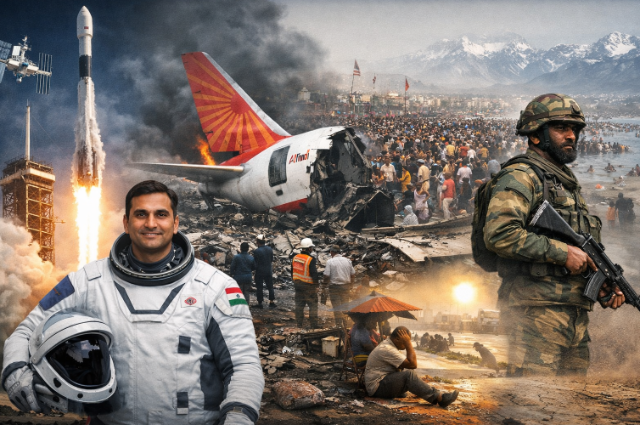
If nations could have a heartbeat, India’s would have been arrhythmic in 2025. The year operated like a violent pendulum, swinging wildly between the celestial heights of scientific conquest and the crushing gravity of terrestrial failure. It was a year where the same nation that commanded the respect of the global space community by sending a pilot to the International Space Station also watched helplessly as its citizens were crushed in stampedes or lost in aviation disasters.
We stood at the edge of a new era, termed the Amrit Kaal, but found ourselves walking through fire. The events of 2025 were not mere headlines; they were stress tests for the Republic's soul. From the charred tarmac of Ahmedabad to the frozen frontiers of the Himalayas, this year demanded a price for every inch of progress. This article dissects the anatomy of these critical incidents—the Why, the How, and the Aftermath—to understand if the scars of 2025 have paved the way for a stable future.
The Renaissance of Indian Human Spaceflight: The Axiom-4 Mission
The Axiom-4 (Ax-4) mission stands as the crowning scientific achievement of 2025, marking the end of a forty-year hiatus in Indian human spaceflight. While the mission was executed on a commercial platform, its implications for India were profoundly strategic, serving as a critical operational bridge between the Gaganyaan program and the future Bharatiya Antariksha Station (BAS).
Strategic Context and Mission Architecture
The mission was not merely a foray into space but a calculated geopolitical maneuver embedded within the US-India Initiative on Critical and Emerging Technology (iCET). The selection of Group Captain Shubhanshu Shukla, a test pilot with the Indian Air Force, signaled ISRO's intent to transition from passive participation to active mission command and control. Shukla’s role was distinct from the "space participants" of other commercial flights; he was designated as the Mission Pilot, a role requiring intimate knowledge of the Crew Dragon’s navigation and docking systems.
The mission profile was designed to test the limits of commercial-government collaboration. Utilizing SpaceX’s Falcon 9 Block 5 rocket and a Crew Dragon spacecraft, the mission aimed to dock with the International Space Station (ISS) for a duration of approximately two weeks. The crew composition was notably international, reflecting the shifting alliances in space diplomacy:
- Commander: Peggy Whitson (USA, Axiom Space) – A veteran NASA astronaut providing command continuity.
- Pilot: Shubhanshu Shukla (India, ISRO) – Representing India’s return to manned missions.
- Mission Specialists: Sławosz Uznański-Wiśniewski (Poland, ESA) and Tibor Kapu (Hungary) – Marking a significant expansion of European participation.
Operational Timeline and Flight Profile
The mission execution was characterized by precision, though it required navigation through complex orbital mechanics.
Table 1: Detailed Operational Timeline of Axiom-4
Phase | Date | Time (IST) | Event Description | Technical Notes |
Launch | June 25, 2025 | 12:01 PM | Liftoff from LC-39A, Kennedy Space Center. | Utilized Falcon 9 B1094-2 (Flight 495). The trajectory targeted a 51.6-degree inclination orbit. |
Orbital Insertion | June 25, 2025 | 12:16 PM | Second Stage Separation. | NASA coverage concluded ~15 mins after insertion as the Dragon spacecraft began autonomous phasing. |
Soft Docking | June 26, 2025 | 4:02 PM | Capture at ISS Harmony Module. | The Dragon utilized its nose-cone docking assembly to latch onto the International Docking Adapter. |
Hard Docking | June 26, 2025 | 4:16 PM | Structural Integration. | A rigid seal was formed, allowing for pressurization of the vestibule between the spacecraft and station. |
Ingress | June 26, 2025 | 5:53 PM | Hatch Opening. | Shubhanshu Shukla, termed Gaganyatri, entered the ISS, the first Indian to do so. |
Welcome | June 26, 2025 | 6:45 PM | Ceremony with Expedition 73. | Formal integration into the station's crew rotation for the 14-day duration. |
Undocking | July 14, 2025 | 4:30 PM | Departure from ISS. | The spacecraft executed a retrograde burn to lower perigee for reentry. |
Splashdown | July 15, 2025 | 3:00 PM | Landing off the California Coast. | Successful parachute deployment and recovery by Axiom/SpaceX recovery vessels. |
Scientific Mandate and Experimental Payload
Unlike early space missions, which often focused on observation, Ax-4 was an intensive scientific sortie. The crew conducted over 60 experiments, with Shukla spearheading 7 critical investigations led by Indian institutions. These experiments were specifically curated to solve physiological and logistical challenges for the upcoming Bharatiya Antariksha Station.
Biological and Physiological Research
Myogenesis (BRIC-InStem, Bengaluru): This experiment addressed one of the most critical risks of long-duration spaceflight: muscle atrophy. Researchers tested novel supplements on muscle tissue samples in microgravity to observe regeneration rates. The findings are expected to inform the diet and medical protocols for Indian astronauts on future 6-month missions.
Tardigrade Resilience (IISc, Bengaluru): Utilizing the legendary resilience of tardigrades ("water bears"), this study exposed specimens to the high-radiation environment of Low Earth Orbit (LEO). The goal was to map the genetic expression changes that allow these organisms to survive vacuum and radiation, potentially unlocking gene therapies for radiation protection in humans.
Cyanobacteria and Algae (ICGEB, New Delhi): This study focused on the growth kinetics and proteomics of cyanobacteria in microgravity. As ISRO plans for bioregenerative life support systems (BLSS) for the BAS, algae are viewed as a primary candidate for oxygen generation and carbon dioxide scrubbing.
Agricultural and Psychological Research
Space Agriculture (UAS & IIT Dharwad): The Sprouts experiment involved the germination of Methi (fenugreek) and Moong (green gram) seeds. Understanding how gravity—or the lack thereof—affects root morphology and water uptake is vital for developing hydroponic systems for deep space transit.
Cognitive Interface Testing (IISc, Bengaluru): Shukla performed tasks using specialized electronic displays designed to test reaction time and cognitive load. This data will refine the cockpit interfaces for the Gaganyaan crew module, ensuring they are optimized for the degraded cognitive state often experienced during orbital adaptation syndrome.
Post-Mission Analysis and Government Action
The successful return of the crew on July 15, 2025, triggered a comprehensive post-mission protocol managed by ISRO and the Department of Space.
Reasons for Success: The mission's success was attributed to the robust training regimen at NASA’s Johnson Space Center and the maturity of the Falcon 9 launch vehicle. The collaboration allowed ISRO to bypass the steep learning curve of orbital docking operations, gaining immediate access to advanced operational knowledge.
Results and Government Actions:
Medical Rehabilitation: Upon splashdown, Shukla underwent a seven-day "structured post-mission medical evaluation" overseen by Axiom and ISRO flight surgeons. This protocol included cardiovascular stress tests and musculoskeletal assessments to measure the impact of the 18-day microgravity exposure. This data is now the baseline for the Gaganyaan medical handbook.
Infrastructure Development: Insights from the mission regarding "international crewed mission coordination" and "emergency response protocols" were immediately fed into the operational procedures of the upcoming Gaganyaan Mission Control Centre (MCC). The government announced that this experience was a "vital stepping stone" for indigenous infrastructure.
Political Leverage: Prime Minister Narendra Modi utilized the mission's success to reinforce the narrative of a "Viksit Bharat" (Developed India). The mission was framed as a demonstration of India's capacity to partner as an equal with global space powers, bolstering public support for the increased budget allocation to the Department of Space for the BAS project.
Crisis in the Skies: The Air India Flight 171 Disaster
While the space sector celebrated a triumph of precision, the civil aviation sector faced its darkest hour. The crash of Air India Flight 171 (AI171) on June 12, 2025, in Ahmedabad, was a catastrophe that exposed systemic vulnerabilities in modern aircraft systems and strained international regulatory relationships.
The Accident Sequence
Aircraft Profile: The aircraft involved was a Boeing 787-8 Dreamliner, registered as VT-ANB. It had been in service with Air India since January 2014 and had accumulated 41,868 flight hours. It was considered a workhorse of the long-haul fleet.
The Crash: At 13:39 IST, AI171 initiated takeoff from Sardar Vallabhbhai Patel International Airport, Ahmedabad, bound for London Gatwick. The aircraft carried 230 passengers and 12 crew members. The manifest was diverse, including 169 Indians, 53 British nationals, 7 Portuguese, and 1 Canadian.
Seconds after liftoff, as the aircraft climbed through the initial departure phase, a catastrophic anomaly occurred. The preliminary report from the Aircraft Accident Investigation Bureau (AAIB) indicated that three seconds after liftoff, the fuel control switches for both GEnx engines moved from the "RUN" position to "CUTOFF". This action instantly starved the engines of fuel.
Cockpit Chaos: The pilots, Captain Sumeet Sabharwal and First Officer Clive Kunder, were faced with a complete loss of thrust at a critical low altitude. A "Mayday" call was transmitted: "Thrust not achieved. Falling. Mayday.
Impact: Deprived of power, the heavy jet stalled and plummeted into a residential zone near the BJ Medical College hostel. The impact and subsequent fire resulted in the death of all 242 occupants and nearly 20 people on the ground.
The Investigation and Geopolitical Friction
The aftermath of the crash was defined by an intense and acrimonious investigation that pitted Indian authorities against the American aviation establishment.
The "Fuel Switch" Controversy: The central mystery was why the switches moved. Boeing’s design places the fuel control switches directly below the throttle levers.
Boeing's Position: The manufacturer implied that the movement was likely a pilot error, suggesting that the pilots might have inadvertently snagged the switches while adjusting the throttles. This "pilot error" narrative is a common defense in automation-heavy accidents.
The Whistleblower's Counter-Narrative: Ed Pierson, a former senior Boeing manager, publicly intervened, describing the 787 as an "electrical monster." He argued that the investigation was overlooking systemic "electrical and manufacturing flaws" that could cause uncommanded actuator movements. He cited the complex Throttle Control Module Assembly (TCMA) as a potential failure point, suggesting the switches could move without human input due to electrical glitches.
Institutional Standoff (AAIB vs. NTSB): The investigation broke diplomatic protocols. Typically, the black boxes (FDR and CVR) of US-manufactured aircraft are sent to the US National Transportation Safety Board (NTSB) for readout. However, due to "mutual suspicion," Indian authorities refused.
Data Sovereignty: Shri GVG Yugandhar of the AAIB famously rebuffed US pressure, stating, "We're not a Third World country. We can do anything you all can do." The data was downloaded in New Delhi, with NTSB specialists kept under strict supervision, highlighting India's insistence on investigative sovereignty.
Results and Government Actions
Judicial Vindication:
By November 2025, the Supreme Court of India was informed that the AAIB's initial report did not blame Captain Sabharwal. This was a significant development, as early leaks had attempted to frame the pilot. The Court's acknowledgment shifted the liability focus firmly onto the aircraft's systems.
Government Measures:
Compensation and Support: The Civil Aviation Ministry ordered Air India to disburse an interim compensation of ₹25 lakh to the next of kin of each victim immediately, pending final settlements.
Fleet Safety Audit: The Directorate General of Civil Aviation (DGCA) ordered a comprehensive audit of all Boeing 787 aircraft operated by Indian carriers (Air India and Vistara). The audit focused specifically on the integrity of the Throttle Control Module and electrical grounding systems.
Legal Battles: Victim families, led by the pilot’s father, Pushkar Raj Sabharwal, filed a petition in the Supreme Court demanding an independent probe headed by a retired judge, arguing that the AAIB might be susceptible to pressure from Boeing to downplay technical defects to preserve commercial relationships.
The Management of Mass Faith: The Maha Kumbh Mela Tragedy
The Maha Kumbh Mela in Prayagraj is the world's largest religious gathering. The 2025 edition, however, became a case study in the catastrophic failure of crowd dynamics management.
The Scale of the Event
The Uttar Pradesh government had prepared for a "Historic" Kumbh.
- Duration: January 13 to February 26, 2025.
- Projected Attendance: 40 to 50 crore (400-500 million) pilgrims over 45 days.
- Infrastructure: A temporary city was erected, featuring 120 electric buses, 43 temporary hospitals with 6,000 beds, and extensive rail connectivity with 360 special trains.
- Technology: The administration deployed AI-powered surveillance grids and 800 multilingual digital screens to manage flow.
The Mauni Amavasya Stampede (January 29, 2025)
The critical failure occurred on Mauni Amavasya, the most auspicious bathing day.
- The Context: By the eve of the bath, over 15 crore people had already visited. On the specific day, an additional 10 crore pilgrims converged on the Sangam (confluence of rivers).
- The Incident: In the pre-dawn hours, a stampede erupted in the Sangam area. The trigger was identified as a broken barrier near a primary access route. A holding area, saturated beyond capacity, burst forth when a barricade gave way. The resulting "crowd collapse" crushed those at the front against stationary structures.
- Casualties: The official death toll was recorded at 37. However, independent reports, including those cited in legal petitions, claimed the toll was at least 79, with over 60 severe injuries.
Reasons for Failure
Despite the technological investments, the failure was one of physics and flow rate.
- Density Saturation: The crowd density exceeded the critical threshold of 6 people per square meter. At this density, individuals lose control of their movement, and the crowd behaves like a fluid. Shockwaves can travel through the mass, lifting people off their feet.
- Barrier Integrity: The physical infrastructure was insufficient to withstand the sheer kinetic pressure of the surge.
- Communication Lag: While AI cameras monitored density, the feedback loop to ground forces to stop the inflow was too slow to prevent the barrier collapse.
Governance Response and Judicial Oversight
Administrative Actions:
- Immediate Triage: The government deployed helicopters—originally intended for flower showers—to act as aerial command posts, directing ground police to divert crowds away from the crushed zones.
- Unidirectional Flow: Post-incident, a rigid "one-way" rule was enforced. Pilgrims were barred from returning via their entry routes to eliminate counter-flow friction, a primary cause of turbulence in crowds.
- School Closures: To reduce city-wide congestion, schools in Prayagraj were closed for three days around the main bathing dates.
- Judicial Intervention: The tragedy reached the Supreme Court via a PIL filed by advocate Vishal Tiwari.
- Supreme Court Ruling: On February 3, 2025, the Court termed the incident "unfortunate" but declined to take direct supervision, referring the matter to the Allahabad High Court. Chief Justice Sanjiv Khanna argued that the local High Court was better positioned to monitor the situation in real-time.
- Mandatory Safety Protocols: The Court suggested that state governments must use "electronic mode messages" (SMS/WhatsApp) to disseminate safety guidelines to devotees before they arrive at the Mela, aiming to educate the crowd on emergency procedures.
- The Security Matrix: Terrorism, Insurgency, and Strategic Retaliation
2025 witnessed a dramatic recalibration of India’s internal and external security posture. The threats evolved into a "hybrid" model, combining traditional cross-border militancy with sophisticated urban "white-collar" terrorism.
The Pahalgam Massacre and Operation Sindoor
The Incident: On April 22, 2025, the picturesque Baisaran meadow in Pahalgam, Kashmir, became a killing field. Four terrorists, armed with automatic rifles, targeted tourists. In a chilling echo of past insurgencies, they segregated victims by demanding identification.
- Victims: 26 people were executed. The dead included 25 Indian tourists—among them a newlywed Indian Navy officer, Lt. Vinay Narwal—and one local Kashmiri who attempted to shield them.
- Perpetrators: The Resistance Front (TRF), a front for Lashkar-e-Taiba (LeT), claimed responsibility. Intelligence indicated the attackers were guided by handlers in Pakistan.'
- Government Action: Operation Sindoor: Abandoning the policy of strategic restraint, the Cabinet Committee on Security (CCS) authorized Operation Sindoor.
- Execution (May 7-10, 2025): The Indian military launched a coordinated air and ground offensive targeting terror infrastructure deep inside Pakistan.
- Targets: Nine specific camps were hit, including facilities in Bahawalpur (Jaish-e-Mohammed headquarters) and Muridke (LeT headquarters).
- Results: The operation resulted in the elimination of over 100 terrorists. It also triggered a four-day military skirmish along the border, with Pakistan retaliating via artillery shelling in the Poonch and Rajouri sectors.
- Strategic Shift: Suspension of the Indus Waters Treaty: In a move with far-reaching geopolitical consequences, India formally suspended the Indus Waters Treaty (IWT) of 1960.
- Reasoning: The government articulated a doctrine that "blood and water cannot flow together." The suspension was declared to be in effect until Pakistan "credibly and irrevocably abjures its support for cross-border terrorism".
- Implication: This action weaponized riparian geography. By suspending the treaty, India signaled a willingness to restrict water flows to Pakistan, threatening the latter's agricultural backbone in Punjab. Analysts described this as a shift into the "grey zone" of international warfare, using environmental leverage as a deterrent.
The Red Fort Blast: The Rise of "White-Collar" Terror
On November 10, 2025, a car bomb detonated near the Red Fort in New Delhi, killing 13 and injuring 32.
- The "White-Collar" Profile: The investigation by the National Investigation Agency (NIA) revealed a disturbing evolution in terror recruitment. The suicide bomber was identified as Dr. Umar Un Nabi, a medical doctor and assistant professor at Al-Falah University in Faridabad.
- The Module: Dr. Umar was not an impoverished recruit but part of a radicalized cell of professionals (doctors and academics).
- The Plot: Raids on the module’s safe houses in Faridabad recovered a staggering 2,900 kg of explosives, suggesting that the Red Fort blast was merely the opening salvo of a larger campaign.
- Mechanism: The attack utilized a Hyundai i20 car packed with Ammonium Nitrate Fuel Oil (ANFO). The sophistication of the bomb and the "clean" background of the attackers made detection by traditional intelligence nets nearly impossible.
- Government Action: The Ministry of Home Affairs directed a massive overhaul of intelligence profiling. The "white-collar" threat forced agencies to look beyond traditional demographics, focusing on radicalization within professional institutions. The NIA arrested nine individuals, including key conspirators like Yasir Ahmad Dar, dismantling the support network.
The Decline of Naxalism: The Bijapur Turning Point
While urban and border terrorism flared, the fight against Left-Wing Extremism (LWE) saw decisive gains.
- The Bijapur Attack (Jan 6, 2025): Maoist insurgents launched a major attack in Bijapur, Chhattisgarh, utilizing a 60-70 kg IED to destroy a vehicle carrying District Reserve Guard (DRG) personnel. Nine security personnel were killed.
- The Counter-Offensive: Security forces responded with intensified area domination operations. The pressure resulted in a collapse of morale among the insurgent ranks.
- Mass Surrender: In a significant victory, 34 hardcore cadres, carrying cumulative bounties of ₹84 lakh, surrendered in Bijapur. This included senior commanders from the Kerlapal Area Committee. By the end of 2025, the government reported a 53% drop in violence and declared that the "Red Corridor" had shrunk to a historical low of fewer than 40 districts.
Legislative Reform: The Waqf (Amendment) Act, 2025
The domestic political landscape was dominated by the passage of the Waqf (Amendment) Act, 2025. This legislation represented the most significant restructuring of Muslim endowment administration in independent India.
The Legislative Battle
The Bill, initially introduced in 2024, faced fierce resistance, leading to its referral to a Joint Parliamentary Committee (JPC). After months of deliberation, the revised Bill returned to Parliament in April 2025.
- Parliamentary Timeline: The Lok Sabha passed the Bill on April 3, 2025. The Rajya Sabha session that followed was historic, witnessing a marathon 14-hour debate that stretched into the early hours of April 4. The Bill was finally passed with 128 votes in favor and 95 against.
- Presidential Assent: President Droupadi Murmu signed the Act into law on April 5, 2025.
Key Provisions and Structural Changes
The Act introduced radical changes aimed at increasing state oversight and reducing the autonomy of the traditional Mutawalli (caretaker) system.
Table 2: Comparative Analysis of Waqf Regulations
Feature | Waqf Act, 1995 | Waqf (Amendment) Act, 2025 |
Board Composition | Exclusively Muslim members. | Mandates inclusion of two non-Muslim members on State Boards and the Central Council. |
Survey Power | Vested in a Survey Commissioner (Muslim). | Transferred to the District Collector (Civil Servant), who now decides if a property is Waqf or Government land. |
Waqf by User | Recognized long-standing oral usage as valid proof. | Abolishes "Waqf by User." Only properties with valid title deeds are recognized. |
Dispute Redressal | Waqf Tribunal decisions were final. | Tribunal decisions are no longer final; appeals can be made to the High Court within 90 days. |
Gender Inclusion | Optional/Limited provisions. | Mandates the inclusion of two Muslim women on all Boards. |
Controversy and Rationale
Government Rationale: The government argued that the Act was a necessary modernization. Minority Affairs Minister Kiren Rijiju stated that the amendments were designed to break the "mafia-like" control of Waqf properties by elite families and ensure the assets generated revenue for the welfare of poor Muslims and women.
Opposition Arguments: Critics viewed the Act as a tool for dispossession.
- Article 26 Violation: The inclusion of non-Muslims in a religious governing body was challenged as a violation of the constitutional right to manage religious affairs.
- State Encroachment: By empowering the District Collector—a representative of the state—to adjudicate property status, critics feared the government would reclaim prime Waqf lands by declaring them state property, especially given the abolition of "Waqf by User," which protects older properties lacking modern paperwork.
The Environmental Crisis: The Great Heatwave of 2025
Overshadowing the political and security dramas was a climatological disaster that struck at the heart of India’s economy. The summer of 2025 was recorded as a "double heatwave" year, testing the limits of human and economic endurance.
Meteorological Intensity
The India Meteorological Department (IMD) forecasts were dire and accurate.
- Duration: Northwest India endured 10-12 heatwave days, significantly higher than the historical baseline of 5-6 days.
- Temperature Extremes: Regions in Rajasthan, Vidarbha, and the Delhi NCR consistently recorded temperatures exceeding 48°C.
- Early Onset: The heatwave conditions began in March, interfering with the crucial grain-filling stage of the wheat crop.
Economic and Social Impact
The heatwave functioned as a "threat multiplier" for the economy.
- Food Inflation: The scorching heat destroyed standing vegetable crops. Prices of "TOP" (Tomato, Onion, Potato) surged, with vegetable inflation hitting 42% in peak summer months due to supply shortages.
- Productivity Decline: The RBI highlighted a "productivity tax" imposed by the heat. With outdoor work becoming impossible for extended hours, the economy faced a potential loss of 4.5% of GDP due to lost labor hours in construction and agriculture.
- Energy Crisis: The cooling load pushed power demand to unprecedented highs. To prevent grid collapse, the government was forced to delay the retirement of aging coal plants, prioritizing immediate survival over long-term decarbonization goals.
Government Response:
- Export Restrictions: To combat food inflation, the government extended bans on the export of onions and sugar to ensure domestic affordability.
- Heat Action Plans (HAPs): The National Disaster Management Authority (NDMA) expedited the implementation of HAPs in 23 states. These plans included shifting work hours for laborers, setting up cooling centers, and mandating "cool roofs" in new construction.
As we close the dossier on 2025, the year presents itself not as a linear narrative of progress, but as a violent paradox. We have proven that the Indian state possesses a "hard shell" capable of withstanding external aggression—demonstrated by the kinetic fury of Operation Sindoor—and the technical prowess to navigate the cosmos, as seen in the Axiom-4 triumph. Yet, the tragic system failures at the Maha Kumbh and the Air India crash reveal a "soft underbelly," where the basic machinery of civil safety remains alarmingly fragile. The year 2025 taught us that our capabilities have outpaced our protocols. We can engineer a rendezvous with the International Space Station, but we struggled to engineer a safe pedestrian flow for pilgrims in Prayagraj. We can monitor terror launchpads across the Line of Control with satellite precision , yet we missed the radicalization of a "white-collar" professor driving a car bomb into the heart of Delhi. This asymmetry between our elite capabilities and our ground-level realities is the defining tension of our time. Furthermore, the "Silent Enemy," the climate has issued a warning that no treaty can be suspended. The heatwave of 2025, which taxed the economy and took hundreds of lives , reminds us that our economic ambitions are ultimately hostage to our environmental limits.
The Verdict: Can 2026 be Happy? The question of whether 2026 can be a "Happy" year hinges on a single, uncomfortable realization: Greatness is not just about altitude; it is about grounding. For 2026 to be happy, it arguably needs to be boring. It needs to be a year where the "software" of governance catches up to the "hardware" of our ambition. A nation that can send a man to space must also ensure a student is safe in a hostel and a devotee is safe at a ghat. If 2026 focuses on the unglamorous work of fixing internal safety cultures, insulating our economy from climate shocks, and bridging the gap between our "Space Age" tech and "Stone Age" crowd management, it will indeed be a happy year of stabilization. However, if we continue to chase the starlight while ignoring the streetlights, 2026 risks being another year of high-velocity collisions. We enter the new year knowing that we have the power to touch the sky. The challenge for 2026 is proving we have the discipline to keep our feet safely on the ground.