
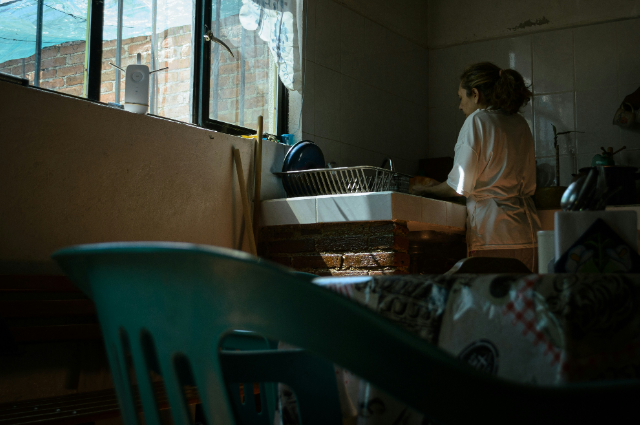
At five in the morning, while much of the household is still asleep, a woman’s working day has already begun. She lights the stove, prepares breakfast, packs a child’s lunch, sweeps the floor and checks on an elderly relative. Before the family leaves for work and school, she has completed a series of tasks that make everyone else’s day possible. Later, she will cook again, wash clothes, help a child with homework, manage household purchases and attend to someone who falls ill. Her work has no closing bell. Imagine this as a composite of countless household routines across India, not the testimony of any single woman. Her circumstances may vary with income, location, family structure and access to services. She might live in a village where domestic responsibilities overlap with agricultural work, or in a city where a long commute competes with childcare. She may have ambitions of her own, including a paid job, but little control over how her time is allocated.
When the day ends, her household has been fed, its children cared for and its basic needs managed. Yet much of what she has done may never appear as employment in conventional labour statistics. The problem is not that India has no way to measure such work; its Time Use Survey already does so. The deeper contradiction is that different statistical systems recognise different things, and the contribution that sustains daily life can remain less visible in the headline picture of the economy. If a woman’s labour keeps a household and, indirectly, the paid economy running, why should the absence of a wage make that labour so difficult to see?
A reform that is real but not yet a reality
The immediate policy development offers a reason to revisit the question. On October 23, 2026, Reuters reported that India was proposing changes to its employment survey to better capture digital-platform workers and unpaid activities. The report is independently corroborated by a Ministry of Statistics and Programme Implementation (MoSPI) press note issued that day. But the distinction between a proposal and an implemented reform matters: the government has invited public and expert comments, with the changes planned for January 2027. The National Statistics Office (NSO), which conducts the Periodic Labour Force Survey (PLFS), proposes two important changes. First, it intends to introduce a separate sampling category for digital-platform workers because the existing arrangement has not captured enough of them. Second, it proposes additional questions about the production of goods for household use, unpaid domestic and caregiving activities, volunteering, and unpaid trainee work. The latter questions would cover rural and urban residents aged 15 and above during the survey's first visit, permitting annual reporting on these activities.
This is an expansion of what an employment survey observes, not an announcement that unpaid domestic work will automatically count as employment. The distinction is fundamental. The proposed questions could produce a more comprehensive account of people's activities without necessarily changing the definitions used to calculate the headline employment and unemployment rates. The reforms also follow an experiment that began in January 2026, when the PLFS started collecting information on digital-platform workers. The experience revealed that the existing sampling arrangement was inadequate. For the proposed changes, the NSO plans a new sample for 2027–28, using an updated sampling frame. It has also provided for a transition period during the first three months of 2027, when estimates will draw on both the previous and updated sampling frames.
The implications extend beyond a technical adjustment. Better questions can reveal activities that earlier survey arrangements captured incompletely. Yet the quality of the resulting picture will depend on how consistently interviewers record these activities, how respondents describe their work and whether the data distinguish between different kinds of unpaid labour. The government has opened a statistical door. What remains uncertain is how much the new view will change public policy.
What the numbers already tell us
India does not have to begin counting from zero. Its Time Use Survey (TUS), conducted by the NSO in 2019 and again from January to December 2024, was designed to measure how people allocate their time among paid activities, unpaid domestic services, caregiving, learning, leisure and other pursuits. Its existence is important: unpaid work has not been wholly absent from India's statistical system. The difficulty is that time-use information and conventional employment indicators answer different questions. The 2024 survey presents a striking contrast. Among people aged six and above, 81.5% of females participated in unpaid domestic services for household members on the reference day, compared with 27.1% of males. Among participants in those activities, females spent an average of 289 minutes a day on them, compared with 88 minutes for males. For unpaid caregiving, participation was 34% among females and 17.9% among males; participants averaged 137 minutes for females and 75 minutes for males. These are participation and time-use measures, not counts of employed people.
The figures are not proof that every woman works longer than every man, or that every household follows the same pattern. They establish something more useful: at the population level, unpaid domestic work remains distributed very unevenly by gender. The employment picture tells a different story. According to the PLFS Annual Report 2025, published on March 27, 2026, the labour-force participation rate among people aged 15 and above, measured by usual status—principal plus subsidiary status—was 40.0% for women and 79.1% for men. The worker-population ratio was 38.8% for women and 76.6% for men. These measures must not be confused with the TUS figures. The labour-force participation rate measures the share of the population employed or participating in the labour force under the survey's definitions. The worker-population ratio measures the share classified as employed. Neither tells us the total time people spend on every domestic and caregiving activity.
Nor does a woman necessarily fall outside employment simply because she performs unpaid tasks. She may also work for wages, run a business, help in a family enterprise or produce goods for household consumption. Different activities can place her in different statistical categories. The danger lies in mistaking one category for the whole picture.
An economy runs on more than wages.
Economists call the network of paid and unpaid activities that sustains people's lives the care economy. It includes direct care feeding a child, supporting an older person or helping someone who is ill—and the indirect work that makes care possible, such as cooking, cleaning and maintaining a household. This is not work separate from the economy. It is part of the infrastructure on which economic life depends. A worker who arrives at a factory has usually eaten, slept in a maintained home and had some of life's practical needs met. A child who attends school has been fed, prepared and cared for. A business owner can devote time to a shop because someone, somewhere, is doing work that keeps the household functioning. Paid employment may be visible at the workplace, while the unpaid labour supporting it remains dispersed across kitchens, farms and living rooms.
Consider a simple thought experiment. Suppose unpaid domestic work stopped for a day. There would be no immediate invoice recording the loss, but meals would go unprepared, dependents would need alternative care, and many paid workers would have to rearrange or abandon their schedules. Some of the work would be purchased from others; some would be delayed; some would fall to different family members. The disruption would travel beyond the household. The International Labour Organisation's 2018 report Care Work and Care Jobs for the Future of Decent Work estimated, using time-use data from 64 countries, that 16.4 billion hours of unpaid care work were performed worldwide each day. Women supplied 76.2% of those hours. The report calculated that valuing these services at an hourly minimum wage would amount to around 9% of global GDP, using purchasing-power-parity values from 2011. This is an international estimate based on a particular valuation method, not a direct measurement of India's unpaid care economy. International Labour Organization: The lesson is not that every domestic task should be assigned a salary. It is that the volume of work and the amount of money exchanged for it are two different things.
Why GDP does not tell the whole story
A related distinction concerns national accounting. GDP is designed to measure production within a defined accounting framework, not every contribution to human welfare. Under the conventional System of National Accounts production boundary, the production of goods for a household's own use is generally included, but many unpaid household services—such as cooking, cleaning and caring for one's own family—are excluded from the core measure. Certain housing services and domestic services provided by paid employees receive different treatment. This is not the same as saying that India has no data about unpaid work, or that every activity performed without wages is excluded from GDP. Rather, measuring an activity, classifying it as employment and counting its monetary value in national accounts are three separate operations.
Time-use statistics can show how much time a household spends caring for its members. Employment statistics can identify whether someone is employed, seeking work or outside the labour force. A supplementary national account can estimate the monetary value of household services using assumptions about replacement costs, wages or other valuation methods. Each approach answers a different question. Time accounts preserve the physical reality of hours spent working; monetary estimates can indicate the scale of services provided. Neither fully captures the emotional dimension of caring for a child or supporting a relative through illness. The policy challenge is to use these tools together rather than treating GDP as a complete scorecard of social contribution.
The rural household is also a workplace.
In rural India, the boundary between home and work can be particularly difficult to draw. A woman may prepare meals, care for children, collect household necessities and manage livestock while also helping with agricultural production. Some of her work might qualify as production for household use, some could be part of an economic enterprise, and some might be classified as unpaid domestic services. Those distinctions matter. If agricultural work or assistance in a family business is poorly identified, employment can be understated. If domestic services are treated as equivalent to market employment, the figures can become misleading in the opposite direction. Better measurement must make these activities visible without pretending they are interchangeable. Poverty adds another dimension. A wealthier household may pay someone to cook, clean or supervise children, creating a recognisable paid job. A poorer household may perform similar tasks internally because it cannot afford those services. The amount of essential work society requires has not disappeared; its location and payment status have changed.
Nor is the burden distributed equally among women. A woman with access to reliable childcare and transport faces different choices from a woman caring for an elderly relative without support. Caste, disability, household income, family structure and local employment opportunities can also shape who provides care, who performs paid domestic work for other households and who has the freedom to refuse either. The PLFS Annual Report 2025 offers an indication of the relationship between domestic responsibility and labour-market participation: among women outside the labour force, 44.4% cited childcare or personal commitments in home-making as their main reason for being outside it. The report records a stated reason, not proof that care alone explains women's economic position. Still, it makes the connection difficult to dismiss. When care consumes time, it can restrict access to education, skill development, rest and paid employment. The result is a paradox: unpaid work may make paid work possible for others while limiting the unpaid worker's own access to it.
Platform work, a different blind spot
Digital-platform work creates a separate measurement problem. A delivery partner, app-based driver or home-service provider may earn through several platforms, combine this work with another occupation or shift between paid tasks and unpaid household responsibilities. Work may be irregular, and the income earned may not resemble a monthly salary. The Economic Survey 2025–26 describes an estimated rise in India's gig workforce from 7.7 million in financial year 2020–21 to 12 million in financial year 2024–25—a 55% increase. It places gig workers at more than 2% of the total workforce. These are estimates of the gig economy, not a complete administrative count of everyone working through digital platforms.
India Budget:
A platform worker is not the same as an unpaid family carer. One performs paid or profit-oriented tasks, while the other supplies domestic or caregiving services without direct monetary remuneration. Their common problem is not the nature of their labour but the inadequacy of a single, narrow picture of work. The proposed PLFS sampling category could improve coverage of people working through digital platforms. Yet, as labour economist K.R. Shyam Sundar told Reuters, platform-based identification may miss informal gig workers who do not use digital platforms. Better sampling is valuable, but it cannot compensate for a definition that excludes the very people a survey seeks to count.
Reuters:
The same person may also be both a worker and a carer. That is precisely why employment, income sources and time use should be measured in ways that can be analysed together.
From counting to changing policy
Better statistics do not automatically redistribute unpaid work, pay carers or create jobs. They can, however, make policy choices more informed.
First, India should conduct time-use surveys more regularly and publish detailed findings by sex, age, rural and urban location, household income and other relevant characteristics where the data permit. More frequent evidence would help policymakers track whether new childcare facilities, public services or changes in employment are actually altering the distribution of unpaid work.
Second, governments should use these findings when planning affordable childcare, community care and accessible support for older people and people with disabilities. Such services cost money, require trained workers and need reliable local delivery. Public provision also has potential benefits: it can relieve household pressure while creating paid employment in care. But facilities must be accessible to low-income families and rural communities, not concentrated only where demand is easiest to serve.
Third, social protection must follow the realities of work. Informal and platform workers may need systems that better accommodate irregular earnings and multiple jobs. The unpaid carer presents a different policy question: whether and how to provide income support, pension protection, respite services or other assistance without making women more dependent on performing care within the home.
Fourth, responsibility for care must be shared more equitably. Better measurement should encourage policies that enable men to take a greater part in domestic work, support parental leave for both parents, and make flexible employment compatible with workers' rights. Otherwise, recognition can have an unintended effect: it may reinforce the assumption that caring is women's natural duty rather than a social responsibility.
Finally, the government should explain how the new PLFS variables are used. Public reporting should distinguish between the number of people performing an activity, the time they spend on it, their employment status and any monetary estimate of its value. Such transparency would allow researchers and citizens to judge whether better measurement is changing decisions—or merely producing more tables. The central question is not whether every hour of care should become a line in GDP. It is whether public policy can understand the economy accurately while remaining indifferent to the work that allows people to participate in it.
A different definition of economic success
Who benefits when unpaid work remains difficult to see? The evidence does not establish that any institution deliberately designed statistical systems to exclude women's contribution. The more defensible argument is structural: when the headline measures focus on employment and monetary output, unpaid services can receive less attention in policy debates, budget priorities and assessments of welfare. Better data can challenge that imbalance. But a survey cannot open a childcare centre, guarantee an informal worker social protection or persuade a family to divide household duties more fairly. Those require budgets, institutions and choices about who should bear the cost of caring for society.
Return to the woman who began her day before sunrise. A revised survey may record more of her activities. A time-use table may quantify the hours she spends in the kitchen, and a supplementary account may estimate what those services would cost if purchased in the market. Each step would make a different part of her contribution more visible. But recognition will remain incomplete if the numbers change while her choices do not. An economy should not confuse the absence of a wage with the absence of work. Nor should it mistake the act of counting that work for the achievement of justice. A country measures itself not only through what it produces for sale, but also through what makes production, education, health and everyday life possible. The real test of India's statistical reforms will be whether the work that was once difficult to see begins to matter in the decisions that shape people's lives.
Tomorrow morning, across India, millions of women will wake before the world around them begins its day. They will prepare meals, care for children, support elderly parents, clean homes, manage family needs and quietly hold households together. They may never receive a salary for these hours, but their contribution will be felt in every meal served, every child prepared for school and every worker who leaves home ready to earn a living. Their work does not become worthless because it is unpaid. Their time does not become less valuable because it appears on no payslip. And their contribution to society should never depend on whether an accountant can attach a number to it.
But recognising unpaid care must mean more than praising women's sacrifices. Women do not need endless applause for carrying an unequal burden; they need a fairer distribution of that burden. Families must share responsibilities. Communities must support those who care. Employers must recognise that workers have lives beyond their workplaces. Governments must turn better statistics into practical action through accessible childcare, support for caregivers and stronger protection for people in vulnerable employment. This responsibility belongs to everyone. Men must become equal partners in care, not merely grateful recipients of it. Society must stop treating domestic labour as an automatic duty of women. Policymakers must look beyond employment rates to understand how people actually spend their days. And every one of us must reconsider the meaning of work in our own homes.
India's proposed statistical reforms offer an opportunity to see more clearly what has too often remained in the background. But a woman appearing in a survey is only the beginning. The real achievement will come when her time, choices, dignity and economic opportunities matter as much as those of the person whose labour earns a visible income. So, the next time we ask how much a country produces, how many people it employs or how fast its economy grows, we should ask another question: Who is doing the work that makes all that possible—and who is paying the price in time, opportunity and unrecognised effort? A nation cannot build a truly inclusive economy by overlooking the hands that sustain its homes. It must learn to count the work it has long taken for granted, recognise the people who perform it, and share the responsibility more fairly. Because progress is not simply about producing more wealth. It is also about building a society in which the people who make everyday life possible are no longer invisible in the life of the economy.
The work was always there. The question is whether we are finally ready to see it—and to act on what we see.
References:
- MoSPI / National Statistics Office. “NSO to introduce changes in PLFS from January 2027.” Press note, October 23, 2026. Official government release.
- Shubham Batra and Manoj Kumar, Reuters. “India plans jobs survey changes to add unpaid work, improve gig worker data.” October 23, 2026. Original report.
- MoSPI / National Statistics Office. Time Use in India, 2024. Published March 28, 2025. Official report announcement and findings.
- MoSPI / National Statistics Office. Periodic Labour Force Survey Annual Report, 2025. Published March 27, 2026. Official findings.
- Government of India, Economic Survey 2025–26. Chapter 12, “Employment and Skill Development: Getting Skilling Right.” Official chapter.
- International Labour Organisation. Care Work and Care Jobs for the Future of Decent Work. Published June 28, 2018. Report and executive summary.
- United Nations Statistics Division. System of National Accounts 2025, including discussion of unpaid household service work and complementary measures of well-being. Official national accounts resources.