
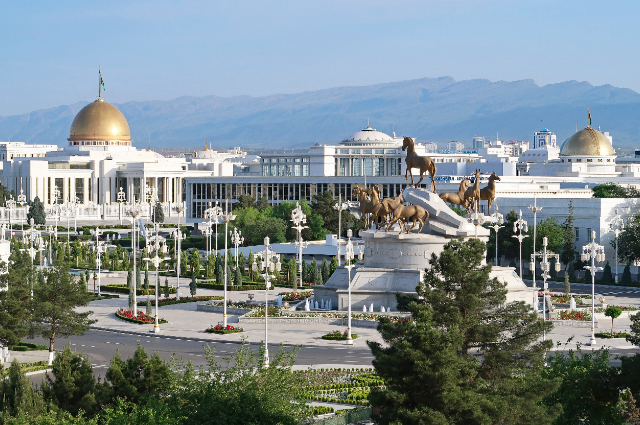
A city in Central Asia has streets wide enough for eight lanes of traffic, yet barely a car moves on them. Where the fountains are the largest in the world but the people living nearby don't always have running water at home. Where every building gleams in imported white marble under the desert sun and has won Guinness World Records for its beauty. And where, if you stand in the middle of it all at two in the afternoon, the sound you hear most clearly is your own footsteps.
This is Ashgabat. The capital of Turkmenistan. One of the most extraordinary and disturbing places on earth, not because of what it is, but because of what it was designed to make you believe.
Travellers who manage to get inside describe a feeling that sets in almost immediately. No wonder. Unease. Something in the symmetry is too perfect, the silence too complete, the smiles on the few faces you do see slightly too fixed. In town squares across the country, you find golden statues of Niyazov standing, or sitting on a throne, chin cradled in hand, as if deep in thought. The whole city feels less like a place people live and more like a stage set waiting for an audience that never comes. Journalists who have visited describe the sensation of being watched through every window. Some describe it as the most dangerous place they have ever tried to film. Several of them didn't make it out with their footage.
To understand what Ashgabat actually is, you have to go back eighty years, to a small town in what is now the Czech Republic, and to one of the most chilling acts of political theatre in recorded history.
The Oldest Trick
On June 23, 1944, representatives from the International Committee of the Red Cross, the Danish Red Cross, and the Danish government were allowed into Theresienstadt concentration camp in German-occupied Czechoslovakia. In preparation for the Red Cross visit, Nazi authorities deported about 7,500 Jews from Theresienstadt to Auschwitz between May 15 and May 18, 1944, to make the ghetto appear less overcrowded. Fake shops, schools, and cafés were built. Cultural performances were staged. Prisoners were given new clothes. The inspection proceeded smoothly, with the Red Cross delegation being taken along a carefully predetermined route and permitted to speak only with prisoners who appeared healthy and had been briefed in advance. The film’s cast, musicians, and director, Kurt Gerron, were all prisoners of Theresienstadt. After directing the film, Gerron and many of the prisoners featured in it were deported to Auschwitz and murdered. As one survivor put it afterward, the Nazis built a Potemkin village. The Red Cross inspected it. This is the oldest trick in the authoritarian playbook. Build something beautiful enough to distract from what is real. Put people in front of it who have been told exactly what to say. Film it. Repeat the film until people forget there was ever anything else to see.
What is happening in Turkmenistan today should not be understood as a smaller-scale repetition of that same tactic. It is that trick applied to an entire nation, sustained across three decades, and refined through mechanisms that Nazi propaganda officers in 1944 couldn't have imagined. The question that matters is not whether Turkmenistan is a dictatorship. Freedom House's Freedom in the World 2025 report recorded Turkmenistan's global freedom score as zero out of one hundred, a decline from the previous year's score of one, due to increased restrictions on access to abortion, new legal obstacles to divorce, and a crackdown on men and women showing affection in public. The question that matters is how. How does a government rewrite reality for seven million people? How does it make them complicit in their own containment? And what does the mechanism reveal about the relationship between psychology, law, political science, and the nature of human identity itself?
The Architecture of Control
When the Soviet Union collapsed in 1991, Saparmurat Niyazov was already in position. He had been the most powerful Communist official in the Turkmen Soviet Socialist Republic, which was answerable to Moscow and ultimately constrained by it. The moment the constraint lifted, he moved with the speed and precision of someone who had been planning for exactly this.
He kept everything. The same parliament. The same constitution. The same ministries. The same intelligence apparatus that the KGB had built and staffed. He then renamed the security service from the KGB to the KNB, the Committee for National Security, and redirected its loyalty from Moscow to himself. The officers were the same. The files were the same. The surveillance infrastructure was the same. Only the master had changed.
What he built over the next fifteen years was not simply a dictatorship in the conventional sense. It was a total social architecture, constructed across four distinct layers, each reinforcing the others and targeting a different dimension of what makes a human being free.
The first layer was physical. Turkmenistan's government imposes harsh restrictions on free expression and exerts total control over access to information. It allows virtually no space for dissent and prohibits the operation of unregistered non-governmental organizations. Authorities continue to impose arbitrary foreign travel bans and engage in transnational repression, including by denying Turkmens the ability to renew their passport abroad. Citizens needed police clearance to stay in hotels in their own capital. Public transport required identity checks. Movement between cities was registered and tracked. A person could be physically present in their own country and simultaneously trapped inside an invisible cell of bureaucratic restrictions that made every journey an act requiring official permission.
The second layer was informational. There is no media freedom in Turkmenistan. Access to the internet remains severely limited. Approximately three-quarters of all global IP addresses were blocked in Turkmenistan. Authorities block instant messenger apps when they become popular, and have ramped up persecution of users and providers of Virtual Private Networks. Foreign newspapers, Russian television channels, books printed outside the country: all banned or made inaccessible. The only information that circulated freely was information the state had created or approved. Television news programs were filled with footage of the president. Newspapers ran his speeches on the front page every day. The radio played his voice.
The third layer was economic. The state controlled nearly all employment, all housing allocation, all access to education and healthcare. To lose the state's favour was not merely a political inconvenience. It was the removal of every material condition of survival. Informants were deployed in schools, mosques, factories, universities, and neighbourhood committees. Prison conditions are extremely harsh, and security forces routinely use torture to extract confessions or punish inmates, which can result in deaths in custody. Turkmenistanis are also subject to enforced disappearances. People who were seen as threats disappeared into a maximum security facility called Ovadan Depe, eighty kilometres from Ashgabat in the desert, where human rights organizations documented widespread use of solitary confinement, starvation, and systematic physical abuse. The foreign minister, Boris Shikhmuradov, once one of Niyazov's most trusted men, was arrested in 2002. He appeared on state television shortly after, visibly disoriented, reading a scripted confession describing himself as a criminal and a drug addict. He has not been seen in public since. Nobody knows whether he is alive.
But the fourth layer is the most intriguing to political science and sociology and the most disturbing to psychology. Physical, informational, and economic control are all external constraints; they act upon people from the outside. They can be resisted, at least in the mind. Niyazov wanted something more total than that. He wanted to control the thing that generates resistance in the first place: identity itself.
The Book That Replaced a Nation's Mind
In 2001, Niyazov published a book. He called it the Ruhnama, meaning the Book of the Soul. Called Ruhnama, it contained answers to "all of life's questions" and became required reading in all schools, universities, and workplaces. Television news programs were filled with recitations from Niyazov's book. Applicants for government jobs were tested on the book during job interviews. Getting a driver's license required taking a sixteen-hour course on the book. Niyazov announced in 2006 that he had interceded with God to ensure that any student who read his book at least three times would automatically get access to heaven. As the principal textbook for students of all ages and across all fields of study, its publication was followed by the rapid closure of conventional academic faculties, the Academy of Sciences, and the National Library. It was even given equal prominence with the Quran in mosques throughout the country. Almost everyone in Turkmenistan was compelled to study the book and pass examinations on its contents. In parallel, the country’s libraries were systematically emptied, leaving little behind beyond the Ruhnama and Niyazov’s own collections of poetry. By any scholarly standard, the Ruhnama was not a serious academic text. It was a rambling tract filled with superficial historical analysis, clichés, parables, and autobiographical passages. Even its appearance was distinctive: the cover was cotton-candy pink and grass green, bearing a golden profile of Niyazov. It rewrote Turkmenistan's history to place Niyazov at the centre of a continuous national narrative stretching back five thousand years. It invented traditions. It erased the contributions of minority ethnic groups. It presented the leader's personal preferences as spiritual law.
What it actually was, and what makes it one of the most significant political documents of the late twentieth century from a social science perspective, is a systematic identity replacement programme.
Neuroscience offers a framework for understanding why this works. The human brain constructs its sense of self through repetition and association. When a message is repeated consistently, especially when it is tied to reward or punishment, it moves through a predictable trajectory: from information to belief, from belief to identity. This is not a metaphor. It is a documented neurological process. The prefrontal cortex, which handles rational evaluation, is gradually bypassed when information becomes sufficiently routine and associatively loaded. Children who recite the same text every day at school, in every subject, for their entire educational career are not merely learning content. Their neural architecture is being shaped by that content in ways that affect how they perceive everything else.
Niyazov, who had no formal training in psychology, arrived at this mechanism through the same route that every effective cult leader in history has taken: observing what actually works on human beings, rather than what is supposed to work on them. The creation of this paternal image was not merely a matter of personal vanity but a deliberate strategy of political legitimacy. By presenting himself as the father of the nation, Niyazov sought to anchor his authority in narratives of cultural continuity, protection, and national renewal. In a country navigating the uncertainties of post-Soviet independence, the symbolism of paternal leadership offered a powerful message of stability. The Ruhnama was not propaganda in the conventional sense, which is designed to persuade. It was identity programming, designed to replace. The distinction matters enormously. Propaganda addresses a person who already possesses an established identity and seeks to alter their opinions without necessarily dismantling that underlying identity. Identity programming addresses a person during the formation of their identity and shapes the container in which all future opinions will be held.
A child who grows up reciting the Ruhnama does not later encounter Niyazov's ideas and evaluate them. Niyazov's framework is the thing doing the evaluating. The ruler has moved inside the critic.
Ashgabat as Psychological Architecture
This is where the city itself becomes comprehensible as something other than vanity; that’s how it is usually described.
Ashgabat was redesigned under Niyazov not primarily as a showcase for foreign visitors, though it served that function. It was designed as a daily psychological environment for the people living in it. Every decision about the built environment was a decision about what signals would enter Turkmen citizens' nervous systems every day when they left their homes. The white marble communicates order, cleanliness, perfection, and control. The symmetry communicates that chaos has been defeated. The gold statues communicate the presence and permanence of a singular authority. Paradoxically, the empty streets convey the impression that everything is functioning exactly as it should.
Urban sociologists have a term for this: the politics of spectacle. The idea, drawing on the French theorist Guy Debord's work on the spectacle society, is that the image of power, if maintained consistently enough, begins to substitute for the exercise of power. People who live in a city that projects an image of order and perfection gradually begin to experience their own lives through that same frame. Dissatisfaction becomes harder to name when the physical environment insists, every single day, that everything is fine.
This is also why emptiness is not an accident. A city full of citizens going about their own business generates its own social reality, its own conversations, its own friction, its own alternative narratives. A city filled with street sweepers, security cameras, and golden statues projects a single, carefully constructed narrative. The one the state has written.
The literature on authoritarian stability in political science has repeatedly emphasized this point. Regimes that achieve genuine longevity are rarely those that rely primarily on violence, though violence is always present as an option. They are the ones that establish what political scientists call preference falsification: a state in which citizens publicly express support for a system they privately reject, but do so consistently enough that each individual believes they may be the only one who secretly disagrees. The result is a society in which opposition exists but cannot organise, because nobody is willing to be the first to say out loud what everyone already knows privately. The cost of being first is too high. The cost of staying silent is survivable. And so everyone stays silent. And the silence becomes, over time, indistinguishable from consent.
Sociologically, this is how compliance masquerades as culture. It is how a population of seven million people can live inside a cage and describe themselves, to each other and to any outsider who asks, as free.
After Niyazov: The System Outlasts the Man
Niyazov died in December 2006. His personal dentist and health minister, Gurbanguly Berdimuhamedov, was announced as interim president within hours. Elections followed weeks later. Elections are tightly controlled, ensuring nearly unanimous victories for the president and his supporters. The new president received, as his predecessor had routinely received, approximately 97 percent of the vote.
Berdimuhamedov removed some of the more eccentric features of the Niyazov era. The months were eventually allowed to revert to their original names. The Ruhnama was gradually de-emphasised in the curriculum, though its architecture had already done its work on the generation that grew up with it. He eventually handed power to his own son, Serdar Berdimuhamedov, in 2022, making Turkmenistan one of the few post-Soviet states to achieve a hereditary transfer of power without any formal constitutional provision for it.
Turkmenistan's government continued to severely restrict civil and political rights, including freedom of expression, association, religion, and peaceful assembly. There is no independent media, and internet access remains tightly controlled. Authorities routinely target civic activists, government critics, and their families, including those in exile, with harassment and politically motivated prosecutions. Significant human rights issues include credible reports of torture or cruel, inhuman, or degrading treatment or punishment, arbitrary arrest or detention, transnational repression against individuals in another country, serious restrictions on freedom of expression and media freedom, and restrictions on religious freedom. The Ruhnama monument still stands in Independence Park in Ashgabat. Ten metres tall. Every evening it opens, mechanically, as if beginning a recitation. The city it stands in is still white. The streets are still empty. The silence is still complete.
The Wider Lesson
Turkmenistan is legible to most people as an extreme case, safely distant from their own experience of the world. That distance is worth examining carefully, because the mechanisms at work there are not exotic. They are the standard mechanisms of any system that seeks to shape how people think rather than merely what they do.
The Ruhnama is specific to Turkmenistan. But the principle that a generation shaped by a single, monopolistic information environment will internalise that environment's assumptions as reality is not specific to any context. It is a general truth about human cognition that applies wherever information is sufficiently concentrated, sufficiently repeated, and sufficiently tied to social reward and punishment.
Ashgabat is specific to Turkmenistan. But the use of built environments and visual culture to communicate power, normalise hierarchy, and manage the emotional register of daily life is not specific to one nation, regardless of location. It is how every system that wishes to be stable designs the experience of living inside it.
The informants embedded in schools, mosques, and workplaces are a distinctive feature of the same context. But the social mechanism they exploit, the fact that each person's behaviour is modified by their uncertainty about who else might be watching and what they might report, operates wherever surveillance is sufficiently credible, whether the surveillance is conducted by state agents or by social algorithms that track, score, and reward compliance with whatever the dominant narrative happens to be.
The reason Turkmenistan matters as a case study, beyond the immediate and urgent obligation to document what its people are living through, is that it shows these mechanisms in a form stripped of all ambiguity. There is no confusion in Turkmenistan about whether the state is trying to shape what you think. The gold statue is explicit. The Ruhnama is explicit. The empty city is explicit. In environments where the same mechanisms operate more subtly, they are harder to name. Naming them requires first being able to see them, which entails accepting that they exist and that you are not immune to them simply because you live somewhere that calls itself free.
The real question Ashgabat poses is not about Turkmenistan. It is about the relationship between information, identity, and freedom in any society at any time. It is the question of whether you know, with any confidence, the extent to which your understanding of the world has been shaped by the environment you grew up inside. And whether you would know the difference if it had been.
A system that shapes how you think is more stable than one that merely controls what you do, because it does not need enforcers at every corner. It has an enforcer inside every mind. That is what Niyazov built. That is what the white city is. And that is what makes Ashgabat not a curiosity from the far side of the world but a mirror, held up at an angle, reflecting something about the nature of power that is worth looking at directly.
References
Primary reports and human rights sources
- Freedom House. (2025). Freedom in the World 2025: Turkmenistan Country Report. freedomhouse.org
- Human Rights Watch. (2026). World Report 2026: Turkmenistan. hrw.org
- Human Rights Watch. (2025). World Report 2025: Turkmenistan. hrw.org
- Human Rights Watch. (2024). World Report 2024: Turkmenistan. hrw.org
- United States Department of State. (2025). 2024 Country Reports on Human Rights Practices: Turkmenistan. state.gov
Holocaust and Theresienstadt documentation
- United States Holocaust Memorial Museum. (2024). Theresienstadt as a Tool of Nazi Propaganda: The Red Cross Visit, 1944. encyclopedia.ushmm.org
- Holocaust Memorial Day Trust. (2023). 23 June 1944: The Red Cross visits Terezin concentration camp. hmd.org.uk
- Facing History and Ourselves. (2016). Terezín Concentration Camp: A Site for Deception. facinghistory.org
- United States Holocaust Memorial Museum. (2023). Theresienstadt: A Documentary Film, 1944. perspectives.ushmm.org
Niyazov, Ruhnama, and personality cult
- Central Asia Forum. (2023). The Age of Maturity for the Turkmen Spirit: The Ruhnama and identity production in post-Soviet Turkmenistan. centralasiaforum.org
- Brewminate. (2026). Turkmenbashi: Personality Cult — Saparmurat Niyazov, Turkmenistan. brewminate.com
- NPR. (2007). Niyazov's Cult of Personality Grips Turkmenistan. npr.org
- Washington Post. (2005). A Turkmen Tome Gets Foreign Aid. washingtonpost.com
- Global Voices. (2013). Turkmenistan's Book of the Soul Facing Difficult Times. globalvoices.org
Academic and political science sources
- Guriev, S., and Treisman, D. (2022). Spin Dictators: The Changing Face of Tyranny in the 21st Century. Princeton University Press.
- Kuran, Timur. (1995). Private Truths, Public Lies: The Social Consequences of Preference Falsification. Harvard University Press.
- Peyrouse, Sébastien. (2012). Turkmenistan: Strategies of Power, Dilemmas of Development. M.E. Sharpe.
- SciSpace. (2023). Cults of Personality, Preference Falsification, and the Dictator's Dilemma. scispace.com