
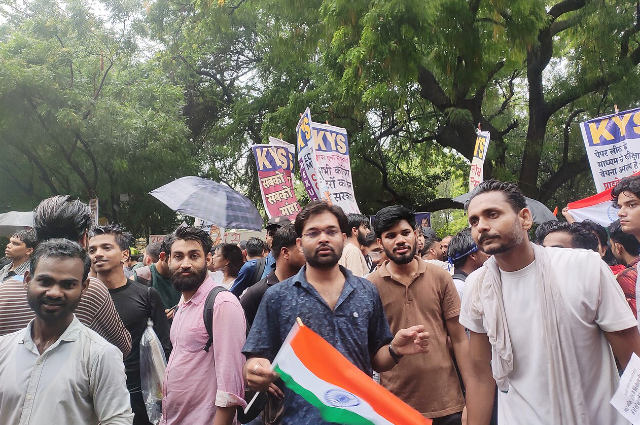
One sentence from a Supreme Court bench on May 15, 2026, lit a fuse nobody in the political establishment saw coming. Chief Justice of India Surya Kant, during a routine hearing on fraudulent legal credentials, remarked that unemployed young people were spreading through public life like "cockroaches" and "parasites of society." The comment was not directed at students. It was aimed at a different category of petitioner entirely. But language, once released into a country of 1.4 billion people carrying a decade of compressed frustration, does not stay where it was aimed.
The very next day, a 30-year-old political communications strategist from Pune named Abhijeet Dipke launched a website and announced the founding of the Cockroach Janta Party, abbreviated, with deliberate irreverence, to CJP. Its membership criteria: unemployed, lazy, chronically online, and able to rant professionally. Within days, the CJP's Instagram following crossed 20 million, eclipsing both the ruling Bharatiya Janata Party and the Indian National Congress on the same platform. What began as a satirical meme had become, almost overnight, one of the largest youth movements India had seen in more than a decade.
By July 25, 2026, India's Education Minister Dharmendra Pradhan had resigned from his post, the government had agreed to compensate the families of at least thirteen students who had died by suicide following the NEET-UG paper leak scandal, and the protest organisers were calling off demonstrations that had drawn thousands to the streets of central Delhi.
Two months. One remark. One resignation. A movement that started as a joke, wrote down an entire political anatomy, and forced it to rewrite the ending.
But to understand what actually happened between that May 15 hearing and that July 25 resignation, and more importantly, why it happened the way it did, you have to go back much further than May 2026. You have to go back to a Florentine diplomat writing in the early 1500s, and an Indian strategist writing roughly eighteen centuries before him. Because the drama that unfolded at Jantar Mantar this summer was not, at its core, a story about exam paper leaks or social media virality. It was a story about two very old theories of power meeting each other in a democratic arena, and both discovering their limits simultaneously.
The Two Anatomies
What Machiavelli and Chanakya actually said about power
Niccolò Machiavelli wrote The Prince around 1513, in the turbulent political landscape of what is now Italy, where small city-states competed, conspired, and occasionally destroyed each other. He had spent years as a diplomat for Florence, watching rulers rise and fall, and what he concluded from all that watching was something his contemporaries found uncomfortable to say out loud: politics is, at its foundation, a contest for power. Not a search for virtue. Not a moral project. A contest. And the ruler who forgets this, who governs as though goodwill alone will protect him, is not noble. He is dangerous to the people depending on him.
Machiavelli's advice to a prince is therefore entirely structural. Understand that people are self-interested by nature, not because they are bad, but because self-preservation is the most basic human instinct. Build systems that account for this reality rather than hoping it away. Keep a balance between fear and love in how people relate to your governance, because love given freely can be withdrawn, while fear, carefully calibrated, creates a more reliable foundation. Know when to be the lion and when to be the fox, when to use force openly and when to use cunning quietly. And above all, understand that the end goal, the stability and security of the state and its people, justifies the means required to reach it, because a collapsed state serves nobody.
Across roughly eighteen centuries and an entire continent, Kautilya, also known as Chanakya, arrived at strikingly similar conclusions from an entirely different starting point. Writing the Arthashastra in ancient India during the period of the Mauryan Empire, Chanakya was not theorising abstractly. He was the strategist who identified a young man named Chandragupta Maurya, trained him, supported him politically, and helped him build what became one of the most extensive empires in Indian history, doing in practice what Machiavelli could only describe in a book.
The Arthashastra is frequently dismissed in Eurocentric academic frameworks as a spiritual or religious text. It is neither. It is a remarkably precise manual for statecraft covering administration, taxation, foreign policy, anti-corruption measures, military strategy, and the psychology of governance with a directness that would not feel out of place in a modern public policy seminar. Chanakya's Mandala theory of geopolitics, which describes how a ruler must navigate relationships with neighbouring powers based on relative strength rather than sentiment, predates modern realist international relations theory by roughly two thousand years. His insistence that a king's primary duty is the material well-being of the people, which is artha, meaning resources and prosperity, is the entire argument of the book's title.
What unites them, across all that distance in time and geography, is the same foundational premise: the world as it actually is, not as we would like it to be. Power is real. Self-interest is real. The state's survival and the well-being of its people depend on a ruler who understands both of these things and governs accordingly, neither paralysed by idealism nor corrupted by cynicism, but operating with clear eyes in the actual terrain of human nature.
Both thinkers also agree on something that becomes directly relevant to the CJP story: a ruler who ignores legitimate grievances until they become a threat, and then responds with force rather than dialogue, is not being realistic. He is making a strategic error. Because Chanakya was explicit that when the people's basic needs- their artha, their material security are unmet, no amount of power will hold the state together. And Machiavelli was equally explicit that the most dangerous combination for any ruler is when citizens move from love to hatred, because hatred, once established, is extraordinarily difficult to reverse.
Both men, in other words, had already mapped the precise mistake the Indian government made between May and July 2026.
The Anatomy of the Movement
From a courtroom remark to a national crisis
To understand the CJP's rapid rise, you have to understand what it landed on. The NEET-UG 2026 controversy was not a minor administrative failure. On May 3, over 2.27 million students, some of them having spent years in preparation, some from families that had taken on debt or sold land to fund coaching fees, sat for India's national medical entrance examination. Nine days later, the exam was cancelled after investigators found overlaps between a pre-circulated question paper and the actual test. Students were told to return and do it all again. At least thirteen of them, according to compiled police and media records, took their own lives in the forty-six days between the cancellation and the scheduled re-test. One seventeen-year-old in Ahmedabad jumped from a sixth-floor balcony hours before he was supposed to sit the re-examination.
This was the ground into which Chief Justice Surya Kant's "cockroach" remark fell. The comment was not about NEET students. But for millions of young people already living in a country where competitive examination has become the single, high-stakes gateway to professional life, where 2.27 million people compete for a fixed number of medical seats, where paper leaks have repeatedly erased years of preparation, being told by one of the country's most senior judges that people like them were parasites was not an insult. It was a mirror.
Abhijeet Dipke, who had previously worked on digital communications for the Aam Aadmi Party and holds a public relations degree from Boston University, understood something that the political establishment did not: the most powerful political narratives are not manufactured. They are found already existing in the population and given a name. The CJP gave the frustration a name, a symbol, a slogan. Meme became identity. Identity became movement.
By late June, when Ladakhi environmentalist and educator Sonam Wangchuk joined the protests at Jantar Mantar on hunger strike, demanding Pradhan's resignation over the examination failures, the movement acquired a moral gravity that pure social media satire could not have generated on its own. Wangchuk's presence made it harder to dismiss, harder to delegitimise, and significantly harder to ignore.
The government tried all three approaches in sequence, and each one made the situation worse.
The Realist Lens: Two Political Anatomies at Work
How each side's operating logic shaped what happened
This is where the Machiavelli-Chanakya framework stops being an intellectual exercise and becomes genuinely explanatory. Because what the Jantar Mantar confrontation of July 2026 reveals, when you look at it structurally, is two different political logics operating simultaneously and both, in different ways, departing from the realist wisdom they might have claimed to represent.
THE TWO OPERATING LOGICS AT JANTAR MANTAR, JULY 2026
| The Ruling Establishment | The CJP Movement | |
| Starting logic | Preserve stability; contain the narrative | Legitimate grievance requires visible accountability |
| Initial response | Ignore; delegitimise | Escalate: from online to offline to march |
| Key error | Treated a material crisis as a perception problem | Allowed the platform to expand beyond its core mandate |
| Machiavellian parallel | Chose contempt over calibrated engagement; created hatred. | Confused idealist messaging with realist strategy |
| Kautilyan parallel | Failed the artha test means did not protect people's basic material interests | Lost control of the mandala; too many competing forces entered the field. |
| Outcome Reactive | Reactive capitulation under pressure rather than proactive resolution | Victory on demands; loss of narrative coherence |
The government's handling of the movement between May and mid-July is a fairly clean illustration of what both Machiavelli and Chanakya warned against: the dangerous combination of contempt and delayed response. Machiavelli was specific that a ruler could be forgiven for being feared, but not for being held in contempt, and the BJP leadership's public statements during this period, which described the protesters as people who wanted to "make the country hollow" and compared the CJP movement to a "virus," moved the dial from management toward antagonism. Chanakya's counsel was more direct still: if the people are suffering materially and you do not address it, they will come into the streets, and lawlessness will follow.
The government eventually sent Health Minister JP Nadda to meet CJP representatives on July 20, the same day thousands of protesters marched toward Parliament, police used tear gas and lathi charges, scores were injured, and Gitanjali Angmo, Sonam Wangchuk's wife, was reportedly assaulted. The meeting lasted ten minutes. Independent fact-checkers from BOOM and Alt News subsequently confirmed, through metadata analysis and GPS coordinates, that video footage of police action matched the protest site on that date, contradicting official government denials. The Delhi High Court took up a judicial inquiry. Both Machiavelli and Chanakya would have identified this sequence of ignore, delegitimise, send a minister for ten minutes as the city burns as a failure of calibration, not just of optics.
But the CJP's own trajectory through the same period offers a parallel structural observation. The movement that began with a precise mandate regarding examination accountability, ministerial responsibility for the NEET failure, expanded, as it moved from Pune to Delhi, in ways that complicated its own coherence. By the time the July 20 march happened, the protest space contained, alongside genuine student aspirants, a remarkably wide coalition: left student unions affiliated with formal political parties, activists associated with various other political causes, professional protest organisers, and individuals whose stated positions on unrelated political questions ranged far beyond exam reform.
Dipke himself acknowledged the presence of organised left-wing student outfits, noting that their volunteers were working hard on the ground. Some of the slogans that emerged from the broader crowd were unconnected to education. Dipke later described what happened at that stage during the march as, in his own words, the dumbest move ever, when the platform was used for statements far outside the CJP's founding mandate. He said it put the entire movement's credibility at risk.
This is not a political verdict on who was right or wrong. It is a structural observation about what both Chanakya and Machiavelli understood as the challenge of power maintenance: holding together a coalition around a single, clear objective is extraordinarily difficult under pressure, and the moment a movement becomes a platform for every grievance in the landscape, its ability to discipline its own narrative collapses. Chanakya's Mandala theory describes exactly this: when too many forces enter the field simultaneously, the central power loses directional control, because everyone is pulling in a different direction.
The students whose NEET results had been stolen, whose futures had been put on hold, whose peers had died, as their issue was specific, urgent, and entirely legitimate. That issue risked being buried under the weight of everything else that attached itself to the movement before July 25.
What the Evidence Actually Shows
A timeline, not a verdict
On July 19, Delhi Police issued a public advisory stating that BNSS Section 163 was in force in the New Delhi district, and that no permission had been granted for a march to Parliament. The designated protest site remained Jantar Mantar. This was a legally established boundary, confirmed by the 2018 Supreme Court ruling in Mazdoor Kisan Shakti Sangathan v. Union of India, which upheld the state's right to impose reasonable restrictions on protests near high-security zones while protecting the fundamental right to peaceful assembly.
On July 20, the march proceeded toward Parliament regardless. The sequence that followed is documented: police deployed tear gas and lathi charges as protesters crossed barricades; scores of protesters were injured; CJP alleged that the force used was disproportionate and that individuals including Gitanjali Angmo were assaulted; Delhi Police and the Press Information Bureau initially denied the video evidence; independent verification by BOOM and Alt News, using metadata tools and embedded GPS coordinates from video footage, confirmed the footage matched the protest site on that date. The matter is now before the Delhi High Court, which is the appropriate forum for determining whether the force used was legally proportionate, a question that evidence and judicial process, not political narrative from either side, will resolve.
Five days later, on July 25, Education Minister Pradhan resigned. The government subsequently accepted the CJP's remaining two demands: financial compensation for the families of students who died by suicide, and no punitive action against protesters involved in the July 20 demonstrations. Dipke fell to his knees outside the protest site on hearing the news. Then he raised his fist and said: We have done it.
The protests ended. The question of whether the underlying system, whether the examination infrastructure, the funding gap, or the implementation failure of NEP 2020 would actually change, remained open.
The Root Cause Neither Side Fully Addressed
The system is the problem.
Both Machiavelli and Chanakya would have pointed, ultimately, to the same thing: the crisis was not caused by a paper leak or a judicial remark. It was caused by a structural failure that has been accumulating for decades, and a ministerial resignation, however symbolically significant, does not resolve it.
India's education spending has remained at approximately 4 per cent of GDP, well below the 6 per cent target recommended by the Kothari Commission in 1966, reaffirmed in every National Education Policy since, including NEP 2020. According to a June 2026 report published by Azim Premji University, that gap has never once been closed in sixty years. The report describes India's learning crisis as a "national emergency." Government data shows that public expenditure on education has failed to keep pace with economic growth, despite rising in absolute terms over the years.
NEP 2020 arrived with a genuinely ambitious vision of moving away from rote learning, building critical thinking, introducing vocational flexibility, create resilient and curious learners. Thirty-three structural reforms were laid out. But the infrastructure required to execute those reforms was never built. The gross enrolment ratio for higher education remains at 28 to 30 per cent, far below the NEP 2020 target of 50 per cent. Over one lakh schools across the country still operate with a single teacher. Central University teaching positions sit nearly 30 per cent vacant. Vocational education credits exist on paper; the workshops, instructors, and industry partnerships required to make them real do not, at anything approaching the scale needed.
The result is a system that functions not as education but as selection, as a sorting machine that funnels millions of students toward a small number of high-stakes examinations, treats failure in those examinations as personal collapse rather than systemic inadequacy, and then is surprised when the mechanism through which those examinations are conducted turns out to be corruptible. On May 3, over 2.27 million students appeared for NEET 2026. Nine days later, the examination was cancelled after investigators found similarities between a leaked question paper and the actual exam. The leak was not an accident. It was, in the most precise sense, what happens when enormous institutional pressure meets insufficient institutional integrity.
Chanakya's Arthashastra was not primarily a book about kings. It was a book about the relationship between the state's organisational capacity and the well-being of its people, the argument that governance is only as strong as the material conditions it creates and maintains. A state that cannot run a fair examination for 2.27 million of its young people is not failing administratively. It is failing the most basic Kautilyan test of what a government exists to do.
STRUCTURAL COMPARISON: VISION VS. GROUND REALITY
| Education System Indicator | Policy Target | Current Reality |
| Education spending as % of GDP | 6% (NEP 2020, Kothari Commission 1966) | ~4% (Azim Premji University, June 2026) |
| Higher education gross enrolment ratio | 50% (NEP 2020 target) | 28–30% (2026 data) |
| Schools with single teacher | 0 (implied by quality targets) | 1 lakh+ (government data) |
| Central university faculty vacancies | 0 | ~29% (2025 data) |
| NEET 2026 aspirants forced to retake exam | 0 | 2.27 million |
| Student suicides following cancellation | 0 | At least 13 confirmed (Outlook India, June 2026) |
The Lesson Both Anatomies Teach
What realism actually demands of a democracy
The deepest insight shared by Machiavelli and Chanakya is the one that neither the government nor the protest movement fully operationalised in 2026 is this: power that ignores its own accountability to the people it governs is not strong. It is fragile. And movements that begin with a legitimate, specific mandate and then expand to encompass every political grievance in the atmosphere are not becoming stronger. They are becoming diffuse. They are handing their opponents the easiest possible argument.
The CJP won its three stated demands. That is a real, documented outcome: a ministerial resignation, compensation commitments, and a government undertaking not to punish protesters. These are not small things. For the families of the students who died, the compensation commitment matters. For every future protest organiser in India, the demonstration that a non-registered satirical movement with no party machinery could compel a cabinet resignation in two months will matter for a long time.
But Pradhan's replacement will inherit the same structural underfunding, the same vacant faculty positions, the same NEP 2020 vision sitting on top of the same inadequate infrastructure. The machine that produced the leak is still there. And both Chanakya and Machiavelli would agree that replacing the person at the top of a broken system without fixing the system is not a resolution. It is a postponement.
The truest realist reading of what happened at Jantar Mantar is that both anatomies of the government's power-preservation instinct and the movement's mobilisation energy did exactly what those frameworks predict. The government delayed until the delay became more costly than the concession. The movement expanded until expansion threatened its own core message. Both were rational, in a narrow sense. Neither was wise, in the broader sense that both Machiavelli and Chanakya meant by wisdom: the long view, the institutional view, the view that asks not what solves today's crisis but what prevents the next generation from inheriting the same one.
A healthy democracy is not one in which protests never happen. It is one in which institutions change when protests reveal that they should. Slogans are not policy. Resignations are not reform. The test of what July 2026 actually meant will not be delivered at Jantar Mantar. It will be delivered in the classrooms, the exam centres, and the budget allocations of the years that follow.
On July 25, 2026, Dharmendra Pradhan posted his resignation letter on X. "I deeply respect the aspirations, feelings, and legitimate expectations of the country's youth," he wrote. Hundreds of young people celebrated through the evening at Jantar Mantar. Abhijeet Dipke knelt on the ground for a moment, then stood up and raised his fist.
It was a genuine victory. It was also the beginning of a harder, quieter question that no protest can answer and no resignation can resolve: what exactly changes next?
Two thinkers separated by two thousand years and two continents both arrived at the same conclusion about governance. The state's legitimacy is not built on ceremony, perception management, or the performance of authority. It is built, piece by piece, from the actual conditions it creates for the people living inside it. Chanakya called it artha. Machiavelli called it the material basis of stable rule. In 2026, thirteen families received the news that they would be compensated for children who died because an examination system failed them. The system that failed them is still there. The next generation of students is already in it.
That is the question Jantar Mantar raised, and that no one, not the government, not the CJP, not the commentators on either side, has yet fully answered. What does the cockroach do the morning after the celebration, when the cameras have gone, and the examination hall is still broken?
References:
- Primary academic and philosophical sources
- Kautilya (Chanakya). Arthashastra. Translated by R. Shamasastry. Government Press, Mysore, 1915. (Original text: c. 300 BCE)
- Machiavelli, N. (1532). The Prince (Il Principe). Translated by Harvey Mansfield. University of Chicago Press, 1985.
- Kaur, Rupinder. (2012). Kautilya's Political Theory: Yogakshema, the Concept of Public Welfare. New Delhi: Concept Publishing.
- Al Jazeera. (2026, July 25). India's education minister resigns after weeks of Cockroach protests. aljazeera.com
- Britannica. (2026, July 25). Cockroach Janta Party and the 2026 Delhi Protest. britannica.com
- CNN. (2026, July 25). India's education minister resigns after days of Cockroach youth protests over exam paper leaks. cnn.com
- NPR. (2026, July 25). India's cockroach movement ousts minister, but can Modi calm youth? npr.org
- Outlook India. (2026, June 19). 13 Reported Suicides After NEET Paper Leak. outlookindia.com
- Outlook India. (2026, July 25). CJP Protest Ends As Govt Accepts All Three Demands. outlookindia.com
- Scroll. in. (2026, July 20). Updates: Sonam Wangchuk says he will continue fast, condemns police brutality during CJP protest. scroll.in
- The Federal. (2026, June 20). NEET re-exam 2026: Leak crisis exposes deeper flaws in India's exam system. thefederal.com
- The Tribune. (2026, June 27). India's education spending remains at 4% of GDP, below NEP's 6% target. tribuneindia.com
- Wikipedia. (2026). 2026 Delhi Jantar Mantar protests. en.wikipedia.org
- Wikipedia. (2026). 2026 NEET controversy. en.wikipedia.org
- Wikipedia. (2026). Cockroach Janta Party. en.wikipedia.org
- Mazdoor Kisan Shakti Sangathan v. Union of India, (2018) 17 SCC 324. Supreme Court of India.
- Azim Premji University. (June 2026). Realising Rights: A Handbook of Welfare in India. Bangalore: Azim Premji University Press.
- Careers360 / Kundu, P. (September 2025). Promises vs Provision: Public funding for NEP 2020 stuck at around 4% of GDP. news.careers360.com
- National Education Policy 2020. Government of India, Ministry of Education.