
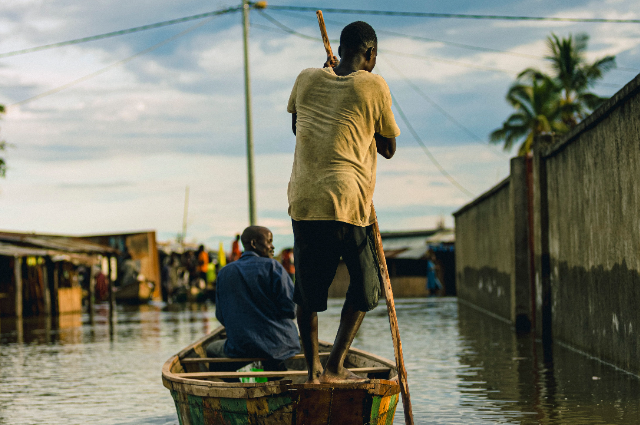
Divya G. had spent more than a day upstairs in a neighbour’s house in Chengannur when a fishing boat finally reached her lane.
For the family, getting upstairs had been a way of waiting. Earlier, Divya had held on to a floating banana plant and then pulled herself through neck-deep water with the help of a rope. The flood had turned the familiar routes around the house into something else entirely. A street that normally connected one home to another had become an obstacle.
The fishing boat changed that.
The crew took Divya and her family to a relief camp. Her experience was reported by Reuters during the floods.
It was one rescue among many.
In August 2018, large parts of Kerala were underwater. Houses became isolated from roads. Families waited on upper floors and other places above the rising water. Reaching a stranded household was no longer simply a question of knowing its address. Someone also had to know how to get there.
Fishing boats began arriving from the coast.
Their crews knew how to work with water, but they did not necessarily know the streets they were entering. They needed directions and local knowledge. Under the water were walls, bridges, electric posts and other obstacles that were difficult to see from the surface.
The rescue operation therefore depended on more than the boats themselves.
It depended on people who knew how to handle them.
The journey inland
At Mattathur in Thrissur, fisherman Majid M.K. abandoned one boat after it struck a wall. His crew continued in another vessel. Later, he described reaching a couple in their seventies who had stacked one bed above another to keep themselves above the rising water.
The couple had used what was available inside their own home to create a temporary refuge.
The fishermen had to get them out.
That meant navigating a flooded neighbourhood in a vessel that could itself be damaged by structures hidden beneath the water.
Antony Silva and Thomas Terry had travelled from Valiyaveli on August 17. Their journey involved trucks being diverted and police helping coordinate the operation. When Silva was asked about special training before the rescue mission, he gave an answer that became the title of the newspaper report about their experience:
“Experience was our weapon.”
But his experience did not make the rescue simple.
Silva later recalled becoming lost after dark with four rescued passengers aboard. The detail is easy to overlook in a story usually told through praise. Yet it reveals something important. Knowing how to work with water did not automatically mean knowing every flooded road or submerged passage.
The fishermen could be experienced and uncertain at the same time.
Terry described reaching forty people near Thiruvalla. His brother's boat was damaged against a concrete bridge, and a strong current forced the engine-powered vessel to be pulled out with a rope.
Finding stranded people was only one part of the journey.
After they climbed aboard, the fishermen still had to bring them back.
The return journey could be as difficult as reaching the house.
When directions became part of the rescue
Some crews faced another problem: they did not know the neighbourhoods well enough to find the right houses.
A seven-man team led by Johnny Chekkitta travelled from the Thiruvananthapuram coast towards Chengannur. According to Asia Times, weak phone coverage and unfamiliar surroundings made navigation difficult. Rescue coordinators sent recorded route messages to help the team.
Then, on August 20, another kind of information arrived.
During a Facebook broadcast, a woman living in the United States recognised that the boat had passed the house where her parents were stranded. Team member Silvadasan Antony told the publication that her call sent the crew back.
The woman knew which house mattered.
The fishermen were close enough to reach it.
The phone connected the two.
But the final distance still had to be covered by boat.
That small episode captures something important about the rescue operation. Technology could provide information, but information alone could not evacuate anyone. A caller could identify a house. A fisherman could reach it. Local knowledge could guide the crew through an unfamiliar area. Police and other organisers could help connect people with vessels.
The rescue depended on these pieces working together.
The photograph everyone remembers
At Muthalamadu near Vengara, Jaisal K.P. became associated with one of the most widely shared images from the rescue effort.
People had reached a rescue boat but needed help getting aboard. Jaisal lowered himself into the water and allowed them to step across his back and into the boat.
The photograph made the action visible.
But the circumstances behind it were more specific than the photograph suggested.
Jaisal told the Times of India that he had received information about a pregnant woman needing help among the stranded group. He could not practically identify her, so he lowered himself to help the group board. He was a trauma-care volunteer as well as a fisherman.
That background matters.
Without it, the photograph can easily become a simple story about an extraordinary act of kindness. With it, another detail comes into view: Jaisal was responding to a practical problem in a dangerous environment, drawing on experience that included more than fishing.
And it was only one moment.
Some boats were damaged, routes that became confusing after dark, families who waited for hours, passengers who had to be fitted into already crowded vessels, and crews who had to make the journey back after reaching the people they were trying to save.
Most of those moments were never photographed.
Whose knowledge counted
In Aluva, Shiji Dency worked with five other fishermen and residents familiar with the area. Reuters reported that the group rescued around a thousand people over five days. Dency also spoke about the social distance between his community and some of the people asking for help.
A rescue boat does not erase those differences.
For the duration of the journey, however, the people aboard depended on abilities that the fishermen already possessed.
Those abilities had been acquired through ordinary work.
The boats were not rescue equipment created for the flood. They were working vessels used by people whose livelihoods depended on them. The knowledge of handling those boats had existed before the emergency. Public recognition came afterwards.
That distinction is important.
The fishermen did not suddenly become capable because newspapers called them heroes. They were already capable. The flood created a situation in which their existing knowledge became urgently valuable somewhere far beyond the coastline.
This does not mean fishermen could replace professional rescue services.
They could not.
The police, fire services, armed forces, National Disaster Response Force and other agencies were also involved in the response. The fishermen became one part of a much greater effort.
But their participation revealed something that disaster planning can easily overlook.
A community may possess useful skills long before anyone formally labels them as disaster-response resources.
A map can show where a house is. It cannot always show which submerged route is passable.
A boat can carry people. It still needs someone who knows how to handle it.
A phone can identify a stranded family. Someone still has to reach the house.
The 2018 floods brought these different forms of knowledge together.
What the rescue cost
There was another side to the story that was less visible in photographs.
A fishing boat is not simply a vehicle. For its owner and crew, it is working equipment.
When a boat strikes a wall or bridge, the damage does not disappear when the rescue ends.
The Indian Express reported fishermen describing boats hitting walls and electric posts. The state government announced compensation for damaged vessels, fuel expenses and a payment of ₹3,000 per boat per day.
But an announcement of compensation is not the same thing as evidence that every repair was completed or every expense was fully recovered.
That distinction matters because admiration can sometimes make sacrifice look easier than it is.
A fisherman can volunteer to rescue strangers and still need his boat to earn a living afterwards.
The coastal communities had also experienced Cyclone Ockhi shortly before the floods. Contemporary reporting connected that experience with the flood response. It would be too broad to claim that every fisherman was motivated by the same memory, but the connection provides important context: people accustomed to one kind of water-related danger were travelling inland to help people trapped by another.
Calling them fearless would simplify what the accounts actually show.
There was danger.
There was uncertainty.
There was damage.
And there was still a decision to go.
Beyond the number of boats
The official figures show the scale of the mobilisation.
Kerala’s Economic Review 2019 recorded 669 boats, 4,537 fishermen and more than 65,000 people saved. The Government of Kerala’s Post-Disaster Needs Assessment contains the same fisherman figure in its executive summary but records 2,927 in its disaster-risk-reduction chapter.
The figures have not been reconciled in the documents.
That inconsistency does not make the rescue less significant. It is simply a reason not to pretend that the official record provides a single perfectly precise number.
Behind any estimate were individual journeys.
Majid's crew continued after one boat was damaged.
Silva had to find his way back after dark.
Johnny Chekkitta's team turned around after receiving information about a stranded family.
Jaisal helped people climb into a boat.
And there were many other journeys that never became widely circulated photographs or named newspaper stories.
The public remembers the number of boats.
The people who needed rescuing experienced individual boats arriving at individual houses.
That difference is worth remembering.
Back at the coast
By August 23, contemporary reporting described rescue boats returning towards the coast as the floodwater receded.
But returning did not mean that everything was over.
The sea itself remained difficult. Fisherman Jerome John of Anchuthengu told a reporter that strong winds had prevented his crew from launching since August 14.
Some vessels also needed repairs after the rescue work.
For the passengers, reaching safety ended an evacuation.
For the fishermen, it did not settle the cost.
A damaged boat remained damaged after it reached the coast. Fuel still had to be paid for. Fishing still had to resume. The same vessels that had carried families through flooded streets were also the vessels their owners depended on for their livelihood.
The photographs of the 2018 floods captured extraordinary moments.
But the larger story was made up of ordinary skills being used in an extraordinary situation.
The fishermen knew their boats.
Residents knew their neighbourhoods.
Organisers connected people who needed help with people who could provide it.
Phones carried information across distances.
And, when those things came together, a stranded household could become a reachable one.
For a few days, fishing boats became rescue boats.
Experience became emergency knowledge.
People whose work was usually associated with Kerala's coast became essential to families trapped far inland.
When the water receded, the fishermen returned to the coast.
Their role in the disaster had ended.
Their ordinary work had not.
They still had to earn a living from the sea.
Perhaps that is the part of the story that deserves to remain after the photographs fade: a disaster can reveal the value of knowledge that society normally overlooks.
The challenge is not simply to thank people after they save lives.
It is to recognise what they know before the next disaster needs it.
References:
- Jose Devasia and Sudarshan Varadhan. “Local boatmen the heroes of flood rescues in India’s Kerala.” Reuters, 21 August 2018, reproduced by Euronews.
- Sajin Saju. “Why flood-battered Kerala is hailing its fishermen as superheroes.” The Indian Express, 21 August 2018.
- The New Indian Express. “Kerala floods: Experience was our weapon, families inspiration, say fishermen who participated in rescue operations.” URL dated 22 August 2018; page updated 23 November 2018.
- Rejimon Kuttappan. “Fishermen the real heroes of Kerala’s great flood.” Asia Times, 23 August 2018.
- T P Nijeesh. “Kerala floods: How a Malappuram fisherman stooped to conquer.” Times of India, 22 August 2018.
- MM Paniyil. “Extreme Rainfall Caused Kerala Floods But Human Folly Made Things Worse.” The Wire Science, 23 August 2018.
- Kerala State Planning Board. Economic Review 2019, Volume I, PDF p. 530.
- Government of Kerala. Kerala Floods and Landslides 2018: Post-Disaster Needs Assessment. Official February 2019 file; executive summary and Disaster Risk Reduction chapter.