
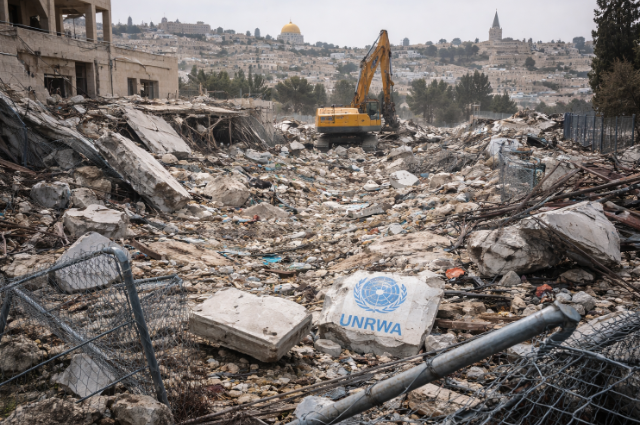
A Breach of International Protocol
The demolition of the United Nations Relief and Works Agency for Palestine Refugees (UNRWA) headquarters in East Jerusalem on January 20, 2026, represents a watershed moment in the history of the Israeli-Palestinian conflict and the broader framework of international diplomacy. For decades, the presence of the United Nations in Jerusalem served not only as a functional provider of services to millions of refugees but also as a symbolic anchor for the international community’s commitment to a negotiated settlement. However, when Israeli heavy machinery began dismantling the compound, it signalled a definitive shift in the geopolitical landscape.
The act was not merely a physical destruction of property; it was the culmination of years of escalating tension between the State of Israel and the UN agency it accuses of being irredeemably compromised. The international response was swift and unusually unified among Western allies. On Wednesday, January 28, 2026, the United Kingdom, France, Canada, and several other nations issued a joint statement condemning the act in the strongest possible terms. This article explores the deep-seated causes of this crisis, the legal precedents being challenged, the humanitarian vacuum created by the agency's removal, and the long-term implications for global governance and the sanctity of UN premises worldwide.
The Jerusalem Headquarters: A History of Neutrality and Service
The UNRWA headquarters in East Jerusalem was more than just an office building; it was the nerve centre for humanitarian operations that spanned across the West Bank, Gaza, Jordan, Lebanon, and Syria. Established in the aftermath of the 1948 Arab-Israeli War, UNRWA was mandated by the UN General Assembly to provide assistance and protection to registered Palestinian refugees. The East Jerusalem compound served as a vital link between the agency's leadership and the field operations that supported over 5.9 million people. Historically, the site operated under the principle of "inviolability," a concept enshrined in international law to ensure that UN agencies can function without interference from host or occupying powers. For decades, it housed the administrative staff responsible for education, healthcare, and social services. In East Jerusalem alone, thousands of families relied on the agency for basic needs that the municipal government did not always fulfil. The physical presence of the UN flag in the heart of Jerusalem was a constant reminder of the city's contested status and the international community's role as a stakeholder in its future.
The dismantling of this site represents the erasure of a legacy. Critics argue that the removal of UNRWA is a tactical move to redefine the status of Jerusalem by eliminating international institutions that uphold the refugee status of Palestinians. Conversely, the Israeli government maintains that the site had become a relic of a failed system that perpetuated the conflict rather than solving it. To understand the gravity of the demolition, one must look at the services provided within those walls: the planning of school curricula for hundreds of thousands of children, the coordination of life-saving medical supplies, and the management of microfinance programs that allowed families to maintain a semblance of dignity under occupation. The loss of this hub creates an administrative nightmare. Without a central headquarters in Jerusalem, the logistical coordination required to move aid through checkpoints and into the various refugee camps becomes significantly more complex. The symbolic weight of the demolition also cannot be overstated. By removing the UN presence from East Jerusalem, the Israeli government is asserting a form of absolute sovereignty that leaves little room for the multi-lateral frameworks that have defined the peace process since the Oslo Accords.
The Legal Battle: Violations of the 1946 UN General Convention
The joint statement issued by the UK, France, Canada, and their allies specifically cited the 1946 Convention on the Privileges and Immunities of the United Nations. This document is the cornerstone of how the UN operates globally. It stipulates that the premises of the United Nations shall be inviolable and that the property and assets of the United Nations, wherever located and by whomsoever held, shall be immune from search, requisition, confiscation, expropriation, and any other form of interference, whether by executive, administrative, judicial, or legislative action.
Israel’s demolition of the UNRWA site is seen by legal experts as a direct challenge to this convention. The Israeli government argues that domestic law—specifically the new legislation passed in late 2025 banning UNRWA—takes precedence over international treaties within its territory. However, international law generally holds that a state cannot invoke the provisions of its internal law as justification for its failure to perform a treaty. This creates a profound legal impasse. If a UN member state can unilaterally declare a UN agency "illegal" and proceed to demolish its premises, the legal protections for every other UN operation in the world, from the WHO to UNICEF, are potentially undermined.
The 1946 Convention was designed precisely to prevent such occurrences. It was intended to ensure that international civil servants could work without fear of harassment or eviction by local authorities. By proceeding with the demolition, Israel has set a precedent that many fear will be exploited by other nations looking to expel international monitors or aid workers. The joint statement from the foreign ministers emphasised that Israel, as a member of the United Nations, has an obligation to uphold the UN Charter. The Charter itself requires members to give the United Nations every assistance in any action it takes in accordance with the present Charter. The legal repercussions may extend to the International Court of Justice (ICJ). While the ICJ usually deals with disputes between states, the General Assembly could request an advisory opinion on the legality of a member state dismantling the premises of a mandated agency. Such a process would further isolate Israel diplomatically. The argument that UNRWA is "not a standard UN agency" due to its specific mandate for Palestinians does not hold water under the 1946 Convention, which applies to the United Nations as a whole. Therefore, the demolition is being viewed not just as a local property dispute, but as a systemic attack on the rules-based international order.
Israel's Legislative Offensive: The Law Banning UNRWA Operations
The demolition was not an isolated act of aggression but the execution of a legal mandate passed by the Israeli Knesset in late 2025. This legislation was the culmination of a decade-long campaign by various political factions in Israel who view UNRWA as an obstacle to peace. The law essentially designated UNRWA as a hostile entity, citing alleged ties to militant groups and the involvement of a small number of its employees in the October 7 attacks. While UNRWA terminated the contracts of the accused individuals and the UN launched an independent investigation (the Colonna Report), the Israeli government maintained that the agency's neutrality was fundamentally compromised.
The legislation banned any contact between Israeli state officials and UNRWA representatives, effectively making it impossible for the agency to coordinate its movements, secure visas for international staff, or import humanitarian goods. By January 2026, the deadline for the agency to cease operations had arrived, and the demolition of the East Jerusalem headquarters was the most visible manifestation of this new legal reality. Proponents of the law argue that it is a necessary security measure. They claim that UNRWA schools incite violence and that its facilities have been used by Hamas for military purposes.
However, the international community has largely rejected the notion that the entire agency should be dismantled based on the actions of a few. The joint statement by the eleven nations highlighted that this move "marks the latest unacceptable move to undermine their ability to operate." Critics of the law point out that it provides no viable alternative for the services UNRWA provides. There is no plan for the Israeli Civil Administration or another international body to take over the education of 300,000 children or the healthcare of millions of refugees overnight.
The legislative offensive also serves a broader political goal: the "de-refugee-ization" of the Palestinian population. By dismantling the agency that keeps the refugee status alive, some Israeli politicians hope to settle the "Right of Return" issue by fiat rather than negotiation. This makes the law not just a security measure, but a tool of demographic and territorial engineering. The demolition of the headquarters is therefore the physical destruction of a political status that Israel no longer wishes to recognise.
International Condemnation: Examining the Joint Statement by Allies
The joint statement issued on January 28, 2026, was remarkable for its breadth and the seniority of its signatories. Representing the United Kingdom, Belgium, Canada, Denmark, France, Iceland, Ireland, Japan, Norway, Portugal, and Spain, the document was a rare show of
Western and Asian unity against a key ally, Israel. The language used—"unprecedented act," "unacceptable move," and "strongly condemned"—goes beyond standard diplomatic concern. It reflects a genuine fear among these nations that the basic "rules of the road" for international relations are being shredded.
The inclusion of Japan and Canada is particularly significant. Japan is one of the largest donors to UNRWA and has traditionally sought a balanced approach to Middle Eastern diplomacy. Its decision to join a "strong condemnation" indicates that Tokyo views the demolition as a threat to the global humanitarian system it heavily invests in. Canada, under various administrations, has often been one of Israel's staunchest defenders in international forums. Its signature on this statement signals that a "red line" has been crossed regarding the treatment of UN institutions. The statement calls on Israel to "abide by its international obligations" and specifically mentions the UN General Convention of 1946. This is a clear signal that the signatories do not accept the "security" justification as sufficient to override international law. The diplomatic fallout is likely to manifest in several ways. We may see a reduction in intelligence sharing, a reassessment of arms export licenses by European nations, and a more aggressive stance against Israel in the UN Security Council and General Assembly.
Furthermore, the statement highlights a growing rift between Israel and its traditional partners in the Global North. While the United States was notably absent from the specific joint statement, its own State Department expressed "deep concern," showing that even Israel's most vital ally is struggling to defend the demolition of a UN facility. The allies are essentially telling the Israeli government that while they support its right to self-defence, they will not support the dismantling of the international legal architecture to achieve it.
The Humanitarian Void: Consequences for Palestinian Refugee Welfare
The most immediate and devastating impact of the demolition and the broader ban on UNRWA is the humanitarian void it creates. UNRWA is not just an aid agency; it is a "quasi-state" provider. In the West Bank and East Jerusalem, it operates 96 schools serving approximately 50,000 students. It runs health centres that provide primary care, vaccinations, and maternal health services. It manages waste disposal in refugee camps, ensuring that public health crises like cholera or typhus do not take hold.
When the headquarters is demolished and operations are banned, these services do not simply transfer to another provider. The Palestinian Authority (PA) is currently facing a severe fiscal crisis and lacks the capacity to absorb tens of thousands of students and patients. The Israeli government has suggested that other UN agencies like UNICEF or the World Food Programme (WFP) could take over, but these agencies have explicitly stated they do not have the mandate, the infrastructure, or the local expertise to replace UNRWA. UNRWA's staff is largely comprised of local Palestinians who know the communities they serve; replacing this 13,000-strong workforce in the West Bank alone is impossible in the short term.
In the refugee camps of Shuafat and Kalandia, located in and around Jerusalem, the tension is palpable. Residents who once relied on UNRWA for flour, oil, and medicine now face an uncertain future. The demolition of the headquarters means that the administrative oversight for these camps is gone. This leads to a breakdown in order and a rise in desperation. Humanitarian experts warn that when you take away education and healthcare from a marginalised population, you create a vacuum that is often filled by more radical elements. The humanitarian crisis also has a regional dimension. If services collapse in the West Bank and Jerusalem, it will place more pressure on neighbouring Jordan and Lebanon, which are already hosting millions of refugees. The "unravelling" of UNRWA could lead to a mass migration event as people seek the basic services they can no longer find at home. Thus, the demolition of a single building in Jerusalem has the potential to destabilise the entire Levant.
Militancy and Neutrality: Deconstructing Allegations of Hamas Infiltration
To understand why Israel took the drastic step of demolishing the UNRWA site, one must examine the allegations of militancy that have dogged the agency. Following the October 7, 2023, attacks, Israel provided evidence that several UNRWA employees participated in the massacre. Subsequent reports claimed that a significant percentage of UNRWA’s male staff in Gaza had affiliations with Hamas or Islamic Jihad. Israel also discovered tunnels near or under UNRWA facilities, leading to the argument that the agency was being used as a "human shield" for militant activities.
UNRWA’s leadership has consistently maintained a "zero tolerance" policy for neutrality violations. They point out that they submit their staff lists to the Israeli government every year for vetting and that, until 2024, no major objections were raised. The Colonna Report, commissioned by the UN, found that UNRWA had "robust" neutrality frameworks but noted areas for improvement, particularly regarding political bias in textbooks and staff social media use.
However, the Israeli government argues that the rot is systemic. They claim that the very nature of UNRWA—being staffed by the local population—makes it impossible for it to remain neutral in a conflict where the local population is governed by a militant group like Hamas. This is the core of the Israeli "security" argument: that UNRWA has become a logistical and ideological arm of the Palestinian resistance. By demolishing the headquarters, Israel is signalling that it no longer believes the agency can be "reformed."
The international community's response to these allegations has been nuanced. While most countries paused funding briefly in 2024, almost all (except the US and initially Israel) resumed it after seeing the internal reforms UNRWA implemented. They argue that even if there are "bad actors" within the agency, the collective punishment of millions of refugees is not a proportional or legal response. The demolition of the East Jerusalem site—where no tunnels were found, and no specific militant activity was cited—is seen by critics as proof that the "security" argument is a pretext for a political goal.
Geopolitical Shifts: The Impact on the Two-State Solution Framework
For decades, the "Two-State Solution" has been the official goal of international diplomacy in the region. This framework assumes that East Jerusalem will eventually serve as the capital of a future Palestinian state. The presence of UNRWA in East Jerusalem was a physical manifestation of that future possibility. It recognised the Palestinians in Jerusalem as refugees with a right to international protection and services until a final status agreement was reached. By dismantling UNRWA's presence and banning the agency, the Israeli government is effectively taking the "refugee issue" and the "East Jerusalem issue" off the negotiating table. If there is no UNRWA, and if the residents are forced to integrate into the Israeli municipal system (or face displacement), the distinct political identity of the East Jerusalem Palestinian community is eroded. This makes the creation of a contiguous and viable Palestinian state significantly more difficult.
The joint statement by the UK, France, and Canada reflects this concern. These nations see the demolition as a "unilateral move" that prejudices final status negotiations. International law prohibits an occupying power from making permanent changes to the territory it occupies that are not for the benefit of the local population. Demolishing a humanitarian headquarters hardly qualifies as a benefit.
Furthermore, the move signals to the Palestinian leadership and the Arab world that Israel is no longer interested in the Oslo-era compromises. This has led to a hardening of positions on the Palestinian side. If the "moderate" path of working with the UN and international agencies is blocked, the argument for armed resistance gains more traction among the youth. The demolition of the UNRWA site might therefore be remembered as the moment the Two-State Solution was officially buried under the rubble of international law.
The Role of Global Powers: US, EU, and Asian Responses
The response to the demolition has exposed the varying degrees of influence and interest among global powers. The United States finds itself in a difficult position. On one hand, the US Congress has passed its own restrictions on UNRWA funding, and the administration has expressed concerns about the agency's neutrality. On the other hand, the US is the guarantor of the international order and cannot easily ignore the demolition of a UN facility by a democratic ally. The US response has been characterised by "quiet diplomacy," trying to persuade Israel to find "alternatives" to UNRWA, but so far, these efforts have failed to stop the demolition.
The European Union, led by France and Germany, has been much more vocal. For Europe, the rules-based order" is not just a catchphrase; it is the foundation of their collective security. If the UN can be ignored in Jerusalem, what stops it from being ignored in the Balkans or the Sahel? The EU is UNRWA's largest collective donor, and they view the destruction of the agency's infrastructure as a direct waste of European taxpayer money. There are now calls within the European Parliament to suspend the EU-Israel Association Agreement, which provides Israel with preferential trade terms, as a direct consequence of these violations.
In Asia, Japan's involvement in the joint statement is a major shift. Japan has recently sought a more active role in global humanitarian leadership. By condemning the demolition, Japan is signalling that it will not allow its investments in Middle Eastern stability to be erased by unilateral military actions. This suggests that Israel is losing the "neutral" ground it once held with Asian powers, who are primarily interested in stability and trade.
The Global South, represented by nations like South Africa and Brazil, has used the demolition as further evidence in their "Genocide" and "Apartheid" cases against Israel at the ICJ. They argue that the systematic destruction of the means of life—including the administrative headquarters of the primary aid agency—is part of a broader plan to make Palestinian life untenable. The demolition has therefore unified a broad swathe of the international community against Israel, albeit for different reasons ranging from legalistic concern to existential outrage.
Diplomatic Fallout: Precedents for International Organisations in Conflict Zones
The most dangerous consequence of the January 20, 2026, demolition is the precedent it sets for other conflict zones. Around the world, the United Nations operates in highly sensitive areas where host governments are often hostile to its presence. In places like Sudan, Myanmar, and Afghanistan, UN agencies provide a lifeline to millions. These agencies rely on the "inviolability" of their premises to protect their staff and assets from local warlords or authoritarian regimes. If Israel—a Western-aligned democracy and a UN member—can demolish a UN headquarters with relative impunity, what is to stop the Sudanese Armed Forces or the Taliban from doing the same? The "inviolability" of the UN flag is a psychological and legal shield. Once that shield is broken in one location, its strength is diminished everywhere. International NGOs like Médecins Sans Frontières (MSF) and the Red Cross (ICRC) are also watching this with alarm. They operate under similar principles of neutrality and protected space.
The "Israel Exception"—the idea that Israel can bypass certain international norms due to its unique security situation—is being increasingly rejected by the international community. Foreign ministers are worried that we are entering an era of "sovereign absolutism," where states believe their domestic security concerns allow them to ignore global treaties at will. This would lead to a fragmented world where humanitarian aid is no longer a neutral, protected activity but a pawn in local political struggles.
To counter this, some nations are proposing a "UN Security Protocol" that would trigger automatic diplomatic or economic sanctions whenever a UN facility is intentionally destroyed by a member state. While such a proposal is unlikely to pass the Security Council due to the US veto, the fact that it is being discussed shows how much the demolition has rattled the international diplomatic corps. The fallout is not just about Israel and Palestine; it is about the future of global humanitarianism.
Sovereignty vs. Inviolability: The Clash of National Law and Global Charters
At the heart of this crisis is a philosophical and legal clash between two competing concepts: National Sovereignty and International Inviolability. Israel’s position is rooted in a strict interpretation of sovereignty. They argue that, as the de facto and de jure sovereign power in Jerusalem (a claim not recognised by most of the world), they have the right to regulate any entity operating within their borders. From this perspective, if an organisation is deemed a threat to national security, the state has the right to shut it down and seize its property.
The United Nations and its supporters argue for the principle of "Functional Sovereignty." This suggests that for international organisations to fulfil the mandates given to them by the global community, they must be granted a "slice" of sovereignty that is independent of the host state. This is why the UN headquarters in New York or Geneva are not technically US or Swiss territory in the standard sense. The "inviolability" of the UNRWA site was supposed to be a guarantee that the agency could serve the refugees regardless of the political whims of the Israeli government. This clash is now being tested in the most volatile city on earth. By choosing to demolish the building, Israel is asserting that its national law (the UNRWA ban) is supreme over its international commitments (the 1946 Convention). This is a direct challenge to the hierarchy of laws that has governed the post-WWII era. Most international legal scholars argue that when a state joins the UN, it voluntarily cedes a portion of its sovereignty to abide by the Charter and subsequent conventions.
The resolution of this clash will define the next century of international relations. If the "national sovereignty" argument wins out, we will see a retreat from multilateralism and a return to a "might makes right" world order. If the "international law" argument is upheld through sanctions or legal rulings, it will reinforce the idea that there are universal standards that even the most powerful states must follow. The dust rising from the demolished UNRWA compound is, in a sense, the smoke from a battlefield where the very idea of a "United Nations" is under fire.
The Road Ahead
The demolition of the UNRWA headquarters in East Jerusalem on January 20, 2026, and the subsequent international condemnation mark a definitive end to an era of "managed conflict." For years, the international community and Israel maintained a tense but functional relationship regarding the humanitarian needs of Palestinians. That relationship has now collapsed. The joint statement from the UK, France, Canada, and others is a signal that the cost of this move will be high, both in terms of diplomatic isolation and the potential for a catastrophic humanitarian failure.
Looking ahead, the immediate priority must be the protection of the civilians who have lost their primary service provider. Whether a new mechanism can be created—or whether UNRWA will be forced to operate "underground" or from across the border—remains to be seen. However, the physical destruction of the headquarters cannot be undone. It stands as a monument to the breakdown of international consensus and the rise of a more fragmented, volatile global order. Ultimately, the crisis in Jerusalem is a warning to the world. It shows how quickly the structures of international law can be dismantled when political will and security fears coincide. As the rubble is cleared from the UN site, the international community is left to wonder: if the UN flag cannot protect Jerusalem, where can it? The answer to that question will determine the future of humanitarianism and the possibility of peace in the Middle East for generations to come.
. . .
References:
- United Nations General Convention (1946). Convention on the Privileges and Immunities of the United Nations. Adopted by the General Assembly of the United Nations on 13 February 1946.
- The Charter of the United Nations. Articles 100, 104, and 105 regarding the status of the organisation.
- The Colonna Report (2024). Independent Review of Mechanisms and Procedures to Ensure Adherence by UNRWA to the Humanitarian Principle of Neutrality.
- Joint Statement of Foreign Ministers. Statement on the Demolition of UNRWA Premises in East Jerusalem. Published via the UK Government Digital Service, January 28, 2026.
- Knesset Legislation (2025). Act for the Cessation of UNRWA Operations within the Territory of the State of Israel.
- Geneva Convention IV. Relative to the Protection of Civilian Persons in Time of War (1949).
- International Court of Justice. Legal Consequences of the Construction of a Wall in the Occupied Palestinian Territory (Advisory Opinion, 2004).
- Reuters and Associated Press Archives. Field reports from East Jerusalem, January 20-29, 2026.
- The Hindu News Archive. Coverage of the Israeli-Palestinian Conflict and UN Relations.
- World Bank and IMF Reports. Fiscal Crisis in the Palestinian Territories and the Impact of Humanitarian Aid Suspension.