
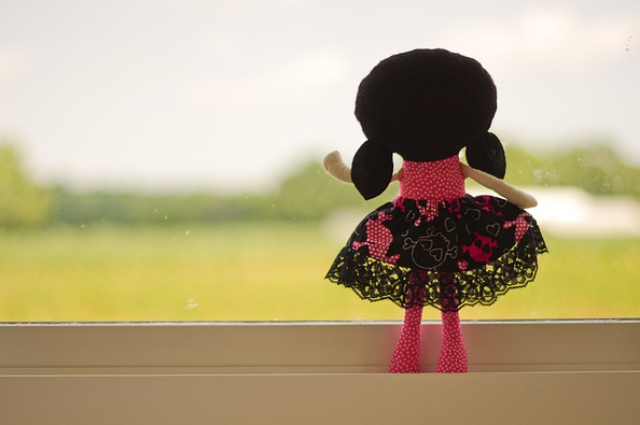
Image by heartandhome from Pixabay
At eight years old, she learned how to disappear without leaving the room.
She sat at the edge of the classroom bench, knees drawn close, watching other children exchange secrets in half-whispers and sudden laughter. No one had pushed her away. No one had told her to leave. Still, she understood something important long before she had words for it. She was not meant to belong there. When the teacher asked the class to form groups, she waited. When recess began, she lingered near the walls. By the time the final bell rang, a quiet lesson had settled deep inside her. Being invisible hurts less than being rejected.
This moment was not dramatic. It would never appear in memory as a single defining scene. That is precisely why it endured. Years later, the feeling of being left out without explanation would surface again in adult relationships, professional spaces, and moments of conflict. It shaped the way she spoke, the way she listened, and the way she learned to doubt herself before anyone else could.
This article examines the real and often overlooked psychological impact of chronic emotional exclusion in childhood, how it functions as a form of trauma, and what research reveals about the slow, uneven process of healing.
The Hidden Nature of Emotional Exclusion
When childhood trauma is discussed, attention often turns to visible harm. Physical abuse. Explicit neglect. Raised voices and broken homes. Emotional exclusion rarely fits this picture. Children who experience it are often well-fed, educated, and outwardly fine. Their pain does not disrupt routines. It does not draw concern.
Yet psychological research increasingly confirms that repeated emotional disconnection can be deeply damaging. Children rely on emotional responsiveness to understand who they are. When their presence is consistently overlooked or minimized, they begin to internalize absence as meaning.
This is known in psychology as relational trauma. It develops not from a single catastrophic event, but from repeated moments of being unseen. Over time, the child stops asking why they are excluded and begins to believe they are inherently unworthy of attention.
The wound forms quietly. It grows without witnesses.
When Silence Becomes a Survival Skill..
For the child who learned to sit still and speak less, exclusion soon became predictable. Predictability offered a strange sense of safety. If rejection could be anticipated, it could be endured.
This response aligns with trauma-based survival patterns identified by psychologists. Children adapt by becoming agreeable, compliant, or invisible. What adults later describe as introversion or emotional distance often begins as self-protection.
Neuroscientific studies demonstrate that social rejection activates the same regions of the brain as physical pain. In developing children, repeated exposure to this pain reshapes emotional regulation. As adults, this may appear as heightened sensitivity to criticism, fear of abandonment, difficulty asserting needs, or intense reactions to small conflicts.
These behaviors are not flaws. They are learned responses to an environment where connection felt uncertain.
The Past That Follows You Forward..
Adulthood brings freedom, but it does not erase early conditioning.
The child who learned to disappear becomes an adult who overanalyzes messages, braces for disapproval, and struggles to feel safe during difficult conversations. Authority figures trigger anxiety. Silence feels threatening. Validation feels necessary for survival.
Attachment theory explains this continuity. Children raised in emotionally inconsistent environments often develop insecure attachment patterns. These patterns influence how relationships are interpreted later in life. Neutral responses feel like rejection. Conflict feels catastrophic.
What deepens the pain is misunderstanding. The adult is told they are too sensitive, too reactive, too much. The language reinforces the belief that something is wrong with them, rather than acknowledging what happened to them.
The Moment of Recognition!
Healing rarely begins with forgiveness. It begins with clarity.
For many adults, healing starts when they encounter language that names their experience without minimizing it. Therapy, research, and reflective writing offer frameworks that replace self-blame with understanding.
Trauma is not defined by the severity of the event, but by its impact on the nervous system. Two children can grow up in similar environments and be affected differently. This knowledge disrupts comparison and dismantles shame.
For the woman who once sat quietly at the edge of every room, healing began when she stopped asking whether her pain was justified and started asking why it had shaped her so deeply.
What Research Tells Us About Healing
Healing from relational trauma does not involve forgetting. It involves integration.
Psychological research identifies several processes that support recovery:
- Emotional validation helps reduce reactivity and rebuild trust in one’s internal experience.
- Safe and consistent relationships slowly reshape attachment expectations.
- Somatic awareness reconnects individuals with bodily cues often suppressed during childhood.
- Narrative reflection allows fragmented memories to become coherent stories.
Healing is not linear. Progress often exists alongside setbacks. This does not signal failure. It reflects the complexity of wounds formed over time.
What Healing Looks Like in Real Life...
Healing does not eliminate fear. It changes the relationship to it.
The woman still feels anxious before difficult conversations. She still senses the urge to withdraw. But now she notices the impulse instead of obeying it. She names her feelings. She reminds herself that survival no longer depends on disappearing.
The inner critic grows quieter. Self-compassion becomes possible. Presence replaces vigilance.
Healing is subtle. It does not arrive with certainty or closure. It arrives in pauses. In breath. In moments where the old response no longer feels necessary.
Why This Story Matters...
Emotional exclusion is easy to dismiss because it leaves no evidence. Yet its consequences are carried by countless adults who struggle to feel secure, worthy, and seen.
Recognizing emotional neglect as a legitimate form of trauma is not about assigning blame. It is about acknowledging reality. When these stories are named, space opens for healthier relationships, more empathetic systems, and deeper understanding.
The child who learned to disappear deserved to be seen.
So do the adults who are still learning how to stay.
And perhaps the most radical form of healing is this.
Choosing presence over invisibility.
Choosing to exist without apology.