
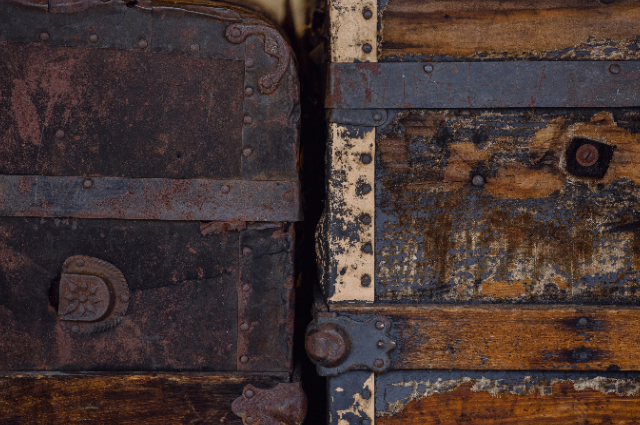
It began with a large brown trunk in my parents' bedroom. My mother had brought it with her from Turkey. As a child, I opened it and searched through it, though I could not have said what I was looking for. One day I found a wedding photograph. The bride was my mother, Clara. The man beside her was not my father. I also found an old booklet with her name in it. Beside her name was one word: “widow.” I went to her and asked who the man in the photograph was. She grew angry and did not answer. I put the picture back in the trunk, but I could no longer look at my mother in quite the same way. I knew she had lived a story before she became my mother.
Over the years, she told me parts of that story. They did not come in order. Sometimes it was a single detail; sometimes a memory she suddenly wanted to share. That is how I heard about Luna, Clara's mother and my grandmother. Luna's father was a doctor, yet she was raising her daughter in a poor Jewish neighbourhood in Balat, Istanbul. How had she come from the home in which she grew up to that life? I never received a full answer. The name of Shlomo, an architect who came to Istanbul, also came up in the family. I do not know whether Luna married him or whether he was Clara's father. My mother grew up without knowing her father. She knew only that he was in the Land of Israel.
Luna worked in a factory. She left early and came home late at night, when Clara was already asleep. Sometimes, my mother said, all Luna managed to do on returning was pull the blanket over her daughter. Someone had to be with Clara during those long days. There was a brothel in the neighbourhood, and Luna asked the women who worked there to look after the little girl. They watched over her, cared for her and made sure she was not alone. That detail has stayed with me for years: my mother as a child among women whom others were quick to judge, while what she remembered was how they cared for her.
When Clara was old enough for school, Luna enrolled her in first grade. She was excited. During one of my searches through the trunk, I found a class photograph. My mother sat among the other children, looking terribly sad. When I asked her about it, she told me she already knew that she would not be able to continue studying. She attended school for only two years. Luna could no longer afford the fees, and they took her out after second grade. Each time I look at that picture, I think of the child who arrived at school so eager to begin and had to leave almost as soon as she had started.
Luna found her a place with a seamstress instead. Clara became an apprentice, learning a trade while she worked. The seamstress sent her to buy buttons, thread and whatever else was needed. My mother told me about the long trips she made alone through the city when she was still very small. She learned to sew and to mend stockings. I cannot say exactly how old she was at each stage. What I remember is the little girl sent on errands for adults, returning to continue her work.
Not all her memories were hard. She had a close Armenian friend in the neighbourhood, and the two spent time together. Clara grew into a cheerful young woman who loved to dance. I remember that she wanted me to know this side of her life too. The school photograph shows one sad moment, but it cannot tell me who that girl was on all the other days. She had joy in her, and she wanted to live and love like any other young woman.
At one of the garden parties where she went dancing, she met a young man and fell in love. He loved her too. He came from a wealthy, prominent family. But his father investigated who Clara was. When he learned that Luna had raised her alone, he would not accept the relationship. He sent his son to study in Greece, away from Clara. My mother told me how heartbroken she was. I never knew the young man's name, but I heard from her how deeply she had loved him.
Not long afterwards, Luna became ill. She was about fifty-five, and my mother believed she probably had lung cancer. She had spent years working in the factory and was now growing weaker. Clara saw how serious her illness had become. She wanted Luna to know, before she died, that her daughter would have a husband and a home, that she would not be left alone. A Jewish soldier agreed to marry Clara even though she had no dowry. His family was poor as well. They married, and Luna lived long enough to know that her daughter was married.
A month later, Luna died. Another month passed, and Clara's husband went to the hospital with terrible abdominal pain. There, he was diagnosed with advanced bowel cancer. Clara stayed with him and cared for him. He died about four months later. When I tried to put the dates together, I realised that their entire marriage had lasted roughly six months. In that short time she lost both her mother and her husband. I could now return to the photograph in the trunk and see more than an image I had not understood. The man beside her belonged to these brief and painful years.
After his death, Clara discovered she was pregnant. She told me that she went to a woman in Balat who performed abortions. I do not know what happened afterwards. Clara took the brown trunk, the only thing she had left, and boarded a ship to the Land of Israel. The trunk that later stood in my parents' bedroom had travelled with her. When I heard that, I looked at it differently.
She arrived at the port of Haifa in 1948, when the State of Israel was being established. She was offered a place on a kibbutz or in a moshav, but she had an envelope with an address on it. She said she was asked to sign a waiver of certain rights, and she signed so she could go to the address. I do not know precisely what the document said. I do know the address she kept: the home of her father's sister in Tel Aviv. Clara wanted to reach the family she had never known, rather than be sent somewhere else.
Her aunt welcomed her warmly, as did the rest of the family. Clara discovered that she had two sisters much older than she was. She was about eighteen; they were grown women, around thirty-one and thirty-two. I can picture the meeting, but I cannot know the words spoken there. My mother told me that they received her with affection, and that is what I hold on to about their first encounter.
The aunt told Clara that she needed a home of her own. That was how she was introduced to the man who would become my father. He was divorced and raising a baby boy of about a year old. His first wife had gone to England, leaving the child with him. I heard other family stories about that marriage: a British officer had been involved in their separation, and the boy grew up for years without knowing his mother. I cannot tell the whole story of my father's first marriage. I know that he was already caring for a small child when he met Clara. Both of them arrived at this marriage with earlier lives behind them.
My parents married. Later my brother was born, and then I was. For years I knew Clara through the home in which I grew up. Only now and then did another part of her earlier life come into view. The brown trunk held the wedding photograph and the booklet. My mother gave me, in fragments, the girl in Balat, the seamstress, her Armenian friend, the dancing, Luna, and the journey from Haifa to Tel Aviv. There are still things I do not know. I do not know what happened between Luna and Shlomo, or why her family was not beside her. But I want to write down what my mother told me. It is her story, and the beginning of our family's story too.
References:
My mother Clara's accounts, told to me over the years; her wedding photograph; a family booklet recording her as a widow; and a photograph from her childhood school class.