
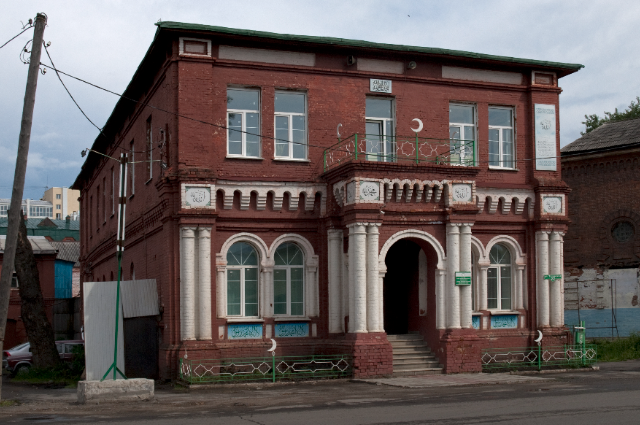
On a Friday afternoon in central Moscow, thousands gather beneath the towering domes of the Moscow Cathedral Mosque. Worshippers spill into the surrounding streets, their prayer mats stretching across pavements under the watch of glass skyscrapers and Soviet-era facades. The scene is striking not only for its scale but for what it represents: Islam, deeply rooted and publicly visible in a country often imagined solely through the lens of Orthodox Christianity and Slavic identity. In today’s Russian Federation, Islam is officially recognised as one of the nation’s “traditional religions,” and its followers—estimated at 20 to 25 million people—form one of Europe’s largest Muslim populations.
Yet behind the spectacle of Friday congregations lies a quieter but equally powerful story: the history of Islamic education in Russia. Madrasas—institutions dedicated to the study of the Qur’an, law, theology, language, and increasingly modern sciences—have served as the backbone of Muslim intellectual life for over a millennium in Russian lands. From the early Islamic communities of the North Caucasus to the flourishing centres of learning in Volga Bulgaria, from Tatar reformist schools of the nineteenth century to the underground religious circles of the Soviet era, Islamic education has repeatedly adapted to political upheaval, cultural pressure, and ideological suppression.
To study Russian madrasas today is not merely to explore a religious institution. It is to examine questions of identity, sovereignty, and modernisation in a multi-civilizational state that straddles Europe and Asia. Russia’s leadership often presents the country as a unique federation where Orthodox Christianity and Islam coexist as historical pillars of national culture. At the same time, debates over extremism, foreign influence, and social integration place Islamic education at the centre of security and geopolitical discussions. Madrasas are seen not only as spiritual spaces but as institutions shaping the moral and civic formation of millions of Russian citizens.
The central argument of this article is that Russian Islamic education has evolved through five major phases: early introduction and institutionalisation, imperial repression and bureaucratic control, intellectual reform under nineteenth-century modernists, near-destruction during the Soviet atheist project, and a complex post-1991 reconstruction under state supervision. Each phase reshaped not only curricula and institutions but also the very meaning of being both Muslim and Russian.
This raises a fundamental question: how did Islamic education survive repeated attempts at erasure—and what does its survival reveal about Russia’s past and future?
Early Foundations: Islam’s Arrival in Russian Lands (7th–16th Century)
Long before the rise of the Russian Empire or the consolidation of Moscow’s political authority, large parts of what is today the Russian Federation were already integrated into the intellectual and commercial networks of the Islamic world. The story of Islamic education in Russian lands begins not as a marginal development, but as part of a broader Eurasian transformation linking the Caucasus, the Volga basin, Central Asia, and the Middle East.
The Caucasus and Derbent
Islam first entered the territories of present-day Russia in the seventh century through the Caucasus. The city of Derbent—strategically located on the western shore of the Caspian Sea—became one of the earliest footholds of Muslim rule in the region. Captured by Arab forces during the expansion of the early caliphates, Derbent (known in Arabic sources as Bab al-Abwab, “Gate of Gates”) served as both a military stronghold and a conduit of religious and cultural exchange.
From Derbent, Islam gradually spread across Dagestan and neighbouring highland communities. Conversion was not instantaneous; it unfolded over generations through trade, intermarriage, political alliances, and the influence of Sufi missionaries. By the eighth and ninth centuries, Muslim communities had become firmly established in parts of the North Caucasus.
With the establishment of Muslim rule came the foundations of religious education. Early mosques functioned as centres of learning, where Qur’anic recitation, basic jurisprudence, and Arabic literacy were taught. Over time, more formal networks of scholarship emerged, connecting Dagestani scholars with intellectual centres in Baghdad and other parts of the Abbasid world. Students and scholars travelled along the trans-Caspian and Silk Road routes, embedding the Caucasus within a larger Islamic scholarly geography. Thus, from its earliest phase, Islamic education in Russian lands was not isolated or peripheral—it was part of a transregional intellectual ecosystem.
Volga Bulgaria and 922 CE
A decisive turning point occurred in 922 CE when Almış, ruler of Volga Bulgaria, formally embraced Islam and declared it the state religion. This conversion was not merely symbolic; it marked the institutionalisation of Islam in the Volga region and laid the groundwork for structured religious education.
The Volga Bulgarian state, located along vital trade routes connecting Northern Europe with Central Asia and the Middle East, became a flourishing centre of commerce and culture. Diplomatic contacts with the Abbasid Caliphate strengthened religious ties, and scholars from Central Asia visited the region. In this context, maktabs (elementary schools) and madrasas began to develop more systematically.
These institutions provided instruction not only in Qur’anic studies and Islamic law but also in fields such as astronomy, medicine, and mathematics—disciplines integral to the broader Islamic intellectual tradition. The Volga region thus became a northern extension of the classical Islamic world, participating in its scientific and juridical debates. Trade links with Baghdad and cities of Central Asia facilitated the circulation of books, scholars, and ideas, embedding Volga Bulgaria within a vibrant cosmopolitan sphere.
The Mongol and Golden Horde Period
The Mongol invasions of the thirteenth century dramatically reshaped Eurasia, but they did not extinguish Islamic development in the region. Under the Golden Horde—particularly during the reign of Uzbek Khan in the early fourteenth century—Islam became the dominant religion of the ruling elite. This period witnessed renewed institutional growth and further Islamization of the Volga basin and Crimea.
Mosques and madrasas expanded under the Golden Horde’s patronage, and Islamic legal and administrative practices gained prominence. The Volga and Crimean regions became interconnected nodes in a network stretching from Anatolia to Central Asia. Islamic education during this era reinforced communal cohesion and transmitted scholarly traditions that predated both Mongol rule and later Russian expansion.
By the sixteenth century, therefore, Islamic education in the Caucasus and Volga regions was already centuries old. It had developed institutional structures, scholarly lineages, and intellectual traditions deeply integrated into the wider Islamic world. Crucially, these foundations were laid long before Russian imperial consolidation. Islam in Russia was not an imported minority faith of the modern era; it was a historically embedded civilisation with its own educational institutions, intellectual authority, and transregional connections.
Tsarist Repression and Controlled Tolerance (16th–18th Century)
The sixteenth century marked a profound rupture in the history of Islamic education in Russian lands. With the rise of Muscovy as an expanding imperial power, Muslim regions that had long maintained their own political and intellectual traditions were drawn into a new political order. The conquest of the Volga basin did not merely alter borders; it reshaped the institutional life of Islam and placed madrasas under unprecedented pressure.
Fall of Kazan (1552) and Aftermath
The decisive turning point came in 1552, when Tsar Ivan IV (“the Terrible”) captured the Khanate of Kazan. The fall of Kazan signalled the end of independent Muslim rule in the Volga region and the beginning of systematic attempts to Christianize and politically subdue its population. Mosques and madrasas—symbols of both religious authority and communal autonomy—were among the first targets.
Many religious institutions were destroyed or confiscated. Islamic endowments that had sustained madrasas were dismantled, depriving scholars of financial support. In some regions, forced conversions to Orthodoxy were encouraged through incentives and coercive measures. By 1593, a decree issued under Tsar Fyodor I reportedly ordered the destruction of remaining mosques and prohibited the construction of new Islamic institutions in certain territories. Though enforcement varied by region, the cumulative effect was devastating: public Islamic education was pushed to the margins.
This repression was not merely religious; it was political. Madrasas functioned as centres of literacy, legal reasoning, and communal leadership. To weaken them was to weaken the social fabric of Muslim communities. Yet the story of this period is not solely one of eradication. It is equally a story of adaptation and endurance.
Survival Mechanisms
Despite official prohibitions, Islamic learning did not disappear. Instead, it retreated into private spaces. “Secret madrasas” emerged in homes and rural villages, where trusted scholars taught small groups of students discreetly. Instruction often took place at night or under the guise of informal gatherings.
Oral transmission became crucial. Memorisation of the Qur’an and key legal texts ensured that religious knowledge could survive even without access to written materials. Families with scholarly lineages preserved manuscripts and passed them down across generations. In some cases, students travelled quietly to more tolerant regions—such as parts of the North Caucasus or Central Asia—to pursue advanced study.
This decentralisation transformed the character of Islamic education. Without large institutional structures, learning became more intimate and localised. Authority rested increasingly in respected families and village scholars rather than formal academies. While this limited intellectual expansion, it also strengthened communal resilience. Islamic education became embedded in everyday life rather than confined to visible institutions.
Catherine the Great’s Reforms
A significant shift occurred in the late eighteenth century under Empress Catherine II. Recognising the impracticality of total repression in a vast, religiously diverse empire, Catherine adopted a more pragmatic approach. Rather than attempting to eliminate Islam, the state sought to regulate and integrate it.
In 1788, Catherine established the Orenburg Muslim Spiritual Assembly, the first centralised Muslim administrative body within the empire. This institution—often described as the foundation of “official Islam” in Russia—placed Muslim clerics under state supervision. Imams and muftis were required to register with imperial authorities, and religious activities became subject to bureaucratic oversight.
Mosque construction was cautiously permitted again in certain areas, and limited forms of madrasa education resumed. However, this restoration came with conditions. The empire did not relinquish control; instead, it transformed Islam into a managed component of imperial governance. Religious leaders were expected to demonstrate loyalty to the tsar, and education operated within defined political boundaries.
Analytical Perspective
The Tsarist strategy thus evolved from attempted elimination to bureaucratic control. The state recognised that Islam was too deeply rooted to be eradicated, especially in regions where Muslims formed majorities. By institutionalising oversight through bodies like the Orenburg Assembly, the empire created a framework in which Islamic education could function—but only within a supervised, depoliticised structure.
This period marked the birth of “official Islam” in Russia: a model in which religious authority was acknowledged yet subordinated to the state. Madrasas survived, but their autonomy was curtailed. The legacy of this arrangement—balancing recognition with regulation—would profoundly shape later Russian approaches to Islamic education, including in the Soviet and post-Soviet eras.
Shihabuddin Marjani and the Jadidist Intellectual Revolution
If the sixteenth and seventeenth centuries were marked by repression and survival, the nineteenth century witnessed a remarkable intellectual reawakening among Russia’s Muslims. At the heart of this transformation stood Shihabuddin Marjani—a scholar, historian, theologian, and reformer whose ideas reshaped Islamic education in the Volga-Ural region and beyond. Marjani did not seek to abandon tradition; rather, he sought to renew it from within. His legacy would lay the foundation for the Jadidist movement, one of the most important reformist currents in modern Muslim history.
Marjani’s Background
Born in 1818 in the Kazan region, Marjani emerged from a scholarly Tatar family deeply rooted in Islamic learning. His intellectual formation, however, extended far beyond local circles. He travelled to Central Asia for advanced study, enrolling in prestigious madrasas in Bukhara and Samarkand—centres renowned for their rigorous training in jurisprudence, theology, logic, and philosophy.
In Bukhara, particularly at the Mir-i Arab madrasa, Marjani encountered the classical canon of Islamic scholarship: the works of Abu Hanifa in jurisprudence, al-Ghazali in theology, Ibn Sina in philosophy, and Ibn Khaldun in historiography. He also absorbed the discipline of mantiq (logic) and the rational sciences, which had long been integral to Islamic intellectual traditions. This exposure convinced him that Islam possessed an internal capacity for renewal grounded in reason, ethics, and adaptability.
When Marjani returned to Kazan, he did so not merely as a religious teacher but as a thinker determined to revive intellectual vitality among Russian Muslims.
Intellectual Contributions
Marjani’s scholarly output was extensive and influential. His 1870 work Nusrat al-Haqq addressed questions of jurisprudence, including the calculation of prayer times in northern latitudes—an issue particularly relevant to Muslims living in Russia’s climatic conditions. The work demonstrated his ability to apply classical legal reasoning to new geographic realities.
Even more transformative was Mustafad al-Akhbar fi Ahwal Kazan wa Bulgar, a pioneering historical study of the Tatars and Volga Bulgars. In writing this work, Marjani moved beyond purely theological discourse and constructed a historical narrative that affirmed the dignity and antiquity of Muslim civilisation in the region. For the first time, Tatars were presented not merely as subjects of empire but as heirs to a sophisticated Islamic past.
This emphasis on history cultivated a new historical consciousness among Russia’s Muslims. Marjani’s scholarship reminded his readers that Islamic learning in the Volga region predated Russian imperial rule and was part of a broader civilizational continuum. In doing so, he subtly challenged narratives that portrayed Muslims as culturally backward or politically marginal.
Educational Reform and Jadidism
Marjani’s most enduring impact, however, lay in education. He argued that madrasas must evolve if they were to remain relevant. Traditional rote memorisation and narrow curricula, he believed, were insufficient in a rapidly modernising world.
He advocated the inclusion of the Russian language in Muslim schools, recognising that mastery of the state language was essential for social mobility and civic participation. At the same time, he insisted that secular disciplines—natural sciences, mathematics, geography, and logic—should complement religious studies. This approach did not dilute Islam; rather, it restored an older Islamic tradition in which theology and rational inquiry coexisted.
Modern pedagogy also became central to his reforms. Instead of unstructured learning, he supported graded classrooms, systematic textbooks, and clearer instructional methods. He encouraged students to question, analyse, and engage critically with texts rather than memorise them passively. In this sense, Marjani’s vision anticipated broader educational reforms taking place across the Muslim world.
These ideas crystallised into what became known as Jadidism (from usul al-jadid, “new method”). The Jadids sought to modernise Muslim society through educational reform, believing that intellectual renewal was the foundation of communal revival.
The Broader Jadid Movement
Marjani’s ideas inspired a generation of reformers, most notably Ismail Gasprinsky. Gasprinsky expanded the Jadidist vision through journalism and publishing, launching the influential newspaper Tercüman in Crimea. Through print culture, reformist ideas spread across the Russian Empire—from the Volga to Central Asia.
The Jadid movement emphasised literacy, women’s education, scientific awareness, and engagement with global intellectual currents. Printing presses multiplied, textbooks were standardised, and networks of reformed schools emerged. By the early twentieth century, thousands of Jadid schools operated across Muslim regions of the empire.
Analytical Perspective
Marjani stands as a bridge between tradition and modernity. He did not reject classical Islamic scholarship; he mastered it. Yet he refused to treat it as static. For him, Islam was a dynamic intellectual tradition capable of responding to new political and scientific realities.
Education, in his vision, became a tool of national and moral revival. By reforming madrasas, he sought to empower Russian Muslims intellectually and socially, enabling them to participate confidently in imperial society without surrendering their religious identity.
The Jadidist revolution demonstrated that Islamic education in Russia was not merely surviving imperial rule—it was reinventing itself. This spirit of adaptability would later prove essential in confronting the far more radical challenge posed by the Soviet state.
The Soviet Catastrophe: Erasure of Islamic Education (1917–1991)
If Tsarist rule sought to control Islam bureaucratically, the Soviet regime attempted something far more radical: the systematic dismantling of religion as a social force. For Islamic education in Russia, the period between 1917 and 1991 was not simply one of repression—it was a civilizational rupture. Institutions were destroyed, intellectual continuity was severed, and entire generations grew up detached from the scholarly traditions that had sustained Muslim life for centuries.
Bolshevik Ideology and Atheism
The Bolshevik Revolution of 1917 introduced a state ideology grounded in militant atheism. Religion, in Marxist-Leninist thought, was considered an instrument of class oppression and a relic of feudal backwardness. Although early Soviet policies briefly promised cultural autonomy to minority groups, this tolerance quickly narrowed as the regime consolidated power.
By the late 1920s, religious instruction was formally banned. Madrasas were closed, endowments confiscated, and religious teachers stripped of legal standing. The Jadid schools that had flourished in the late imperial period—symbols of intellectual reform and modern Muslim engagement—were dismantled. Islamic education, once a vehicle of communal advancement, was reclassified as counterrevolutionary.
The attack was not limited to formal institutions. Teaching religion to minors, even in private settings, could invite penalties. Clerics were surveilled, arrested, or pressured to abandon their posts. The Soviet project aimed not merely to weaken religion but to eliminate its public presence entirely.
Script Reform and Cultural Rupture
Perhaps the most consequential measure was linguistic reform. In 1928–1929, the Arabic script—long used by Tatars, Bashkirs, and other Muslim communities—was replaced with a Latin-based alphabet. A decade later, in 1939–1940, even the Latin script was abolished in favour of Cyrillic.
This transition from Arabic to Latin to Cyrillic was presented as modernisation. In reality, it severed Muslims from centuries of written heritage. Classical religious texts, legal commentaries, poetry, and historical works were suddenly inaccessible to younger generations who could no longer read the script in which they were composed.
The consequences were profound. Islamic scholarship depends heavily on textual transmission. When script reform rendered manuscripts unreadable to most people, it created a generational literacy break. Young Muslims could not access foundational works of theology or law without specialised training that was increasingly unavailable. The rupture was not only educational but epistemic: the continuity of knowledge itself was fractured.
Destruction of Infrastructure
The physical infrastructure of Islamic life suffered equally. At the time of the Revolution, tens of thousands of mosques operated across the empire. By the mid-twentieth century, only a fraction remained open. Many were demolished; others were repurposed as warehouses, cultural clubs, or administrative buildings.
Clergy repression intensified during Stalin’s purges. Imams and scholars were arrested, exiled, or executed under charges ranging from “anti-Soviet agitation” to “nationalism.” The elimination of religious leadership deepened the crisis of transmission. Without teachers, even basic religious literacy declined.
Yet Islam did not vanish. In villages and private homes, small underground learning circles persisted. Elderly scholars taught children to recite short Qur’anic passages. Religious rituals—marriage ceremonies, funerals, circumcisions—continued discreetly. These informal networks preserved fragments of tradition, though often stripped of broader intellectual depth.
Over time, Islamic knowledge was reduced to ritual familiarity rather than scholarly engagement. The rich integration of jurisprudence, philosophy, and science that had characterised earlier centuries faded from communal memory.
Spiritual Directorates and Controlled Survival
Despite its hostility to religion, the Soviet state did not eliminate Islam. During World War II, seeking Muslim loyalty against Nazi Germany, authorities reactivated limited religious structures. Centralised “Spiritual Directorates of Muslims” were established to oversee officially permitted religious activity.
These directorates functioned under strict state supervision. Clergy appointments required government approval, sermons were monitored, and foreign contacts were restricted. A small number of mosques and one or two higher Islamic institutions—most notably in Central Asia—were allowed to operate.
This arrangement created a paradox. Islam survived, but only within tightly confined boundaries. Religious leaders were expected to demonstrate political loyalty and avoid any independent social influence. Education under these structures was minimal and carefully regulated. While a narrow clerical class remained, broader intellectual life was stifled.
Analytical Perspective
The Soviet assault on Islamic education was not merely institutional repression; it was epistemic destruction. By closing madrasas, banning religious instruction, repressing clergy, and altering script, the regime targeted the mechanisms through which knowledge is preserved and transmitted. Islam was reduced from a comprehensive civilisation—encompassing law, ethics, science, and philosophy—to a limited set of private rituals.
The long-term psychological effects were significant. Many Muslims internalised a sense of marginalisation or cultural inferiority. Religious knowledge became fragmented and often detached from systematic scholarship. At the same time, the memory of repression fostered a resilient attachment to faith as a marker of identity.
When the Soviet Union collapsed in 1991, the revival of Islamic education would not begin from a position of continuity but from the aftermath of rupture. Institutions had to be rebuilt, curricula reconstructed, and scholarly lineages reestablished. The catastrophe had nearly erased centuries of intellectual tradition—yet it had not extinguished the desire to reclaim it.
Post-1991 Islamic Revival: Reconstruction and Expansion
The collapse of the Soviet Union in 1991 marked one of the most dramatic religious reversals in modern history. After seven decades of militant atheism and institutional suppression, Islam re-emerged into public life across the Russian Federation. Mosques reopened, madrasas were reestablished, and a new generation sought to reconnect with a heritage long suppressed. Yet this revival was neither chaotic nor entirely independent. It unfolded within a carefully managed political framework that continues to shape Islamic education in Russia today.
Collapse of the Soviet Union and Religious Freedom
With the dissolution of the USSR, the legal barriers against religious activity were lifted. Constitutional guarantees of freedom of conscience allowed communities to register religious organisations, reclaim properties, and establish educational institutions. The change was immediate and visible.
In the late Soviet period, only around 179 mosques were officially functioning across the Russian republic. Within a decade, that number rose into the thousands. Today, estimates suggest more than 8,000 mosques operate across Russia, alongside hundreds of Islamic educational institutions. The reopening and construction of mosques became powerful symbols of identity restoration, particularly in historically Muslim regions.
This explosion of religious infrastructure reflected more than spiritual renewal. It signalled the reassertion of public religious identity after decades of enforced secularism. For many communities, rebuilding a mosque or madrasa was an act of cultural recovery as much as religious devotion.
Demographic Context
The revival must be understood within Russia’s demographic realities. Muslims constitute between 20 and 25 million people—approximately 15 percent of the population. In certain republics, Islam is the majority faith.
Tatarstan in the Volga region maintains a strong Tatar Muslim heritage with a history of Jadid reform. Dagestan in the North Caucasus is ethnically diverse but overwhelmingly Muslim, with deep Sufi traditions. Chechnya and Ingushetia are similarly Muslim-majority and have experienced intense political upheaval since the 1990s.
In addition to historic Muslim regions, internal migration has increased the visibility of Islam in major cities such as Moscow and St. Petersburg. Labour migrants from Central Asia further contribute to the urban Muslim population. As a result, Islamic education is not confined to peripheral republics but has become a national phenomenon.
Institutional Growth
Post-Soviet reconstruction required more than reopening mosques; it required rebuilding educational infrastructure almost from scratch. One of the most important developments was the establishment of higher Islamic institutions within Russia itself, reducing reliance on foreign seminaries.
The Russian Islamic University became a central hub for Islamic higher education, offering programs in theology, Islamic law, Arabic language, and pedagogy, often alongside secular disciplines. The aim was to cultivate scholars trained within the Russian context rather than exclusively abroad.
Similarly, the Bolgar Islamic Academy was founded to serve as an advanced centre for Islamic scholarship. Located near the historic site of Volga Bulgaria’s conversion to Islam, the academy symbolises continuity with the region’s medieval intellectual heritage.
Beyond these flagship institutions, regional madrasas multiplied in Tatarstan, Bashkortostan, Dagestan, and elsewhere. Weekend schools, summer programs, and Qur’anic courses enrolled tens of thousands of students annually. Publishing houses reprinted classical works and produced new textbooks tailored to contemporary realities.
State Strategy: Controlled Revival
While the revival appeared organic, it unfolded within a deliberate state strategy. The Russian government promotes the concept of “traditional Islam,” framing it as compatible with national stability and cultural continuity. This doctrine distinguishes historically rooted Russian Muslim practices—often Sufi-influenced and Hanafi in jurisprudence—from foreign-inspired radical movements.
Anti-extremism legislation plays a central role in shaping Islamic education. Curricula are subject to oversight, and religious organisations must register with official spiritual administrations (muftiyates). These muftiyates maintain close working relationships with the Kremlin, forming a partnership that blends religious leadership with state objectives.
This model reflects a broader federal strategy. In regions such as Chechnya and Dagestan, promoting state-aligned Islamic institutions serves as a counterweight to insurgency and radicalisation. Islam is thus positioned as a stabilising force within the federation, reinforcing social cohesion and discouraging separatist ideologies.
Analytical Perspective
The post-1991 revival represents both renewal and regulation. On one hand, Islamic education has reemerged as a vibrant sector, reconnecting communities with their historical traditions and fostering intellectual reconstruction after decades of suppression. Institutions such as the Russian Islamic University and Bolgar Islamic Academy symbolise a reclaiming of scholarly autonomy within national borders.
On the other hand, this revival is carefully managed. The state’s partnership with muftiyates ensures that Islamic education aligns with broader political priorities. Religious autonomy exists, but within defined parameters. The balance between independence and oversight remains delicate.
In this sense, contemporary Russia has not abandoned the model first developed under Catherine the Great: recognition combined with supervision. Yet unlike the imperial era, today’s framework operates within a formally secular constitution and a globalised environment where ideas cross borders rapidly.
Islamic education in post-Soviet Russia thus stands at a crossroads. It is rebuilding intellectual depth and institutional capacity, but it does so within a political system that views religion as both cultural heritage and an instrument of stability. Whether this controlled revival will foster long-term intellectual flourishing or limit independent theological development remains one of the central questions of Russia’s evolving religious landscape.
Structure and Curriculum of Modern Russian Madrasas
The revival of Islamic education after 1991 required more than reopening buildings; it demanded the reconstruction of a coherent educational system. Modern Russian madrasas today operate within a multi-tiered institutional framework that blends classical Islamic sciences with secular disciplines. This structure reflects both historical continuity—particularly the Jadid reformist legacy—and contemporary state expectations. The result is a uniquely Russian synthesis: a model designed to produce graduates who are at once grounded in Islamic scholarship and integrated into national civic life.
Institutional Structure
The contemporary system generally operates across four levels.
Primary maktabs function as introductory religious schools, often attached to mosques. These institutions typically provide part-time education for children and adolescents, focusing on Qur’anic recitation, basic creed (aqidah), moral instruction, and foundational knowledge of Islamic practice. Many operate as weekend or evening schools, allowing students to attend state schools simultaneously.
Secondary madrasas offer more structured, multi-year programs. Students study classical texts in jurisprudence (fiqh), prophetic traditions (hadith), Qur’anic interpretation (tafsir), and Arabic grammar. Admission requirements vary, but many institutions require completion of general secondary education. These madrasas often prepare graduates either for local religious service—such as imams or teachers—or for advanced study.
At the apex are higher Islamic universities and academies, which provide undergraduate and postgraduate degrees in theology, Islamic law, pedagogy, and Islamic history. Institutions such as the Russian Islamic University and the Bolgar Islamic Academy serve as flagship centres for advanced scholarship. These institutions emphasise research, publication, and engagement with contemporary social issues.
A crucial component of the system is teacher training programs. Given the rupture caused by the Soviet era, rebuilding qualified faculty has been a priority. Specialised pedagogical tracks train imams, Qur’an teachers, and religious educators not only in theology but also in classroom methodology, psychology, and civic law. This professionalisation reflects both Jadidist influence and state regulatory standards.
Curriculum Model
The curriculum of modern Russian madrasas demonstrates a deliberate balance between tradition and modernity.
At its core remain the classical Islamic sciences:
- Qur’an (memorisation and exegesis),
- Hadith (study of prophetic traditions),
- Fiqh (Islamic jurisprudence, often within the Hanafi school),
- Aqidah (theology).
Arabic language instruction is central, as access to primary sources depends on linguistic competence. Courses in grammar (nahw), morphology (sarf), and rhetoric ensure textual engagement with classical works.
However, unlike many traditional seminaries elsewhere, Russian madrasas systematically incorporate Russian language instruction and often conduct significant portions of coursework in Russian. This ensures graduates can operate effectively within national institutions and engage with broader society.
Secular subjects form another distinctive layer. Students frequently study social sciences, including history, sociology, and political science, alongside philosophy and logic, echoing earlier Islamic rational traditions. Courses in natural sciences—mathematics, geography, and occasionally basic biology or physics—are integrated at varying levels, particularly in secondary and higher institutions.
This blended curriculum reflects a conscious effort to avoid intellectual isolation. Graduates are expected to understand contemporary social dynamics, legal frameworks, and ethical debates, positioning them as mediators between religious communities and state institutions.
Gender and Education
An important dimension of the post-Soviet revival has been the expansion of female participation in religious education. Women’s madrasas and specialised courses for female students now operate in several regions, particularly in Tatarstan and Dagestan.
Female religious education focuses on Qur’anic studies, family law, pedagogy, and community leadership. Increasingly, women serve as teachers in maktabs and as lecturers in higher institutions. While the imam role remains predominantly male, women have become influential as educators, administrators, and organisers of community programs.
This development reflects both historical precedent—women have long participated in Islamic scholarship in various forms—and contemporary social expectations regarding gender inclusion. It also strengthens community-based education by expanding the pool of qualified instructors.
Comparison with Other Countries
Compared with many Middle Eastern madrasas, Russian Islamic institutions exhibit notable differences. In countries where religious seminaries operate independently of state oversight, curricula may remain more exclusively focused on classical texts. In contrast, Russian madrasas function within a secular federal system that mandates legal registration, educational standards, and curriculum transparency.
Moreover, the integration of Russian civic studies and social sciences distinguishes the Russian model. While institutions such as Egypt’s al-Azhar combine religious and secular subjects, many smaller Middle Eastern seminaries retain narrower scopes. Russian institutions, shaped by both Jadidist reform and Soviet-era rupture, prioritise producing graduates capable of engaging a pluralistic society.
This model can be described as a “Eurasian synthesis.” It draws on Central Asian Hanafi jurisprudence, Sufi ethical traditions, Russian-language scholarship, and modern academic standards. The outcome is neither wholly traditional nor fully secularised, but a hybrid form adapted to Russia’s specific historical trajectory.
Analytical Perspective
Modern Russian madrasas represent a tangible continuation of Jadidist reform. The emphasis on rational inquiry, linguistic competence, and engagement with contemporary sciences echoes Marjani’s vision of adaptive scholarship. At the same time, state oversight ensures alignment with national legal and political frameworks.
The result is the cultivation of a blended identity: graduates are trained to be both Muslim scholars and Russian citizens. They are expected to articulate religious teachings within the language of constitutional order and civic responsibility. Whether this synthesis will foster long-term intellectual dynamism or constrain theological independence remains an open question. What is clear, however, is that Islamic education in Russia today reflects a conscious effort to reconcile faith, modernity, and national belonging within a uniquely Russian context.
Challenges Facing Russian Islamic Education Today
The post-Soviet revival of Islamic education has restored institutions, rebuilt curricula, and reconnected communities with their religious heritage. Yet revival has not eliminated vulnerability. Russian madrasas today operate within a complex environment shaped by security concerns, state oversight, globalisation, and shifting national narratives. The central challenge is sustainability: can a distinctly “Russian Islam” remain intellectually vibrant while aligned with state stability?
Extremism Concerns
Since the 1990s, concerns about radicalisation have significantly influenced the development of Islamic education in Russia. Armed insurgencies in the North Caucasus—particularly in Chechnya and Dagestan—heightened fears of extremist ideologies gaining footholds within religious institutions. Although most Russian Muslims adhere to traditional Hanafi and Sufi-oriented practices, the emergence of small radical networks, often influenced by foreign Salafi or jihadist doctrines, prompted intense state scrutiny.
Foreign ideological influence remains a sensitive issue. In the 1990s and early 2000s, some students pursued religious studies in the Middle East and returned with interpretations perceived as incompatible with local traditions. As a result, authorities increasingly encouraged domestic theological training to reduce dependence on foreign seminaries. While this policy aims to protect indigenous religious culture, it also reinforces centralised oversight.
State Control vs Intellectual Independence
A defining feature of contemporary Islamic education is its close relationship with state-approved muftiyates. Registration requirements, textbook approvals, and curriculum reviews are standard procedures. This framework helps prevent the spread of extremist literature, but it also raises concerns about intellectual independence.
Excessive bureaucratisation can limit theological debate and critical scholarship. Scholars may hesitate to explore controversial topics if perceived as politically sensitive. The balance between safeguarding public order and allowing academic freedom remains delicate. If madrasas become overly administrative or cautious, they risk losing the creative dynamism that characterised earlier reform movements.
Globalisation and Digital Authority
The digital age has transformed religious learning worldwide, and Russia is no exception. Young Muslims increasingly access sermons, fatwas, and theological discussions online—often from scholars based outside Russia. Social media platforms bypass institutional hierarchies, creating decentralised forms of authority.
This global connectivity presents opportunities for intellectual enrichment but also challenges local institutions. Competing interpretations can create confusion, particularly among youth navigating questions of identity in a multicultural society. The risk is not only radicalisation but fragmentation: traditional Russian Islamic institutions may struggle to maintain relevance if they cannot engage effectively in digital spaces.
Youth identity crises further complicate the picture. In urban centres such as Moscow and Kazan, Muslim students often negotiate multiple identities—ethnic, national, religious—within a predominantly secular public sphere. Madrasas must therefore address not only doctrinal instruction but also psychological and social questions about belonging and purpose.
Integration into the Russian National Narrative
Islam’s status as a “traditional religion” coexists with persistent social tensions. Periodic incidents of Islamophobia, debates over migration, and ethnic stereotypes affect public perceptions of Muslim communities. In multiethnic republics, competition between local nationalism and federal authority can also create friction.
Islamic education thus carries a dual burden: preserving religious authenticity while reinforcing civic integration. Madrasas are expected to produce leaders who affirm loyalty to the Russian state while maintaining theological integrity. Any perceived deviation—toward separatism or political activism—invites scrutiny.
Analytical Perspective
The sustainability of “Russian Islam” depends on navigating these pressures. The current model seeks equilibrium: autonomy within oversight, revival within regulation. Yet future tensions between security and intellectual freedom are inevitable. If control becomes too restrictive, it may stifle theological development; if autonomy expands without safeguards, authorities fear destabilisation.
Ultimately, the long-term resilience of Russian Islamic education will depend on its ability to foster credible scholarship, engage digital generations, and maintain trust both within Muslim communities and the broader national framework. The challenge is not merely survival—but maturation in a landscape where faith, politics, and identity remain deeply intertwined.
Conclusion: Resilience, Adaptation, and the Future of Russian Islam
The history of Islamic education in Russia is not a linear narrative of decline or revival; it is a story of resilience shaped by rupture, reform, suppression, and reinvention. From its early foundations in the Caucasus and Volga regions, Islam developed institutions that were deeply integrated into the intellectual geography of the wider Muslim world. Madrasas flourished long before Russian imperial consolidation, embedding scholarship, law, and science into communal life.
Under Tsarist expansion, these institutions endured repression yet adapted through survival strategies and eventual bureaucratic accommodation. The emergence of reformers like Shihabuddin Marjani demonstrated that Islamic education was not static but capable of renewal from within. The Jadidist movement reframed learning as a vehicle of social empowerment and national consciousness, linking tradition with modern pedagogy.
The Soviet period marked the most severe rupture. Madrasas were closed, scripts were changed, clergy were repressed, and intellectual continuity was shattered. Islam was reduced from a comprehensive civilisation to a constrained ritual practice. Yet even in that era of epistemic destruction, fragments of knowledge survived in private homes and collective memory.
Since 1991, Islamic education has undergone a dramatic reconstruction. Mosques have multiplied, universities have opened, and a new generation of scholars is emerging. But this revival operates within a carefully managed political environment. The contemporary model blends faith with civic integration, autonomy with oversight. It reflects a hybrid form of religious life—neither entirely independent nor wholly subordinated—shaped by Russia’s Eurasian identity and federal structure.
The future of Russian Islamic education raises important questions. Can its madrasas produce scholars whose influence extends beyond national borders, contributing meaningfully to global Islamic thought? Will state patronage and regulation provide stability or gradually constrain intellectual exploration? And what lessons might this controlled yet vibrant model offer to Muslim minorities in other non-Muslim-majority states?
Russian Islamic education today is not merely recovering from Soviet devastation. It is redefining itself within a complex political and cultural framework. Its trajectory suggests that resilience alone is not enough; adaptation must be thoughtful, and reform must be rooted in tradition. As Russia continues to navigate its identity between Europe and Asia, the evolution of its madrasas will remain a revealing indicator of how faith, state, and modernity can coexist—sometimes uneasily, yet persistently—within a shared national space.
References
- Islam in Russia – Historical Overview
- Derbent and the Spread of Islam in the Caucasus
- Volga Bulgaria and the Adoption of Islam (922 CE)
- Golden Horde and Islamization under Uzbek Khan
- Fall of Kazan (1552) and Russian Expansion
- Orenburg Muslim Spiritual Assembly (1788)
- Shihabuddin Marjani – Tatar Scholar and Reformer
- Jadidism in the Russian Empire
- Ismail Gasprinsky and Muslim Reformism
- Religion in the Soviet Union – Policies and Suppression
- Islam in the Soviet Union
- Russian Islamic University (Kazan)
- Bolgar Islamic Academy
- Council of Muftis of Russia
- Moscow Cathedral Mosque