
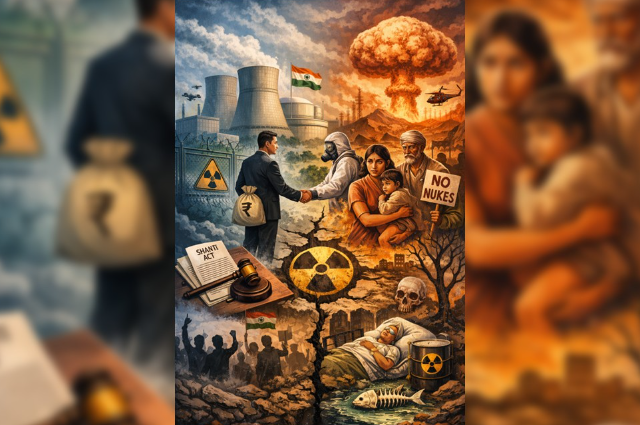
Why the SHANTI Act Matters
In late 2025, the Indian Parliament passed the SHANTI Act (Sustainable Harnessing and Advancement of Nuclear Energy for Transforming India), a law that fundamentally alters the country’s approach to nuclear power. While officially presented as a reform to accelerate clean energy production and attract private investment, the Act has triggered deep unease among scientists, environmentalists, legal experts, and sections of civil society. This concern arises not merely from policy differences, but from the scale of risk involved. Nuclear laws are not ordinary economic regulations; they govern technologies capable of causing irreversible damage to human life, ecosystems, and national stability. Any change in this domain therefore, carries consequences that extend far beyond balance sheets and power-generation targets.
India’s nuclear energy programme was historically built on the principle of strict state control. The Atomic Energy Act of 1962 placed the entire nuclear fuel cycle—mining, fuel processing, reactor operation, and waste management—under sovereign authority. This approach was rooted in two realities: the strategic importance of nuclear technology and the catastrophic potential of nuclear accidents. Even when India amended its legal framework in 2010 through the Civil Liability for Nuclear Damage Act, it did so in the shadow of the Bhopal gas disaster, ensuring that responsibility for nuclear harm could not be easily evaded by corporations or suppliers.
The SHANTI Act marks a sharp departure from this cautious tradition. Passed with limited parliamentary scrutiny and without extensive public consultation, the law opens large sections of India’s nuclear sector to private and foreign participation while simultaneously weakening liability provisions. For many critics, the speed and manner of its passage raise serious democratic concerns. Communities living near proposed nuclear sites, independent safety experts, and public health specialists were largely excluded from the discussion, despite being the most vulnerable to potential consequences.
The law has generated intense opposition because it redefines accountability in the event of a nuclear accident. By limiting corporate liability and shifting long-term risks to the state and taxpayers, the Act challenges the ethical foundations of public safety governance. Scientists warn that nuclear risks cannot be fully predicted or contained, while legal experts argue that capping compensation undermines citizens’ constitutional right to life and justice.
At the heart of this debate lies a critical question that this article seeks to examine: Does the pursuit of development and energy security justify an increase in nuclear risk, especially when that risk is borne by ordinary citizens rather than those who profit from the industry?
What Is the SHANTI Act? Key Provisions Explained
The SHANTI Act, formally titled the Sustainable Harnessing and Advancement of Nuclear Energy for Transforming India Act, is a comprehensive piece of legislation enacted in 2025 to restructure India’s nuclear energy framework. The government presents it as a forward-looking reform aimed at accelerating nuclear power generation, meeting climate commitments, and modernising an outdated legal regime. In practice, however, the Act introduces structural changes that redefine ownership, regulation, and responsibility in one of the country’s most sensitive sectors.
At its core, the stated objective of the SHANTI Act is to expand India’s nuclear power capacity rapidly in order to meet rising energy demand and reduce dependence on fossil fuels. Nuclear energy is promoted as a low-carbon, base-load power source capable of supporting India’s long-term economic growth and its international climate pledges. To achieve this, the Act seeks to attract private capital, advanced technology, and international expertise—elements the government argues the public sector alone cannot sufficiently provide at the required scale and speed.
One of the most significant features of the SHANTI Act is the repeal of earlier nuclear legislation, notably the Atomic Energy Act of 1962 and the Civil Liability for Nuclear Damage Act of 2010. The 1962 Act had established an almost complete state monopoly over nuclear energy, reflecting concerns about national security and public safety. The 2010 liability law, shaped by lessons from industrial disasters like Bhopal, ensured that operators and suppliers could be held accountable in the event of nuclear harm. By replacing these laws with a single consolidated statute, the SHANTI Act fundamentally alters the philosophy that governed India’s nuclear programme for over six decades.
Perhaps the most transformative provision is the opening of nuclear power generation to private and foreign companies. Under the new framework, entities other than government-owned corporations can now participate in building, owning, and operating nuclear power plants, subject to approval by the central government. This marks a decisive shift from the earlier model, where nuclear energy was considered too strategic and hazardous to be entrusted to profit-driven actors. Supporters argue that this move will unlock large-scale investment and help overcome delays that have historically plagued nuclear projects.
The Act introduces a licensing-based system to regulate participation in the nuclear sector. Any entity seeking to engage in nuclear activities must obtain government authorisation and comply with prescribed safety, security, and technical standards. While the government retains the authority to deny or revoke licences, critics point out that the criteria for approval remain largely executive-driven, raising concerns about transparency and political discretion. Sensitive aspects of the nuclear fuel cycle, such as enrichment and reprocessing, are formally retained under sovereign control, though the boundaries of this control remain a subject of debate.
A key institutional change under the SHANTI Act concerns the Atomic Energy Regulatory Board (AERB). The law grants the AERB explicit statutory status, ostensibly strengthening nuclear regulation. The Board is tasked with overseeing safety standards, issuing clearances, and monitoring compliance. However, the AERB continues to function under the broader influence of the executive, leading critics to question whether regulatory independence has genuinely been enhanced or merely formalised without substantive autonomy.
The government claims several benefits from the SHANTI Act. These include increased domestic and foreign investment, faster expansion of nuclear capacity, job creation, and progress toward a cleaner energy mix. By reducing legal and financial barriers for corporations, the Act is expected to make India a more attractive destination for global nuclear technology providers.
Yet, while the law promises growth and efficiency, its provisions also raise fundamental questions about risk, accountability, and public consent—questions that extend well beyond the technical language of legislation and into the lived realities of citizens.
Evolution of India’s Nuclear Policy: From State Control to Privatisation
India’s approach to nuclear energy has historically been shaped by caution, sovereignty, and a strong emphasis on public accountability. Unlike many other energy sectors, nuclear power was never treated as a conventional industrial activity. From the very beginning, it was regarded as a strategic domain with profound implications for national security, public safety, and long-term environmental health. Understanding this history is essential to grasping the magnitude of change introduced by the SHANTI Act.
The foundation of India’s nuclear governance was laid by the Atomic Energy Act of 1962, enacted during the early years of the republic. This law placed the entire nuclear sector under exclusive state control, granting the central government complete authority over nuclear research, fuel production, power generation, and waste management. The rationale was clear: nuclear technology involved materials and processes that could not be safely regulated by market forces alone. The risks of radiation leaks, proliferation, and sabotage demanded sovereign oversight. As a result, nuclear power in India developed as a public-sector monopoly, insulated from private profit motives.
Key institutions such as the Bhabha Atomic Research Centre (BARC) and the Nuclear Power Corporation of India Limited (NPCIL) became the pillars of this system. BARC functioned as the scientific backbone, conducting research and developing indigenous nuclear technology, while NPCIL operated nuclear power plants across the country. These institutions were accountable directly to the state, and by extension, to Parliament. Although not free from criticism, this model ensured that safety and strategic considerations formally outweighed commercial interests.
The next major legal milestone came with the Civil Liability for Nuclear Damage Act (CLNDA), 2010. This legislation was shaped by hard-earned lessons from India’s industrial history, particularly the Bhopal gas disaster of 1984, where victims were left with inadequate compensation and justice. The CLNDA introduced the principle that nuclear operators, and in certain cases suppliers, could be held financially liable for nuclear accidents. By allowing a limited “right of recourse” against suppliers, the law sought to prevent corporations from escaping responsibility for faulty design or substandard equipment. In doing so, it embedded ethical accountability into India’s nuclear framework.
For decades, India resisted privatisation in nuclear energy for several reasons. First, nuclear accidents carry consequences that extend across generations, making them fundamentally different from failures in other industries. Second, the strategic nature of nuclear materials raised concerns about espionage, terrorism, and national security. Third, the enormous costs of disaster management made it impractical to rely on private insurance or corporate guarantees. The state, therefore, remained the ultimate guarantor of safety and compensation.
However, over the past decade, India’s broader economic philosophy began to shift. Increasing energy demand, climate commitments, and a growing emphasis on ease of doing business pushed policymakers to reconsider long-standing restrictions. Frustration over slow nuclear capacity growth and pressure from international reactor suppliers further accelerated this change. The SHANTI Act emerged from this context, reflecting a transition from state-led caution to market-oriented expansion—a transition that fundamentally redefines India’s nuclear future.
Nuclear Liability and Compensation: Who Pays When Disaster Strikes?
The most controversial and consequential aspect of the SHANTI Act lies in how it redefines liability and compensation in the event of a nuclear accident. While nuclear power is often promoted as safe and low-risk, history demonstrates that when accidents do occur, their impacts are vast, long-lasting, and extraordinarily expensive. The question of who bears responsibility in such scenarios is therefore not a technical detail but a moral and constitutional issue.
Under India’s earlier legal framework, particularly the Civil Liability for Nuclear Damage Act, 2010, nuclear operators were primarily responsible for compensating victims, and crucially, they retained a limited right of recourse against suppliers. This provision was significant because it acknowledged that accidents can result from faulty reactor design, defective equipment, or substandard components supplied by private or foreign corporations. By allowing operators to seek damages from suppliers, the law discouraged negligence across the entire nuclear supply chain and reflected lessons learned from the Bhopal gas disaster, where supplier accountability was conspicuously absent.
The SHANTI Act removes this supplier liability. In doing so, it effectively shields equipment manufacturers, technology providers, and foreign vendors from financial responsibility, regardless of their role in an accident. All liability is concentrated on the operator, who in many cases may be a public-private entity with limited financial capacity. Critics argue that this creates a dangerous incentive structure: corporations can profit from nuclear contracts while being insulated from the consequences of failure. Safety, they warn, risks becoming subordinate to cost-cutting and speed.
Equally contentious is the cap placed on operator liability. The SHANTI Act sets an upper limit on the amount an operator must pay in compensation, beyond which the responsibility shifts to government-managed funds and ultimately to the state. The law also imposes strict time limits on compensation claims—generally ten years for property and environmental damage and twenty years for personal injury or death. These limits stand in stark contrast to the medical reality of radiation exposure, where cancers and genetic disorders often emerge decades after an incident.
When compared with the actual costs of major nuclear disasters, these caps appear alarmingly inadequate. The Chernobyl disaster of 1986 caused economic losses running into hundreds of billions of dollars and left large regions uninhabitable even today. The Fukushima Daiichi accident in 2011 has already cost Japan well over a hundred billion dollars in cleanup, compensation, and long-term rehabilitation, with expenses continuing to rise. No private operator, and certainly no capped liability fund, could realistically absorb such losses. The SHANTI framework, therefore, does not eliminate risk—it merely transfers it.
This transfer of risk results in a systematic shifting of the burden from corporations to the state and taxpayers. Once the operator’s liability limit is exhausted, public funds are used to compensate victims and manage cleanup operations. In effect, profits remain privatised while losses are socialised. For citizens who neither consented to the risk nor benefited from the profits, this arrangement raises profound questions of fairness and justice.
The ethical implications are particularly severe for radiation-related illnesses. By limiting compensation windows, the law risks excluding thousands of future victims whose suffering may only become visible years later. This undermines the constitutional right to life and health, reducing human suffering to a calculable and capped expense.
Finally, the SHANTI Act stands in direct conflict with the “Polluter Pays” principle, a cornerstone of environmental law. Instead of holding those responsible for hazardous activity fully accountable, the law dilutes responsibility and disperses it across society. In doing so, it transforms nuclear disasters from corporate failures into public tragedies—legally contained, but morally indefensible.
Environmental and Public Health Risks of Nuclear Privatisation
Beyond questions of economics and investment, the privatisation of nuclear energy under the SHANTI Act raises serious concerns about long-term environmental and public health risks. Nuclear power is not merely another industrial activity; it involves radioactive materials that remain hazardous for thousands of years. Any weakening of oversight or accountability in such a sector can produce consequences that are irreversible and intergenerational.
One of the most sensitive stages of the nuclear process is uranium mining and fuel preparation. Mining exposes workers and surrounding communities to radioactive dust and contaminated water sources. In India, existing uranium mining areas have already reported higher incidences of respiratory illness, skin diseases, and birth defects. Privatisation increases the risk that profit-driven operators may cut corners in environmental safeguards, worker protection, and waste disposal, especially in remote or economically marginalised regions where resistance is limited.
Nuclear waste management presents an even graver challenge. High-level radioactive waste remains dangerous for tens of thousands of years, far exceeding the lifespan of any corporation or regulatory regime. The SHANTI Act offers little clarity on long-term waste storage responsibilities, particularly when private entities are involved. Inadequate handling or storage can lead to groundwater contamination, soil degradation, and long-term ecosystem damage. Unlike conventional pollution, nuclear contamination cannot be easily cleaned or reversed once it spreads.
At the reactor level, even minor operational failures can result in radiation leaks with far-reaching health impacts. Radiation exposure does not always cause immediate symptoms. Instead, it often manifests years or decades later in the form of cancers, thyroid disorders, infertility, and genetic abnormalities passed on to future generations. Historical evidence from Hiroshima, Nagasaki, Chernobyl, and Fukushima demonstrates that the full health impact of radiation continues long after the initial event. This scientific reality stands in stark contrast to the SHANTI Act’s compensation time limits—ten years for property damage and twenty years for personal injury—which are insufficient to address delayed and chronic illnesses.
The environmental consequences of a nuclear accident extend beyond human health. Agriculture and fisheries, which form the backbone of livelihoods in many nuclear plant regions, are particularly vulnerable. Radioactive contamination of soil can render farmland unusable for decades, while polluted water bodies can destroy fish populations and marine ecosystems. The economic loss to farmers and fishing communities often becomes permanent, with displacement and loss of cultural heritage compounding material damage. Biodiversity loss, though less visible, can disrupt ecosystems irreversibly, affecting food chains and regional climate stability.
Equally troubling is India’s limited disaster preparedness and evacuation capacity. Nuclear emergencies require rapid evacuation of large populations, effective communication systems, and long-term rehabilitation planning. In densely populated regions, where several nuclear plants are located, evacuating millions within hours is a logistical challenge bordering on impossibility. Past industrial disasters in India have exposed weaknesses in emergency response, coordination, and medical preparedness. Privatisation does not inherently improve these capacities, yet it introduces new actors whose accountability during crises remains uncertain.
In sum, the environmental and public health risks associated with nuclear privatisation cannot be measured solely in economic terms. They involve long-term human suffering, ecological degradation, and intergenerational injustice. By prioritising rapid expansion over precaution, the SHANTI Act risks transforming nuclear energy from a controlled national endeavour into a diffuse and potentially uncontrollable hazard, with consequences that society may be forced to bear for centuries.
National Security and Sovereignty Concerns
Nuclear energy is not merely a source of electricity; it is inseparably linked to national security and sovereignty. For this reason, most countries treat nuclear technology as a strategic asset rather than a conventional industrial sector. The SHANTI Act’s move toward greater corporate participation in nuclear power therefore, raises security concerns that remain largely absent from mainstream public debate.
At the heart of these concerns lies the nuclear fuel cycle, which includes uranium mining, fuel fabrication, reactor operation, spent fuel handling, and waste management. Control over this cycle has traditionally been viewed as essential to safeguarding a nation’s strategic autonomy. Nuclear materials and technologies have dual-use potential, meaning they can be diverted for military or illicit purposes if oversight weakens. India’s earlier insistence on sovereign control reflected an understanding that even small regulatory lapses could have consequences far beyond civilian energy production.
Opening parts of the nuclear sector to private and foreign companies inevitably increases exposure to espionage, sabotage, and cyber threats. Modern nuclear facilities are highly digitised, making them potential targets for cyberattacks capable of disabling safety systems or manipulating operational data. Unlike state-run institutions, private corporations often rely on outsourced digital infrastructure and third-party contractors, expanding the attack surface for hostile actors. In a geopolitical environment marked by regional tensions and global cyber warfare, such vulnerabilities pose a serious risk.
Corporate participation also risks diluting sovereign control. While the SHANTI Act formally reserves certain sensitive activities for the government, practical control over daily operations, maintenance, and technological systems may rest with private entities. Decision-making driven by commercial considerations can conflict with national security priorities, especially during crises. The presence of foreign technology providers further complicates matters, raising concerns about dependence on external supply chains and the potential for geopolitical leverage.
A comparison with other nuclear powers highlights the significance of this shift. Countries like France and Russia continue to maintain strong state dominance over their nuclear sectors. France’s nuclear industry is largely controlled by state-owned entities, ensuring centralised oversight and strategic coherence. Russia’s nuclear operations are managed by a state corporation deeply integrated with national security structures. These models reflect a global recognition that nuclear energy, even when commercially viable, demands direct state stewardship.
Accountability in the event of a security breach remains another unresolved issue under the SHANTI framework. If sabotage, cyber intrusion, or material diversion occurs at a privately operated facility, determining responsibility becomes complex. Legal liability may be limited, jurisdiction may be contested, and response time may suffer as multiple actors coordinate under pressure. In such scenarios, the state ultimately bears the consequences—political, environmental, and diplomatic—regardless of who operates the facility.
In essence, the SHANTI Act risks transforming nuclear energy from a sovereign strategic enterprise into a fragmented corporate activity. By prioritising investment and expansion without adequately addressing security implications, the law potentially weakens India’s long-standing principle that nuclear power must remain firmly anchored in national control.
Economic Arguments: Growth Promise vs Hidden Costs
Supporters of the SHANTI Act present a powerful economic narrative. India’s rapidly growing economy demands vast amounts of reliable energy, and the government has committed itself to ambitious climate targets that require a reduction in carbon emissions. Nuclear power, positioned as a low-carbon and stable source of electricity, is portrayed as essential to achieving these goals. By opening the sector to private and foreign investment, policymakers argue that India can overcome financial and technological constraints, accelerate capacity expansion, and secure long-term energy stability.
A central claim in favour of the SHANTI Act is that private investment will unlock growth. Nuclear power plants require enormous upfront capital, and public sector funding alone has struggled to meet these demands. Allowing corporate participation is expected to bring in billions of rupees, introduce advanced reactor technologies, and reduce project delays. Proponents also highlight potential job creation, both directly in plant construction and operation and indirectly through supply chains, engineering services, and local infrastructure development.
However, this optimistic projection often overlooks the true cost of nuclear power. Nuclear energy is among the most expensive forms of electricity when full life-cycle costs are considered. These include construction overruns, decommissioning expenses, long-term waste storage, and security requirements. In contrast, renewable energy sources such as solar and wind have seen dramatic cost reductions and can be deployed faster with far lower financial risk. Unlike nuclear projects, renewables do not carry the potential for catastrophic accidents that can devastate entire regions and economies.
The SHANTI Act also underestimates the long-term fiscal burden on the state. While private operators may fund construction and operation, the government remains the ultimate insurer of last resort. In the event of a nuclear accident, compensation beyond liability caps, environmental remediation, healthcare costs, and economic rehabilitation fall on public finances. Even without accidents, managing radioactive waste for thousands of years requires continuous state expenditure, far exceeding the lifespan of any private corporation. These hidden costs rarely appear in official projections but represent a significant drain on future budgets.
Another economic risk lies in the emergence of “too big to fail” nuclear corporations. As private entities invest heavily in nuclear infrastructure, their financial collapse could threaten national energy security. Governments may feel compelled to bail out failing operators to prevent shutdowns or safety lapses, effectively socialising losses while privatising profits. This dynamic has been observed in banking and infrastructure sectors worldwide and could be particularly dangerous in an industry as sensitive as nuclear power.
In balancing the economic argument, it becomes clear that the SHANTI Act’s growth promises rest on assumptions that discount risk and externalise cost. Economic development cannot be assessed solely through immediate investment figures or installed capacity. When long-term liabilities, public safety, and environmental sustainability are accounted for, the economic rationale for rapid nuclear privatisation appears far less certain than its proponents suggest.
Democratic Deficit: Lawmaking Without Public Consent
One of the most troubling aspects of the SHANTI Act is not only what it changes, but how it was enacted. Laws governing nuclear energy affect public safety, environmental health, and national security for generations. In a constitutional democracy, such legislation demands the highest standards of transparency, deliberation, and public participation. The passage of the SHANTI Act, however, exposes a serious democratic deficit in India’s lawmaking process.
A primary concern is the lack of detailed parliamentary scrutiny. The Act was not subjected to examination by a standing or select parliamentary committee, a process normally used for complex and high-risk legislation. Committee review allows lawmakers to consult experts, assess long-term implications, and incorporate dissenting views. By bypassing this step, Parliament limited informed debate and reduced the opportunity for corrective amendments. For a law reshaping an entire strategic sector, this omission is particularly significant.
Equally concerning is the absence of meaningful expert consultation. Nuclear policy involves specialised knowledge spanning physics, public health, environmental science, disaster management, and constitutional law. Independent scientists, medical professionals, safety engineers, and jurists were largely excluded from the legislative process. Instead, policymaking remained confined to executive circles, reinforcing the perception that technical complexity was used as a shield against public scrutiny rather than as a reason for broader consultation.
The marginalisation of affected communities further underscores this democratic shortfall. People living near existing or proposed nuclear facilities—often farmers, fishers, and indigenous groups—face the greatest risk in the event of accidents or contamination. Yet their voices were conspicuously absent from the decision-making process. No widespread public hearings or social impact assessments preceded the law, despite its potential to reshape local livelihoods and environments.
Transparency is another casualty of the SHANTI Act’s passage. Key details regarding liability, safety oversight, and emergency preparedness were not adequately disclosed or debated in public forums. The complexity of the legislation, combined with limited access to explanatory materials, made informed public engagement difficult. This opacity undermines trust and fuels suspicion that economic interests were prioritised over public welfare.
Ultimately, the manner in which the SHANTI Act was enacted reflects an erosion of democratic accountability. When laws of such magnitude are passed without robust debate, consultation, and consent, governance shifts away from participatory democracy toward executive-driven policymaking. In the context of nuclear energy—where the consequences of failure are borne by citizens rather than policymakers—this democratic deficit is not merely procedural; it is profoundly unjust.
Lessons from Global Nuclear Disasters
The risks embedded in nuclear energy are best understood not through theory, but through history. Major nuclear disasters across the world demonstrate that when things go wrong, the consequences are neither short-lived nor easily contained. These events offer crucial lessons that are directly relevant to India’s current policy choices under the SHANTI Act.
The Chernobyl disaster of 1986 remains the most severe nuclear accident in history. The explosion and fire at the reactor released massive amounts of radioactive material across Europe, contaminating land, water, and air far beyond national borders. Decades later, large exclusion zones remain uninhabitable. The health impacts—ranging from thyroid cancers to genetic abnormalities—continue to surface across generations. Economically, the disaster devastated the Soviet Union’s resources, with long-term costs running into hundreds of billions of dollars. Chernobyl demonstrated that nuclear accidents are not isolated technical failures but societal catastrophes.
The Fukushima Daiichi disaster in 2011 reinforced this lesson in a technologically advanced country with strong regulatory institutions. Triggered by an earthquake and tsunami, the accident led to reactor meltdowns, widespread radioactive contamination, and the displacement of hundreds of thousands of people. Many of the displaced have never returned home. The financial burden of cleanup, compensation, and decommissioning continues to escalate, straining Japan’s public finances more than a decade later. Fukushima shattered the assumption that modern engineering can fully eliminate nuclear risk.
The Hiroshima atomic bombing of 1945, though a wartime event, offers critical insight into the long-term health effects of radiation. Survivors, known as hibakusha, experienced elevated cancer rates, reproductive health issues, and psychological trauma for decades. Even today, the descendants of survivors are monitored for genetic effects, highlighting radiation’s intergenerational impact.
These cases reveal a fundamental truth: nuclear accidents cannot be treated as “contained events” with predictable costs or timelines. Radiation spreads invisibly, health effects emerge slowly, and social disruption becomes permanent.
For India, these lessons underscore the dangers of limiting liability, weakening oversight, and accelerating nuclear expansion without robust safeguards. History makes clear that when nuclear disasters occur, the price is paid not by corporations alone, but by entire societies—for generations.
Public Opposition, Expert Criticism, and Civil Society Response
Opposition to the SHANTI Act has often been portrayed by its supporters as ideological or anti-development. In reality, much of the resistance has come from informed and experienced voices—scientists, legal scholars, environmental experts, and affected communities—who raise substantive concerns grounded in evidence and historical experience.
Several nuclear scientists and safety experts have questioned the dilution of liability and the introduction of profit-driven actors into a high-risk sector. They argue that nuclear safety depends on a culture of caution, transparency, and long-term accountability, qualities that do not always align with corporate incentives. Former regulators and independent engineers have also expressed doubts about whether existing institutions possess the capacity and independence required to oversee a privatised nuclear industry effectively.
Jurists and constitutional scholars have been particularly critical of the liability framework under the SHANTI Act. Many argue that capping compensation and limiting the time window for claims undermines the constitutional right to life and access to justice. Drawing parallels with the Bhopal gas tragedy, legal experts warn against repeating a model where victims bear the cost of industrial disasters while corporations remain shielded from meaningful accountability.
Environmentalists and public health professionals have emphasised the long-term ecological and medical risks associated with nuclear energy. Their concerns extend beyond accidents to routine radiation exposure, waste disposal, and the absence of credible long-term monitoring mechanisms. They stress that environmental damage and health effects cannot be neatly quantified or confined within legal deadlines.
The media response has reflected these anxieties. Editorials and investigative reports have criticised the speed of the law’s passage, the lack of public consultation, and the government’s reliance on economic arguments without addressing safety and justice concerns. Rather than opposing nuclear energy outright, many commentators have called for stronger regulation, greater transparency, and democratic oversight.
At the grassroots level, community organisations and local movements near nuclear sites have voiced fears about displacement, livelihood loss, and emergency preparedness. These groups have demanded public hearings and environmental impact assessments before further expansion.
Collectively, civil society has called for repeal, substantial amendment, or judicial review of the SHANTI Act, insisting that national development must not come at the cost of public safety, democratic accountability, and human dignity.
Alternatives to Nuclear Privatisation
Critiquing the SHANTI Act does not imply rejecting energy development or climate responsibility. On the contrary, India possesses viable and safer alternatives that can meet its growing energy demands without transferring nuclear risks to ordinary citizens or weakening democratic accountability. A forward-looking energy policy can prioritise sustainability, security, and social justice at the same time.
India’s renewable energy potential is vast and largely untapped. The country enjoys high solar radiation for most of the year, strong wind corridors, and significant scope for hybrid renewable systems. Solar and wind energy costs have fallen sharply over the past decade, making them among the cheapest sources of electricity today. Unlike nuclear power, renewable projects can be deployed rapidly, scaled flexibly, and do not pose catastrophic risks in case of failure. Expanding renewables also aligns more closely with India’s climate commitments and employment goals.
Decentralised energy models offer an additional advantage. Rooftop solar systems, microgrids, and community-owned energy projects reduce dependence on large centralised plants and long transmission networks. Such models enhance energy security, especially in rural and disaster-prone regions, and empower local communities by involving them directly in energy production and management.
If nuclear energy is to continue playing a role, an alternative to privatisation lies in strengthening the public sector framework. This would involve improving the independence and capacity of regulatory bodies, investing in advanced safety systems, ensuring transparent public oversight, and reinforcing liability mechanisms. Public ownership allows safety and long-term responsibility to take precedence over profit considerations.
India can also draw from international best practices in energy transition, where countries combine strong public regulation with innovation and public participation. These examples demonstrate that energy expansion need not come at the cost of public safety or democratic values.
Taken together, these alternatives show that India has multiple pathways to energy security—pathways that do not require diluting accountability in one of the most dangerous technological sectors known to humanity.
Conclusion: Development at What Cost?
The SHANTI Act represents a turning point in India’s nuclear policy, not merely because it seeks to expand energy capacity, but because it fundamentally alters how risk, responsibility, and accountability are distributed in society. As this article has shown, the law raises unresolved questions across multiple domains—environmental safety, public health, economic justice, national security, and democratic governance. By weakening liability norms, limiting compensation, and opening the door to corporate control in a high-risk sector, the Act shifts the burden of nuclear danger from profit-makers to citizens.
At the heart of this debate lies the ethical responsibility of the state. Governments exist to protect life, health, and dignity, especially when citizens are exposed to risks they did not choose. Nuclear energy, with its potential for irreversible harm, demands an exceptional level of care and accountability. When laws prioritise investment and speed over precaution and justice, they undermine this foundational responsibility. Development that compromises the safety and rights of present and future generations cannot be considered genuine progress.
Equally troubling is the manner in which the SHANTI Act was enacted. The absence of wide public consultation, expert scrutiny, and transparent debate reflects a democratic shortfall. Decisions of such magnitude should not be confined to executive chambers or justified solely through technical or economic arguments. A society has the right—and the duty—to question policies that could shape its environmental and health landscape for centuries.
India stands at a crossroads. It can pursue energy security through pathways that emphasise caution, inclusiveness, and sustainability, or it can accept a model where risks are normalised and accountability diluted. The central lesson is clear: nuclear energy demands patience, robust regulation, and democratic consent. Haste, secrecy, and corporate immunity are incompatible with the gravity of nuclear power. The true measure of development lies not in megawatts added, but in lives protected and futures secured.
References
Official Government & Legislative Sources
- Government press note on the SHANTI Act summarising key features and objectives — enabling private participation, regulatory reform and clean-energy goals. Press Information Bureau: SHANTI Act Key Takeaways (19 Dec 2025)
- PRS Legislative Research summary of the SHANTI Bill provisions — including liability structure, regulatory bodies, and dispute resolution frameworks. PRS Legislative Research: SHANTI Bill Summary PDF
News Coverage & Analyses
- Overview of the SHANTI Bill and its passage through Parliament, highlighting major shifts in nuclear policy. The Times of India: SHANTI Bill Tabled in Lok Sabha
- Analysis of liability changes and how the law redistributes risk from suppliers to operators and the state. The Morning Context: SHANTI Act and Liability Transfer
- Media explanation of how the new law opens India’s nuclear sector to private players, discusses regulatory shifts and safety provisions. Indian Express Explainer on SHANTI Bill
- International reporting on India’s nuclear overhaul and the strategic shift away from the state monopoly. Evrimagaci: India Reshapes Nuclear Laws with SHANTI Act
- Commentary from pro-industry groups welcoming the SHANTI Act as a turning point for energy and investment. USISPF on SHANTI Act’s Impact
- Economic Times report on private entry into the nuclear sector, detailing the policy shift and private participation. Economic Times: SHANTI Bill Opens Sector to Private Players
Critical Perspectives & Opposition Voices
- New Indian Express coverage of parliamentary criticism and safety/liability concerns raised by opposition MPs. New Indian Express: Opposition Critiques SHANTI Bill
- Drishti IAS analysis discussing concerns about liability dilution and public safety against the backdrop of Bhopal and other industrial disasters. Drishti IAS: Core Concerns Surrounding SHANTI Bill
- Fortune India explanation highlighting reduced supplier liability and related criticisms. Fortune India: SHANTI Bill Reforms and Criticism
. . .