
The Man Who Killed Magellan
On the morning of 27 April 1521, the shores of Mactan became the setting for an encounter that would alter the course of Philippine history. Across the shallow waters, Ferdinand Magellan, the Portuguese navigator commanding a Spanish expedition, approached the island expecting its inhabitants to submit to the authority he represented. Magellan had already demonstrated his expedition's power in Cebu, where alliances had formed, and local rulers had accepted Spanish influence. Mactan, however, would prove different.
Its leader, Lapu-Lapu, refused to recognise Magellan's authority. The confrontation was not simply a meeting between an explorer and an unknown island chief. It brought together two very different worlds: a European expedition driven by imperial ambitions and a local political community determined to defend its autonomy. When Magellan's men landed, they encountered fierce resistance from indigenous fighters who knew the coastline and terrain far better than the foreigners did. The shallow water prevented the Spanish ships from bringing their full firepower to bear, while Lapu-Lapu's warriors attacked at close range.
The battle ended disastrously for Magellan. Wounded and surrounded, he was eventually overwhelmed and killed. His surviving soldiers retreated to their ships.
Yet a striking paradox lies at the heart of this story. Magellan became one of history's most celebrated navigators, while Lapu-Lapu—the man who resisted him successfully—remains surprisingly difficult to know with certainty.
Before Mactan: A World That Already Had Its Own History
Long before Ferdinand Magellan's ships appeared on the horizon in 1521, Southeast Asia was already a world connected by the sea. The islands and coastal societies of the region were not isolated communities waiting to be “discovered.” They participated in established networks of trade, migration, diplomacy and cultural exchange that connected distant ports across the maritime world. Cebu, where Magellan first established an important relationship in the central Philippines, was part of this wider commercial landscape. It functioned within a network of major and secondary trading centres linked to Borneo, Malacca, the Moluccas, Mindanao, China and other parts of Southeast Asia. The National Quincentennial Committee describes Cebu and the surrounding region as part of an already active commercial system rather than an isolated frontier.
Political life was similarly complex. Authority was not organised everywhere according to the centralised kingdom model familiar to Europeans. Communities were often organised around local leaders known as datus, with political relationships built through kinship, alliances, tribute, trade and personal loyalty. The term barangay is associated with these local political communities, while powerful rulers could be referred to as rajahs. Authority therefore depended heavily on local relationships and could vary from one community to another.
This political structure is crucial to understanding what happened at Mactan. Magellan's alliance with Rajah Humabon of Cebu did not automatically give him authority over neighbouring communities. Lapu-Lapu's refusal to recognise Humabon's authority—and consequently his refusal to submit to the demands associated with Magellan—reflected the political autonomy of Mactan. The NQC likewise emphasises that Lapu-Lapu's position must be understood within the decentralised political landscape of the period.
Religion also formed part of this interconnected world. Islam had already spread through important maritime centres of Southeast Asia, including Borneo, Sulu and Mindanao, alongside extensive Muslim commercial networks. These connections demonstrate that the religious and cultural landscape encountered by Europeans was already diverse and internationally connected.
Yet this background does not, by itself, prove that Lapu-Lapu was Muslim. His religious identity remains disputed and requires separate examination of the contemporary evidence and later traditions. That uncertainty is important because understanding the world of Mactan requires resisting the temptation to replace one simplistic historical narrative with another.
Magellan: Explorer, Navigator—and Agent of Empire
Ferdinand Magellan entered history with several identities at once: a Portuguese-born navigator, an experienced soldier of the Indian Ocean, a servant who changed allegiance from Portugal to Spain, and the commander of an expedition that would become associated with the first circumnavigation of the globe. To reduce him to either a heroic explorer or a simple colonial villain is to miss the complexity of the man and the world in which he operated.
Born in Portugal, Magellan acquired experience in Asian waters through Portuguese service. His earlier career brought him into contact with the maritime world of the Indian Ocean and Southeast Asia, giving him knowledge that later became valuable to his Spanish venture. After falling out with the Portuguese Crown, he moved to Spain and presented King Charles I with a proposal to reach the Moluccas, or Spice Islands, by sailing westward. The Spanish Crown supported the project, and in 1519 Magellan departed with a fleet of five ships.
His voyage was therefore much more than an exercise in geographical curiosity. Behind the search for a western passage lay the enormous economic value of spices and the fierce competition between Spain and Portugal for access to Asian trade. The Moluccas were among the world's most valuable commercial destinations, and control over their trade promised enormous wealth. The expedition also carried political and religious objectives. Spanish authority was to be extended into regions that Spain claimed, while Christian conversion became an important part of Magellan's dealings with local rulers.
This imperial dimension becomes especially visible after Magellan reached the Philippines. He did not merely observe local societies; he attempted to influence their political relationships and secure recognition of Spanish authority. The conflict at Mactan developed partly from this effort to make local communities submit to a power arriving from thousands of kilometres away. Your source describes Magellan's attempts to compel Mactan to recognise Spanish authority and the resistance led by Lapu-Lapu.
Yet recognising Magellan's imperial role should not erase his genuine achievements. He possessed considerable navigational knowledge, extraordinary determination and the ability to lead a difficult expedition through largely unfamiliar waters. His voyage crossed the Atlantic and Pacific, passed through the strait that now bears his name, and demonstrated the immense scale of the world's interconnected oceans.
There is, however, an important correction to the familiar phrase that Magellan “circumnavigated the world.” He did not complete the journey himself. Magellan was killed at Mactan on 27 April 1521, while the surviving members of his expedition continued westward. One of the expedition's ships eventually returned to Spain in 1522, completing the first recorded circumnavigation. Pigafetta, who witnessed Magellan's final battle, was among only a small number of the approximately 240 men who originally departed and later returned.
Magellan was therefore neither simply a heroic explorer nor merely a symbol of colonial aggression. He was a navigator pursuing an extraordinary geographical objective, a man shaped by European imperial competition, a committed Christian, an ambitious military commander—and ultimately a commander whose confidence and political ambitions brought him into a battle he could not win. His death at Mactan would become the moment when the limits of European power were exposed by a local resistance movement he had seriously underestimated.
From Cebu to Mactan: How the Confrontation Developed
When Magellan's expedition reached Cebu in April 1521, the encounter initially appeared to be a diplomatic success. Cebu was already an important trading centre, and its ruler, Rajah Humabon, established relations with the newcomers. Magellan presented himself not merely as a foreign navigator but as a representative of the Spanish Crown, seeking alliances and recognition of Spanish authority. The encounter therefore quickly moved beyond trade and exploration into the realm of politics and religion.
Humabon and members of his community were baptised, and Christianity became an important part of Magellan's relationship with the Cebu leadership. Magellan's influence consequently began to extend beyond his relatively small expedition. Conversion was accompanied by political expectations: accepting Christianity and forming an alliance with the Spaniards could also bring a local ruler into a new relationship with the Spanish Crown. The NQC describes this period as one in which Magellan sought to establish Spanish influence among the local rulers he encountered.
But Cebu was not a unified political territory under Humabon's unquestioned authority. Different communities possessed their own leaders and interests, and some accepted the newcomers while others resisted them. This distinction becomes crucial when the story moves toward Mactan.
According to the traditional account, a local leader named Zula sought Magellan's assistance against Lapulapu, one of the leaders of Mactan. Zula's son reportedly told Magellan that Lapulapu had refused to provide the demanded tribute and would not recognise the authority of the Spanish king. The NQC similarly describes the confrontation as emerging from Lapulapu's refusal to submit to the political demands being made through Magellan.
For Magellan, this was not simply a disagreement between two neighbouring chiefs. He had begun to regard his authority—and the authority of the Spanish Crown—as something that local rulers were expected to recognise. Lapulapu, however, had little reason to accept that claim. The Spaniards were newcomers, and Humabon's alliance with them did not automatically give them authority over an independent community such as Mactan.
This raises a difficult question: what kind of conflict was the Battle of Mactan actually becoming? Was it primarily a religious confrontation between Christianity and the indigenous faiths? Was it an early episode of Spanish colonial expansion? Was it a local political dispute between rival rulers that Magellan became involved in? Or was it all three at once?
The surviving evidence suggests that no single explanation is sufficient. Local political rivalries, Spanish imperial ambition, Christian conversion, questions of tribute and authority, and resistance to an external power were becoming intertwined. Mactan was therefore not simply a battle between “Europeans and Filipinos,” nor can it be reduced to a religious war. It emerged from a complicated political landscape in which Magellan's ambitions collided with the autonomy of a local community—and where a dispute that might once have remained regional became a confrontation with consequences far beyond Mactan.
The Battle of Mactan: Reconstructing 27 April 1521
Before dawn on 27 April 1521, Ferdinand Magellan and his men approached Mactan expecting to force the island's leaders into submission. The previous day, Magellan had received a message from Zula's son explaining that Lapulapu had refused to recognise the authority of the Spanish king and had not provided the tribute demanded from Mactan. Magellan therefore decided to confront him directly. During the night, his force travelled toward Mactan in several local boats alongside Rajah Humabon and his men. By the time they reached the island, however, the conditions were far less favourable than Magellan had anticipated.
The first major obstacle was the sea itself. According to Antonio Pigafetta, who accompanied the expedition and participated in the battle, the tide was low, and coral formations prevented the boats from coming close to the beach. Magellan and his men were consequently forced to leave their boats and wade through the water for more than a kilometre before reaching the shore. The ships, meanwhile, remained too far away to provide the kind of immediate support their weapons could otherwise have offered.
Magellan's force that reached the shore numbered approximately 49 men, including Pigafetta. They possessed firearms, crossbows and European armour, but their technological advantage was severely restricted by the circumstances. Their ships—described by the NQC as a floating arsenal with powerful artillery—were unable to move close enough to the battlefield to make that firepower decisive.
Waiting for them was a much larger indigenous force. Pigafetta estimated Lapulapu's warriors at around 1,500, arranged in three divisions. The number should be treated as an eyewitness estimate rather than an exact military census. The defenders carried shields, spears and other local weapons and possessed an enormous practical advantage: they were fighting on their own ground.
Magellan first attempted to avoid a battle. Through the expedition's interpreter, Enrique of Malacca, he reportedly demanded that Lapulapu submit to the authority of Spain and accept the consequences of refusing. The demand was ignored. Magellan's force then advanced toward the shore while the defenders prepared for the attack.
The first exchange demonstrated the limitations of European weapons under these conditions. Magellan's men fired their crossbows at the defenders, but Pigafetta's account, as reconstructed by the NQC, indicates that the projectiles failed to penetrate their shields effectively. Magellan therefore ordered his men to stop wasting their ammunition. The Spanish force had entered a battle in which its technological advantage was rapidly becoming less useful.
Then Magellan attempted another tactic. He ordered two of his men to set fire to houses in a nearby settlement called Bulaia, apparently hoping that destroying the settlement would frighten the defenders and force them to retreat. Instead, the action appears to have produced the opposite result. Indigenous warriors rushed toward the burning settlement, and the two Spaniards involved were killed. The destruction of their homes intensified the defenders' anger, and they began attacking Magellan's men from several directions.
The battle now became close and chaotic. Magellan was struck by an arrow in the leg and was subsequently hit in the face by a spear. His men struggled to protect him while facing a much larger force. According to Pigafetta's account, the Spaniards were gradually forced backwards toward the water. The battle lasted roughly an hour, and the expedition suffered significant casualties. Pigafetta recorded eight Spaniards and four Cebuano allies killed, while fifteen of the opposing warriors were reportedly killed by crossbow fire. The Spaniards were ultimately unable to recover Magellan's body.
The death of Magellan was therefore not the result of a simple clash between European technology and supposedly primitive weapons. Terrain, tides, numbers, tactical decisions, local knowledge and the inability to bring the expedition's ships close to shore all shaped the outcome. Magellan had entered Mactan believing that his authority and military reputation would be enough to compel submission. Instead, the battlefield deprived him of many of the advantages on which his confidence depended.
There is also an important detail that separates the historical event from its later legend. It is common to see Lapu-Lapu depicted as personally killing Magellan. The contemporary evidence does not establish this. Indeed, Pigafetta himself participated in the battle but apparently could not identify Lapu-Lapu among the combatants. The NQC therefore cautions that even whether Lapu-Lapu personally fought at the scene remains uncertain.
What is certain is more powerful than the legend: Magellan's force was defeated, Magellan was killed, and the expedition was forced to retreat. The Library of Congress identifies Pigafetta's surviving account as one of the principal contemporary records of the voyage and confirms that Magellan died at Mactan on 27 April 1521.
Mactan was thus more than the death of a famous navigator. It was a moment when a European imperial expedition encountered the limits of its power—and when the political autonomy of a local community survived an attempt to force it into submission.
Who Was Lapu-Lapu? The Problem of the Missing Biography
For a figure who occupies such a prominent place in Philippine history, remarkably little can be said with certainty about Lapu-Lapu's personal life. The historical record does not provide a detailed biography of the man who became famous for resisting Magellan. Instead, most of what we know comes from a small number of references surrounding the events of 1521. The most important contemporary source is the account of Antonio Pigafetta, a member of Magellan's expedition. Pigafetta recorded the name of the Mactan leader as “Çilapulapu” and identified him as one of the chiefs of Mactan. The National Quincentennial Committee regards this as the earliest significant record of his name and recommends the modern spelling Lapulapu, without the hyphen.
Beyond this, the evidence becomes remarkably thin. We know that Lapulapu was a political leader in Mactan and that he refused to accept the demands being made by Magellan and his allies. We know that the forces defending Mactan defeated Magellan's landing party and that Magellan died during the battle. But we do not possess a contemporary biography describing Lapulapu's childhood, age, appearance, education, family, political career or personal beliefs.
Even his precise relationship with other leaders remains uncertain. His interaction with Rajah Humabon of Cebu appears to have been politically significant, but the surviving sources do not provide enough information to reconstruct the complete relationship between the two men. The NQC itself describes Lapulapu's life as mysterious and emphasises how little the historical records actually reveal.
This lack of evidence has created an unusual historical situation. The battle is relatively well documented, but the man at its centre is not. Later generations filled these gaps with traditions, interpretations and heroic imagery. His name itself developed through different forms, including Çilapulapu, Si Lapulapu and later Kalipulako. The NQC explains that the “Çi” recorded by Pigafetta has been interpreted as an indigenous honorific, possibly related to Sri, rather than evidence of a particular religious identity.
This uncertainty is not a weakness to be hidden. It is one of the most fascinating facts about Lapulapu. We know what he is remembered for far more clearly than we know who he was. The historical leader who confronted Magellan is partly hidden behind the much larger national hero created by five centuries of memory.
Was Lapu-Lapu Muslim? Separating Evidence from Tradition
One of the most intriguing claims surrounding Lapu-Lapu is that he was Muslim. The idea is not entirely without historical context. Islam had already established important networks across maritime Southeast Asia before Magellan arrived in 1521, connecting communities in Borneo, Sulu, Mindanao and other trading centres. Yet the existence of Islam in the region is not, by itself, evidence that Lapu-Lapu personally followed Islam. To answer the question responsibly, it is necessary to separate what the sixteenth-century sources actually record from interpretations that appeared much later.
The earliest and most important evidence comes from Antonio Pigafetta, who accompanied Magellan's expedition and recorded the events surrounding the Battle of Mactan. Pigafetta called the Mactan leader Çilapulapu. The National Quincentennial Committee emphasises that this contemporary account contains very little information about Lapu-Lapu's personal life or religious identity. More importantly, Pigafetta's description of Mactan in 1521 does not identify the community as Muslim.
This does not prove that Lapu-Lapu was not Muslim. Historical silence cannot automatically establish the opposite. But it means that the claim cannot be presented as a fact on the basis of the principal contemporary source.
The argument for a Muslim Lapu-Lapu largely develops from later traditions, names and interpretations. One frequently mentioned name is Kalipulako. However, the NQC traces this form to later sources rather than Pigafetta's original account. The name appears in Gonzalo Fernández de Oviedo's Historia de las Indias in 1557, more than three decades after Mactan, and later variations such as Calipulapo also emerged.
Later writers and modern interpreters have gone further, proposing forms such as Qari Pulako or Kaliph Pulaka, which give the name an explicitly Islamic appearance. But this is precisely where caution is required. The NQC notes that such forms were derived from the later Calipulaco tradition and argues that presenting them as evidence of Lapu-Lapu's Muslim identity goes beyond what Pigafetta's account establishes.
There is nevertheless a genuine historical reason why the question continues to attract attention. The Philippines in the sixteenth century was not isolated from the wider Islamic world. Muslim communities and political networks existed elsewhere in the archipelago and across maritime Southeast Asia. Borneo, Sulu and Mindanao were connected to broader commercial and cultural networks in which Islam played an important role. Therefore, a Muslim presence in the region is historically plausible; what remains uncertain is Lapu-Lapu's own religious identity.
Another problem is the tendency to interpret names retrospectively. The NQC argues that the “Çi” in Pigafetta's Çilapulapu was probably an honorific related to “Si,” itself associated by scholars with the Sanskrit Sri, rather than an indication of Islamic identity. The same kind of honorific appears in other historical names recorded in the Philippines.
The distinction between historical Lapu-Lapu and symbolic Lapu-Lapu becomes especially important here. During the nineteenth century, Filipino nationalists recovered Lapu-Lapu as a symbol of resistance to Spanish domination. Mariano Ponce used Kalipulako as a pen name, while Emilio Jacinto invoked Kalipulako as an example of Filipino courage. By the time of the 1898 declaration of independence, Lapu-Lapu had become part of the emerging Filipino national memory.
In much more recent times, the uncertainty surrounding his identity has also allowed competing political and cultural interpretations. Modern scholarship has examined how Lapu-Lapu's ambiguous historical identity can be used to construct different narratives about nationalism, sovereignty and religion.
Therefore, the most defensible historical conclusion is neither “Lapu-Lapu was definitely Muslim” nor “Lapu-Lapu definitely was not Muslim.” The evidence simply does not allow that level of certainty.
What can be said with confidence is that Lapu-Lapu belonged to a Southeast Asian world in which Islamic, Hindu-Buddhist and indigenous cultural influences interacted, and that later generations interpreted his identity in different ways. His possible Muslim identity remains a historical hypothesis rather than a fact.
That uncertainty is not something that weakens his story. It makes it more fascinating. We know that the Mactan leader resisted Magellan and that his side survived the encounter. We know far less about the religious beliefs, origins and personal life of the man himself. The gap between what history records and what later generations imagine is precisely where the legend of Lapu-Lapu begins.
What Happened After Magellan's Death?
Magellan's death did not bring the expedition to an immediate end. Instead, it plunged the surviving crew into a period of uncertainty, leadership struggles and further danger. With their commander gone, Duarte Barbosa and Juan Serrão initially assumed command. But the expedition's situation deteriorated rapidly. Within days, several senior officers and sailors were killed during a feast associated with Rajah Humabon in Cebu, leaving the survivors with even fewer men. The remaining crew then abandoned the Concepción, one of the expedition's three surviving ships, because there were no longer enough men to operate and maintain all three vessels. The NQC records this succession of commanders and the destruction of the Concepción as important developments following Mactan.
The survivors eventually continued toward the Moluccas, the original destination of Magellan's voyage. By November 1521, the Trinidad and Victoria reached the Spice Islands and obtained valuable cloves. But the expedition remained in crisis. The Trinidad developed serious problems and was eventually unable to make the return voyage, while Juan Sebastián Elcano took command of the Victoria.
Elcano chose a westward route across the Indian Ocean, around the Cape of Good Hope and toward Spain. The journey was extraordinarily difficult. Starvation, illness, Portuguese opposition and the exhaustion of the crew reduced the expedition to a fraction of its original strength.
On 6 September 1522, the Victoria finally reached Sanlúcar de Barrameda. Of the roughly 240 men who had originally departed with Magellan, only 18 survivors returned with the ship, including Antonio Pigafetta.
The irony is striking: Magellan began the voyage, but he did not complete it. The first recorded circumnavigation was achieved by the survivors under Elcano. Magellan's death at Mactan therefore marked not the end of his expedition, but the beginning of its final and most arduous chapter.
From Lapu-Lapu to National Hero
Lapu-Lapu did not become a “Filipino national hero” in the modern sense during his own lifetime. In 1521, the Philippines as a nation-state did not yet exist, and the people of the archipelago identified primarily through their own communities, political affiliations and cultural groups. The transformation of Lapu-Lapu into a national figure happened centuries later, as Filipinos began to construct a shared national identity under Spanish colonial rule. The National Quincentennial Committee makes this distinction explicitly: Lapu-Lapu was not historically a Filipino in the modern national sense, but later generations adopted him as part of their collective heritage.
His memory became particularly powerful during the Filipino nationalist movement of the late nineteenth century. Reformers and revolutionaries looked into the precolonial past for examples of people who had resisted Spanish domination. Lapu-Lapu offered a remarkably powerful symbol: centuries before the Philippine Revolution, a local ruler had already refused to submit to a Spanish representative and had defeated Magellan at Mactan.
José Rizal played an important role in recovering this memory. In his 1890 annotations to Antonio de Morga's Sucesos de las Islas Filipinas, Rizal used the form “Si Lapulapu.” His fellow reformist Juan Luna also used the name in a letter to Rizal and envisioned an artwork depicting the event not merely as Magellan's death, but as Lapu-Lapu's victory and the retreat of the Spaniards.
The memory became even more explicitly political among the revolutionaries. In 1895, Emilio Jacinto, one of the leading figures of the Katipunan, invoked Lapu-Lapu while encouraging Filipinos to remember the courage of their ancestors. Mariano Ponce, another prominent reformist, adopted Kalipulako as a pen name. Three years later, the 12 June 1898 proclamation of Philippine independence itself referred to the battle in which Magellan was killed by the forces of “King Kalipulako” of Mactan.
Thus, Lapu-Lapu's transformation was not simply a government decision to declare an ancient warrior a hero. His memory was gradually incorporated into the emerging idea of a Filipino nation. The people who fought for independence looked backwards and found in Mactan a story that could express sovereignty, courage and resistance to foreign domination.
By the twentieth and twenty-first centuries, that memory became institutionalised through historical markers, monuments, public commemorations and educational materials. The Philippine Historical Committee, predecessor of today's National Historical Commission, placed a historical marker at the Liberty Shrine in Mactan in 1951. The 2021 Quincentennial commemorations further elevated Lapu-Lapu's place in national historical memory.
Yet this process also reveals something important about history: heroes are not remembered in the same way they lived. The historical Lapu-Lapu belonged to a sixteenth-century world that had no Philippine republic. The national hero Lapu-Lapu was created by later generations who needed symbols through which to understand their own struggle for freedom.
His transformation from Mactan leader to Filipino national symbol therefore tells us almost as much about the birth of Filipino nationalism as it does about the Battle of Mactan itself.
The Problem of the “Perfect Hero”
As Lapu-Lapu's reputation grew, the historical man gradually became separated from the hero imagined by later generations. The temptation is understandable: a leader who resisted Magellan and whose forces defeated the expedition naturally lends himself to heroic storytelling. But the further we move from the surviving evidence, the easier it becomes to turn Lapu-Lapu into a figure who seems almost too perfect—fearless, physically powerful, politically united with his people, personally responsible for Magellan's death and unquestionably fighting for a modern idea of Filipino independence. Much of that image, however, belongs to later memory rather than the evidence of 1521.
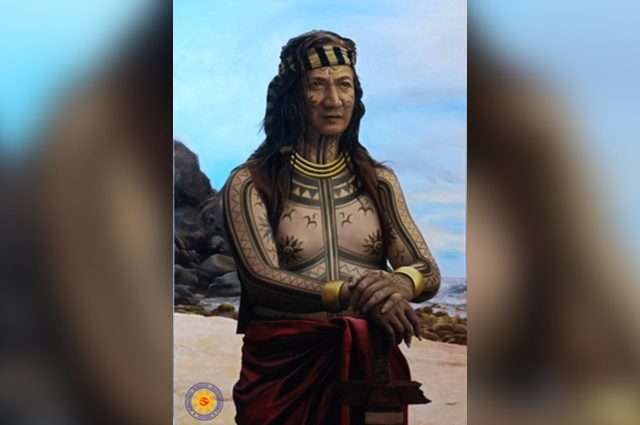
One of the clearest examples is Lapu-Lapu's appearance. There is no reliable contemporary portrait of him. In 2020, the National Historical Commission of the Philippines released a new portrait by artist Carlo Caacbay that deliberately portrayed him as an older man, drawing on historical research suggesting that he may have been advanced in age. The portrait also incorporated tattoos, gold ornaments and a kampilan, using historical and archaeological material to create a more evidence-informed representation. The NHCP acknowledged that the image was an interpretation grounded in available historical, cultural and archaeological research—not a photograph of what Lapu-Lapu actually looked like.
Another popular assumption is that Lapu-Lapu personally killed Magellan. The historical evidence does not establish this. What we can say with confidence is that Lapu-Lapu's forces defeated Magellan's landing party and Magellan was killed during the battle. The identity of the individual who delivered the fatal blow remains uncertain.
Even the language used to describe his victory has changed with time. A 1951 historical marker called Lapu-Lapu the “first Filipino” to repel European aggression, although the modern Filipino nation did not yet exist in 1521. The 2021 NHCP marker uses more historically specific language, describing him as one of the leaders of Mactan who insisted that his community remain independent of the Spanish king's authority.
This distinction matters. Respecting Lapu-Lapu does not require turning every popular story about him into historical fact. His achievement is already extraordinary without exaggeration: a local leader successfully resisted an armed expedition led by one of Europe's most experienced navigators, and Magellan died in the encounter.
Perhaps the most honest way to remember Lapu-Lapu, then, is not as a flawless warrior created by legend, but as a historical figure whose real actions were significant precisely because we do not need to invent a perfect man to make his victory meaningful.
What Mactan Really Teaches Us About Colonial History
The Battle of Mactan is often remembered as a simple story: Magellan arrived, Lapu-Lapu resisted, and the indigenous warriors won. But its deeper historical significance lies in what it reveals about the nature of colonial expansion. Mactan shows that European arrival did not mean the immediate disappearance of local political authority. The people encountered by Magellan already possessed their own societies, alliances, economies and systems of leadership. The National Quincentennial Committee has therefore emphasised that Philippine history did not begin with Magellan's arrival and that the societies encountered by the expedition should not be understood as passive or “undiscovered” peoples.
Mactan also demonstrates that colonial power was not inevitable. Magellan arrived with ships, firearms, armour and the authority of the Spanish Crown, yet those advantages did not guarantee victory. His attempt to impose external authority encountered a community capable of resisting it. The battle was a reminder that imperial power depended not only on superior weapons, but also on political alliances, geography, logistics and the willingness of local people to accept or reject foreign authority.
At the same time, Mactan should not be transformed into the opposite oversimplification—that Europeans were simply conquerors and indigenous societies were perfectly united against them. The events involved local rivalries, alliances, religious conversion, political negotiations and competing claims to authority. Different communities responded to Magellan differently.
Perhaps the most important lesson is therefore about perspective. For centuries, 1521 was commonly framed as the “discovery” of the Philippines. Modern Philippine historical scholarship has increasingly rejected that formulation, emphasising instead that the islands already possessed flourishing societies and that 1521 represented a moment of contact, conflict and mutual encounter.
Mactan ultimately teaches us that colonial history is not only the history of those who arrived with imperial ambitions. It is also the history of those who were already there—and who could choose to resist, negotiate, cooperate or refuse. Lapu-Lapu's victory matters precisely because it reminds us that indigenous people were not merely subjects of history. They were making history themselves.
Conclusion: The Man We Know—and the Man We Don't
Five centuries after Mactan, Lapu-Lapu remains easier to remember than to know. We can say with confidence that the leader of Mactan resisted Magellan's demands, that his forces defeated the expedition's landing party, and that Magellan died in the battle on 27 April 1521. Beyond those events, however, the historical record becomes remarkably incomplete. Even the name recorded by Pigafetta—Çilapulapu—has passed through different forms and interpretations over time.
That uncertainty has allowed later generations to construct different versions of Lapu-Lapu: warrior, defender of local sovereignty, national hero, and, in some interpretations, Muslim resistance figure. Some of these identities may contain elements of historical truth, while others belong more clearly to later memory. The responsible historian must therefore resist the temptation to turn possibility into certainty.
Yet uncertainty does not diminish the significance of Mactan. The National Quincentennial Committee itself emphasises that the people who lived in the archipelago in 1521 were not “discovered” by Europeans; they already possessed sophisticated societies, cultures and systems of exchange. Lapu-Lapu's importance lies partly in reminding us that these people were active participants in history, capable of making choices and resisting external authority.
Perhaps, then, the most honest way to remember Lapu-Lapu is to hold the man and the legend apart. We may never recover the complete biography of the historical leader. But we do know enough about his decisive moment at Mactan. And sometimes history's most powerful figures are not those about whom we know everything, but those whose actions leave questions that continue to shape how later generations understand freedom, resistance and themselves.
References
- [National Quincentennial Committee – Battle of Mactan: Beyond Textbooks](https://www.nqc.gov.ph)
- [National Quincentennial Committee – Cebu and Southeast Asia During Magellan's Arrival](https://www.nqc.gov.ph)
- [National Quincentennial Committee – Lapulapu: Ang Datu ng Mactan](https://www.nqc.gov.ph)
- [National Quincentennial Committee – Lapulapu in the Eyes of Our Heroes](https://www.nqc.gov.ph)
- [National Quincentennial Committee – Lapulapu Versus Lapu-Lapu](https://www.nqc.gov.ph)
- [National Quincentennial Committee – A New Portrait of Lapulapu](https://www.nqc.gov.ph)
- [National Historical Commission of the Philippines – Lapulapu Historical Marker](https://philhistoricsites.nhcp.gov.ph)
- [National Historical Commission of the Philippines – Lapulapu Historical Marker, 2021](https://philhistoricsites.nhcp.gov.ph)
- [Library of Congress – The First Voyage Around the World by Antonio Pigafetta](https://www.loc.gov)
- [Library of Congress – Pigafetta's Account of Magellan's Expedition](https://www.loc.gov/)
- [National Library of Medicine – The New Imperial Encyclopaedia: Ferdinand Magellan](https://tile.loc.gov)
- [Spanish Army – Arrival of the Magellan-Elcano Expedition in the Moluccas](https://ejercito.defensa.gob.es)
- [SAGE Journals – Contemporary Scholarship on Lapu-Lapu and Historical Memory](https://journals.sagepub.com)