
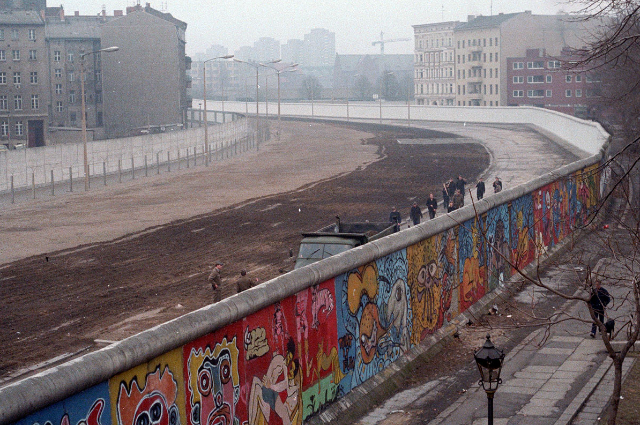
The Night the Wall Fell — And What It Meant
On the icy night of 9 November 1989, Berlin felt like it was holding its breath. For decades, the Wall had carved the city in two—concrete, steel, watchtowers and floodlights slicing through streets where families once walked together. But that night, something shifted. Rumours spread like sparks in the cold wind: “The border is open.” No one knew if it was true. Still, people poured out of their apartments, gathering at checkpoints that had long symbolised fear, separation, and silence.
The border guards were as confused as the crowds pressing against the gates. They had heard the same broadcast—a clumsy government announcement suggesting new travel rules—but no one had told them what to do. As hundreds became thousands, chanting, crying, demanding entry, the guards made a decision that would change the world: they stepped aside. The gates swung open. Floods of East Berliners poured into the West, laughing, screaming, hugging strangers. On top of the Wall—once a place where even a misstep could mean death—young people danced and clinked bottles of champagne.
The fall of the Berlin Wall mattered far beyond Germany. It wasn’t merely the collapse of a physical structure, nor just a geopolitical turning point in the Cold War. It was a moment when the world saw, unmistakably, that no human-made division is stronger than the human desire to connect. The Wall stood for 28 years—28 years of broken families, stifled dreams, psychological scars, and an entire society living under surveillance and fear. Yet in the end, it took only a few hours of collective will for the people to reclaim what had been denied.
Today, as nations once again build fences—between the U.S. and Mexico, across the Middle East, around enclaves and borders worldwide—the story of the Berlin Wall remains sharply relevant. It reminds us that walls may carve up land, but they cannot carve up the human heart. And sooner or later, people find a way to push back against any barrier that tells them they must remain apart.
From World War to Cold War: How Germany Became a Divided Nation
When World War II ended in 1945, Germany lay in ruins—physically shattered, politically discredited, and morally shaken. Entire cities had been flattened by air raids. Millions were dead or displaced. Railways, bridges, factories, and communication lines were twisted heaps of metal. The Nazi regime had collapsed, leaving a power vacuum in a society exhausted by years of war and propaganda. For the defeated population, survival had become the only priority; food, shelter, coal, and medicine were scarce. Germany was not just a defeated nation—it was a dismantled one.
Into this vacuum stepped the Allied powers: the United States, the Soviet Union, the United Kingdom, and France. Determined to prevent another rise of militarism, they divided Germany into four occupation zones, each governed by one of the victors. Berlin, although situated deep inside the Soviet zone, was also split into four sectors. What was intended as a temporary administrative arrangement soon hardened into a geopolitical fault line.
The seeds of division were planted early. The Western Allies—especially the United States—favoured rebuilding Germany through democratic institutions and capitalist economic policies. The Soviet Union, however, emerged from the war deeply suspicious of Western intentions. Having lost nearly 27 million people in the conflict, it sought security above all else: buffer states, controlled governments, and ideological allegiance. These divergent visions clashed again and again, turning Germany into a laboratory of the broader ideological struggle between capitalism and communism.
By 1949, the divide became official. The three Western zones merged to form the Federal Republic of Germany (FRG)—commonly known as West Germany—with Bonn as its capital. It was aligned with the United States and Western Europe, supported by initiatives like the Marshall Plan, which poured billions into reconstruction. Industries revived, democracy took root, and the economy began its historic “Wirtschaftswunder,” or economic miracle.
In response, the Soviet zone became the German Democratic Republic (GDR)—East Germany—with East Berlin as its capital. The GDR adopted a centralised socialist model, heavily influenced and supervised by Moscow. While West Germany embraced markets and political pluralism, East Germany enforced state ownership, limited freedoms, and a one-party system under the Socialist Unity Party. From this moment onward, Germany was not simply divided by administrative zones—it was divided by incompatible ideologies.
Nowhere was this more visible than in Berlin, the city caught at the crossroads of global tensions. Though surrounded entirely by East German territory, West Berlin remained a Western island, protected by the Allies. This made it a symbol of freedom for many East Germans and a constant irritation for the Soviet-backed GDR. The city became a stage where Cold War dramas played out: airlifts, espionage, diplomacy, propaganda. Berlin was the place where the United States and the Soviet Union stared each other down across checkpoints, fences, and barbed wire.
The divide was not just political—it became sharply economic. West Germany surged ahead with growing industries, rising wages, and expanding opportunities. East Germany, though initially stable and industrialised, soon lagged behind. Shortages were common. Consumer goods were limited. Travel restrictions isolated citizens. Gradually, the gap widened, and so did resentment.
By the late 1950s, millions of East Germans—especially young professionals and skilled workers—began migrating to the West. They saw better wages, better housing, and better futures across the border. This “brain drain” threatened the survival of the GDR’s economy. And so, backed by Moscow, East Germany chose a drastic solution: sealing the border and cutting the country in two.
The story of the Berlin Wall begins not with its construction, but with this long, painful divergence—a nation split by war, reshaped by superpowers, and frozen by global rivalries. Germany did not divide itself; the world divided it. And Berlin stood at the centre of this fracture, becoming the most visible front line of the Cold War.
The Birth of the Berlin Wall: A City Cut Overnight
By the late 1950s, East Germany was bleeding people. More than three million East Germans—nearly 20% of the population—had already slipped into West Germany since 1949. Trains, trams, footpaths, and even street crossings inside Berlin became quiet escape routes. Young professionals, engineers, doctors, and students were leaving in waves. Every departure weakened the East German economy. Every missing scientist, nurse, or teacher intensified the panic inside the ruling Socialist Unity Party (SED). If the outflow continued, the GDR feared it would collapse from the inside.
The pressure grew unbearable by 1961. As the Cold War intensified, East Germany’s leadership begged Moscow for permission to stop the migration at any cost. Soviet Premier Nikita Khrushchev—tired of embarrassment and eager to stabilise the Eastern Bloc—finally agreed. The plan would be executed swiftly, secretly, and without warning.
In the early hours of 13 August 1961, while most of Berlin slept, trucks rolled through the streets of East Berlin. Soldiers, police, and factory militia moved in coordinated silence. At precisely 1:00 a.m., they began unspooling rolls of barbed wire, stretching them across streets, tram lines, railway tracks, canals, and squares. Streetlamps flickered over tangled metal where roads had been open the day before. Confused dogs barked. Residents peered from windows, watching their city being sliced apart in real time.
By dawn, Berliners awoke to an entirely new reality. Neighbourhoods separated by only a pavement or courtyard were suddenly divided between two states. Friends waved to each other across the wire, crying, shouting through knots of metal that they could no longer reach each other. Parents were trapped on one side while their children were on the other. Workers who lived in the East but worked in the West arrived at checkpoints to find armed guards refusing entry.
Within hours, East German forces reinforced the barricades. Over the next days and weeks, the temporary wire became concrete blocks, then reinforced walls. Streets were torn up. Buildings along the border were evacuated and bricked shut. Windows facing West Berlin were sealed with cement. Entire roads disappeared behind obstacles. What began as barbed wire would grow into a 155-kilometer-long fortified border system, complete with guard towers, searchlights, anti-vehicle trenches, patrol paths, minefields, and what became infamous as the “death strip.”
Berlin had become a prison with one half trapped inside.
The shock was profound. People had believed—even up to August 12—that the leadership would never dare seal the city. Just two months earlier, East German leader Walter Ulbricht had confidently declared: “No one has any intention of building a wall.” Yet on that August morning, the contradiction stood in front of every Berliner: a wall of wire, guarded by rifles.
Life changed instantly. Weddings were postponed indefinitely. Elderly parents died without their children beside them. Lovers were separated mid-relationship, unable to meet again for decades. The city that once symbolised freedom of movement became, overnight, a stark symbol of coercion, control, and fear.
The Wall’s birth was not gradual. It was a midnight amputation, cutting a living city in two—swiftly, brutally, and without mercy.
Anatomy of a Prison: Surveillance, Guard Towers, and “The Death Strip”
What began as a line of barbed wire in August 1961 soon evolved into one of the most fortified borders in modern history. To the East German leadership, the Berlin Wall was not simply a barrier; it was an engineered prison—designed to intimidate, immobilise, and if required, eliminate. For those living near it, the Wall didn’t just loom over the landscape; it invaded their minds.
By the 1970s, the Berlin Wall had hardened into a 155-kilometer-long militarised boundary, equipped with an astonishing array of security measures. Rising above the concrete were 166 watchtowers, manned day and night by border guards trained to detect even the smallest movement. These towers, visible from miles away, were fitted with sniper platforms, high-powered binoculars, and automatic floodlights that sliced into the darkness. At night, the border glowed unnaturally bright—an eerie reminder that people were not meant to escape.
Between the inner and outer walls lay the infamous “death strip”: a barren expanse of raked sand and gravel designed to expose footprints, lined with tripwires, guard dogs, and in some areas anti-personnel mines. Escape attempts were calculated to fail. Anti-vehicle trenches prevented cars from crashing through. Metal grids, known as “Stalin’s Grass,” shredded clothing and skin. Even children knew that stepping into the death strip meant gambling with their lives.
The brutality of policy was clear: shoot-to-kill orders. Officially denied for years, they were quietly embedded in the guard regulations. Young East German soldiers—many barely out of their teens—were told they would be rewarded for stopping escapees and punished for failing to fire. The moral weight was crushing. Some guards defected to the West rather than be complicit. Others hesitated at their posts, haunted by the possibility of shooting an innocent person desperate for freedom.
Yet people kept trying. Escape stories became legends of both courage and tragedy. Some tunnelled underneath, breathing dust for hours in the hope of emerging into freedom. Families stitched hot-air balloons from scraps of fabric. One man used a zip line to glide over the Wall. But not everyone made it. The case of Peter Fechter, an 18-year-old bricklayer, became infamous. Shot while attempting to climb the Wall in 1962, he bled to death in the death strip as helpless crowds on both sides screamed for help.
Each failed attempt reinforced the Wall’s message: escape was dangerous, often deadly, and meant leaving behind everything familiar. Yet each successful escape proved something far more powerful—that even the harshest prison cannot fully crush the human instinct for freedom.
Through its towers, wires, lights, and traps, the Berlin Wall became a symbol of oppression. But in the stories of those who tried to cross it, the Wall also revealed the limits of fear. No system—however fortified—can fully contain the human will to choose one’s own destiny.
Human Suffering Behind Concrete: Psychological and Social Damage
Long before the Berlin Wall cracked and crumbled, it had already shattered thousands of lives from the inside. Its concrete blocks created not just a geographic split but a deep psychic wound—one that lingered long after the Wall itself disappeared from Berlin’s skyline. For the people who lived in its shadow, the Wall became an emotional presence: a constant reminder of separation, control, and enforced silence.
The trauma of family separation struck hardest and earliest. On 13 August 1961, sons who had stepped out for work in West Berlin returned home to find themselves cut off from their parents in the East. Newlyweds on opposite sides of the city were denied the chance to reunite. Grandparents watched their grandchildren grow up through binoculars from observation platforms. These weren’t isolated incidents; entire family trees were abruptly split, creating emotional fractures that therapists would later compare to the trauma experienced by refugees and wartime evacuees. What made this even more devastating was the suddenness: no warning, no goodbye, no closure.
Among border residents, this emotional shock evolved into something darker—what psychologists eventually named Mauerkrankheit, or “Wall Sickness.” First identified by East German psychiatrist Dietfried Müller-Hegemann, the condition described a cluster of psychological symptoms directly linked to living near the Wall. Patients reported anxiety, chronic fear, depression, and a suffocating sense of entrapment. Some felt watched; others felt hopeless. The constant proximity to the death strip, guard towers, and blinding floodlights produced an atmosphere of ongoing threat.
The symptoms could be subtle at first: sleeplessness, irritability, nervousness. Over time, they deepened. Many reported growing paranoia—not irrational paranoia, but the understandable fear that someone was always listening or watching. For those separated from loved ones, grief blended with frustration, creating long-term emotional exhaustion. The Wall was not simply a structure; it was a psychological cage that seeped into every relationship, every decision, every memory.
The people most affected were those who could see the Wall from their windows—border residents—and those with fractured families. Many East Berlin apartment buildings faced West Berlin across only a narrow strip; residents could watch free citizens walking to shops or buses only meters away, separated by concrete and barbed wire. This visual contrast intensified feelings of loss and resentment. It wasn’t just that they couldn’t leave—it was that the life they wanted was visible, tantalizingly close.
Layered on top of this was the chilling presence of the Stasi, East Germany’s secret police. If the Wall created external barriers, the Stasi created internal ones—walls of fear and mistrust between neighbours, colleagues, even family members. Every tenth citizen became an informant. Conversations were whispered, diary pages hidden, friendships doubted. Children learned early not to repeat what their parents said at home. Even marriages collapsed under the pressure of mutual suspicion. In such an environment, authentic human connection became dangerous, and emotional loneliness intensified.
Daily life also underwent a slow erosion. Careers were disrupted as workers who once crossed into West Berlin for jobs suddenly found themselves stranded. Students lost access to universities, apprenticeships, and professional opportunities. Many were forced into state-assigned work. Artists, writers, and academics suffered under censorship and ideological control. A generation grew up in East Germany with their identity shaped by restriction, by the sense that the world was vast yet permanently out of reach.
Individual stories give shape to this collective suffering. There was the young mother who watched her toddler visit grandparents in the West the day before the Wall rose—and did not see him again for 28 years. The factory worker whose apartment overlooked the Wall and who spent nights trembling at the floodlights sweeping his window. The teenage girl developed severe panic attacks after witnessing a failed escape attempt from her bedroom balcony. These people rarely appear in textbooks, but their experiences formed the emotional landscape of divided Berlin.
The Wall imprisoned bodies, but more profoundly, it imprisoned emotions. It stifled hope, strained relationships, and created an environment where fear became routine. Yet, even amid this psychological darkness, the human desire for connection persisted—proof that no amount of concrete or coercion can fully silence the heart.
Resistance, Courage, and Daily Acts of Defiance
Even as the Berlin Wall towered over the city—grim, gray, and seemingly immovable—it never fully crushed the human instinct to resist. Behind its concrete slabs, East Germans refused to surrender their desire for freedom. Their defiance took many forms: some bold and dramatic, others quiet and everyday, but all equally courageous.
The most daring acts happened underground, above ground, and through the air. Families and friends joined hands to carve tunnels beneath the Wall, sometimes only a meter high, working with shovels, buckets, and sheer determination. Many of these tunnels collapsed; others succeeded spectacularly, smuggling dozens to freedom in a single night. Those who couldn’t dig sometimes forged identity documents or bribed border guards to look the other way. The creativity of escape attempts seemed limitless. In 1979, two East German families stitched together scraps of fabric to build a homemade hot-air balloon. Under the cover of darkness, they lifted into the sky and drifted across the border in a feat that stunned the world.
But resistance wasn’t always about escape. Much of it happened in the realm of culture—art, humour, graffiti, and music—especially on the western side of the Wall. West Berliners transformed the blank concrete into a sprawling open-air gallery, splashed with protest slogans, satirical drawings, and vibrant murals. Each stroke of paint was a reminder that the Wall was not just a barrier but a canvas for defiance. Meanwhile, East Berliners whispered jokes mocking the government, hid banned records, or shared samizdat literature—small acts that kept the spirit of dissent alive.
International voices also amplified the resistance. In 1963, U.S. President John F. Kennedy electrified Berlin with his iconic declaration, “Ich bin ein Berliner”, affirming solidarity with a city surrounded by hostile borders. Two decades later, in 1987, Ronald Reagan stood at the Brandenburg Gate and delivered a challenge that echoed across the world: “Mr. Gorbachev, tear down this wall!” These speeches didn’t break the Wall physically, but they emboldened those longing for change, reinforcing that the world had not forgotten them.
Together, these acts—whether underground, artistic, or international—kept the flame of freedom alive. They showed that even in a city divided by fear, courage could still flourish, proving that no wall could fully contain the human will to resist.
The Fall: A Political Accident That Changed History
By the late 1980s, the once-rigid Soviet empire was beginning to crack. When Mikhail Gorbachev became General Secretary in 1985, he inherited an economy sinking under the weight of stagnation and decades of military overspending. His signature reforms—glasnost (openness) and perestroika (restructuring)—were meant to revive the USSR. Instead, they unleashed pent-up frustrations across Eastern Europe. For satellite states like East Germany, these reforms signalled something unprecedented: Moscow would no longer intervene militarily to prop up failing communist regimes. Without the Soviet “big brother,” the East German government suddenly found itself standing alone.
This shift emboldened citizens. Beginning in 1989, mass protests erupted in Leipzig, at the historic St. Nicholas Church, where thousands gathered every Monday with candles and chants of “Wir sind das Volk!”—“We are the people!” What started with a few hundred demonstrators swelled into gatherings of tens of thousands. The movement quickly spread to Dresden, Berlin, Magdeburg, and beyond, creating a nationwide wave of civil resistance. The East German leadership, ageing and out of touch, tried to suppress the unrest but failed utterly. Their attempts only further alienated the public.
Then came the moment that changed history—almost by accident. On 9 November 1989, during a routine press conference, Politburo spokesperson Günter Schabowski read from hastily prepared notes announcing new travel regulations. When a journalist asked when the changes would take effect, Schabowski, confused and unprepared, replied, “As far as I know… immediately. Without delay.” His words flashed across global television within minutes.
East Berliners, stunned and sceptical, rushed to border checkpoints to test what they’d heard. Border guards, who had received no instructions, were overwhelmed by the growing crowds. They radioed superiors, but no one wanted to take responsibility for ordering violence. Finally, at 10:45 p.m., a commander at the Bornholmer Strasse crossing made a decision that would echo through history: he ordered guards to open the barrier.
The world watched live as East Berliners flooded into the West. Television cameras broadcast tears, laughter, and disbelief as families reunited after decades of forced separation. People climbed onto the Wall, popping champagne, banging on the concrete with hammers, kicking loose chunks into the street. What had once symbolised oppression suddenly became a literal stage for celebration.
For global audiences, the images carried immense symbolic weight. The Wall had been the concrete embodiment of the Cold War; its collapse signalled not just the end of a barrier, but the end of an era. In a single night, the political map of Europe began to redraw itself.
And for Berliners, the moment was simpler, more intimate, and profoundly human: after 28 years of division, they could finally embrace those they loved, walk streets that had once been forbidden, and reclaim the city that had been stolen from them.
After the Wall: Reunification, Complications, and Long-Lasting Scars
When the Berlin Wall fell, the world celebrated a triumphant symbol of freedom restored. Yet for Germans themselves, the years that followed were far more complicated. Reunification, formally achieved on 3 October 1990, brought joy—but also profound economic, social, and cultural challenges. A divided nation could be politically stitched together in a day; emotionally and economically, it would take much longer.
One of the first hurdles was the economic shock. The East German economy—long isolated, state-controlled, and underfunded—struggled to compete in a newly opened market. Factories that had survived only through government subsidies collapsed almost overnight. Entire industries vanished. The introduction of the West German Deutsche Mark, though symbolically important, made East German products too expensive and uncompetitive. By the mid-1990s, unemployment in the East soared, with some regions facing rates above 20%. Many young people migrated westward, seeking opportunities their hometowns could no longer provide.
These disparities fueled a cultural divide often summed up in the labels “Ossis” (East Germans) and “Wessis” (West Germans). While many embraced unity, stereotypes flourished. Some West Germans viewed Ossis as naïve or overly dependent on the state; some East Germans saw Wessis as arrogant or dismissive of their lived experiences. The sense of being second-class citizens haunted many in the East, who felt that reunification sometimes meant assimilation rather than genuine integration.
Still, amidst the struggles, healing slowly took shape. Germany invested heavily in rebuilding the East—modernising infrastructure, renovating cities, restoring historical buildings, and expanding universities. New highways, rail lines, and tech hubs began to close the gap. Over time, younger generations grew up with fewer divisions, shaped more by global culture than Cold War narratives.
Equally important was the rise of memory culture. Museums like the Berlin Wall Memorial, the Checkpoint Charlie Museum, and the Stasi Museum created spaces for reflection. Former watchtowers became educational exhibits; preserved Wall sections turned into open-air galleries. These places allowed Germans—not just from the East or West, but from both—to confront their shared history openly.
Reunification was not a clean page turn; it was a long process of stitching wounds, building bridges, and learning to understand one another again. The scars remain, but so does the commitment to ensure that the mistakes of division are never repeated.
Modern Parallels: Why Walls Still Rise — and Why They Still Fail
More than three decades after the Berlin Wall crumbled, the world still hasn’t outgrown the impulse to divide. In fact, since 1989, more border walls have been built than at any other time in modern history. Whether justified as security measures, anti-immigration barriers, or counter-terrorism infrastructures, these structures echo the fears and politics that once carved Berlin in two.
The US–Mexico border wall is perhaps the most well-known example. Stretching across deserts, rivers, and cities, it stands as a physical manifestation of America’s struggle with immigration, nationalism, and economic disparity. Families separated by policy, communities split by barbed wire, and the heavy militarization of border towns all mirror, in different contexts, the tensions that Berliners once lived with daily. The fear of “the other,” amplified by political rhetoric, hardens identities on both sides of the fence.
In the Middle East, the Israel–West Bank barrier winds through Palestinian towns and farmland. To Israelis, it represents security; to Palestinians, it symbolises occupation and confinement. The emotional and psychological toll—restricted movement, anxiety, alienation—recalls the sense of entrapment East Germans described under Mauerkrankheit. Many Palestinians now use the same vocabulary of isolation that Berliners once did, proving that the emotional consequences of walls repeat across continents.
Closer to South Asia, the India–Bangladesh border fence—one of the world’s longest—divides families, disrupts livelihoods, and shapes local identities. Entire villages find themselves cut off from their own farmlands, mirroring the absurdity of Berliners living meters from their workplaces or relatives yet unable to reach them. Border guards enforce strict rules, and the constant surveillance creates a climate of suspicion reminiscent of Cold War-era Berlin.
What ties these modern walls together is not just their physical form but their psychological impact. Wherever borders are sealed with concrete, barbed wire, or armed patrols, communities experience similar wounds: separation trauma, mistrust, militarisation, and the hardening of identities. People living near these barriers speak of fear, uncertainty, and a persistent awareness of being watched.
And this is where Berlin offers a powerful lesson for the future: no wall lasts forever. They may appear strong, but they are fragile against the force of human connection. The Berlin Wall teaches us that walls can suppress movement, but not hope; they can dictate borders, but not belonging. Ultimately, every wall reflects a political moment—not human destiny.
Conclusion: A Warning and a Hope for a Divided World
The Berlin Wall stands today not just as a historical memory, but as a powerful symbol of what humanity is capable of—both its darkest impulses and its deepest resilience. For 28 years, it represented human cruelty in concrete form: a structure built to divide families, suppress dreams, and enforce obedience through fear. Yet its collapse revealed something far stronger than any ideology or political system: the enduring human longing for connection, freedom, and dignity.
The Wall’s fall reminds us of a simple truth: no wall lasts forever. Physical barriers can restrain movement, but they cannot imprison the human spirit indefinitely. Where separation grows, resistance grows too. Where borders harden, so does the determination to cross them—if not with feet, then with voices, culture, solidarity, and memory.
In this age of rising fences—between nations, communities, and even ideologies—the lessons of Berlin feel urgent. Walls promise safety, but often deliver fear. They claim to create order, yet leave behind trauma and mistrust. And while they may stand for decades, they are always temporary in the face of human will.
Human beings are wired to reach out—to seek kinship, understanding, and belonging. We build bridges more naturally than barriers, and when forced apart, we find ways to return to one another. This is why the Berlin Wall fell: not because politicians decided it should, but because people refused to accept a life defined by separation.
As we confront new divisions in the modern world, may Berlin’s memory guide us. Let it serve as both a warning against building new walls—and a hope that, someday, we will have the courage to dismantle the ones that still stand.
References:
1. Berlin Wall History & Primary Sources
- Berlin Wall Foundation (Official)
- Berlin.de – Official City Archive on the Berlin Wall
- The Cold War Museum – Berlin Wall Overview
2. Historical Context: Division of Germany
3. Construction of the Wall
4. Border Security, Death Strip, Shoot-to-Kill Orders
5. Psychological Impacts & Mauerkrankheit- Müller-Hegemann, Dietfried. Mauerkrankheit: psychische Störungen in der DDR (East German psychology studies).
- (German-language reference)
- Academic overview of the psychological effects of separation:Springer – Mental Health and Border Conflict
6. Resistance & Escape Stories
- Checkpoint Charlie Museum – Escape Attempts Archive
- Deutsche Welle – “The Most Daring Escapes Under, Over, and Through the Wall”
7. The Fall of the Wall
8. German Reunification
- Federal Agency for Civic Education (Bundeszentrale für politische Bildung)
- German Federal Government – Reunification Resources
9. Modern Parallels: Global Border Walls
- Pew Research Center – “Rise of Border Walls Around the World”
- Council on Foreign Relations – Border Security Dossiers
- UN OHCHR – Reports on Border Militarisation and Human Rights
https://www.ohchr.org