
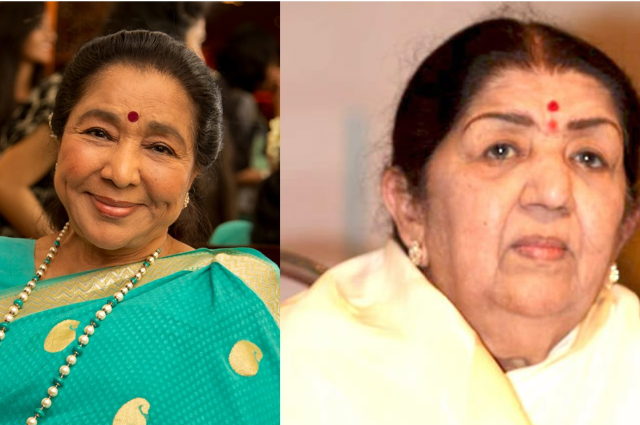
The tradition of playback singing in Indian cinema is one of its most distinctive artistic innovations, separating the voice from the on-screen performer while preserving emotional authenticity. Emerging in the 1930s and gaining prominence by the 1940s, playback singing allowed specialised vocalists to lend their voices to actors, creating a powerful fusion of music and storytelling. Over time, this system became central to Bollywood's identity, where songs are not mere embellishments but narrative drivers that convey emotion, character, and cultural values. Within this rich musical ecosystem, few voices have resonated as profoundly or enduringly as those of Lata Mangeshkar and Asha Bhosle.
Lata Mangeshkar came to embody the ideal of vocal purity and emotional clarity, her high-pitched, melodious voice setting a benchmark for generations of singers. She became the definitive sound of the Indian heroine, shaping how femininity, devotion, and romance were expressed in cinema. In contrast, Asha Bhosle carved a path defined by versatility and bold experimentation. Her voice adapted effortlessly across genres—cabaret, pop, ghazal, folk, and classical—capturing a broader and often more playful or rebellious spectrum of human emotion. Together, they did not merely participate in Bollywood’s musical evolution; they actively shaped its direction, influencing composers, lyricists, and audience expectations alike.
The contrast between Mangeshkar’s classicism and Bhosle’s adaptability reflects a deeper artistic duality within Indian cinema itself—between tradition and modernity, restraint and expression. Yet, it is precisely this contrast that underscores their shared legacy. Their combined influence has defined not only the soundscape of Hindi cinema but also its emotional and cultural identity, making their voices inseparable from the story of Indian music itself.
Historical Context: Evolution of Playback Singing in India
Playback singing, now inseparable from Indian cinema, emerged as a transformative innovation in the 1930s, fundamentally reshaping how music functioned within films. In the early years of sound cinema, actors were required to sing their own songs on screen, which often limited casting choices to those with adequate vocal ability. This began to change with the gradual adoption of playback recording techniques, notably in films like Dhoop Chhaon, where voices were recorded separately and synchronised with on-screen performances. By the 1940s, playback singing had become an established practice, enabling filmmakers to prioritise acting talent while entrusting musical expression to trained vocalists.
This shift gave rise to a new class of professional singers whose voices became closely associated with particular screen personas. The separation of voice and body enabled greater artistic specialisation, leading to improvements in musical quality and emotional depth. Playback singers were no longer hidden contributors; they gradually achieved celebrity status, becoming integral to a film’s success. The evolution also coincided with advancements in recording technology, which enhanced sound quality and expanded creative possibilities.
Following India’s independence in 1947, the film industry experienced rapid growth, particularly in Bombay (now Mumbai), which became the hub of Hindi cinema. Music emerged as a central element of filmmaking, with songs often driving narratives and determining commercial success. This period also saw the rise of influential composers and lyricists who collaborated closely with playback singers to create enduring works. The demand for distinctive and emotionally resonant voices increased, paving the way for iconic artists to dominate the industry.
Parallel to cinema, mass media platforms such as radio and gramophone records played a crucial role in popularising film music. Stations like All India Radio broadcast songs across the country, bringing film music into everyday life. Record companies such as His Master's Voice (HMV) further expanded their reach by producing and distributing records, allowing songs to transcend the boundaries of cinema halls. This widespread dissemination helped create a shared musical culture across diverse linguistic and regional audiences.
It was within this dynamic and rapidly evolving ecosystem that Lata Mangeshkar and Asha Bhosle emerged. Their careers not only paralleled the maturation of playback singing but also actively shaped its trajectory. As the industry evolved, their voices became defining elements of its golden age, reflecting both continuity and change in Indian musical expression.
Early Life and Musical Foundations
Family Background and Training
The musical journeys of Lata Mangeshkar and Asha Bhosle are deeply rooted in a rich artistic lineage shaped by their father, Dinanath Mangeshkar. A respected classical vocalist and theatre actor, Dinanath played a pivotal role in introducing his children to the discipline and rigour of Indian classical music from an early age. Training within the framework of traditional gharana practices, the sisters were exposed to the intricacies of ragas, voice modulation, and expressive delivery, which later became defining features of their singing styles.
Their early years were spent in a culturally vibrant yet demanding environment, where music was not merely an art form but a way of life. Both sisters accompanied their father to stage performances, gaining firsthand experience of live audiences and the emotional power of music. This early exposure cultivated not only technical proficiency but also a deep understanding of performance dynamics. Lata’s inclination toward purity and precision and Asha’s flair for expressive variation can both be traced back to this formative training. The discipline instilled during these years laid a strong foundation, enabling them to navigate the complexities of playback singing with exceptional control and confidence.
Entry into the Film Industry
The untimely death of Dinanath Mangeshkar in 1942 marked a turning point in the lives of the Mangeshkar siblings, forcing them into financial hardship. As the eldest, Lata Mangeshkar assumed responsibility for supporting the family, entering the film industry not out of ambition but necessity. She began with small acting roles and minor singing assignments, gradually building her presence in a competitive environment. During this period, the industry favoured heavier, more mature voices, making it difficult for her lighter, high-pitched tone to gain acceptance.
Similarly, Asha Bhosle faced her own set of challenges. Entering the industry at a young age, she initially sang for low-budget films and secondary roles, often overshadowed by established singers. Personal struggles, including an early and troubled marriage, added to her difficulties. Both sisters navigated intense competition, limited opportunities, and the pressure to prove their worth in a male-dominated industry.
Despite these obstacles, their persistence and adaptability enabled them to gradually secure recognition. Their early recordings, though modest, marked the beginning of careers that would later redefine Indian playback singing and set new artistic standards.
Career Trajectories and Breakthrough Phases
Rise of Lata Mangeshkar
The rise of Lata Mangeshkar in the late 1940s marked a decisive turning point in the history of Indian film music. At a time when the industry favoured deeper, more robust female voices, Lata’s high-pitched, delicate tone initially faced resistance. However, her breakthrough came with songs like “Uthaye Ja Unke Sitam” from Andaz, which showcased a new vocal aesthetic—one that emphasised clarity, emotional subtlety, and technical finesse. This marked the beginning of a paradigm shift in playback singing.
Throughout the 1950s and 1960s, Lata established herself as the preeminent female voice in Bollywood. Her collaborations with legendary composers such as Naushad, S. D. Burman, and Madan Mohan played a crucial role in shaping her career. These composers tailored their melodies to suit her vocal strengths, creating songs that highlighted her ability to convey deep emotion with precision and grace. Her voice became synonymous with leading actresses of the time, effectively defining how the “ideal” female character should sound on screen.
Lata’s dominance was not merely a result of talent but also consistency and adaptability within a classical framework. She brought a sense of discipline and refinement that elevated the musical standards of the industry. Her diction, control over pitch, and emotive restraint set new benchmarks, influencing both contemporaries and future generations. By the mid-20th century, she had become the default choice for most heroines, standardising what came to be regarded as the “ideal female playback voice”—pure, youthful, and expressive without overt dramatisation.
Her influence extended beyond individual songs; she reshaped the expectations of composers and audiences alike. The emotional authenticity she brought to romantic ballads, devotional songs, and melancholic pieces made her voice an essential component of cinematic storytelling. In doing so, Lata Mangeshkar did not just rise to prominence—she redefined the sonic identity of Bollywood music.
Rise of Asha Bhosle
In contrast to her sister’s early success, the journey of Asha Bhosle was marked by persistence through adversity and gradual recognition. During the late 1940s and early 1950s, Asha often found herself relegated to singing for low-budget or “B-grade” films, where opportunities were limited, and visibility was minimal. Overshadowed by established voices—including that of Lata—she had to carve her own niche in an industry that was already saturated with talent.
Her breakthrough came in the late 1950s through her collaboration with composer O. P. Nayyar. Nayyar recognised Asha’s unique vocal texture and ability to bring energy and sensuality to songs, qualities that differed significantly from the prevailing style. Their partnership produced a series of hits, including songs from films like Naya Daur, which established her as a leading playback singer. This phase marked her transition from a struggling artist to a recognised voice with a distinct identity.
Asha’s true artistic evolution, however, emerged through her collaboration with R. D. Burman. Their partnership in the 1960s and 1970s revolutionised Bollywood music by incorporating Western influences such as jazz, rock, and disco. Asha’s remarkable adaptability allowed her to experiment with unconventional styles, from cabaret numbers to romantic duets and ghazals. Songs like those in Teesri Manzil demonstrated her ability to handle complex rhythms and expressive phrasing with ease.
Over time, Asha Bhosle transitioned from being seen as an alternative voice to becoming an indispensable part of the industry. Her willingness to take risks and explore diverse genres enabled her to remain relevant across decades. Unlike a singular stylistic identity, her strength lay in versatility—constantly evolving with changing musical trends. This adaptability ensured her gradual but steady rise to prominence, ultimately securing her place as one of the most dynamic and influential voices in Indian cinema.
Vocal Styles and Techniques: A Comparative Analysis
Lata Mangeshkar’s Style
The vocal style of Lata Mangeshkar is often regarded as the gold standard of playback singing in India, characterised by a high-pitched, crystal-clear, and almost ethereal tonal quality. Her voice carried a sense of innocence and purity that resonated deeply with audiences, making it the definitive sound of the Indian cinematic heroine for decades. Unlike many of her contemporaries, Lata mastered the art of maintaining tonal consistency across octaves, ensuring that her voice remained smooth and unstrained even in complex compositions.
A key feature of her singing was precision—every note was rendered with remarkable accuracy, supported by impeccable breath control and diction. Her classical training played a crucial role in shaping this technical excellence. Rooted in the traditions of Hindustani classical music, she displayed a refined understanding of ragas, ornamentation (such as meend and gamak), and rhythmic discipline. However, what distinguished her was not just technical mastery but her ability to simplify classical elements for cinematic appeal without compromising their integrity.
Emotionally, Lata’s singing was marked by restraint and subtlety. Rather than overt dramatisation, she conveyed feelings through nuanced variations in pitch and tone, allowing listeners to internalise the emotion rather than be overwhelmed by it. This made her particularly effective in romantic, devotional, and tragic songs, where a delicate balance between expression and control was essential. Songs of longing, spiritual devotion, or quiet heartbreak became her forte, as her voice could evoke deep sentiment with minimal embellishment.
Her style also influenced how composers approached songwriting. Melodies were often designed to complement her vocal purity, leading to compositions that emphasised lyrical beauty and melodic flow. Over time, this created a standardised expectation of the “ideal female playback voice”—one that was youthful, melodious, and technically flawless. In essence, Lata Mangeshkar’s style was not just a personal artistic choice but a defining force that shaped the aesthetic direction of Indian film music.
Asha Bhosle’s Style
In contrast, the vocal artistry of Asha Bhosle is defined by its extraordinary versatility and expressive dynamism. Where Lata represented purity and consistency, Asha embodied adaptability and experimentation. Her voice possessed a distinctive texture that could shift effortlessly across moods and genres, making her one of the most flexible playback singers in Indian music history.
Asha’s singing style is often described as playful, bold, and emotionally expansive. She had a unique ability to infuse personality into her performances, whether through subtle vocal inflexions, rhythmic variations, or tonal shifts. This made her particularly effective in songs that required a sense of spontaneity or dramatic flair. Unlike the restrained emotional approach of Lata, Asha often embraced a more direct and expressive style, allowing her to capture a wider spectrum of human emotions—from sensuality and mischief to intensity and melancholy.
One of her greatest strengths was her adaptability to Western and experimental musical forms. Through collaborations with innovative composers like R. D. Burman, she explored genres such as jazz, rock, disco, and Latin-inspired music, integrating them seamlessly into the Bollywood soundscape. Her ability to handle unconventional rhythms and phrasing set her apart, enabling her to thrive in an era of musical transition and globalisation.
Asha also demonstrated remarkable proficiency in traditional forms, including ghazals and folk music, proving that her versatility was not limited to modern or popular genres. Her performances in films like Umrao Jaan highlighted her capacity for depth and classical expression, challenging any narrow categorisation of her talent.
Ultimately, Asha Bhosle’s vocal style represents a dynamic and evolving artistic identity. Her willingness to experiment, combined with her technical skill, allowed her to transcend genre boundaries and redefine the possibilities of playback singing, making her an enduring and influential figure in Indian music.
Musical Collaborations and Industry Relationships
Key Collaborators of Lata
The artistic journey of Lata Mangeshkar is inseparable from her collaborations with some of the most influential composers in Indian cinema. Among them, Naushad played a pivotal role in elevating her status during the early phase of her career. Known for his strong grounding in classical music, Naushad composed intricate melodies that perfectly complemented Lata’s vocal purity and discipline. Their collaborations resulted in songs that balanced classical rigour with cinematic accessibility, helping define the golden era of Bollywood music.
Equally significant was her association with S. D. Burman, whose minimalist yet deeply expressive compositions brought out the emotional depth of her voice. Burman’s approach often emphasised simplicity and mood, allowing Lata’s nuanced singing to take centre stage. Their work together produced timeless melodies that continue to resonate across generations. Similarly, Madan Mohan was known for crafting ghazal-inspired compositions that highlighted Lata’s ability to convey longing and melancholy with extraordinary finesse. His compositions are often regarded as some of the finest showcases of her emotive power.
Beyond composers, Lata maintained close creative relationships with lyricists and film directors, ensuring that her singing aligned seamlessly with narrative contexts. Her sensitivity to lyrics allowed her to internalise the emotional intent of a song, making each performance deeply authentic. Over time, composers began tailoring their compositions specifically for her voice, reinforcing her influence on musical structure and style. This symbiotic relationship not only strengthened her dominance in the industry but also contributed to a refined and cohesive musical aesthetic in Hindi cinema.
Key Collaborators of Asha
The career of Asha Bhosle is distinguished by a series of dynamic and transformative collaborations that highlight her versatility and openness to experimentation. Her early breakthrough was largely shaped by her partnership with O. P. Nayyar, who recognised her potential to bring energy, rhythm, and sensuality to songs. Nayyar’s compositions often deviated from classical norms, incorporating Punjabi folk rhythms and upbeat orchestration, which suited Asha’s expressive and lively vocal style. This collaboration helped establish her as a distinct voice in the industry.
Her most iconic and influential partnership, however, was with R. D. Burman. Together, they revolutionised Bollywood music by introducing Western influences such as jazz, rock, and disco. Burman’s experimental compositions demanded flexibility and innovation, qualities that Asha delivered with remarkable ease. Their collaborations produced a wide range of hits, from playful cabaret numbers to emotionally rich melodies, demonstrating her ability to adapt to diverse musical contexts.
In later decades, Asha continued to evolve through collaborations with modern composers like A. R. Rahman, whose global and fusion-oriented style brought new dimensions to her singing. Beyond Bollywood, she engaged in international projects, working with global artists and ensembles, thereby extending her influence beyond Indian cinema. These ventures included genre-bending experiments that fused Indian classical elements with contemporary global sounds.
Asha’s collaborative approach reflects her artistic philosophy—constant reinvention and exploration. By embracing diverse musical influences and partnerships, she not only sustained her relevance over decades but also expanded the boundaries of playback singing, making her a truly global musical figure.
Gender Dynamics and Industry Challenges
The evolution of playback singing in Indian cinema unfolded within a largely male-dominated industry, where composers, producers, and decision-makers were predominantly men. In this environment, female playback singers had limited control over their careers, often dependent on the preferences of music directors and film studios for opportunities. Despite their immense popularity, singers like Lata Mangeshkar and Asha Bhosle had to navigate a system that did not initially prioritise fair recognition or autonomy for women artists.
Competition among female singers was intense, driven both by limited opportunities and the industry’s tendency to favour a dominant voice at any given time. Lata’s rapid rise to prominence in the late 1940s and 1950s set a high benchmark, often making her the default choice for leading actresses. This created a hierarchy in which other singers, including Asha in her early years, were frequently relegated to secondary roles or specific song types. However, rather than remaining confined, Asha responded by carving out a distinct identity through versatility and experimentation, gradually expanding the scope of female playback singing.
The dynamic between Lata and Asha has often been interpreted through both professional and personal lenses. As sisters with shared musical roots, their relationship was shaped by early familial tensions as well as industry competition. While public narratives sometimes emphasised rivalry, their careers can also be understood as complementary. Lata’s dominance established a standard of excellence, while Asha’s alternative path challenged and diversified that standard, allowing space for broader artistic expression.
Beyond artistic competition, structural issues such as wages, credit, and royalties posed significant challenges. Playback singers were not always adequately compensated or credited for their contributions, despite their central role in a film’s success. Lata Mangeshkar, in particular, was instrumental in advocating for better financial recognition and royalty rights for singers, helping to initiate important conversations about intellectual property and fair compensation in the music industry.
Together, Lata and Asha’s persistence and success reshaped the landscape for female artists. They demonstrated that women could achieve longevity, influence, and creative authority in a competitive field. Their journeys paved the way for future generations of singers, expanding opportunities and setting new standards for professionalism, artistic independence, and recognition in Indian music.
Awards, Recognition, and Global Reach
The extraordinary careers of Lata Mangeshkar and Asha Bhosle have been marked by an unparalleled array of awards and recognitions, reflecting both their artistic excellence and their immense cultural influence. Lata Mangeshkar received some of India’s highest civilian honours, including the Bharat Ratna, the Padma Vibhushan, and the Dadasaheb Phalke Award. Similarly, Asha Bhosle was honoured with the Dadasaheb Phalke Award and the Padma Vibhushan, recognising her lifetime contribution to Indian music. Both singers also received multiple National Film Awards and Filmfare Awards, reinforcing their dominance across decades.
In terms of record-breaking achievements, Lata Mangeshkar was long associated with being one of the most recorded voices in history, with thousands of songs spanning multiple languages. Asha Bhosle, too, has recorded an astonishing number of songs—over 12,000—demonstrating not only longevity but also remarkable versatility. These achievements are not merely numerical milestones; they signify an enduring presence in the evolving soundscape of Indian cinema.
Beyond national recognition, both artists achieved significant global acclaim. They performed extensively across continents, captivating audiences in Europe, North America, the Middle East, and beyond. Their concerts attracted diverse audiences, including the Indian diaspora and international listeners, thereby extending the reach of Indian music. Asha Bhosle’s collaborations with global artists and ensembles further strengthened her international profile, while Lata Mangeshkar’s iconic voice became synonymous with Indian musical identity worldwide.
Their contributions extend into the realm of cultural diplomacy, where music serves as a bridge between nations. Through their work, both singers helped introduce global audiences to the richness of Indian musical traditions, fostering cross-cultural appreciation. In this sense, their legacy transcends entertainment, positioning them as cultural ambassadors whose voices carried the essence of India across borders.
Reinvention and Longevity
One of the most remarkable aspects of the careers of Lata Mangeshkar and Asha Bhosle is their ability to sustain relevance across vastly changing musical landscapes. As Bollywood music transitioned in the 1990s and 2000s—shaped by globalisation, digital production, and the rise of new genres—both singers demonstrated an extraordinary capacity for adaptation without losing their artistic identity.
For Lata Mangeshkar, this phase involved selective participation, choosing projects that aligned with her established style while subtly accommodating contemporary sensibilities. Her collaborations with modern composers allowed her to maintain a dignified presence in an industry increasingly driven by younger voices and evolving tastes. Even as musical arrangements became more technologically advanced, her voice retained its signature clarity and emotional depth, appealing to both older audiences and new listeners discovering her work.
In contrast, Asha Bhosle embraced reinvention more actively and experimentally. She collaborated with composers like A. R. Rahman, whose fusion of electronic, classical, and global sounds provided a fresh platform for her versatility. Songs from films such as Rangeela reintroduced her to younger audiences, proving her ability to align with contemporary musical trends. Her ventures into pop albums, international collaborations, and genre-crossing projects further reinforced her adaptability.
Both artists demonstrated that longevity in music is not merely a function of time but of evolution. Their continued relevance across generations reflects not only their technical brilliance but also their willingness to engage with change. In doing so, they bridged the gap between tradition and modernity, ensuring that their voices remained integral to the evolving narrative of Indian music.
Influence on Modern Music and Artists
The influence of Lata Mangeshkar and Asha Bhosle on modern music is both profound and far-reaching, shaping not only contemporary playback singing but also broader musical trends in India and beyond. For today’s playback singers, Lata’s legacy lies in her emphasis on technical perfection, clarity of diction, and emotional subtlety. Artists such as Shreya Ghoshal and Sunidhi Chauhan often reflect elements of this influence, whether through classical grounding or the ability to convey refined emotion within cinematic contexts.
Asha Bhosle’s impact, on the other hand, is especially visible in the diversity of styles embraced by modern singers. Her willingness to experiment across genres paved the way for artists to move beyond rigid musical boundaries. Contemporary performers increasingly explore fusion, blending Indian classical traditions with global genres such as jazz, electronic, and pop—an approach that echoes Asha’s collaborations with composers like R. D. Burman and A. R. Rahman. This openness has significantly influenced India’s indie music scene, where artists freely combine regional sounds with international influences to create hybrid musical identities.
Beyond playback singing, their legacy is deeply embedded in music education and popular culture. Reality television shows such as Indian Idol and Sa Re Ga Ma Pa frequently use their songs as benchmarks for evaluating contestants, reinforcing their status as standards of excellence. Aspiring singers are trained using their recordings as reference points for technique, expression, and versatility.
Globally, their music continues to inspire cross-cultural collaborations and reinterpretations, contributing to the international recognition of Indian musical traditions. Together, Lata Mangeshkar and Asha Bhosle have not only influenced generations of artists but have also expanded the possibilities of what Indian music can represent in a rapidly globalising world.
Comparative Legacy: Unity and Contrast
The legacies of Lata Mangeshkar and Asha Bhosle are often framed through the lens of comparison, yet their true significance lies in how their contributions complement rather than compete with each other. While popular narratives have occasionally emphasised rivalry, a closer examination reveals a more nuanced reality—one in which both artists expanded the expressive range of Indian playback singing in distinct but interconnected ways.
Lata Mangeshkar came to be regarded as the “voice of purity,” embodying a refined, almost transcendental quality that defined the emotional core of Hindi cinema. Her singing represented idealised femininity—graceful, restrained, and deeply emotive—making her the natural choice for songs of romance, devotion, and introspection. In contrast, Asha Bhosle emerged as the “voice of experimentation,” bringing energy, versatility, and boldness to her performances. She explored musical territories that extended beyond conventional boundaries, embracing Western influences, cabaret styles, and unconventional themes that added new dimensions to cinematic storytelling.
Rather than occupying opposing spaces, these identities functioned as complementary forces within the same musical ecosystem. Lata’s consistency established a standard of excellence, while Asha’s adaptability challenged and expanded that standard, ensuring that Bollywood music remained dynamic and responsive to change. Together, they represented the full emotional and stylistic spectrum of Indian cinema—from the deeply spiritual to the playfully modern.
Their combined legacy is not defined by contrast alone but by balance. By embodying both tradition and innovation, restraint and expression, they collectively shaped a holistic musical identity that continues to influence Indian music today.
Conclusion
The musical journeys of Lata Mangeshkar and Asha Bhosle stand as unparalleled contributions to Indian cinema and global music culture. Across decades of artistic evolution, both singers not only defined the sound of Bollywood but also elevated playback singing into a respected and influential art form. Their voices became emotional anchors of storytelling, shaping how generations of audiences experienced love, loss, devotion, and joy through film.
Their music today exists as a timeless cultural heritage—transcending language, region, and era. Whether through Lata’s ethereal melodies or Asha’s dynamic and genre-defying performances, their songs continue to resonate with listeners old and new. They are not merely recordings of a bygone era but living expressions of India’s artistic identity, preserved and rediscovered through digital platforms, performances, and reinterpretations.
As the music industry continues to evolve with new technologies and global influences, its legacy remains deeply embedded in its foundation. Emerging artists draw inspiration from their techniques and versatility, while audiences continue to measure musical excellence against their standards. In this ongoing evolution, the voices of Lata Mangeshkar and Asha Bhosle endure—not as relics of the past, but as guiding forces shaping the future of music.
References
- https://www.britannica.com
- https://www.britannica.com
- https://www.thehindu.com
- https://indianexpress.com
- https://www.bbc.com
- https://scroll.in
- https://www.jstor.org
- https://oxfordre.com
- https://www.allmusic.com
- https://www.allmusic.com