

In an age where information travels at the speed of light and technology has entered every classroom and household, it is natural to believe that education has reached its highest point. Smart boards, online classes, digital libraries, and artificial intelligence have transformed the learning process. However, amidst this technological progress, an important question arises: Is education only about access to information, or is it also about values, equality, and humanity?
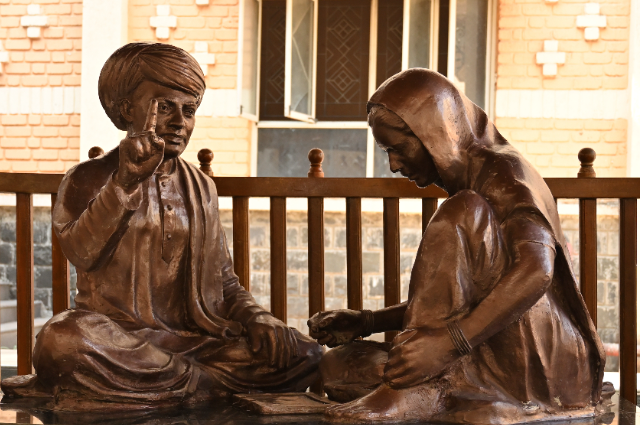
The answer to this question can be found in the timeless thoughts of Savitribai Phule, India’s first woman teacher and a great social reformer.
Savitribai Phule believed that education is the most powerful tool for social transformation. One of her most well-known thoughts states, “Without education, a human being is no better than an animal.” This statement remains deeply relevant even in the digital age. Today, although information is easily available, true education still requires critical thinking, moral values, and social responsibility.
Education Beyond Technology
The digital age has made learning more accessible than ever before. A student sitting in a remote village can attend online lectures, access e-books, and participate in virtual discussions. However, Savitribai Phule’s vision of education went far beyond literacy or technical skills. For her, education meant self-respect, awareness, and the courage to question injustice.
A well-known proverb says, “Education is not the filling of a pot, but the lighting of a lamp.” Savitribai Phule lit this lamp at a time when educating girls and marginalised communities was considered unacceptable. Today, digital tools may fill minds with information, but Savitribai’s thoughts remind us that education must also light the lamp of wisdom and compassion.
Savitribai Phule and Gender Equality in the Digital Era
One of Savitribai Phule’s greatest contributions was her fight for girls’ education. In today’s digital world, girls are learning coding, data science, and artificial intelligence. Many young women are excelling in science, technology, engineering, and mathematics. This progress reflects the realisation of Savitribai Phule’s dream.
Yet, challenges remain. Digital inequality, lack of access to devices, and social barriers still prevent many girls from continuing their education. Here, the proverb “Where there is a will, there is a way” becomes meaningful. Savitribai Phule showed extraordinary willpower by continuing her mission despite insults and threats. Her life teaches us that technology alone cannot bring equality; determined efforts and progressive thinking are equally important.
Knowledge with Humanity
The digital age has also introduced new challenges. Social media spreads knowledge rapidly, but it also spreads misinformation, hatred, and discrimination. In such a scenario, Savitribai Phule’s emphasis on humanity becomes highly relevant.
An old saying goes, “Knowledge without values is dangerous.” Savitribai Phule believed that education should make individuals humane, rational, and socially responsible. She taught not only reading and writing but also empathy and respect for others. In today’s times, when online interactions often lack sensitivity, her thoughts guide us to use technology ethically and responsibly.
Reaching the Last Person
Savitribai Phule strongly believed in inclusive education. She worked for those who were denied learning opportunities because of caste, gender, or poverty. In the digital age, technology has the potential to reach the last person in society—but only if it is used with the right intention.
The proverb “The one who lights a lamp does not fear darkness” perfectly reflects Savitribai Phule’s life. She lit the lamp of education in the darkest social conditions. Today, digital platforms can become that lamp for millions, provided we ensure accessibility, affordability, and inclusiveness.
If Savitribai Phule Were Alive Today
If Savitribai Phule were alive in the digital age, she would certainly embrace technology—not as an end, but as a means. She would use online platforms to educate girls, raise awareness against social evils, and promote critical thinking. She would remind students that learning is not only for personal success but also for social upliftment.
Another thoughtful saying goes, “True education teaches us not what to think, but how to think.” This aligns perfectly with Savitribai Phule’s philosophy. In an era dominated by algorithms and automated information, her thoughts encourage independent thinking and moral judgment.
Our Responsibility in the Digital Age
Remembering Savitribai Phule through speeches, articles, and celebrations is important, but it is not enough. The real tribute lies in practising her thoughts in everyday life. As learners, teachers, and responsible citizens, we must ensure that technology is used to promote equality, not deepen divisions.
A meaningful proverb states, “Change your thoughts, and you change your world.” By adopting Savitribai Phule’s thoughts—equality, dignity, and education for all—we can shape a more just and inclusive digital society.
The digital age may be defined by rapid technological advancement, but its true success depends on the values that guide it. Savitribai Phule’s thoughts act as a moral compass in this fast-changing world. Her belief in education as a tool for liberation, equality, and humanity remains timeless.
As we move forward with technology, let us not forget her powerful message:
“Rise, learn, and struggle.”
These words remind us that progress is meaningful only when it uplifts everyone.
In conclusion, while technology shapes the future, Savitribai Phule’s thoughts give that future a direction—one rooted in justice, compassion, and true education.