
When I was in tenth grade, I was part of a student exchange programme. Five of us from India were chosen to travel to the Czech Republic and stay with host families, soaking in as many cultural differences and unfamiliarities as our developing minds could hold. Our preparations began months in advance. We attended daily meetings that kept us back after school, where we were briefed on everything we needed to know about travelling abroad and, more importantly, how to behave in a way that would be palatable. The notorious lack of Indian civic sense, we were told, must not be represented by us. We were expected to be polite, restrained, and exemplary, like good students from a semi-Catholic school.
Two weeks before departure, we were handed a list, simply called “The List.” It catalogued things about us we did not even realise needed correcting. We were not supposed to keep our hair loose. It had to be tied at all times to prevent hair fall, something we were told Indians were especially susceptible to. We were not allowed to wear anything shorter than two inches above the knee because, even though we were travelling to a European country, we were still expected to represent “good-charactered” Indians. Most importantly, we were forbidden from any public display of affection, especially with someone from our host school, because our teacher-in-charge detested it.
We were a bunch of overly excited kids, beaming at that splendid opportunity. How many other schools even allowed their students to travel abroad? How many offered them an experience that was still very much an Indian dream? So we chose to ignore the small inconsistencies and complied with whatever our teacher-in-charge told us, crossing the days off the calendar in anticipation.
When the day finally arrived, we boarded the flight in sensible shoes, dressed in careful layers, mentally rehearsing everything we were supposed to do and everything we were not supposed to do. After the long journey, the first thing I noticed on arrival was the quality of the air. It felt lighter, cleaner, almost startlingly pure, as if it could easily beat Delhi’s AQI in a fistfight. The boys, however, noticed something else first. Across the road stood a billboard advertisement of a woman, very obviously topless and entirely unbothered by it. Our teacher-in-charge shot them a single look to stop their giggling and force their eyes away. She already seemed to regret the decision to bring us abroad.
“The Czechs are particularly aware of their history and are very cultured. The war museums and burial grounds are still regularly visited by their families. I expect you to maintain decorum and remain respectful at all times. Once we are inside, there is no need to be loud.”
She delivered the speech the way she always did, slow and deliberate, as if we were moments away from embarrassing the nation. It made us wonder, quietly, whether we would have behaved any differently without the warning. Wouldn’t we have done the same anyway? After all, we were from good, respectable families. We knew how to behave. Or at least we thought we did. Yet every reminder suggested that civility was something we had to be coached into, rehearsed like lines before a play.
The cab ride from the airport felt longer than it probably was. Outside the window, the city passed by in neat rows of buildings and unfamiliar street signs, everything muted and orderly. Inside, we nodded through the lecture for what felt like the hundredth time, our excitement slowly dissolving into a dull tiredness. Our stomachs growled. We were jet-lagged and hungry, but still we sat up straight, careful not to laugh too loudly, careful not to take up too much space.
On the fifth day of the trip, I met her, my blonde host sister who, despite being the same age as me, seemed far more mature. Her house rested on top of a hill in a small town called Ostravice, surrounded by wide green meadows that looked almost unreal after the concrete I was used to.
That evening arrived like a wave of calm. We had dinner in her backyard, a slow, unhurried meal that stretched for nearly three hours. Conversation drifted easily. We discovered a shared love for Friends and roasted chicken. Her family took turns saying my name, rolling it carefully over their tongues and exclaiming how exotic it sounded. “Well, do you play?” she asked after dinner, leading me to the study. A grand piano took up most of the green-walled room, its corners crowded with books. We pressed random keys, sang a few songs off-tune, and dissolved into giggles. Everything felt gentle and unguarded. For the first time since we had arrived, the tiredness of travel loosened its grip, and the days stopped rushing past.
That night, I lay in bed, staring out the window, surprised at how clearly I could see the stars. Back home, the sky was usually a dull grey, swallowed by smog. Here, it felt endless. Still, instead of feeling peaceful, I found myself dreading what was to come next.
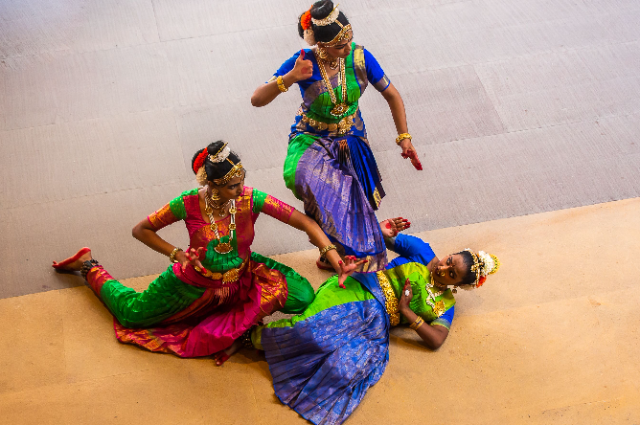
Our school had made us prepare a special dance to perform in front of the host school. It was tradition, something that had been done ever since these exchange trips began, a matter of great prestige and proof of our ability to represent our “colourful culture.”
Usually, stage fright would have been my only worry. This time, I couldn’t stop thinking about what the other students might perform. What if they were better, more polished, more graceful? I was particularly intimidated by the French, who I imagined would be effortlessly elegant. And what if one of the Russian students turned out to be a trained ballerina? That would surely make our carefully practised routine look amateur. Lying there in the unfamiliar quiet, I realised that even before meeting them, I had already decided we were the ones who had something to prove.
We were gathered at the huge gymnasium at nine sharp in the morning, lined up in our costumes and stiff with anticipation. The polished wooden floor smelled faintly of varnish and old sweat, the kind that lingers in school sports halls everywhere. We stood in neat rows, whispering last-minute reminders to each other, mentally rehearsing counts and steps, waiting for the performances to begin. I expected an order to be announced, music to be queued, each country presenting itself one by one like exhibits in a cultural fair.
But the Czech students did something we hadn’t prepared for. Instead of performing for us, they invited us to join them. Someone dragged a speaker to the centre, and a bright, lilting folk tune filled the hall. “Kalamajka,” they said, smiling, already reaching for our hands before we could refuse. It wasn’t a stage performance at all but a couple dance. We paired off awkwardly at first, boys and girls, strangers and friends, forming a loose circle. The steps were simple but quick, a pattern of stepping forward and back, spinning, switching partners, then spinning again. Skirts flared, shoes scraped against the floor, and every few beats you were laughing because you had lost the rhythm or bumped into someone new.
In between all this fun, I kept trying not to forget the carefully rehearsed speech I had to give before our performance. While everyone else was spinning and laughing and switching partners, I was quietly mouthing sentences to myself, afraid a single word might slip away. When my turn finally came, I walked to the centre of the hall and stood there meticulously, one hand folded over the other, back straight, with no notes to rely on. I had practised this posture as much as the speech itself.
“Today we are going to perform a dance routine based on the famous Indian actor Govinda,” I began, my voice echoing slightly in the large gymnasium.
Govinda, to us, had always belonged to Sunday afternoons and loud living rooms. He was colour and chaos and unapologetic joy. His dances were never delicate or restrained. They were exaggerated, rubber-limbed, full of comic expressions and improbable pelvic thrusts, the kind of steps that looked as though your body had briefly forgotten how bones worked. He wore neon shirts, clashing prints, sunglasses indoors, and somehow made awkwardness look like confidence.
But standing there in that bright, foreign gymnasium, those same steps suddenly felt ridiculous on us. There were only two girls in our group, and trying to recreate his loose, swaggering movements felt unnatural in our carefully pinned hair and modest costumes. The boys, tasked with the more theatrical bits, kept biting back smiles, their shoulders shaking as they tried not to laugh mid-step. The whole routine felt louder and clumsier than it ever had back home. I could feel my face burn as we performed, painfully aware of how we must look, how desperately we were trying to package something messy and joyful into something presentable. And, surprisingly, no other country performed after this.
It has been seven years since that trip, and yet my memories of that dance remain strangely vivid. The gymnasium, the music, the heat rising to my face as we tried to sell Govinda to a room full of strangers. As I grow older, I begin to notice the same pattern everywhere, this quiet, rehearsed urge to impress. Little children on the street still gawk at foreign tourists, waving too eagerly, trying out broken English like it is a party trick, hoping for a smile or a photograph in return.
I see it in other places too. Shopkeepers suddenly raising their prices and their accents at the sight of white customers, stretching their vowels into an exaggerated “hello ma’am, hello sir.” Restaurant menus swapping out local names for “continental” ones. We straighten our posture, soften our slang, laugh a little too quickly at jokes we don’t fully understand. We become overly polite, overly grateful, overly careful, as though the world is always watching and judging.
We come from a culture that is vast and layered, colourful enough to overwhelm the senses, old enough to fill libraries the size of cities. What unsettles me now is how often we wait for someone else to approve of it first. We begin to value our food when it appears on foreign menus, our clothes when they walk international runways, our festivals when they are photographed by tourists. Only after that validation do we claim them proudly. And even then, what we offer is a softened version, trimmed and subtitled, a version made easy to consume. Something palatable.