
"Gadi aa gayi hai. Sab saman taiyar hai." Prem told his elder brother, who was fixing his right locks of hair with oil, to set it in place while looking calmly in the mirror.
"It was the early winter season of 1935, my grandfather, Uma, was all set to take my grandmother home. In early India, irrespective of its urban classification, "Gowna" was quite popular in northern states. It was a tradition where a girl after marriage rituals was supposed to live with her birth parents for a while. And on one auspicious day, the groom would return with a doli (palanquin) to ceremoniously take his bride to his family home.
There was an utmost commotion at my grandfather's house. The unexpected cats and dogs rain further heightened the commotion as everyone hurried to pack, load, lock the house, inform the neighbours, arrange the bullock cart, and shield the beautifully adorned doli from the relentless rain. And all this was to bring my grandma "Home".
Amidst the rain and the hubbub, the fourth sibling of my grandfather, Pushpak screamed in fear and agony, "Bhaiya, Mai... Mai behosh ho gayi hai." My grandfather, who was loading a few shagun on a bullock cart, rushed towards his brother’s terrified cry. "Kya hua?" "Mai, bhaiya", Pushpak replied in a trembling voice.
My grandfather's mother was lying down on the mud floor outside the kitchen. She was surrounded by all her 7 children - from my grandfather of 27 years to her youngest daughter of 3 years. She was no more, her heart was probably full of happiness from her first child's marriage.My grandfather who was eagerly waiting to see her bride was left bereft of all joy, consumed completely by the grief.
"Bhaiya, bhauji ek saal tak ghar nhi aa sakti." His third sibling said in a calm, sordid tone. My grandfather was left with no words, he simply stood speechless. His going-to-be colorful life suddenly turned black and white.
"Sab keh rhe hain dulha bahut hi sundar hai. Gore rang, kad lamba aur ujle kurte mein char chand..." one of my grandma's distant cousins paused before completing the praise for the groom. That day my grandma was very anxious, yet very excited and curious to meet her life partner. She blushed a bit while her younger sisters were putting henna on her hands, grinded from the fresh leaves. Other sisters prepared alta from paan (betel) leaves and were gently putting the red alta on her legs.
"Didi, aapko neeche bulaya hai, taar aaya hai ki aapki saans nhi rhi." "Gowna rokne ki baat chal rhi hai." My grandmother was only seventeen, yet mature enough to understand that, according to tradition, she would not see her husband again for another year. The irony was heartbreaking - she had seen him only once, for barely a fleeting moment, through a tiny, worn mirror during one of the wedding rituals.She remained speechless. Though no one can truly know what she felt in that moment, I can only imagine the weight of her sorrow. A young bride, bound by tradition, she must have been utterly devastated.
Both the houses witnessed utmost grief and sorrow. Just days earlier, the houses echoed with laughter and celebration, adoring every corner with the vibrant colors of joy and happiness. Now, an overwhelming silence had replaced the festivities, and the brightness of those cherished moments had faded into mourning.
Those days, letters and postcards were quite common. And my grandparents - they ventured into letter writing to know each other’s whereabouts.Almost a year passed exchanging letters. In fact, it was more than words that travelled between them.It was their hopes, their longing, and the quiet affection that blossomed with every letter.
The day finally arrived when Uma went to take my grandma - Sreelata.
And from there on, with every turn of the seasons, they found new reasons to rejoice. They had 3 beautiful children to raise and adore. Though, my mother was yet to arrive.
It was the year 1943. My grandfather also joined the new era of the printing press in Kolkata alongside his distant uncle. This was the time when journalism was shaping differently in India and nationalism was on rise. He had to leave Sreelata in the village with their three children. But they both learned at a very young age that practicality is seldom kind. To keep a family safe - one had to be bound with guilt - the guilt of the sacrifices that neither had truly chosen. The silent sacrifices that the love demanded but memory refused to forgive.
And again, the season of exchanging letters had arrived in their lives. At an age when life still promised beginnings, Sreelata was already raising three children alone, her youth quietly giving way to responsibility.
Every Dussehra there used to be a huge fair and circus at the village. It was said by my grandma that if children were not found in their houses, it was implied that they would have gone to see the fair.
Nothing had prepared Sreelata for that night. Her second son, just six years old, had set out for the village fair like any other child and never found his way back home. The huge typhoon that shook not only the fair but the whole village didn't show mercy for Sreelata and her kid.
She rushed along with her elder son to the torn pieces of fairground. Wrapped in a drenched saree, with her sindoor all wiped out, yet tears were clearly visible in her eyes. Perhaps the rain understood that a mother’s tears carried a weight greater than its fiercest downpour.
My grandma relentlessly searched for her second son, Prahlad. She wandered through the fairgrounds, calling his name, stopping strangers, peering into every corner where a frightened six-year old might have hidden. Every face she met was unfamiliar; every answer deepened her despair.As hope slowly gave way to dread, she broke down, hollowed by fear, her voice dissolving into silence. Barely able to stand, she had to be led home by Prem and her elder son. The rain was again merciless.
Two days went by. Sreelata holded herself probably for her living sons, among whom the youngest was mere 2 years old. "Bhauji, woh Prahlad...aapko aana hoga", Prem who was guarding the family in absence of Uma found Prahlad(the second son) on the banks of the river. He was clad in white dhoti and plain kurta.
It was one of the darkest chapters of her life, a season of grief beyond words. A mother had lost her child, a child who didn't even get a chance to witness independence.
Some say, including my mother, that my grandma was deranged by sorrow, others say she went into a coma for a while. Needless to mention, healthcare was a novice during that era.
Uma was informed by her siblings through a telegram called "taar" that his second son, Prahlad couldn't survive. My grandfather left everything and settled back in the village with his family.
It was the toughest phase my grandparents were going through.
The seasons passed, carrying sorrow into memory, and in May 1950, my mother finally arrived. My grandma loved telling me that the birth of their first daughter filled my grandfather with unrestrained joy that he danced to Bollywood tunes. She grew up in a little home which hardly had food for 3 times. India was going through a major shift post-independence and Uma, my grandfather, was trying hard to find a job. Most of the days went by with empty stomachs by the family, yet they were thankful for the roof over their head. Somehow, my grandfather got a job as an Account Manager at the district King's palace. Those were the golden days my mother and grandma often remember while telling their stories; when hardship briefly loosened its grip, and hope quietly found its way back into their lives.
Life moved on and grandma, grandpa shifted to a city in Purvanchal region for a better life along with their two sons. My mother was married and settled in the western part of India. It was 1978.
My grandfather was not keeping well for some time. He was diagnosed with high blood pressure, and before long, he suffered a heart attack twice. The doctors warned that another could strike at any moment.My grandmother did everything she could to keep him well. Every day, she lovingly prepared a soup of beetroot and spinach, convinced that each bowl might add another day to his life. My grandfather, however, detested it. The moment she turned away, the soup would find its way over the garden fence, where grateful birds feasted on it instead.Whether she knew or merely chose not to, she never stopped. The next day, another pot of soup would simmer on the stove, and she would watch over him with the quiet vigilance of a woman determined to bargain with fate.
And then the night of January 18, 1982 arrived when Sreelata lost her Uma. My grandfather had a heart attack, which was the 3rd in 7 years. She cried her heart out, but at the same time she was grateful to be part of Uma's life. A life that they shared together, cherished together, cried together - holding each other's hands.
After my grandfather’s demise, I saw my grandma taking a stand for the family and taking charge of the stitching business. As a child, I witnessed a shift of a naive, innocent woman to a bold, independent woman taking care of the family and yes, of course, the stitching orders.
But life... no matter how hard we try, we cannot anticipate. It took a turn and put Sreelata again in the giant typhoon where she received a phone call. It was from her third son, Lakshman who was on a stretcher going inside the operation theatre, afraid and scared as it was 4th stage cancer which had never been diagnosed before. It was only a few years since he shifted to another city after getting a job as a teacher.
That was probably the last time I saw my grandma speaking. She even stopped eating and started hallucinating. She knew that she lost her Prahlad again. In her lifetime, she had to bear the loss of her two kids. She was filled with the guilt again that if Lakshman was with her, probably he would have been diagnosed earlier. Why did she let him go? For the first time, I saw my grandma was battling to evade the memory as if she wanted the memory of losing her kids to fade away.
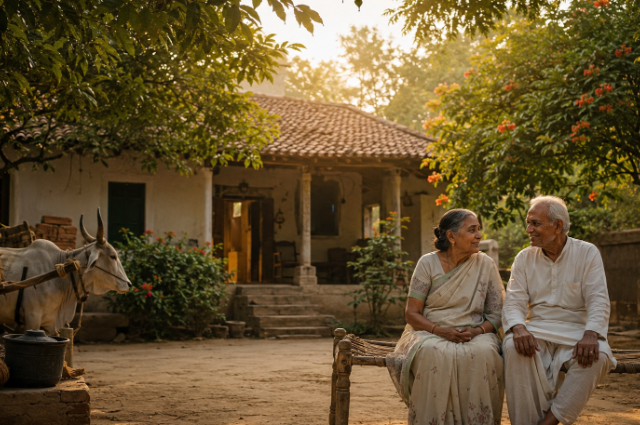
And it was 1991, amidst the extreme heat of the April month where sun was on the rise, we all saw her closing her eyes forever. The year 1991 was the longest year of my life. We all knew that in another world those eyes would be seeing her two beautiful kids along-with her Uma living in the same small house surrounded by trees and gardens, blossoming roses, Gulmohar trees.
The year 1991 was the longest year of my life.
My grandmother’s stories taught me that life does not pause for grief, no matter how unbearable it may seem. We carry our losses with us, just as we carry our guilt, learning not merely to survive but, somehow, to live with grace.
Perhaps love is the boat that carries us across the deepest waters. It was my grandfather’s love that gave Sreelata the strength to rise each morning after losing her son. It was that same love that filled her days with memories so tender they outlived his presence. And when he was gone, those memories did not haunt her; they became the place she returned to for solace.
Perhaps that is the greatest gift love can leave behind - not the absence of sorrow, but the courage to revisit it without fear. That is how my grandmother lived - not a life untouched by loss, but a life lived fully, with quiet resilience and an open heart.
As we journey through life, so much slips away. Time softens faces, blurs voices, and quietly steals even our most cherished memories. Before that happened to me, I wanted to preserve Sreelata’s story. I am her granddaughter, and these pages are my way of keeping her alive - not only in memory, but in the hearts of those who meet her through this book.