
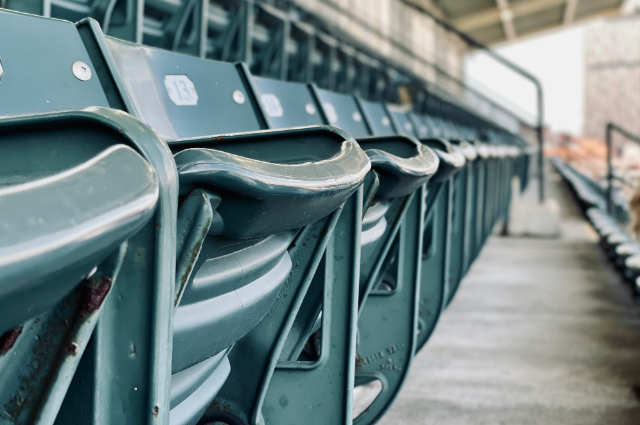
There are eleven empty seats in a stadium that will never really be empty, yet must appear that way so something else – something more difficult – can remain untouched.
Around them, the crowd gathers as it always has. Voices rise, then merge, dissolving into a single, continuous sound that feels less like expression and more like atmosphere – a low, steady hum that seems to settle in the chest. The game proceeds. The scoreboard updates. The floodlights hold everything in place with indifferent clarity.
At first, the camera keeps returning to them, more often than necessary. The frame insists. Commentary follows, repeating the gesture, adjusting its tone, and leaning without fully committing.
But tournaments have their own momentum. The camera moves on. The mentions fade. What was once made visible becomes easier not to see.
Nothing is interrupted.
Except those eleven spaces.
They are not absent in the ordinary sense. They are arranged absences: held, preserved, and made visible in a way absence rarely is unless it is needed.
They mark absence the way numbers do – precise, countable, and distant enough not to overwhelm.
At M. Chinnaswamy Stadium, a place that runs on crowding, on bodies pressed into proximity where you stop noticing where you end, the decision to carve out emptiness does not go unnoticed. It can't. It unsettles something the space usually takes for granted.
But the interruption is controlled.
Measured.
Almost aesthetic.
In June 2025, outside the stadium, density lost its discipline.
Eleven died.
That is the simplest way to say it, also the most insufficient. Because density is no accident. It is produced, invited, encouraged, and then managed until it is not.
What should have dispersed into memory as celebration collapsed into something else: compression, panic, and the failure of flow – a pressure that builds faster than it can be understood. A crowd gathered to witness victory became, briefly and irreversibly, a site of loss.
Eleven people died. Dozens were injured.
For a few days, the language of accountability surfaced, as it always does. There were questions about planning, crowd control and who knew what and when. Then assurances followed: that it would be examined, responsibility located somewhere, and things corrected.
On screens, it felt different. Less like process, more like momentum. Names appeared, disappeared, and returned altered. Officials were mentioned, then replaced. Authority kept shifting: sometimes in uniform, sometimes in influence, sometimes just out of reach.
The focus didn't stay in one place for long. It drifted from the incident site to grieving parents, from grief to outrage, then back to noise without drama.
Panels filled up. Voices rose, crossed, and began to overrun each other: sharp, overlapping, leaving no room for anything to land. A claim would start to take shape and fall apart before it could fully arrive. At some point, it became difficult to tell what was being held onto versus what was just being said.
Some voices grew louder than the rest. Urgent. Insistent. Certain.
And you begin to wonder: whose loss is this, really?
The grieving families are somewhere else, mostly unseen. Here in the frame, people who know almost nothing. A mispronounced name. A guessed age. A photograph pulled from somewhere, passed around until it begins to stand in for a life.
The rest is filled in.
The questions drift too. The crowd is blamed. Then management. The victims appear, are briefly held, and then are edged out again – as if the conversation has already started flowing somewhere else.
What remains constant is not clarity.
Just drift.
Gradually, the intensity thins.
Not vanished. Not denied.
Just harder to locate.
The number eleven is stuck somewhere in my mind, like a half-remembered dream, sharper than the faces I never saw. It carried weight without detail, which made it easier to hold: like a jersey number, remembered for the game, not the person.
We remember in counts because counts are easier to carry than names and easier to repeat without consequence.
Did I read their names that night?
Did I pause long enough for them to feel real?
Or did I encounter the number first and only later imagine the lives it stood in for? I cannot say with certainty.
Memory, when it comes to such things, has a way of rearranging itself into something more bearable.
That night, the sound of celebration still carried. Even from a distance, even through walls, it arrived: muted but insistent, slipping through in fragments, never fully leaving. A kind of echo that did not yet know what it was echoing.
Joy and rupture, for a moment, shared the same frequency.
Somewhere else, the shift had already begun. Campaigns built around victory had to be reworked overnight. The tone adjusted. What had been certain a few hours earlier no longer held in quite the same way.
Even the slogan (so easy in its repetition) seemed to falter, as if it didn't quite know where to sit anymore.
It is difficult to locate the exact point at which one became the other.
A year later, Royal Challengers Bengaluru leaves eleven seats empty.
It is called a tribute.
And perhaps it is.
But what unsettles is not the gesture itself. It is how easily it holds. How quickly something uncontainable finds a form that can be looked at and understood.
Grief, here, has edges.
It can be seen. Counted. Pointed to.
It doesn't spill.
Or if it does, it is gathered back before going too far.
We live in a moment where grief has to show itself. It has to take shape so it can move between people, so it can be recognised. A black armband, a minute of silence, an empty seat – these are how loss becomes visible.
And what becomes visible also becomes containable.
This is where something shifts.
Because once grief takes form, it begins to feel complete. Not resolved, but adequate.
The eleven empty seats hold something in place.
Everything else is past them, the noise folding back in until the gap feels smaller than it is. People remember.
But nothing necessarily follows.
No demand. No insistence. No answer.
Their names are held there, fixed to a small, marked space. A place in the stadium that they did not have that day is now given back to them.
As if that is sufficient.
As if that space can stand in for what was lost.
As if being seen, finally, can replace what was never answered.
The questions didn't end when the crowd dispersed. They didn't end when headlines moved on, enquiries were announced, or responsibility was (at least on paper) assigned.
After that, things begin to take a familiar shape: reports, suspensions, procedural changes. It starts to feel like something is being done.
But feeling is not the same as anything actually changing.
From a distance, it becomes difficult to trace what changed in proportion to what was lost. Whether the systems that failed were restructured or merely adjusted. Whether accountability took root anywhere at all, or simply dispersed into something harder to point to.
These are not questions the empty seats ask.
They remain where placed: quiet, visible, and complete in their symbolism. Maybe that's what they're for.
Because symbols do something, processes don't quite manage. They give things a shape. Something you can look at and say, 'This has been acknowledged.'
Not completely. But sufficient to feel like it has.
They draw a kind of boundary around it.
The eleven empty seats sit inside that.
Inside them: loss, memory, something like respect.
Outside them, everything else keeps going.
The game resumes. The crowd returns. The noise comes back, slowly filling the space that (for a while) felt different: layer by layer until it feels uninterrupted again.
It doesn't feel like indifference.
If anything, it feels familiar.
Things just keep going.
And continuation has its own way of working. It makes space for what has happened, but not in a way that lets it linger too long. It rearranges things. Let them settle somewhere else.
I didn't follow the inquiry.
That feels like a small thing to admit. But it isn't.
I remember the interruption: the article, the number, the vague unease that lingered longer than it should have. But I do not remember what came after with the same clarity. I do not know who was held accountable, or whether accountability (in any meaningful sense) was ever reached.
What I remember instead is how easily attention shifted.
Not abruptly or consciously.
Just enough.
Enough for the incident to drift from something immediate to something known, then quietly to something more distant.
It's easier, I think, to stay with grief at the moment it appears than to follow it once it starts to spread into everything else. To feel it briefly. To recognise it. Then, without quite deciding to, move on.
Maybe that's where the unease begins.
Because these gestures meet us exactly there: at the point where recognition is still possible. They don't ask for much beyond that.
Just that we see.
That we register it.
Not that we stay.
In a world where being seen matters, remembrance has to show itself. It has to take a form others can recognise.
It isn't enough to feel it privately. It has to appear to be noticed and to be confirmed.
And institutions, especially, don't do this quietly. What they show has to be visible to everyone – something that can be pointed to and agreed upon.
This year, even the beginning was altered. The usual spectacle (music, lights, and ceremony) was set aside. The Board of Control for Cricket in India chose silence instead, cancelling the opening ceremony as a mark of respect for those who died.
For a moment, it seems like something has shifted more deeply this time.
And yet the structure holds.
The matches proceed. The crowds return. The noise, briefly deferred, gathers itself again. Silence here does not interrupt the system. It slips back into it. It prepares it. It does not make the grief insincere.
But it does mean the grief now has a place. It can be seen.
And once seen, it begins to feel sufficient.
Not resolved. Just sufficient to move past.
And that's where it shifts.
Permission doesn't arrive all at once. It takes root quietly. What looks like remembrance begins to do the work of letting things continue.
The matches go on. The empty seats stay where they are: inside the frame now, part of it. Not interrupting anything. If anything, helping it hold like a pause that no longer quite pauses anything.
Even absence has its place. Its timing.
It fits.
And that's harder to sit with than indifference.
What if the seats aren't empty in the way we keep saying they are?
What if they're holding something else:
Not the dead, but everything we don't stay with us for long?
A measure of attention.
Given, then taken back.
This isn't an accusation.
I've done it too.
I didn't stay with it. Didn't follow the questions once they stopped being immediate. I let the symbol take over what was still unresolved.
Because it's easier that way.
Once you've seen it, it feels like you've done your part.
It doesn't ask anything more from you.
And maybe that's the unsettling part.
Not that these symbols exist.
But how easily we step into them.
How quickly they become sufficient.
The seats remain empty.
The stadium doesn't.
Everything continues.
Responsibility doesn't disappear. It just disperses. Thins into something harder to point to. A sense that something must have been done, somewhere, by someone.
And that's usually where it ends.
Things settle.
Eleven spaces left open.
Thousands filled.
From a distance, it almost looks right: the kind of balance that only holds if you don't step too close.
But only if you don't stay with it too long.
Because if you do, something else begins to show.
That the emptiness isn't really there in those seats.
It's elsewhere.
In how easily we return.
In how quickly we forget we ever paused.
In that quiet agreement, that marking something is sufficient, that it doesn't have to be followed any further.
Maybe the seats aren't there to remember the dead.
Maybe they're there to hold the memory still.
To keep it from drifting.
From asking for more.
The seats remain empty.
The stadium remains full.
Eleven is small enough to carry.
And still easy enough to let pass through.
And somewhere in all of this, something has already been given up: not all at once, not even clearly, but slowly – just by allowing remembrance to stand in for responsibility.
Eleven spaces, yes.
But how many more quietly let go?
And when did that begin to feel like sufficient?