
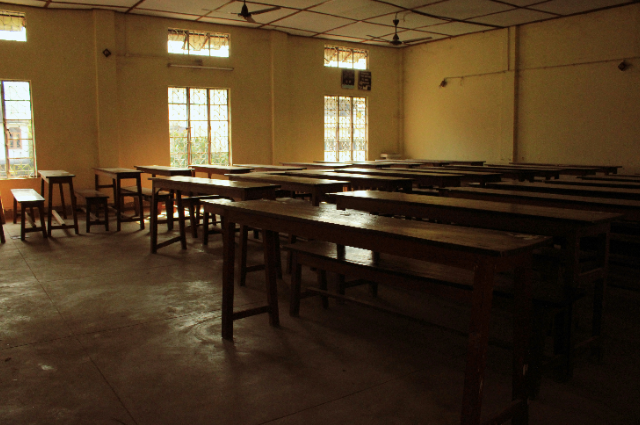
On a humid August morning in 2025, students at a government high school in Bagalkot, Karnataka, walked out of their campus and marched to the Navanagar Police Station. Their uniforms were sun-bleached, backpacks hung loosely, and voices, though young, carried urgency that came not from routine protest but from exhaustion. These teenagers were not demanding extra classes or exam delays. They were demanding dignity.
They accused their principal, Geeta Kapase, of caste-based taunt lines like “I’ll make you carry slippers on your head” and of verbal abuse that cut deeper than words. They spoke of water tanks crawling with insects, toilets without water, and classrooms so dark that switching on a fan earned threats to slash marks. Local Dalit organizations joined the students, amplifying their call for accountability. As India Today reported, Bhoomika Venkatesh Dodmani told reporters, “The water has insects… we study in mosquito-filled dark rooms while teachers scold us for existing.”
The image lingered, heavy and uncomfortable. Teenagers fighting not for grades, but for the right to learn without humiliation in the very place that should shelter every child equally. It forced me to ask a question I had long sidestepped: what invisible protections had made my own schooling feel safe? And, more broadly, what does privilege look like when it’s not about money?
A Country That Still Teaches Unequal Lessons
Caste-based discrimination in Indian schools is neither a relic nor isolated. It remains persistent and documented.
The 2021–22 UDISE+ report notes that schools in over ten states continue to record complaints of caste-based discrimination, especially in rural government schools. An NCERT-supported study found Dalit children reporting segregation during mid-day meals, mockery based on surnames or neighborhoods, and unequal access to water. A 2023 UNICEF brief highlighted that children from marginalized castes face more than double the risk of dropping out by Class 10 compared to their peers. ASER’s annual surveys consistently show that first-generation learners from Dalit, Adivasi, and migrant communities struggle not from lack of ability, but because the system treats them as outsiders from the start.
The Bagalkot protest was part of a larger fire. Similar incidents echo across India: In Velur, Tamil Nadu, Dalit students were forced to sit separately at the back of classrooms; in Sanchore, Rajasthan, a 9-year-old Dalit boy died after being beaten by a teacher for drinking water from a pot “not meant for him”; in Barmer, Rajasthan, a viral video showed upper-caste students on benches while Dalit children sat on the floor—a “tradition” of segregation justified as routine.
These stories are more than news; they are mirrors, reflecting the invisible ladders I had walked on without noticing.
I Grew Up Thinking I Wasn’t Privileged
If you had asked me as a child whether I was privileged, I would have laughed.
I grew up in ordinary, budget-conscious 1990s India. We reused plastic jars and school notebooks, folded polythene bags carefully, and guarded ketchup sachets as if they were precious. A train journey felt like a festival. A taxi ride felt like a luxury. A flight was something.
You pointed at the sky, not something you boarded. Everything we bought was debated and weighed.
In my mind, privilege belonged to people who travelled abroad, who owned imported stationery, and who spoke flawless English. Our world was stitched from discounts, hand-me-downs, and middle-class anxieties.
So I drew a simple line in my head: no wealth = no privilege.
That belief stayed unchallenged until a small incident changed everything.
A Girl, a Notebook, and a Question That Shook Me
It happened outside a stationery shop, on a day I barely remember otherwise. I was buying a pen refill.
A girl, maybe sixteen, stood at the counter. Her shoulders hunched slightly, as if trying not to occupy space. She was arguing softly with the shopkeeper, but it sounded more like an apology. She wanted a cheap brown-paper notebook.
The shopkeeper asked, “Ruled chahiye ya plain?” Ruled or plain?
She froze.
Not from indecision, but unrecognition. The words themselves were unfamiliar. He repeated the question, slower. She hesitated, fingers tightening around the counter edge. Finally, she said:
“Aap batao… kaunsa school mein chalta hai?”
You tell me… which one is used in school?
There was no embarrassment, only a practical question. She didn’t know. She hadn’t used one before. Not just because of poverty—though her worn-out slippers and carefully counted coins suggested that—but because she had never been to school at all.
I froze. My body stayed, but inside, something jolted, like a train suddenly switching tracks. Street noises faded: the horns, the vendors, the scooters. All I could hear was the echo of her question: Which one is used in school?
For the shopkeeper, it was routine. For her, it was new territory. For me, it was a quiet earthquake. Privilege stopped being an abstract concept and became a mirror pressed against my face.
Privilege Is Often Silent
I walked home carrying a strange heaviness. The plastic bag in my hand felt disproportionately light, almost mocking. I tried to recall my first notebook—the smell, the thrill, the moment of opening crisp pages. Nothing came.
There had been no milestone. No hesitation. No debate. Nobody explained to me why a notebook mattered. It wasn’t earned. It was simply given.
And in that realization, I understood: my privilege was not wealth—it was familiarity, exposure, ease.
I grew up in a home where:
- Parents discussed news, assuming I would absorb its importance.
- Teachers assumed I would understand, or someone at home would help. 4
- Classrooms and learning spaces were never questioned; I always belonged.
- Books were everywhere—on tables, under pillows, stacked near the TV.
- Education was expected, not aspirational.
This was a privilege. Quiet, invisible, and foundational. The notebook girl—and the students in Bagalkot did not have that.
Bagalkot: More Than a News Article
When I read about Bagalkot, I immediately thought of that girl in the shop. Her hesitation over a notebook mirrored the students’ experience of exclusion:
- Spoken to differently because of caste
- Routine humiliation
- Unequal access to facilities
- Feeling that classrooms were not fully theirs
These are not isolated incidents. They are signals: the promise of equal education enshrined in law is still fractured in practice. The students in Bagalkot had courage: courage to protest while cramming for board exams, courage to demand equality in a system designed to resist it. Their story cracked open my neatly held belief that my schooling had been “ordinary.”
The Invisible Inheritance
Privilege is not just what you have; it is what you never had to worry about.
I didn’t fear mockery for holding a pencil wrong. I didn’t have to negotiate my right to learn. Questions like “What does this word mean?” were met with answers, not ridicule. The students in Bagalkot and the girl in the shop lacked this cushion.
For them, even small questions carried risk. For me, it was assumed I belonged. I had inherited ladders beneath my feet: language, encouragement, assumed belonging, familiarity with classrooms and exams. I had thought I was “ordinary,” but ordinary was itself a kind of inheritance.
Responsibility, Not Guilt
For days, I carried a stone in my pocket. Was it guilt for having what she did not? Shame for taking it for granted? Over time, the feeling crystallized: responsibility.
I began offering free tutoring to two neighborhood children. It started tentatively. Their mother asked, “Zyada time toh nahi lega na?” It won’t take too long, right?
We began with basics, not multiplication or grammar, but how to ask questions without fear, how to erase and try again without shame, how to hold a pencil comfortably, how to sit at a table and claim the space. Slowly, their backs straightened, as if the act of learning itself lengthened them.
I realized I wasn’t just giving knowledge. I was given familiarity—the quiet inheritance I had never earned: the understanding that books can be touched, notebooks replaced, classrooms belong to you.
A Quiet Shift
Since that day, and reading about Bagalkot, I stopped saying, “I don’t have privilege.” It feels dishonest. I do. Not the glamorous kind. Not billionaire or Instagram-worthy.
Mine is the privilege that shapes the inner world: the certainty of finishing school, attending college, and finding meaningful work.
The privilege of:
- Safety so my mind could wander into books, not scan for danger
- Support from parents and teachers who assumed I could learn
- Encouragement in every note, every “Well done.”
- Belonging to classrooms where my presence was never questioned
- Language making instructions legible, not intimidating
- Awareness of opportunities, exams, and scholarships
- Dreams without negotiating entry
- Freedom and the responsibility to question, sit with discomfort, and let it change me. Education Should Expand Futures, Not Shrink Some
Bagalkot shows discrimination is often quiet: a teacher’s tone, last access to water, sitting on the floor while others use benches, hesitation overruled, or plain. India celebrates literacy rates and enrollment, but numbers do not measure dignity. Bagalkot’s teenagers, marching with placards while preparing for board exams, tell us what statistics cannot: equality on paper does not guarantee lived equality.
The Moments That Last
Turning points are not always dramatic. Sometimes, they are a girl buying her first notebook, or teenagers protesting “slippers on your head” threats and frog-filled water tanks. Moments so small you could miss them until they hold up mirrors.
No instant halo. No moral upgrade. Just honesty: honest about the invisible ladders beneath your feet, honest that you started further ahead than you admitted, honest that Bagalkot’s fight for basics was your unspoken inheritance.
Final Reflection
The notebooks I buy now feel heavier, not with guilt, but awareness. Awareness that privilege is not foreign trips or branded objects, but unseen doors already open for me. While Bagalkot students still knock, and a girl still asks: “Kaunsa school mein chalta hai?” Which one is used in school?
Once you see whether in the news or a cramped shop, you cannot unsee it. You can only choose what you do next.
. . .
Sources and References: