
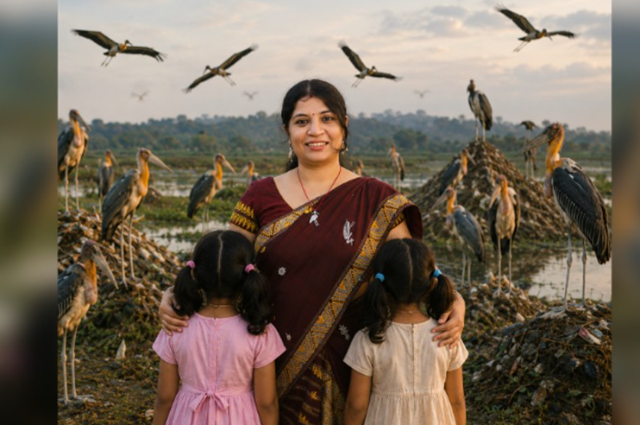
Photo taken from Northeast Today and edited through ChatGPT.
"We cannot protect what we do not love, and we cannot love what we do not know."— Stephen Jay Gould
"Taak Taak Taak
Taak Taak Taak
Taak Taak Taak
Taak Taak Taak
Taak Taak Taak Taak Taak......"
You might be wondering, what is this "taak... taak... taak"? This harsh, rattling sound belongs to that unwanted bird named Hargila(হাড়গিলা)—the Greater Adjutant Stork, a sound that everyone used to hate. What happened to those birds? Did people kill them all? Let's see..
THE BIRD NOBODY WANTS
What makes the people hate the bird so much ??
Walking through a village, I saw a bird that was almost as tall as a person and looked extremely terrible, almost like 5 feet tall. Later, I learned the name of that bird, "The Greater Adjutant Stork", which people in Assam call Hargila(হাড়গিলা)is a big bird. It stands five feet high and has a long beak that is shaped like a wedge. It also has a head and a throat pouch that hangs down. The Hargila looks pretty scary and not that beautiful.
The name Hargila (হাড়গিলা)in Assamese means "the bone swallower" because "Har"(হাড়) means bone and "Gila"(গিলা) means to swallow. This bird neither sings songs like other birds nor has pretty feathers. Instead, the Hargila eats animals, old rotten fish and bones. It even eats waste from animals. Because of this, people usually see the Hargila near animals, garbage and wetlands. This makes people think the bird is dirty and spreads disease. For a time, people in villages, especially in Assam, thought the Hargila was bad luck, had negative energy and disease carrier. They did not think it was important for the environment.
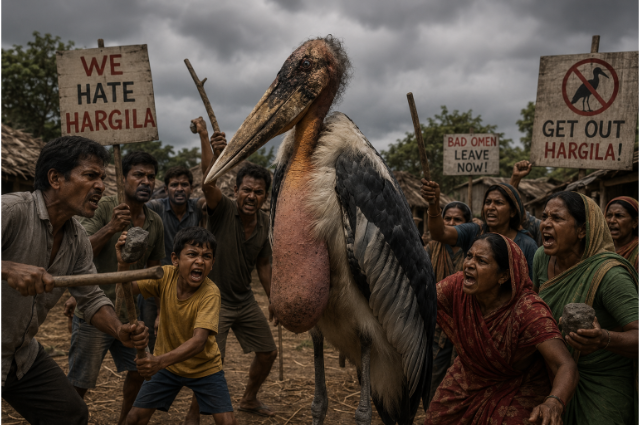
Image created through ChatGPT
People also did not like the Hargila because of how it builds its nest. When they have babies, the Hargilas build nests on big, tall trees near villages. When they feed their babies, they carry fish, snakes, dead bodies of animals and other food in their beaks. Sometimes this food falls into people's yards. The Hargilas also make a lot of noise, smell bad and poop a lot. And also, Hargilas catch the chicks and ducklings of the nearby households. This is why people do not want them around. So some people cut down the trees where the Hargilas have their nest to make them go away.
But the reality is Hargila is extremely valuable to us all. It feeds on dead animals and refuse, and thus plays a vital role in keeping all of us disease-free. It also aids in decomposition and maintenance of environmental cleanliness. The Hargila is nature’s own sanitation worker. It has been doing this job without humans even knowing the importance of cleaning the refuse. The Hargila is very efficient at its job.
Once widespread across vast regions of South and Southeast Asia, the Greater Adjutant Stork has seen its populations crash due to habitat destruction, industrialisation, wetland degradation and persecution. Now, the bird breeds naturally in only a few sites and mostly in Assam, other parts of Northeast India, and Cambodia. With the total population numbering only about 3,000 individuals, conservationists had begun to fear the extinction of the species in the near future. In a period when the bird was seen as a harbinger of bad luck and thus not wanted by anyone, few believed that it needed protection. But, in time, history would come to show that the survival of this species lay not only in the hands of the government and international agencies but that of one determined woman from Assam. She is Hargila Baideo(Stork Sister), Dr Purnima Devi Barman.
CONNECTION BETWEEN LITTLE PURNIMA AND HARGILA
Why did little Purnima feel attracted towards the bird having negative energy?? Did the demonic birds do something with her?
Long before she became an internationally celebrated conservationist, Dr Purnima Devi Barman was a curious young girl growing up in the Kamrup district(nearby Guwahati city) of Assam. Unlike many children who feared or ignored the Hargila, Purnima developed a quiet interest in the bird during her childhood. Many of you may think it is because of any demonic energy associated with the bird, but much of this affection came from her grandmother, whose stories introduced her to the natural world in a way that textbooks never could. While others saw an ugly scavenger, her grandmother spoke of the bird as another living being sharing the same landscape with humans. Those stories unknowingly planted the seeds of empathy in the mind of a little girl who would later dedicate her entire life to protecting one of the world's rarest birds.
With growing age, Purnima’s curiosity became scientific curiosity. She wanted to connect nature with science. She decided to work on wildlife and selected her doctoral research on the Greater Adjutant Stork, which was a big surprise for many. Whereas other scientists and researchers were always keen on working with tigers, elephants or rhinoceroses, Purnima spent years of her research life studying birds that were hated and neglected. Years of research brought her closer to villages, wetlands and nesting sites of the birds, where she recorded all aspects of the bird’s life from breeding behaviour, nesting ecology, food habits and interaction with the village community. This gave her an understanding of the fact that the most dangerous factor in the survival of the Hargila was not biological but sociological in nature. It was not going extinct due to the fact that it was weak and could not survive; it was going extinct because society had stereotyped the bird as a destructive and negative one.
All of this changed in 2007, when Purnima witnessed something that would make her go from being a researcher to a conservationist. An entire nesting tree with nine nests belonging to the Hargilas was brought down by the villagers due to their being nuisance birds. Their eggs and newly hatched chicks were killed on impact or while struggling to survive on the ground. Purnima herself had become a mother of two daughters at this time. Watching the terrified chicks struggling on the ground under the branches of their demolished nests, she did not see the birds. She saw helpless children seeking shelter and help. As a mother, the pain that she felt was much more severe than that of a scientist. That moment made her realise that all of the research papers in the world would not save the Hargila unless she made the villagers change their minds. Otherwise, more nesting trees would be cut, and more chicks would be killed, and the species would become extinct.
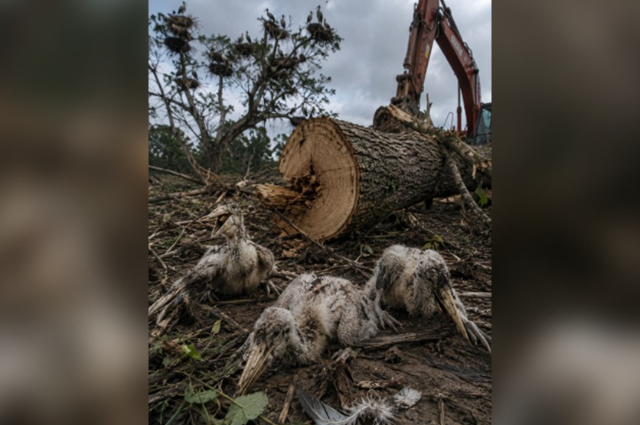
Image created through chatgpt
THE HARGILA ARMY
Hargila Army for what? To kill the unwanted birds? What is the motive behind this?
Purnima Devi Barman took it upon herself to challenge the attitude of society. She started to travel to villages with the aim of sensitising and giving awareness to people about the ecological significance of the Hargila. She organised awareness camps where she enlightened villagers about the ecological role of the bird and appealed to them not to cut nesting trees. Yet, the reaction she got was devastating in the true sense. Nobody seemed willing to attend the camp meetings or even listen to what she had to say. Those who came mocked her and her attempts to conserve the bird. They ridiculed her for spending time on a bird they used to avoid since time immemorial. Others criticised her for wasting time on a bird instead of concentrating on domestic chores. They used to say that they had work at home and didn't have time to waste on these unusual activities.
Rather than pointing fingers at the ignorance of society, she chose to understand it. She found out that people were not likely to attend scientific lectures. So what she observed was that they held their culture, festivals, and celebrations in high regard. So she decided to integrate culture and conservation rather than keeping them apart. During the breeding period, she started organising community cooking competition events, traditional Naam (Kirtan) programs, festivals, and baby shower programs for pregnant Hargilas in the same manner as Assamese people organise for expecting mothers. Slowly, people came and started enjoying the events. In this way, she turned conservation into an event of celebration enjoyed by all rather than one of moral responsibility. People gathered to cook, sing, enjoy themselves,
and, at the same time, learn about the importance of the bird in nature. Something that seemed odd in the beginning slowly turned into a matter of pride for the community.
More and more villages began adopting these celebrations as cultural practices, and soon the perception of the Hargila started changing. The bird, which was a bad omen earlier, became a source of pride for the state of Assam and its culture. Instead of cutting down nesting trees, people began conserving them. And with time, the efforts led to the creation ofthe Hargila Army, which refers to a community-based effort to conserve a species, beginning with a single woman but soon reaching a membership of more than 10,000. With each new village, the Hargila Army debunked various myths, promoted science and inspired many people to become involved in the process of conserving one of the rarest birds in the world. It showed that conservation can only be effective if it arises from the communities themselves.
NATURE, CULTURE AND EMPOWERMENT UNDER THE SAME ROOF
Dr. Purnima Devi Barman knew that conservation would become truly sustainable when the local community would also benefit from it. With this idea in mind, she took the Hargila movement one step ahead by connecting it to the empowerment of women. She inspired local women who weave to use designs of the beautiful Hargilas in Assamese Mekhela Sador (traditional wear of Assam), Gamosa, traditional jackets, shawls and jewelry. When tourists and researchers come from different places of the world they take a piece of Assam with them. The once-ugly bird slowly started gaining an important place in the culture of Assam, becoming a part of people’s artistic pride. Not only did these creations promote the rich biodiversity of the state but also provided women with new income generating activities.
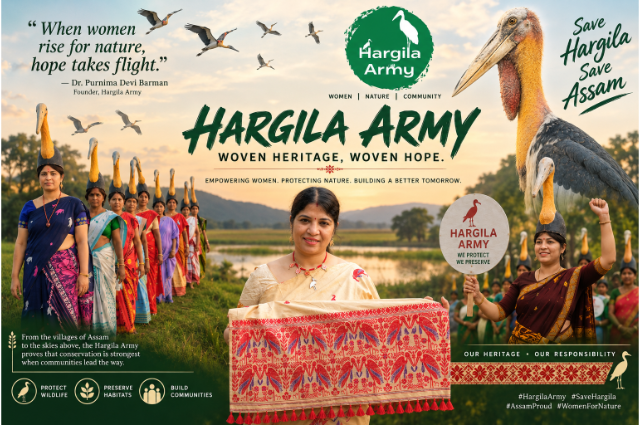
Photo inspiration sourced from Facebook, Time Magazine, smitasharma.com and edited trough chatgpt.
The new initiative was a means by which the Hargila became a representative bird of Assam itself, just like one horned rhino. Instead of being mere observers, women became ambassadors for wildlife conservation, spreading the message among their neighbours and ensuring that the next generation also receives the message. The case study proved that conservation of the environment did not always need sophisticated technology or rigorous enforcement but could even start from something as simple as a loom, a festival, or a community celebration. The case brought together the concepts of nature, culture and women's empowerment in one place.
INCLUSION OF MEN OF THE SOCIETY
Did the men agree with the women of the Society to save Hargila??
Even though women took the center stage in the formation of the Hargila army, Dr. Purnima Devi Barman realized that an effective conservation movement could not be restricted to any one community. It was necessary to involve men as well since many decisions concerning the use of land, cutting of trees, and the running of villages have been taken by them. Rather than making them feel alienated or unwanted, she involved them in the journey of conservation. Through continuous interaction with village leaders and youth groups, she made them realize that Hargila conservation is not only about saving a bird but also protecting the natural legacy of Assam for posterity. With growing knowledge and awareness, many men who used to see the bird as an intruder or negative now take up the responsibility of protecting its nesting sites.
This became even more important during the breeding time when wind and storms used to make the young chicks fall down from the nest, before they learned how to fly. Before, the chicks used to die due to these reasons or get eaten up by other predators. Now, under the directions of the Hargila Army, the local men started installing safety nets under the nesting trees to reduce the damage done by these falls. When ever they found any chick that fell off from the nest, the locals picked it up and immediately informed the Assam Forest Department. They gave veterinary treatment to these young ones and rehabilitated them in the forests. With this simple act, there was an incredible increase in the survival rate of these young Hargilas. They also helped in protecting the nesting trees from any illegal cutting of these trees. In addition, they spread awareness about the importance of saving the nesting trees in neighbouring villages. It was quite a big change from the people who used to cut down nesting trees to save themselves from attacks, to becoming the protectors of the same species.
REAL IMPACT
What is the exact impact of all the work done by Hargila Army ?
The conservation story of Dr. Purnima Devi Barman is among the most amazing achievements in wildlife conservation today. In 2007, when Dr Purnima Devi started this movement, the Greater Adjutant Stork was critically endangered in Assam. Less than 115 storks had been recorded in Assam, and their nests were getting destroyed due to hostility from humans. Every year it seemed increasingly possible that Assam would soon lose its distinct bird population forever. However, something that seemed impossible at first began to happen gradually.
Now, what is happening is amazing. There has been an increase in the number of Hargilas in Assam, which stands at a whopping figure of more than 1,800 birds, comprising a substantial share of the total number of the estimated worldwide population of around 3,000 birds. The Kamrup district has now become the greatest nesting site for the Greater Adjutant Storks in the world, thus making Assam the epicenter for the conservation of this endangered species. Also, the conservation status of the bird has been upgraded from endangered to near threatened on the IUCN red list, indicating the successful efforts made for the conservation of this bird. More importantly, the conservation effort is not only quantifiable but also changes the attitude of people towards them. The villages where the celebration of the felling of nesting trees was once prevalent have now become proud custodians of these trees. Children now know about the significance of the role played by Hargilas in the ecosystem. People take pride in themselves being the custodian of a globally threatened species.
This movement has received global recognition since it offers an example that can be followed everywhere. Not only by imposing legal or scientific limitations but by combining the preservation of biodiversity with cultural practices, empowering women and involving the community, Dr. Barman has achieved this great success. It shows us that sometimes changing people's mindsets works better than changing the law. The return of the Greater Adjutant Stork should not be viewed simply as an achievement in conservation, but rather as an example of how compassion, culture, and collaboration can bring back an endangered species.
AWARDS AND RECOGNITION
True efforts should really need to get appreciated..
The huge success of Dr Purnima Devi Barman has resulted in many awards and honours at both the national and international level. Her unique conservation approach has influenced environmentalists across the globe and serves as a model for integrating local knowledge with biodiversity conservation.
| Year | Award/Honour | Awarding Organisation |
| 2017 | Whitley Award | Whitley Fund for Nature, UK |
| 2017 | Nari Shakti Puraskar | Government of India |
| 2022 | UN Champions of the Earth Award | United Nations |
| 2024 | Whitley Gold Award (“Green Oscar”) | Whitley Fund for Nature, UK |
And many more awards and honours she received from various institutions. These awards are not just for the individual but for thousands of people from ordinary villages who have turned one of the rarest species of birds into a symbol of hope. The achievements of Dr Barman show how leadership is about influencing the entire community towards conserving nature.
THE REAL MEANING OF MOTHER
Motherhood can be described as the selfless love and protection offered by mothers towards their own kids. But the story of Dr. Purnima Devi Barman takes this meaning much wider than mere biological ties. The unfortunate accident that took place regarding the fall of the hargila chicks in 2007 stirred up her innermost maternal side. Being the mother of two daughters herself, she just could not turn a blind eye towards the suffering of these innocent chicks, falling from their nestling tree. She found in them every kid, completely dependent upon others.
CONCLUSION
Being an assamese, I must say that it is not easy for anyone to change the point of view of a whole society. The true inspiring story of Dr. Purnima Devi Barman and the Greater Adjutant Stork is much more than just an example of successful wildlife conservation. It was not easy for anyone to change the point of view of the Society. It is a case study of empathy, persistence and community activism. During an era when the bird was considered to be ugly and an ill-omen for society, she chose to value the importance of the Hargila ecologically. Rather than confronting the community with negative comments and criticism, she made conservation a celebration by combining science with culture, festivals, and empowerment of women. The establishment of the Hargila Army proved that a common goal could help common people make uncommon progress.
For now, the Hargila no longer brings bad luck to several communities in Assam; it has transformed into a symbol of strength, culture and environmental consciousness. This impressive population growth, as well as the preservation of its breeding grounds, serve as a testament to what compassion and community work can achieve. The story of Dr. Purnima Devi Barman is a lesson to the world that real conservation starts with the heart of man. It shows that when science is paired with culture and communities are made partners in conservation, even an unwanted bird can transform into an inspiration to the entire world. Through her efforts to save the Hargila, Dr. Barman has done more than save an endangered species from extinction; she has taught humankind that all lives are worth respecting and preserving.
"Conservation cannot happen in a day; it is a slow process of changing hearts. When you plant love for nature in a mother’s heart, it naturally flows down to her children, and that is how you secure the future of the earth." — Dr. Purnima Devi Barman.
References:
- International Union for Conservation of Nature (IUCN). The IUCN Red List of Threatened Species – Greater Adjutant (Leptoptilos dubius).
- BirdLife International. Species Factsheet: Greater Adjutant.
- Whitley Fund for Nature. Dr. Purnima Devi Barman – Whitley Award & Whitley Gold Award.
- https://youtu.be
- United Nations Environment Programme (UNEP). Champions of the Earth 2022.
- Wikipedia.com
- Aaranyak (Biodiversity Conservation Organisation), Assam.
- BBC News – Features on Dr. Purnima Devi Barman and the Hargila conservation movement.