
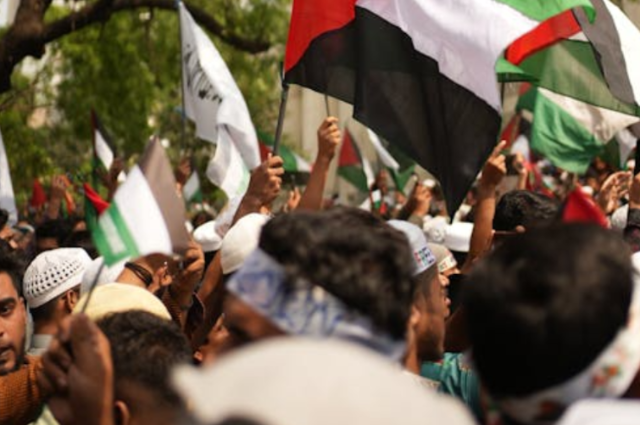
When Dissent Burns
The recent wave of violence in Bangladesh, marked by arson, mob brutality, intimidation of journalists, and attacks on symbols of free expression, has triggered an unsettling question that refuses to remain confined within national borders: what is happening to a country born out of a language movement, a secular constitution, and the blood-soaked promise of pluralism? The killing of Dipu Chandra Das, a Hindu factory labourer, allegedly lynched and burned by a mob, and the torching of newspaper offices, are not isolated incidents. They are symptoms of a deeper, systemic malaise, one where radicalism feeds on fear, religion is weaponised for power, and democratic institutions appear either paralysed or complicit through silence.
This article examines the anatomy of this violence, not merely as a catalogue of horrors, but as a political, psychological, and sociological phenomenon. Why do radical elements seek to silence dissent? What drives mobs to murder in the name of faith? Can Bangladesh, in the face of these developments, still credibly claim its democratic and secular identity? And what does the rising tide of anti-India sentiment signal for regional stability and shared history?
Bangladesh’s Secular Promise and Its Gradual Unravelling
Bangladesh’s birth in 1971 was not the consequence of religious nationalism, but its rejection. The Liberation War was fought against linguistic, cultural, and political subjugation, not to erect a theocracy. The founding constitution enshrined secularism, nationalism, socialism, and democracy as its four pillars. Religion, though deeply embedded in society, was not meant to dominate the state.
Yet history is rarely linear. Military coups, political assassinations, and periods of authoritarian rule gradually diluted this secular ethos. Constitutional amendments reintroduced religious language into the state framework, legitimising political Islam and opening space for faith-based mobilisation. What followed was not an overnight transformation, but a slow recalibration of public life, where religious identity began to overshadow civic identity.
The present unrest must be seen as the culmination of this long erosion. Radical groups did not appear suddenly; they were incubated over decades, often tolerated or instrumentalised by political actors seeking short-term gains.
The Politics of Fear: Why Extremists Target the Press
The burning of newspaper offices is not random vandalism; it is strategic violence. Independent media represents one of the last barriers against authoritarian drift and mob rule. By attacking journalists and threatening editors, radical groups send a clear message: dissent will be punished, truth will be incinerated, and silence will be enforced through terror.
This pattern is neither new nor uniquely Bangladeshi. Across the world, extremist movements, religious or otherwise, share a common instinct: control the narrative or destroy it. Journalism thrives on nuance, verification, and plurality. Extremism survives on absolutism, emotional manipulation, and moral binaries. The two cannot coexist peacefully.
When journalists receive death threats for expressing opinions, the chilling effect extends far beyond individual reporters. Self-censorship becomes a survival mechanism. Editorial caution replaces investigative courage. Democracy begins to suffocate, not with a single dramatic blow, but through a thousand small silences.
Mob Violence and the Psychology of Radicalisation
To understand the brutality inflicted upon Dipu Chandra Das and others like him, one must confront the psychology of mob violence. Radical mobs are not spontaneous eruptions of anger; they are socially engineered phenomena.
At their core lies dehumanisation. The victim is no longer an individual with a name, family, or history, but a symbol of impurity, heresy, or imagined threat. Religion becomes the vocabulary through which violence is justified, even as its ethical foundations are betrayed.
Radical leaders exploit economic precarity, social resentment, and political alienation. In societies where unemployment is high and institutions appear inaccessible, anger seeks a target. Minorities, visible, vulnerable, and politically expendable, become convenient scapegoats.
The mob offers something intoxicating: belonging. In a fractured society, radical groups provide identity, purpose, and moral certainty. Violence, then, is not merely permitted; it is sanctified.
Religion as a Tool, Not a Faith
It is crucial to distinguish between religion as personal belief and religion as a political instrument. The extremists driving violence in Bangladesh cannot be described as religious in any meaningful ethical sense. Their actions violate the fundamental tenets of compassion, justice, and restraint that lie at the heart of Islam, as they do in every major faith tradition.
What they practise is not religion, but ideological opportunism. Sacred texts are reduced to slogans. Complex theological traditions are flattened into simplistic commands. Doubt is forbidden, debate criminalised.
This hollowing out of faith serves power. When religion is stripped of introspection and reduced to obedience, it becomes an efficient mechanism for mass mobilisation. Questioning authority is reframed as blasphemy. Political opposition is recast as religious betrayal.
Minorities Under Siege: The Hindu Question
The killing of Dipu Chandra Das highlights a disturbing trajectory: the normalisation of violence against minorities. Hindus in Bangladesh, once integral to the nation’s cultural and economic fabric, increasingly find themselves living under an unspoken condition: visibility invites vulnerability.
Such violence sends a dual message. To minorities, it signals precarity and disposability. To the majority, it tests the limits of impunity. When mobs murder with minimal consequence, the social contract collapses.
A democracy is measured not by how it treats its majority, but by how it protects its minorities. On this metric, Bangladesh is facing a profound moral and institutional crisis.
Law Enforcement: Silence as Complicity
Perhaps the most damning aspect of the current unrest is the reported passivity of law enforcement. When police stand by as mobs attack, kill, and burn, the message is unambiguous: the state has abdicated its monopoly on legitimate force.
This failure is not merely operational; it is symbolic. Citizens lose faith in the promise of protection. Vigilantism becomes normalised. Justice is outsourced to the loudest, most violent actors.
Whether this paralysis stems from fear, political pressure, or ideological sympathy matters less than its effect. Inaction emboldens extremists and erodes the rule of law.
Is Bangladesh Becoming Just Another Muslim State?
This question is provocative, but necessary. Bangladesh was never meant to be defined solely by religious identity. To reduce it to “another Muslim state” is to erase its unique history of linguistic nationalism, cultural pluralism, and secular struggle.
Yet symbols matter. When attacks on minorities go unpunished, when religious mobs dictate public life, and when dissent is framed as sacrilege, the state drifts—de facto if not de jure—towards majoritarian theocracy.
The danger lies not in Islam itself, but in its politicisation. A state that privileges one religious identity over others ceases to be democratic in substance, regardless of electoral rituals.
Anti-India Sentiment and Regional Destabilisation
The attack on the Indian High Commission in Mymensingh and the surge of anti-India rhetoric reflect a broader strategy: externalising internal failures. Nationalist fervour, when fused with religious radicalism, often seeks an external enemy.
India becomes a convenient target, historically entangled, politically influential, and symbolically charged. Anti-India narratives serve multiple purposes: they unify disparate radical factions, distract from domestic grievances, and legitimise violence under the guise of patriotism.
Such hostility endangers not only bilateral relations but also regional stability. Bangladesh and India share history, rivers, culture, and economic interdependence. Poisoning this relationship through hate speech and mob violence threatens long-term cooperation.
Democracy Beyond Elections
Bangladesh still holds elections, but democracy is more than periodic voting. It requires independent institutions, free media, minority protection, and a culture of dissent.
When journalists are threatened, minorities attacked, and mobs rule the streets, democracy becomes performative, a shell emptied of substance. The current trajectory raises uncomfortable questions about whether democratic norms are being hollowed out from within.
The Road Ahead: Reckoning or Rupture
Bangladesh stands at a crossroads. One path leads towards deeper radicalisation, international isolation, and internal fragmentation. The other demands courage: confronting extremist networks, restoring institutional integrity, protecting minorities, and reclaiming secular principles, not as ideology, but as lived practice.
This reckoning cannot be cosmetic. It requires political will, judicial independence, and societal introspection. Silence is no longer neutral; it is enabling.
Remembering What Was Promised
Bangladesh was born from the refusal to submit to linguistic erasure, cultural domination, and imposed identity. To allow fear and fanaticism to dictate its future is to betray that origin.
The violence witnessed today is not inevitable. It is the result of choices made and unmade. Whether Bangladesh can still be considered a democratic and secular nation depends not on the constitutional text, but on its actions. On whether it chooses to protect the vulnerable, defend the free, and remember that faith, when weaponised, ceases to be sacred.
The world is watching. More importantly, history is being recorded.