
The moment I boarded the Sambalpur–Samaleswari Express from Howrah, I sensed this was not just a journey but an expedition into another world. This train is the only direct lifeline to Koraput, and its slow, measured pace seemed to whisper: you cannot rush through these landscapes, you must surrender, move gently, and let nature reveal itself to you.
From the train’s window, the first scenes unfolded: lush rice fields, winding streams, and mud-walled huts. Soon, the scenery transformed into undulating green hills, stretches of grassland, and plots of shifting cultivation. Here and there, streaks of red soil cut across the mountainsides like brushstrokes on a giant canvas painted by nature herself.
Before reaching Koraput, the train must tunnel through thirty-seven pitch-dark caverns. Each tunnel felt like nature’s secret doorway, and each emergence brought fresh light, fresh breath, and a new landscape. When I finally stepped down at Koraput station, it felt like I had entered a parallel world; untainted, pollution-free, and refreshingly untouched by the excesses of modernity.
The Call of Waterfalls
The first invitation of Koraput and Jagdalpur in the rains comes from their waterfalls. The monsoon transforms this land into a symphony of thundering streams and cascading white sheets of water.
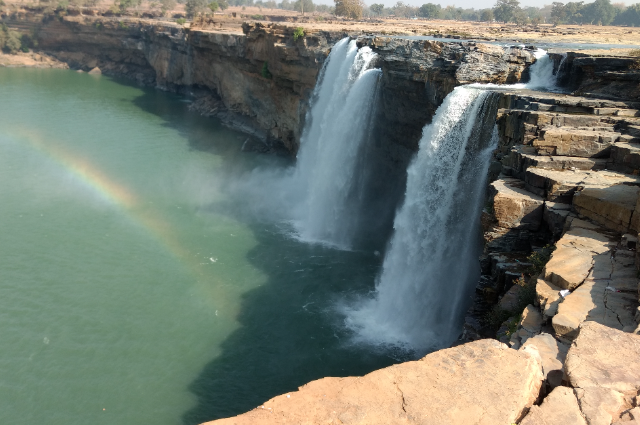
Chitrakote Waterfall
Chitrakote Falls, known as the Niagara of India, is the crown jewel. The Indravati River plunges nearly 95 feet in a wide, frothing curtain of white. The roar reverberates like thunder, while mist rises into the air, catching sunlight and scattering rainbows across the gorge. Standing there, it felt like nature was offering an endless prayer in water and sound.
Duduma Waterfall
Not far away, the legendary Duduma Falls - mentioned in ancient literature- tumbles down 570 feet from the Machkund River. Long before you reach it, the spray wets your skin, as if reminding you that this is not just a waterfall but an epic carved into rock and water.
Rani Duduma Waterfall
Hidden within the Kanger Valley National Park, Tirathgarh Falls flows like a white sari unravelling gently over terraced rocks. Surrounded by reddish cliffs and thick forest, it exudes an almost sacred calm. Locals believe its waters are holy, akin to a ritual bath at a pilgrimage.
Tirathgarh Waterfall
Smaller but no less enchanting, Chitradhara Falls is a place for quiet meditation. Sitting in solitude among the hills, listening to its murmuring stream, one feels attuned to nature’s inner rhythm.
Nalco Hanuman Mandir
Nalco’s Towering Hanuman
Travel in Koraput is not just about ancient natural wonders. In Damanjodi township, modern devotion rises skyward as the Nalco Hanuman Mandir. Here stands the world’s second-tallest Hanuman statue, soaring 108 feet high. Built by the National Aluminium Company, it is now a cultural landmark where villagers, devotees, and travellers gather daily for worship and awe. Standing before this colossal figure, framed by hills, felt like witnessing an extraordinary confluence of timeless faith and modern craftsmanship.
Deomali Hills
Heights and Horizons
No journey to Koraput is complete without scaling the Deomali Hills, the highest peak in Odisha at 5,481 feet. As we ascended, mist clung to the valleys, rivers snaked below, and distant villages appeared as specks. At the summit, it was as if the entire world lay beneath my feet, while above floated only drifting clouds. The cool wind carried the earthy fragrance of rain-drenched soil, and with it, a fleeting taste of freedom.
Talamali Hilltop
Nearby, the Talamali region charmed us with mahua trees, small villages, and sparkling brooks. The local tribes here still perform traditional dances, drumbeats echoing through the woods, and their weekly markets brim with handwoven baskets, beads, honey, and the intoxicating aroma of mahua flowers. Talamali felt less like a place and more like a living fairytale.
Gupteshwar Shiv Cave Shrine Temple Of Caves and Kings
One of the most mystical experiences was at the Gupteshwar Cave Temple. To reach it, one must climb nearly two hundred stone steps through dense forests, before entering the dimly lit cavern. There, illuminated by oil lamps, stands a natural Shiva lingam. Legends say Lord Rama himself first discovered it, and later it was rediscovered by Maharaja Veer Vikram Dev. Even today, locals believe the lingam is mysteriously growing in size. The atmosphere inside was electric, a palpable presence of something eternal.
Bastar Palace
History, too, leaves its grandeur here. In Jagdalpur, we wandered through the regal Bastar Palace. Its white façade, carved doors, sprawling courtyards, and royal throne hall seemed to echo with stories of kings, their victories, and their decline. Every wall seemed to whisper the glories and struggles of the Bastar dynasty.
Koraput Jagannath Temple
Equally fascinating is the Jagannath Temple of Koraput. Modelled on the famous shrine at Puri, it carries a unique distinction: here, the hands of Lord Jagannath are visible, a rarity in traditional iconography. Even more extraordinary is its inclusive ethos; people of all faiths may enter and worship, reflecting the tribal spirit of harmony and pluralism.
Tribals in Koraput
The Heartbeat of Tribal Life
The real soul of Koraput and Jagdalpur lies in its tribal culture. Every week, the region comes alive with vibrant haats (markets). Women bring baskets of mahua flowers, men display bamboo crafts, while others sell colourful bead necklaces, wild honey, and forest herbs. These bazaars are not just about trade; they are community gatherings filled with music, dance, and laughter.
During festivals, tribal women in bright attire sway gracefully to folk songs, while men beat the madal drums. The rhythm feels inseparable from the forest itself, the very scent of the soil and the whisper of trees blending with the music.
And then there is Koraput coffee, the pride of the region. Cultivated on cool mountain slopes, these beans have found appreciation even in international markets. Sitting in a Koraput café, sipping steaming coffee, I felt as though each drop carried the freshness of the mountain air, the fragrance of green forests, and the warmth of the land’s people.
Upper Kolab Dam
Other Hidden Gems
We ended our journey at the Upper Kolab Dam, built across the Kolab River. At sunset, golden light rippled across the water while the surrounding green hills turned a shade darker. The air was tinged with the smell of moss and wet earth, another reminder of how intimately nature thrives here.
A Journey Beyond Tourism
Travelling through Koraput and Jagdalpur in the monsoon was not merely sightseeing; it was a dialogue with nature. The roar of waterfalls, the silence of misty peaks, the mystique of caves, the echoes of palaces, the colours of tribal haats, and the aroma of coffee all came together like verses of an unwritten poem.
This corner of India remains untouched by the excesses of modern tourism, preserving a raw, soulful beauty. To walk here is to be reminded of life’s deeper rhythms, the ones that pulse quietly beneath concrete and chaos.
Koraput and Jagdalpur are not just destinations; they are experiences, memories etched in green, and whispers of a timeless land that tell us again and again—
The truest music of life is hidden in the heart of nature.