
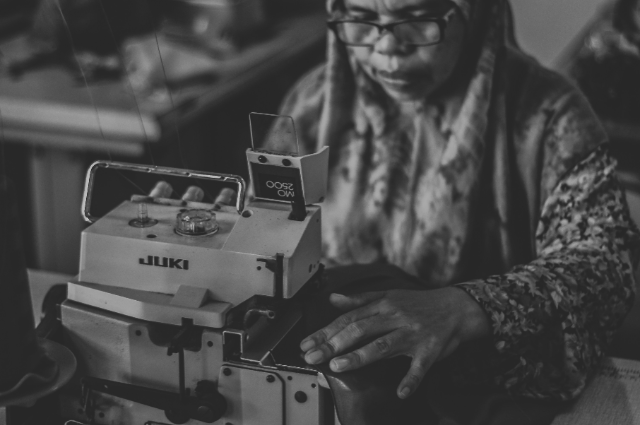
How a woman in Bihar turned an unwanted childhood skill into a manufacturing enterprise, creating livelihoods and demonstrating the potential of rural entrepreneurship.
As a child, Khushbu Devi disliked sewing lessons. Her parents insisted that she learn the skill, but she had little idea that it would eventually become the foundation of a business that supported her family and created work for other women. Years later, financial difficulties following her marriage compelled her to put her basic sewing knowledge to practical use. What she had once regarded as an unwelcome obligation became an economic resource.
Khushbu, a resident of Rasulpur village in Muzaffarpur district, Bihar, was 34 when ThePrint reported her story on 24 August 2024. By then, she owned a mosquito-net manufacturing enterprise with an annual turnover exceeding ₹12 lakh and provided employment to approximately 62 women. These figures were reported at the time of publication and should not be mistaken for independently verified current figures. Nevertheless, they offer a revealing example of how a modest skill, when combined with initiative and an understanding of local demand, can develop into a source of employment beyond the individual who possesses it.
Khushbu told ThePrint that she had learnt the basics of sewing as a child but had not practised much until her marriage in 2009. Financial difficulties then made it necessary for her to take up stitching to support her family. Her early enterprise was not born out of a grand business vision or an abundance of capital. It began with a practical need and a skill she could use to earn money.
This is often how small businesses begin. A person recognises that an existing ability can meet a need, starts on a manageable scale and learns through experience. The first objective may simply be to supplement household income. With persistence, an understanding of customers and careful decisions about costs and production, that activity may develop into a more organised enterprise.
Turning competition into cooperation
Khushbu's early difficulties included resistance from local women tailors who feared that her business would take away their customers. She could have interpreted their concerns as a reason to abandon the venture. Instead, according to ThePrint, she persuaded six or seven of these women to join her in starting a business.
They began manufacturing mosquito nets, responding to local demand that few other producers were adequately meeting. The significance of this decision lay in her willingness to see a possibility for cooperation where others saw competition. Women with similar skills could work together to fulfil demand rather than struggle individually for a limited number of customers.
The business subsequently grew into a production unit employing approximately 62 women, according to the 2024 report. A separate report published by Amar Ujala in March 2025 identified the unit as Pratigya Mosquito Net and stated that the enterprise supplied mosquito nets to markets across the country. The two reports provide a basis for understanding the scale of her work, although they do not establish the present employment or financial position of the business.
The example has particular relevance in places where formal employment is scarce, and many people possess practical skills but lack the means to convert them into regular earnings. Tailoring, food processing, weaving, handicrafts, furniture making and other forms of small-scale production can create opportunities where there is sufficient demand and a workable business model.
The important lesson, however, is not that every skill automatically leads to a successful business. It is that skills become economically valuable when someone identifies a need, understands what customers are willing to buy and organises production accordingly. Hard work matters, but so do market research, cost calculation, quality, pricing and the ability to deliver goods reliably.
Growing beyond the original product
Khushbu did not remain confined to mosquito-net manufacturing. In the ThePrint report, she explained that she had diversified into women's garments after receiving advice from a mentor not to depend on a single product. She also reported building a network of approximately 600 women across three nearby districts who manufactured garments for orders she obtained through her wholesale-market connections. She had teams handling marketing, packaging and accounts.
The distinction between these two activities is important. The approximately 62 women were associated with the mosquito-net enterprise, while the figure of around 600 referred to a wider garment-making network. It would be inaccurate to describe all 662 women as employees of one factory or to assume that every member of the wider network worked full-time.
Even with this distinction, the expansion is significant. It illustrates how a small enterprise can develop from producing one locally demanded product into coordinating a broader network of producers. It also shows that entrepreneurship involves much more than making goods. Finding buyers, negotiating orders, maintaining standards, organising delivery and keeping accurate accounts are essential to the survival of a business.
Diversification can reduce dependence on a single product, but it also introduces new risks. Different products require different materials, skills, equipment and marketing strategies. Expanding production without reliable orders or sufficient working capital can leave a business with unsold stock and mounting expenses. Growth therefore needs to be planned rather than pursued simply for the sake of increasing output.
For aspiring entrepreneurs, Khushbu's experience suggests that ambition must be accompanied by learning. A person may begin by producing goods at home, but the next stage may require better equipment, improved packaging, formal bookkeeping, access to wholesale markets or the ability to coordinate other workers. Recognising these needs early can help a small business develop on firmer foundations.
Self-reliance must begin with initiative.
Khushbu's story raises a larger question about employment in India. For many families, a government post or a salaried position in an established company remains the preferred route to financial security. This aspiration is understandable. Regular employment can offer predictable earnings, benefits and a degree of stability that a small business cannot always provide.
Nevertheless, not everyone who seeks employment will find a suitable vacancy. An economy also needs people who produce goods, provide services, solve practical problems and create work for others. Small enterprises can contribute to this process, especially in communities where local demand can sustain activities that do not require a large industrial establishment.
More individuals could therefore consider whether their existing skills, interests and resources might support a modest business. A person who can stitch could investigate demand for school uniforms, bags or household textiles. Someone with experience in preparing food might explore pickles, snacks or other products that can be produced safely and sold legally. A group of artisans might pool their skills to fulfil larger orders than any one person could manage alone.
Such ventures should begin with realistic questions. Who are the likely customers? What do they currently buy, and at what price? What will raw materials, labour, transport, packaging and electricity cost? How much working capital is required before the first payment arrives? Can the product compete on quality, price or convenience? These are not discouraging questions; they are safeguards against investing money in a venture without understanding its risks.
Self-reliance does not mean that everyone must become an entrepreneur, nor does it mean that people who cannot establish businesses have failed to show initiative. Starting a business requires resources, time, confidence and often a willingness to accept financial uncertainty. People with limited savings may have very little room for error. The objective should be to widen their choices, not replace the expectation of secure employment with an unrealistic demand that every individual create a job.
Yet those who have a viable idea and are prepared to learn should not assume that employment can only be found by waiting for recruitment announcements. They can investigate opportunities to work independently, collaborate with others or gradually build an enterprise alongside existing employment. Even a small venture that supports its owner and provides paid work to a few people can make a meaningful contribution to a household and a community.
Government support as a means, not an end
Khushbu's journey also demonstrates why individual initiative and institutional assistance need not be treated as opposing forces. Amar Ujala reported in March 2025 that she joined the Ganga self-help group under Bihar's Jeevika programme in 2013 and received ₹2.67 lakh in assistance from the group's incubation fund to expand her business. ThePrint reported that her enterprise was among 450 women-led businesses selected across Bihar, Assam and West Bengal for a rural enterprise incubation initiative supported by the Ministry of Rural Development and implemented with the involvement of IIM Calcutta Innovation Park.
The initiative provided selected enterprises with support intended to help them increase revenue and generate rural employment. Under the programme described by ThePrint, some businesses received soft loans, and others received grants, while mentors helped entrepreneurs with business plans, market identification, branding and other aspects of expansion. Khushbu's story therefore cannot accurately be presented as an achievement accomplished without any institutional assistance.
That does not diminish her initiative. Access to finance or advice does not, by itself, identify customers, organise production or maintain a business. Support can create opportunities, but entrepreneurs must still make decisions and undertake the work required to turn those opportunities into viable livelihoods.
Government data provide a broader context. In a December 2024 release, the Press Information Bureau reported that the Start-up Village Entrepreneurship Programme, a component of the Deendayal Antyodaya Yojana–National Rural Livelihoods Mission, had supported 3,13,464 rural enterprises by October 2024. The total included 24,892 enterprises in Bihar and 18,892 in West Bengal. A subsequent government update reported that the programme had supported 3.74 lakh enterprises by 30 June 2025.
These figures demonstrate the reach of a programme intended to encourage rural enterprise, but they should not be interpreted as proof that every supported business remained operational or became profitable. The number of enterprises assisted is one measure of reach; their survival, earnings, working conditions and capacity to provide sustainable employment are equally important measures of success.
The wider lesson is that public assistance is most valuable when it helps people develop the capacity to earn, produce and make decisions independently. Training, appropriate credit, mentoring and access to markets can help reduce barriers that individual effort alone cannot always overcome. At the same time, aspiring entrepreneurs need to take responsibility for planning, learning, maintaining accounts and assessing risks. Neither initiative without opportunity nor assistance without sustained effort is sufficient.
The confidence that comes from creating work
The benefits of a successful small enterprise can extend beyond its financial accounts. When people earn their own income, they may gain greater control over household decisions, become better able to plan for their children's education and healthcare, and develop confidence in their ability to manage challenges. For women who have had limited access to paid work, the experience of earning through their skills can be particularly significant.
An enterprise that provides work to others may also strengthen the local economy. Wages spent on food, education, transport and other household needs support further economic activity. Local production can create opportunities for people who might otherwise have to travel long distances in search of work, although the extent of this benefit depends on the nature and location of the enterprise.
The quality of employment matters as much as its availability. Workers should receive fair payment, be treated with respect and have safe working conditions. Orders should be managed responsibly, and the owner should be careful not to expand in ways that expose workers or the business to avoidable risks. Creating jobs is a valuable achievement only when the work offers a meaningful and reasonably dependable source of income.
There is also a need to recognise the difficulties that small entrepreneurs face. Limited access to credit, unreliable electricity, changing material costs, inadequate transport, competition from larger manufacturers and difficulty reaching customers can undermine otherwise promising ventures. Women may face additional restrictions on mobility, access to property or control over household finances. Telling people to become self-reliant without addressing such barriers would be inadequate.
Practical support should therefore connect vocational training to real market demand, make financial guidance accessible and help small producers find reliable buyers. Self-help groups and producer collectives can help members pool resources, share knowledge and fulfil larger orders. Digital platforms may widen access to customers, but entrepreneurs also need to understand packaging, delivery costs, online payments and the risks of relying on a single sales channel.
The aim should be to build an environment in which individual initiative has a realistic chance of succeeding.
A skill can become the beginning of something larger.
Khushbu Devi's experience began with a skill she had once resented learning. Financial necessity led her to use it, but her willingness to respond to demand, work with other women and explore new products helped her develop it into an enterprise. Her story does not suggest that success is inevitable for anyone who works hard, nor does it eliminate the need for financial and institutional support. It demonstrates that an existing skill can become the starting point for a larger economic possibility.
India needs secure salaried employment, but it also needs people who are willing and able to create sustainable livelihoods through small businesses. Cottage industries and other microenterprises will not solve unemployment on their own, and they should not be romanticised as easy routes to prosperity. Their value lies in the opportunities they can create when a genuine market, practical skills, responsible management and appropriate support come together.
More people could be encouraged to examine what they know how to do, identify needs in their communities and explore whether a small venture could meet those needs. Some may work independently; others may collaborate with neighbours, join a producer group or employ people as demand grows. Not every enterprise will become large, and it need not. A modest business that provides a sustainable income for its owner and fair work for a handful of others has already made a worthwhile contribution.
The purpose of self-reliance is not to reject help or deny the importance of government responsibility. It is to develop the confidence and capacity to make choices, earn a livelihood and contribute to the lives of others. Public institutions can help people acquire skills, access finance and reach markets, while individuals bring their knowledge, effort and judgement to the work of building a business.
Khushbu's story reminds us that employment need not always begin with a vacancy announced by a government department or a large company. Sometimes it begins with a sewing machine, an unmet local need and a person prepared to discover what an ordinary skill can accomplish. When that initiative grows into an enterprise that creates opportunities for others, the achievement reaches beyond individual financial independence. It becomes a contribution to the economic confidence and productive capacity of an entire community.
References:
- Risha Chitlangia, ThePrint, 24 August 2024. “Mosquito nets to pickles, 450 rural women-led enterprises & how a govt-IIM initiative helped them soar.”
- Amar Ujala, 3 March 2025. “Bihar News: Lakhpati Didi Khushboo Became An Example In Muzaffarpur.”
- Press Information Bureau, Ministry of Rural Development, 20 December 2024. “Bank credit to women Self-Help Groups.”