
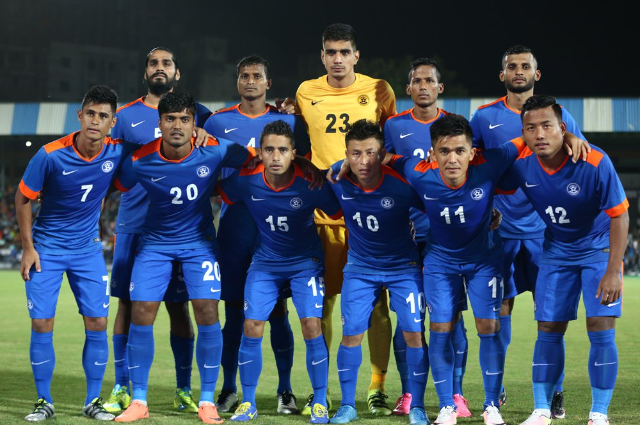
Every four years, a strange phenomenon occurs in India. From the sun-soaked streets of Goa to the packed local trains of Kolkata and the high-rises of Mumbai, millions of people suffer from collective sleep deprivation. They wear neon-blue Argentina jerseys or deep-red Portugal kits, scream at televisions at 2:00 AM, and engage in fierce office debates over the tactical genius of European managers.
India loves football. India has 1.4 billion people. Yet, when the actual World Cup kicks off, the Indian national football team—the Blue Tigers—is nowhere to be found.
The 2026 FIFA World Cup was supposed to be different. With the tournament expanding to a massive 48 teams, Asia (AFC) was handed a golden ticket: 8.5 qualification slots instead of the usual 4.5. The door wasn’t just open; it was practically off its hinges. Yet, India managed to miss the party entirely. Why does a nation with infinite human capital and ravenous interest consistently fail to qualify?
The 2026 Campaign: Hope, Heartbreak, and the Afghan Disaster
To understand the macro-failure, one must look at the micro-debacle of the 2026 World Cup qualification cycle.
India entered the qualifiers in the Second Round, placed in Group A alongside Asian heavyweights Qatar, a resilient Kuwait, and an underdog Afghanistan. The assignment was simple: finish in the top two of the group to advance to the decisive Third Round. With Qatar expected to run away with the group, India’s battle was for the second spot.
Wikipedia
Final Standings - 2026 World Cup Qualifiers (AFC Second Round - Group A)
| Pos | Team | Pld | W | D | L | GF | GA | GD | Pts |
| 1 | Qatar (Q) | 6 | 5 | 1 | 0 | 18 | 3 | +15 | 16 |
| 2 | Kuwait (Q) | 6 | 2 | 1 | 3 | 6 | 6 | 0 | 7 |
| 3 | India | 6 | 1 | 2 | 3 | 3 | 7 | -4 | 5 |
| 4 | Afghanistan | 6 | 1 | 2 | 3 | 3 | 14 | -11 | 5 |
The campaign started like a dream. India secured a gritty 1-0 away victory against Kuwait, throwing the nation into a frenzy. Fans started looking up flights to North America. But what followed was a masterclass in self-sabotage.
FIFA
The turning point was a double-header against Afghanistan—a team displaced by war and lacking regular infrastructure. India played out a drab 0-0 draw away, and then, in front of a stunned home crowd in Guwahati, collapsed to a 1-2 defeat against the Afghans. By the time India lost their final match to Qatar, the dream was dead. India finished third, watching Kuwait sneak into the next round.
AIFF+ 1
The psychological toll spilt into the following months. Relegated to lower-tier football, India suffered a historic slump, dropping to 139th in the FIFA rankings after suffering losses to teams like Singapore, Bangladesh, and Zimbabwe.
Anatomy of a Debacle: Why the Giant Won't Wake Up
If India has the people and the passion, what is missing? The answer lies in a combination of structural deficiency, administrative gridlock, and cultural misalignment.
1. The Population Illusion vs. The Match-Volume Crisis
The argument "We have 1.4 billion people, how can we not find 11 players?" is a mathematical fallacy. India has a population of 1.4 billion cricket fans, casual football viewers, and citizens. It does not have a pool of 1.4 billion trained footballers.
In elite footballing nations like Japan or Germany, a child enters a structured academy by age 6, playing 40 to 50 highly competitive tactical matches a year. In India, grassroots football is predominantly recreational. A talented 12-year-old in India might play only 10 to 15 organised matches a year. By the time they reach adulthood, they are thousands of hours behind in tactical awareness and decision-making.
2. The Comfort Zone of Domestic Luxury
The launch of the Indian Super League (ISL) in 2014 brought glitz, glamour, and foreign managers to Indian shores. Broadcast quality soared, and player salaries skyrocketed. However, this financial boom created an accidental trap.
Indian players are paid handsomely within the domestic bubble. Because the national team's ranking is low, it is incredibly difficult for Indian players to secure work permits in competitive European leagues. Furthermore, because they are comfortable at home, they lack the financial or professional incentive to rough it out in lower-tier European or tougher Asian leagues. Contrast this with South Korea or Japan, whose best players leave their home comfort zones to play in the gruelling environments of the Bundesliga or the English Premier League, bringing that elite intensity back to their national squads.
3. Physicality and Sports Science
Modern football is an athletic chess match played at hyper-speed. It requires immense lung capacity, explosive pressing, and physical upper-body strength. Historically, Indian squads have struggled to match the physical conditioning and sheer athletic power of West Asian nations (like Iran or Qatar) and the relentless stamina of East Asian giants. The integration of modern sports science, nutrition, and data-driven scouting has only recently begun to tick upward in India, but it remains decades behind the global standard.
The Blueprint: How India Can Blueprint a Path to 2030 and Beyond
India cannot simply coach its way out of this hole by changing managers every two years. Fixing the Blue Tigers requires a foundational overhaul:
- A "Match Volume" Revolution: The All India Football Federation (AIFF) must implement a robust, mandatory youth league framework across every state. Young players must play a minimum of 40 competitive games a year.
- A Coaching Army: India currently suffers from a massive deficit of elite, certified coaches. To train a million children, India needs tens of thousands of licensed grassroots coaches, not just a handful operating out of tier-1 cities.
- The Diaspora Loophole: Countries like Morocco (World Cup semi-finalists) and Indonesia have rapidly accelerated their success by actively scouting and integrating eligible diaspora players playing in European leagues. India's strict citizenship laws currently prohibit dual passport holders from representing the country—a policy that severely limits the immediate talent pool.
- Patience Over Quick Fixes: The country must accept that a successful senior national team is merely the byproduct of a healthy youth ecosystem.
India’s footballing story is not a tragedy of lack of talent; it is a comedy of mismanaged systems. The passion is there, sitting on couches every weekend watching overseas leagues. But until the nation stops treating football as a four-year entertainment carnival and starts treating it as a grassroots infrastructure project, the Blue Tigers will remain what they have always been: the world's greatest spectators.