
In Jharkhali, in the Sundarbans of West Bengal, the forest is never only a forest. It is a source of fish, crabs, honey and livelihood, a wall against the water, a place where tides continually reshape the edge of the land and where the Royal Bengal tiger can move through the mangroves with a person sometimes unaware of its presence until it is too late. The villages sit on inhabited islands surrounded by tidal waterways, their homes and fields separated from the water in places by embankments that have to withstand the pressure of the sea and the rivers. The mangroves are part of that protection, but they are also part of the economy. Men enter the forest to fish, collect crabs or gather honey, and for some families the income earned there can mean the difference between managing a month and going without. Some men do not return. In Jharkhand, several women carry the particular knowledge of what that loss means because their husbands were killed by tigers while earning a living in the forest. They are often referred to as tiger widows, a term that describes not only the manner in which their husbands died but also the economic and social vulnerability that can follow.
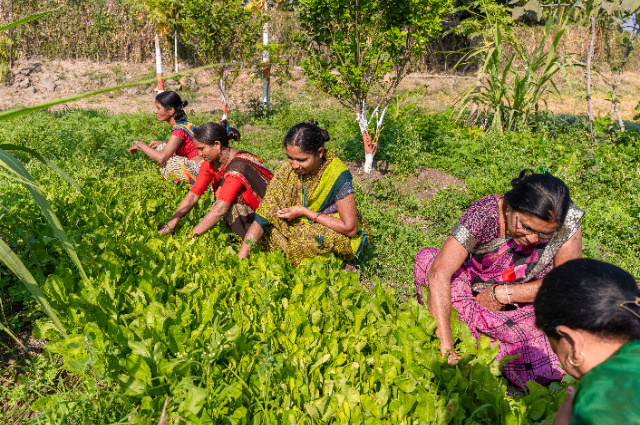
Their lives have recently drawn national attention for a reason that initially appears almost impossible to reconcile with their losses. Women who have lost husbands to tiger attacks are participating in the restoration of the mangrove landscape on which their communities depend. They collect seeds and propagules, raise young plants, carry them to vulnerable stretches and help protect them after planting. Some of the women have been part of this work for years. The work is not an attempt to erase the danger of the forest or to turn a tiger attack into a sentimental conservation story in which tragedy is neatly transformed into virtue. It is much more practical than that. These women still have households to support, children to feed and bills to pay, while the land around them remains vulnerable to erosion, cyclones, saline water and the loss of vegetation. The condition of the mangroves is not an abstract environmental question for them. It is connected to the ground beneath their homes and fields, the embankments that protect their settlements and the waters from which their communities earn their living.
The restoration story in Jharkhali began long before the attention of 2026. Jharkhali Sabuj Bahini, an environmental organisation formed in 2005 under Akul Biswas, was already working in the area when Cyclone Aila struck the Sundarbans in 2009 and exposed the vulnerability of settlements to storm surges, flooding and damaged embankments. The devastation made the absence of vegetation along exposed stretches impossible to ignore, and community members began concentrating on restoring mangrove cover along vulnerable riverbanks. Women became part of that effort, collecting seeds, raising seedlings and planting them where the protective vegetation had thinned or disappeared. By 2021, reporting by Mongabay-India recorded that approximately 300,000 mangrove saplings had been planted in Jharkhali since 2017. The number matters not simply because it is large, but because it establishes a history: the women now appearing in national reports did not suddenly begin planting trees in response to the publicity of September 2026. Community restoration had already become part of life in Jharkhali over many years.
The work itself is far removed from the easy symbolism of a photograph showing a woman putting a sapling into the earth. Mangrove planting requires an understanding of a difficult intertidal landscape in which water, soil and salinity are constantly changing. Seeds and propagules have to be collected from suitable local species and raised before they are ready to be planted. The location matters. A stretch of land that appears bare may be too exposed to strong tidal movement, while another may offer a better chance of survival. Young plants can be damaged by grazing animals, human activity, erosion and storms. The women involved in the work therefore do more than plant. They help prepare, raise, carry, place and protect the young trees, returning to the work after the planting itself. Their knowledge comes partly from experience, from knowing how water behaves in the places where they live and from seeing which stretches of land hold and which ones are repeatedly taken away.
For women such as Malati Mondal and Santi Das, the work has a personal history that cannot be separated from the landscape. Malati's husband was killed by a tiger while fishing in the mangroves. Santi's husband was killed while collecting honey. These are not exceptional occupations in the Sundarbans. Fishing, crab collection and honey gathering have long formed part of the livelihood economy of communities living beside the forest, and entering the mangroves can be an ordinary part of earning money even when everyone knows that the risk of encountering a tiger exists. The danger is not evenly distributed, however. It is carried home most heavily by the family when a worker dies. A widow can suddenly become responsible for children, food, schooling, medical expenses and debts without the income that had sustained the household. The death is therefore both an emotional rupture and an economic one, and the second can continue long after the first shock has passed.
This is one reason the restoration work has another significance beyond conservation. It can provide women with paid work close to their homes, reducing their dependence on livelihoods that are seasonal, uncertain or require male family members to enter dangerous environments. A December 2025 report on a newer restoration programme in the area described women receiving ₹300 a day for plantation-related work, with the organiser explaining that even a modest payment could contribute to household expenses such as food and medical needs. ₹300 a day does not transform a household's circumstances, and there is little value in romanticising it as though it does. But a paid day's work can still have an immediate meaning for a family whose income is uncertain, particularly for women who may have limited opportunities to earn independently after the death of a husband.
The newer restoration effort in Jharkhali is associated with Shahif Ali, a young environmental entrepreneur working through HaloFlora Restoration and linked to the wider Mountains to Mangroves initiative. A September 2026 report described the current programme as aiming to restore about 100 hectares of degraded mangrove habitat and to plant 1 lakh, or 100,000, mangrove saplings. Those figures describe the stated scale and target of the present effort rather than a completed restoration. The sites are in villages vulnerable to erosion, storm surges and saline water, where an embankment separates settlements and agricultural land from tidal waterways. The women working there are therefore not planting trees in some distant conservation area whose condition has little connection with their own lives. They are working on land where the condition of the shoreline can affect homes, fields, ponds and livelihoods.
The scale of the current programme is significant, but the number of saplings should not be mistaken for the final result. A sapling put into the ground is only the beginning of a much longer process. Young mangroves have to survive tides, erosion, salinity, grazing, storms and other forms of disturbance before they become established vegetation. The difference between planting and restoration is therefore important. Planting can be counted on a particular day; restoration can only be understood over time, by looking at what survives and what the vegetation eventually does for the land around it. The 100-hectare area and 100,000-sapling figure reported in 2026 should consequently be read as the scale of the present effort, not as a claim that an equivalent area of mature mangrove forest has already been created.
That longer view also places the current programme within the history of Jharkhali rather than presenting it as a sudden beginning. The community planting that followed years of cyclone damage, the work of Jharkhali Sabuj Bahini and other local initiatives have established an accumulated knowledge of nurseries, species, planting sites and aftercare. The newer programme brings a larger stated target and a wider institutional framework to a landscape where people have already been attempting to repair damaged stretches for years. For the women involved, this continuity may matter more than the publicity surrounding the latest project. They are not learning to care for a strange ecosystem. They are working within the landscape that has shaped their families' lives.
The environmental importance of that work is considerable because mangroves perform several functions at once. Their tangled root systems help bind soil and reduce erosion, while the vegetation can lessen the force of waves and storm surges reaching exposed settlements. Mangrove habitats also provide breeding and feeding grounds for fish, crabs and other organisms on which local communities depend. In a region repeatedly exposed to cyclones and tidal flooding, the loss of mangrove cover is therefore not simply a loss of trees. It can leave embankments and settlements more exposed, reduce habitat and put additional pressure on the natural resources that support local livelihoods. A mangrove plantation is consequently both an environmental intervention and, in a place like Jharkhali, a form of investment in the physical security of a community.
But it would be misleading to suggest that planting mangroves solves the problem of human-tiger conflict. Tigers do not attack people simply because mangroves are degraded, and restoring mangrove habitat cannot guarantee that people entering the forest will be safe. The relationship between people and tigers in the Sundarbans is shaped by geography, livelihood, forest access, tides, prey availability, conservation rules and the economic necessity that takes some workers into dangerous areas. A healthier mangrove ecosystem may strengthen the coastal environment and support wildlife, but it does not remove the difficult choices that families face when earning a living requires entering a landscape inhabited by a large predator. The deaths of the women’s husbands cannot be explained away by a single environmental cause, nor can restoration be presented as a guarantee against another such loss.
The women working in Jharkhali therefore occupy an unusual position within that complicated relationship. They have experienced the forest as a place of bereavement, but they also understand its value as a source of livelihood and protection. Their work does not suggest that grief has disappeared or that the danger has somehow become acceptable. It suggests something more difficult and more ordinary: after a loss, people still have to find ways to feed their children, earn money and remain in the place they call home. For a widow whose husband died while fishing or collecting honey, planting a mangrove sapling is not necessarily an act of forgiveness towards the forest or a symbolic reconciliation with the tiger. It can simply be a day's work, done because there is work to be done.
That distinction matters when their story is reduced to the phrase “tiger widows planting mangroves.” The phrase is powerful, but the women are not defined only by the way their husbands died. They are workers, mothers, cultivators, members of self-help groups and participants in a local environmental effort whose history predates the current publicity. Their work requires patience and repetition rather than spectacle. Seeds have to be gathered, seedlings tended, sites prepared and young plants protected. The work may never produce the dramatic moment that a tiger attack or a cyclone produces in a news report, but its consequences are measured in the quieter condition of the land months and years later.
Nor is the story one in which tragedy can be neatly converted into inspiration. The husbands who were killed by tigers cannot be brought back, and the mangroves planted today cannot undo those deaths. What the women can do is address some of the conditions that shape their lives now. They can earn from restoration work, contribute to their households, participate in protecting vulnerable stretches of land and help maintain an ecosystem on which the wider community depends. Their work also complicates the familiar picture of the Sundarbans as a wilderness standing apart from human life. This is a lived landscape, one in which forests, rivers, embankments, farms, ponds, boats, markets and homes are tied to one another, and where environmental damage eventually reaches the people living at the edge of it.
The word restoration itself therefore has a more complicated meaning in Jharkhali. It does not mean returning the Sundarbans to some untouched past, because people have lived, worked and struggled along these waterways for generations. Nor does it mean creating a perfect barrier against the sea or a landscape without danger. It means trying to repair damaged edges of an environment while the people who depend on it continue to inhabit those edges. For the women who lost husbands in the forest, the work contains no promise that the past can be repaired. Its value lies in what can still be done in the present.
In September 2026, as the newer programme's target of 100 hectares and 100,000 saplings brought Jharkhali into national attention, the most important fact was not simply the number of trees to be planted. It was that the people doing the work already knew what the loss of the landscape could cost them. They had seen cyclones tear through settlements, watched embankments give way, depended on the same waters that could destroy a field, and lost husbands in the mangroves while trying to earn a living. The saplings are still small, the restoration is still unfinished, and the dangers of the Sundarbans remain. But on the exposed edges of Jharkhali, women who have already lost one form of security are earning money by helping build another, not by forgetting what the forest has taken from them, but by continuing to live and work in the place where that loss occurred.