
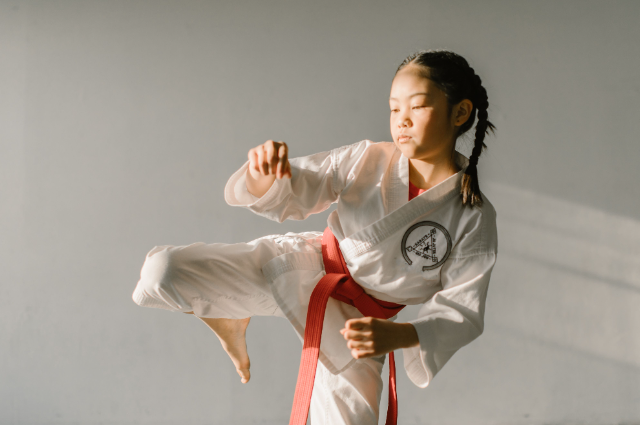
On August 9, 2026, seventeen-year-old Janmoni Konwar stood on a podium at Delhi's Talkatora Indoor Stadium with a gold medal around her neck. A few weeks earlier, she didn't know whether she would be able to leave Assam at all. On July 19, floodwater entered her home in No. 2 Sonari Mojiabheti Bhogdoiporiya village in Jorhat district, forcing her family out and leaving their house submerged. Their fishery, an important source of livelihood and expected to help finance Janmoni's journey to Delhi, was badly damaged. Ducks and poultry were swept away. The family moved to the embankment of the Bhogdoi River and put up a makeshift shelter under a tarpaulin, trying to establish some form of daily life in a place that was never meant to be a home. For Janmoni, the flood had taken away more than the security of a roof. It had also threatened the journey for which she had been preparing for years. She was seventeen, a Class 12 student and a karate player who had already won at the national level, and she had been preparing to compete in the 20th All India Independence Cup Karate Championship in Delhi. The family had been raising fish for several years and had hoped that its sale would help pay for the journey. Then the water came, and the money they had expected from the fishery disappeared with it. The question was no longer simply how a displaced family would rebuild its life. For Janmoni, it was whether she would be able to reach the championship at all.
Janmoni's relationship with karate had begun when she was five. Long before the flood, before the tarpaulin and the embankment, there had been the slow accumulation of training, competitions and the discipline of returning to the practice ground. Her family did not have the financial ease that makes a sporting career straightforward. Her father had played football at the state level, and her elder brother Krishnamoni was also associated with karate. Supporting Janmoni's training and competition expenses required sacrifices. The family had sold two buffaloes to help meet the costs of her participation in tournaments, and they had continued to find ways of keeping her training alive. By 2026, Janmoni had already established herself as a national-level medal winner. Her next opportunity was the championship in Delhi, and the fishery had been part of the family's plan for getting her there. The flood destroyed that plan in a matter of hours. With their home damaged and their livelihood disrupted, the family settled on the embankment. Janmoni continued training there, making use of whatever space was available. Among the possessions the family managed to save were some of her medals and prizes, objects that had once represented achievement and now also represented continuity. So much had been swept away, but those small pieces of metal and paper remained evidence of the years she had already spent building a life around karate.
The circumstances around the family were becoming increasingly difficult. A sporting competition can appear like a luxury when a family's house has been destroyed and its source of income damaged, and Janmoni came close to giving up the Delhi championship. There was no question of pretending that the flood had not happened or of treating the competition as more important than the family's immediate struggle. They needed shelter and money. They had lost property and livelihood. The fishery that might have paid for her journey had been affected by the same flood that had taken their home. Yet Janmoni kept practising around the embankment where the family was living. The contrast was stark without needing to be dramatised: a teenager training for a national karate championship while her family lived under plastic beside the river, preparing for a future that suddenly looked very uncertain.
The possibility of Delhi returned through an encounter that Janmoni and her family could not have planned. Alakh Pandey, founder and CEO of PhysicsWallah, had been travelling through flood-affected parts of upper Assam from July 30 as part of relief efforts. On August 3, he met Janmoni's family at their shelter in Jorhat. He saw the medals and learned about the young karate player who had been preparing for a national championship but whose journey had become financially impossible after the flood. Pandey arranged her flight tickets to Delhi and her accommodation there, and he also provided financial assistance to the family. Other support was reported from Union Minister of State for External Affairs Pabitra Margherita. None of this changed what had happened to the Konwar family. The house was still gone, the fishery had still been damaged, and the family was still living on the embankment. What changed was that Janmoni once again had a way of reaching the place where she had intended to compete. On August 6, she travelled to Delhi.
The 20th All India Independence Cup Karate Championship was held at Talkatora Indoor Stadium from August 7 to 9. Janmoni entered the Ashihara category, carrying with her the preparation of years and the circumstances of the weeks immediately behind her. The championship itself did not know or care what had happened to her house. Once she entered the competition, there were opponents, rules, rounds and the requirements of the sport. The story had to be decided on the mat. Janmoni won all three of her bouts. In the final, she won 10–2 and took the national gold medal. The result was precise. It could be recorded in a scoreline. The journey to Delhi had depended upon assistance, but the three victories were hers. Nobody could stand in her place, absorb the pressure of the bouts, execute the techniques she had spent years learning or make the final score 10–2 for her. The girl who had nearly been unable to afford the journey had become the national champion.
The temptation in a story like this is to make the gold medal the point at which everything changes. The disaster happens, the young athlete refuses to surrender, help arrives, she wins, and the story closes with victory. Janmoni's actual story is more complicated, and the complication is what makes it worth telling. When she returned to Assam, the family did not return to a house restored by her achievement. They were still living under the tarpaulin on the embankment. The gold medal had travelled back from Delhi with her; the house had not. The fishery that had been part of the family's livelihood and had been expected to help finance her journey remained damaged. The losses of the flood had not been reversed by the result of a karate championship. A medal cannot rebuild a home or restore possessions carried away by floodwater. It cannot put poultry back into a yard, return the income that disappeared or give a displaced family the ordinary privacy of four walls. The national victory and the continuing hardship therefore existed side by side, each making the other more visible.
There is also something important in the way Janmoni reached the championship. Her story is not one of a solitary figure conquering every obstacle without assistance, and there is no need to make it one. Her family had supported her training for years and had sacrificed what they could afford. Her coaches had taught and prepared her. When the flood made the Delhi journey impossible, a person outside the family happened to encounter her circumstances and helped make the journey possible. Relief and support can create an opportunity, but opportunity and achievement are not the same thing. Pandey could arrange the ticket and accommodation; he could not fight the bouts. The people who helped Janmoni reach Delhi could not supply the years of training stored in her body, nor could they make decisions for her inside the ring. That part belonged entirely to her. She entered the championship and won three bouts, including the 10–2 final. The gold was not a reward for having suffered. It was the result of what she did when she was given the chance to compete.
Her victory drew attention beyond the championship. On August 14, the Sports Authority of India became involved in supporting her sporting future. The SAI Regional Centre in Guwahati contacted her family, coach, district sports officials and other concerned authorities after learning about her circumstances and performance, with the aim of exploring continued support for her training and development. The sequence is significant without needing to be embellished. Before the flood, Janmoni had been a young athlete training and competing with the support of her family. After July 19, she was a displaced teenager practising around an embankment. On August 3, an unexpected encounter opened the possibility of Delhi. On August 9, she became a national champion. A few days later, the country's sports establishment was taking an interest in what might come next. Her circumstances had not suddenly become easy, but the horizon around her sporting career had widened.
Janmoni has spoken about wanting to represent India at the Olympics one day and about wanting to buy a proper house for her family. Those ambitions sit beside the immediate realities of her life. She is still a Class 12 student. Her family still has to recover from a flood that destroyed their home and damaged their livelihood. The championship gold did not turn her life into a finished success story. It became another point in a life that is still unfolding. That distinction is important because adversity is rarely overcome in a single dramatic gesture. A house may take months or years to rebuild. A livelihood may have to be started again from almost nothing. An athlete's career requires the next training session, the next competition, the next expense and the next opportunity. The gold medal can mark an achievement, but it cannot substitute for the work still waiting to be done. Janmoni knows that better than anyone because she returned from Delhi carrying the medal into the same landscape from which she had left.
The most striking image in Janmoni Konwar's story is therefore not simply the young athlete standing with a medal in Delhi. It is the distance between that image and the tarpaulin on the embankment in Assam. Both belong to the same week in the life of the same girl. One shows what she achieved; the other shows what she and her family were still facing. The medal does not make the tarpaulin disappear, just as the tarpaulin does not make the medal less real. One is the continuing consequence of a disaster; the other is the result of years of discipline and an opportunity that nearly vanished. The flood took away the family's home and damaged the livelihood on which they depended. It nearly took away Janmoni's journey to Delhi as well. It could not take the years she had spent learning karate, the sacrifices her family had made for her training or the ability she carried onto the mat. When the opportunity returned, she did not need to pretend that the disaster was over. She needed only to compete, and she did. She won three bouts and took the gold.
When Janmoni came home, the family was still living under the tarpaulin. There was no neat ending in which the medal repaired everything the flood had destroyed, and perhaps that is what makes the story more truthful. The championship had given her a national title, but her family still needed a home. The gold had travelled back from Delhi, while the work of rebuilding remained in Assam. Janmoni's triumph did not lie in having escaped hardship permanently, because she had not. It lay in the fact that hardship had entered her life, taken away the conditions in which she had expected to compete, and still failed to prevent her from reaching the mat when the opportunity came. She had begun karate at five. Her family had sacrificed for her. She had trained beside an embankment after losing her home. She had nearly lost the chance to travel, then travelled when a helping hand made it possible. At Talkatora Indoor Stadium, she fought three bouts and won the final 10–2. She returned to a family that was still displaced, but she also returned with something that could not be washed away by the flood: a national gold medal, earned not because her difficulties had disappeared, but because she had continued working through them.