
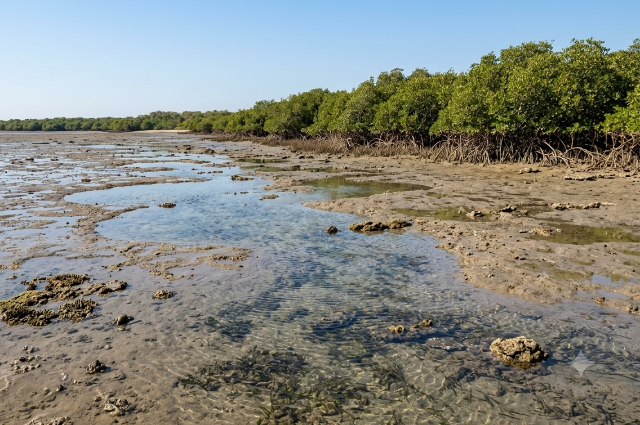
It was a crisp January morning when we set off from Jamnagar, winding our way through the salt-swept countryside of Gujarat. After a 1.5-hour drive covering nearly 60 kilometres, we reached Narara Marine National Park and Sanctuary, nestled in the Gulf of Kutch, India’s first designated Marine National Park, established in 1982. What awaited us was not just a park, but a living, breathing classroom—an ecological treasure trove revealed only at low tide.
Spanning 162 km² of protected marine park within a broader 458 km² sanctuary extending from Okha to Jodiya, Narara is one of the few places in the world where you can literally walk across the seabed and witness an intertidal wilderness without diving gear. Here, land and sea merge under the orchestration of tides—revealing mangrove forests, mudflats, coral reefs, and tide pools teeming with marine life.
Gateway to a Hidden World
On January 21, 2025, we began our guided marine walk from Vadinar, the access point to Narara. Entry is strictly regulated by the Forest Department, requiring permits, and in the case of foreign visitors, police clearance. Entry fees vary—₹100–150 for Indian nationals, ₹650 for foreigners—with additional charges for cameras (₹200) and trained guides (₹300). These fees contribute directly to conservation efforts.
Our guide, Abdul Bhai, a local naturalist trained by the Marine Park Authority and Gujarat Government, led us into the park, reminding us to wear rubber shoes suitable for the 4-kilometre wade through soft sediment and shallow pools. His quiet authority and eco-sensitive guidance would shape our experience profoundly.
As we set foot into the intertidal flats, the tide had just receded, laying bare a microcosmic world where time seems to pause, and the planet whispers its oldest stories.
Mangrove Forest: The Breathing Edge
The first phase of our journey took us through dense mangrove swamps, a tangle of salt-loving species like Avicennia marina, Rhizophora mucronata, Ceriops tagal, and Aegiceras corniculatum. Their pneumatophores—aerial roots poking out of the sludge—serve as nature’s snorkels, breathing life into an environment where salt meets freshwater.
These mangrove ecosystems are biological nurseries, protecting the coastline from erosion and housing juvenile fish, crustaceans, and migratory birds. Once degraded prior to 1980 due to deforestation and industrial activity, the mangroves here are now gradually recovering, thanks to sustained conservation efforts.
As we walked, the mangrove canopy came alive with birdlife—painted storks, darters, black-necked ibises, egrets, and herons, while below, crabs of all shapes and colours scuttled between root systems. Wolf crabs, hermit crabs, and the elegant Neptune crab revealed themselves as Abdul Bhai gently lifted stones, letting us observe without disturbing.
Mudflats and the Symphony of Birds
Emerging from the mangroves, we crossed expansive mudflats dotted with gastropod trails and crab burrows. This stretch of open terrain is a magnet for migratory birds, especially between October and March, when wintering species arrive in great flocks.
Here, the diversity was staggering—crab plovers, ruddy turnstones, godwits, oystercatchers, avocets, sandpipers, gulls, skimmers, and terns shared the flats with larger species like pelicans, ducks, and ospreys. We stood in reverent silence as flocks of flamingoes, some from colonies of up to 20,000, descended in swirling formations to forage for beached crustaceans.
Every footstep on this terrain brought us closer to a living pulse, a harmony of avian migration, tidal rhythm, and coastal ecology. The birdlife was not just scenic—it was a key indicator of ecosystem health, each feathered visitor a testament to Narara’s global ecological relevance.
Reef Zone: A Coral Kaleidoscope
As we ventured further, we arrived at the reef zone, where patches of coral interspersed with tide pools, seagrass beds, and seaweed carpets created a surreal, jewel-like seascape. Narara hosts over 40 species of hard coral—including brain coral, moon coral, plate coral, and finger coral—as well as 10 soft coral species and more than 40 varieties of sponges.
Peering into the tide pools was like unlocking miniature aquariums. Sea anemones, some glowing iridescent blue, housed transparent shrimp; brittle stars crawled delicately under coral; starfish, sea cucumbers, Sabella sea worms, and jewel-like nudibranchs revealed themselves in slow, mesmerizing motion.
A collective gasp rose when Abdul Bhai expertly located and handled a camouflaged octopus. We watched in awe as its skin changed colour and texture before it slipped away into deeper water. Not far from it, a pufferfish inflated defensively—another marvel of biological ingenuity.
This zone was a reminder that coral reefs, though vibrant, are fragile. Once home to 52 coral species, recent surveys show only 31 remaining, with the decline attributed to bleaching, industrial runoff, turbidity from sand extraction, and oil refinery pollutants. Conservation, here, is not optional—it is existential.
Life Beyond the Low Tide
Though unseen during our walk, Narara’s deeper waters shelter a breathtaking range of marine megafauna—dolphins (including common, Indo-Pacific bottlenose, humpback, and finless porpoises), whales (blue, sei, humpback, and sperm), dugongs, whale sharks, rays, and three sea turtle species (green, olive ridley, and leatherback), alongside sea snakes.
The park’s biodiversity is staggering: over 40 coral species, 70 sponges, 200+ molluscs, 30 types of crabs, multiple shrimp and lobster species, and 80–100 species of birds recorded during peak seasons. Few locations in the world offer such ecological density in walkable terrain.
Echoes of the Ocean: A Personal Reflection
As the sun began to dip, casting amber hues across the seafloor, we began our return. Every step back across the tide-slick flats felt like leaving behind a dreamscape. A juvenile crab plover darted past, following its parent. A starfish, orange and radiant, clung to a coral head. Abdul Bhai’s soft-spoken reminder—“Don’t pick anything, even dead shells. The reef survives the way it is,” echoed in our minds.
Our marine walk had turned into a meditation on fragility, resilience, and the art of observation. In just a few hours, we experienced Earth as sea, as forest, as memory, and as possibility. Narara is not just a destination; it’s an unfolding story of survival, co-existence, and transformation.
Stepping Lightly Into the Future
Narara stands today as both a symbol of India's early conservation efforts and a cautionary tale. Human pressures—from boat traffic and coral mining to overfishing and pollution—continue to threaten its balance. Yet, with responsible tourism, guided policies, and community-led conservation, this marine wilderness can still thrive.
Our visit to Narara was not merely an excursion; it was an awakening. It showed how walking can be witnessing, and how witnessing can lead to protecting.
Let this be more than a travelogue. Let it be a call—to explore, to understand, and most importantly, to tread gently.
Plan Your Visit: Quick Facts
- Best Time to Visit: October to March (ideal tides and migratory bird season)
- Permits: Required from the Forest Department; foreign nationals need police clearance
- Access Point: Vadinar, approx. 56–60 km from Jamnagar
- Guides: Highly recommended; trained local naturalists available
- Entry Fees: ₹100–150 (Indians), ₹650 (foreigners), ₹300 (guide), ₹200 (camera)
- Things to Carry: Rubber shoes, water bottle, sun protection, and eco-sensitivity
- Important Rule: “Take only photos, leave only footprints”